The Talkdesk seed deck is a standout example of how to pitch a complex technical transition—moving from hardware-heavy legacy systems to cloud-native software—using minimal text and maximum visual impact. By spending the first five slides building a 'visual problem' of hardware silos and fragmented communication, the deck makes its 'browser-only' solution feel like an inevitability rather than just a feature. The deck successfully balances this high-level narrative with granular unit economics, showing a clear path to $3,796 per month from a single mid-sized client. While it lacks a formal 'A…
Key takeaways
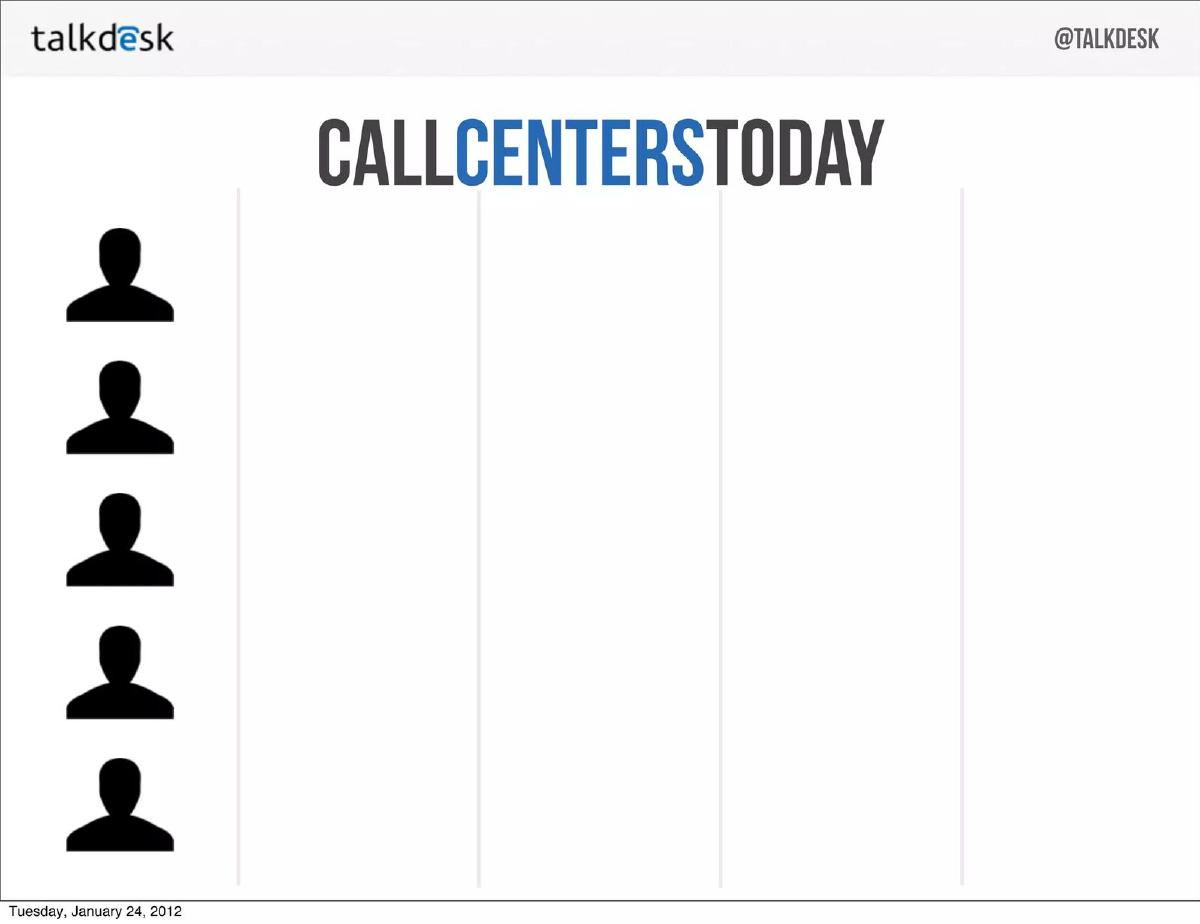
- The deck uses a 5-slide visual build to illustrate the complexity of 'Call Centers Today' before introducing the solution (Slides 2-6).
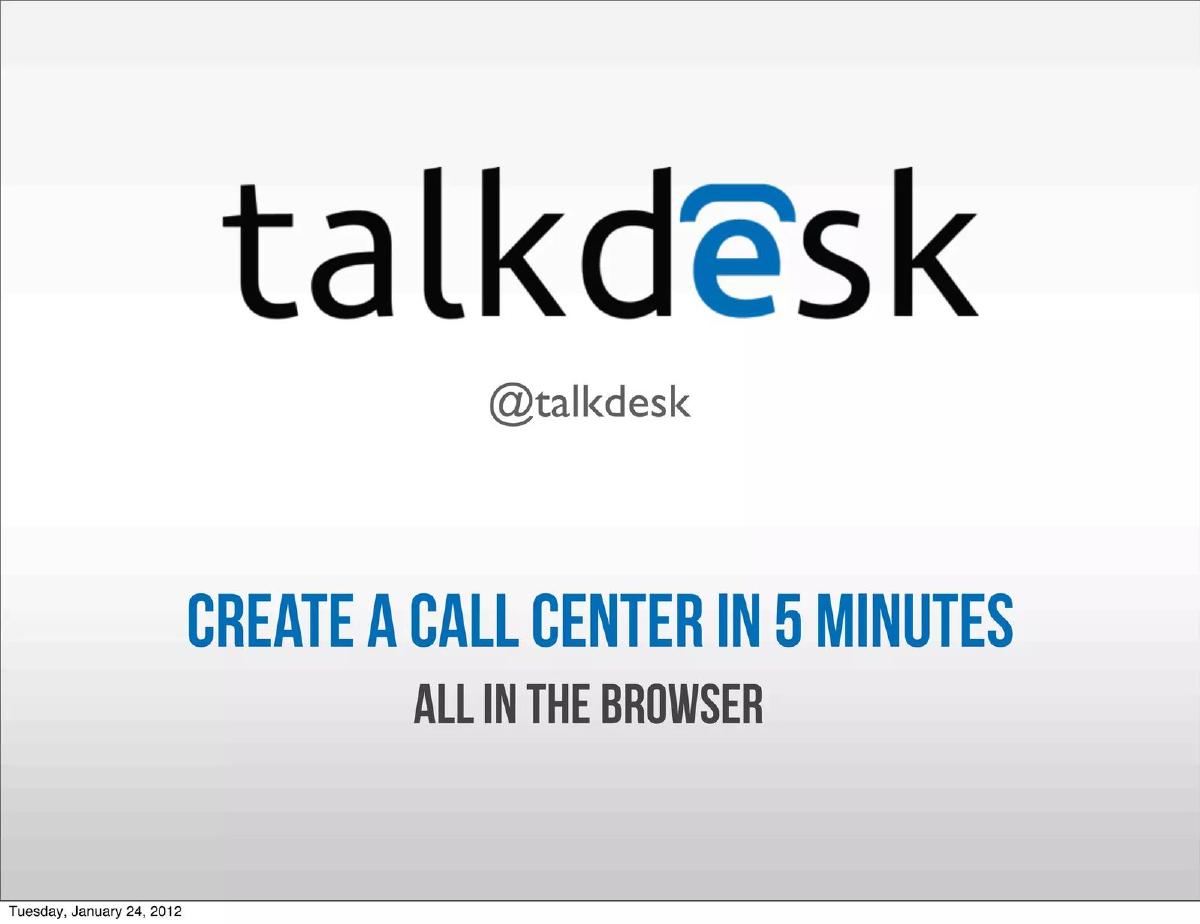
- The value proposition is distilled into a single, time-bound promise: 'Create a call center in 5 minutes' (Slide 1).
- Talkdesk highlights its scalability by claiming the ability to scale from 1 to 10,000 agents entirely in the browser (Slide 9).
- The revenue model is transparent, showing a mix of a $49 flat fee per agent and $0.04 per minute usage fees (Slide 12).
- Unit economics are clearly defined, projecting that a single client with 5 agents can generate $3,796 in monthly revenue (Slide 12).
- Traction is demonstrated through a waiting list of 600 companies and 4,500 agents, indicating significant pre-launch demand (Slide 13).
- The team slide emphasizes technical pedigree, noting Masters degrees in Computer Engineering and experience at Procter & Gamble (Slide 14).
- The product is positioned as a data aggregator, pulling in 'Public & CRM Data' and 'Support Tickets' directly into the browser interface (Slide 11).
The Power of Visual Progressive Disclosure
Talkdesk’s 2014 seed deck is a masterclass in visual storytelling. At a time when the call center industry was dominated by heavy hardware like Avaya and Cisco, Talkdesk needed to prove that a browser-based solution wasn't just possible, but superior. They achieved this by using a series of slides that build upon one another to illustrate the 'mess' of current systems before sweeping it away with their logo.
Slides 1-6: The Visual Problem Build
The deck opens with a bold claim on Slide 1 : "Create a call center in 5 minutes. All in the browser." This sets the stage for the entire presentation. It identifies the product, the speed of implementation, and the technical differentiator immediately.
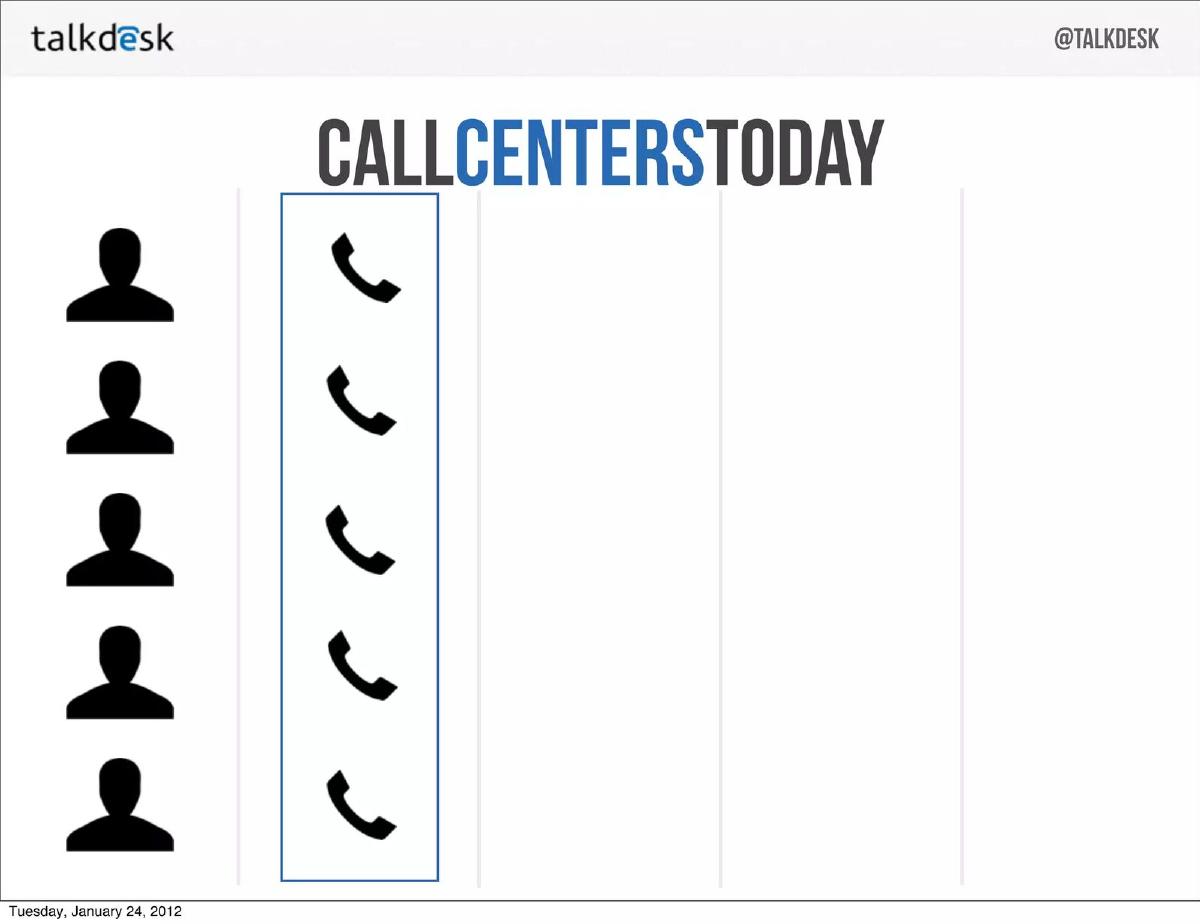
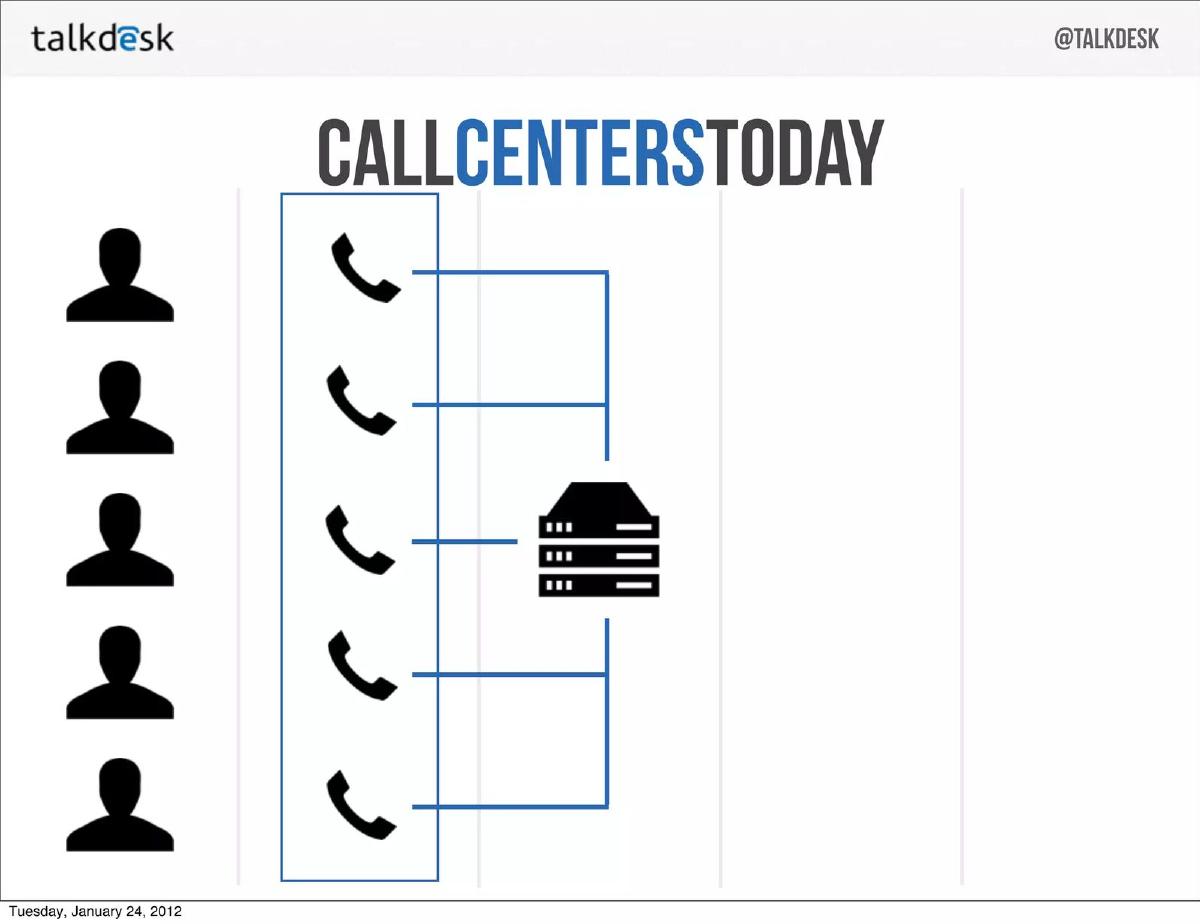
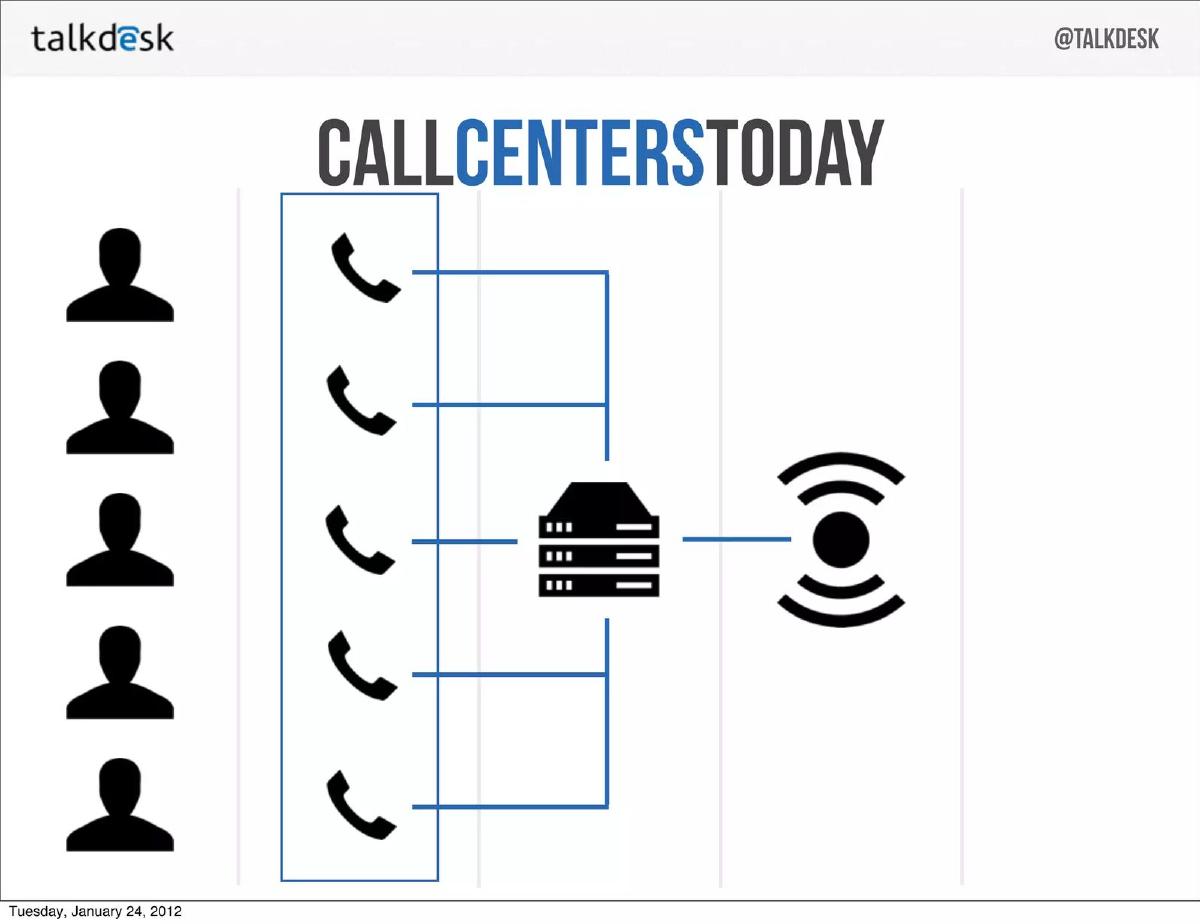
Slides 2 through 5 are titled "CALLCENTERSTODAY." Rather than using text, they use icons to build a diagram of complexity. Slide 2 shows the agents. Slide 3 adds the server hardware. Slide 4 adds the physical phone lines. Slide 5 adds the fragmented communication channels (chat and voice). By the time the viewer reaches Slide 6 , which features a statue with its head in its hands and a speech bubble saying "I NEED...", the investor has been visually primed to understand that the current status quo is a logistical nightmare.
Slides 7-11: The Browser-First Solution
Slide 7 provides the 'aha' moment. The Talkdesk logo literally slides over the complex hardware diagram, visually 'replacing' the server and phone lines. This is followed by Slide 8 , which repeats the opening hook but adds two critical scale metrics: "Scale from 1 to 10K agents" and "International phone numbers." This addresses the immediate concern of whether a browser-based tool can handle enterprise-level volume.
Slides 10 and 11 dive into the product interface. The deck uses a screenshot of a dashboard featuring "Dave McClure" (a nod to the 500 Startups founder, likely a strategic choice for the audience). These slides highlight the integration capabilities. Slide 11 specifically points out that the tool pulls in "Public & CRM Data" and "Support Tickets." This positions Talkdesk not just as a phone system, but as a central intelligence hub for customer support agents.
Slides 12-14: The Business Case and Team
The transition from product to business occurs on Slide 12 , titled "REVENUEMODEL." This is one of the most effective slides in the deck because it removes all ambiguity. It states a "Flat fee per agent/month" where the "1st agent is free" and a "Pay per minute" usage fee. The slide provides a concrete example: 5 agents and 90,000 minutes results in a single client worth $3,796 per month. By breaking down the math ($49 per agent and $0.04 per minute), Talkdesk makes their path to high MRR (Monthly Recurring Revenue) look simple and achievable.
Slide 13 , "OURTRACTION," uses a bar chart to show the growth in the number of agents from September to December. While the Y-axis shows a climb toward 5,000 agents, the most impressive figures are on the right: a waiting list of 600 companies and 4,500 agents. This proves market pull—the idea that the product is being 'pulled' out of the startup by eager customers.
Finally, Slide 14 introduces the team: Tiago Paiva (CEO), Cristina Fonseca (CTO), and Raoul Félix (Software Engineer). The credentials listed are brief but high-signal: "Masters Degree in Computer Engineering," "Startup Experience," and "Procter & Gamble Employee." This suggests a mix of high-level technical skill and enterprise-grade professional background.
What Works in the Talkdesk Deck
1. Extreme Clarity: There is almost no 'fluff' in this deck. Every slide serves a specific purpose in the narrative arc from 'problem' to 'traction.' The use of a single, clear revenue example on Slide 12 is particularly effective for Seed-stage investors who want to see how the company will actually make money.
2. The 'Replacement' Narrative: By visually showing the Talkdesk logo covering up hardware icons, the founders positioned their software as a direct replacement for expensive CapEx (Capital Expenditure). This is a powerful value proposition for CFOs and business owners.
3. Social Proof via Traction: The mention of a waiting list is a classic fundraising tactic. It creates a sense of urgency and FOMO (Fear Of Missing Out) for the investor, suggesting that the company is already successful and only needs capital to unlock the existing demand.
What is Missing from the Talkdesk Deck
1. Competitive Landscape: The deck does not mention competitors like Zendesk (which was expanding its voice capabilities) or legacy players like Avaya. It assumes the investor already knows the market is broken, but it doesn't explain why Talkdesk will win against other emerging cloud players.
2. The Ask: As noted, there is no slide detailing how much money is being raised or what the specific milestones are for the next 18 months. While this information is often shared in person, its absence in the deck leaves the 'ending' of the story somewhat abrupt.
3. Market Size (TAM): There is no slide dedicated to the Total Addressable Market. While the call center industry is massive, a Seed deck usually benefits from quantifying the multi-billion dollar opportunity to justify the potential for a venture-scale return.
What a Founder Should Copy
The 'Unit of One' Revenue Slide: Founders should emulate Slide 12. Instead of showing complex five-year projections that no one believes, show exactly what one typical customer pays you. If you can explain the math for one customer, the investor can easily do the math for a thousand customers.
Minimalist Design: Talkdesk avoids the 'wall of text' trap. Most slides have fewer than 15 words. This forces the presenter to speak to the slides rather than reading them, and it keeps the investor focused on the high-level concepts and the data.
Progressive Problem Definition: If you are disrupting a legacy industry, don't just say it's 'old.' Show the layers of complexity that your solution removes. The icon-based build-up used in Slides 2-5 is a perfect template for any SaaS company replacing a hardware-heavy or manual process.
Frequently asked questions
- How does Talkdesk handle the 'Problem' slide differently than most startups?
- Instead of a bulleted list of pain points, Talkdesk uses a progressive animation-style sequence across Slides 2 through 6. It starts with agents, adds hardware, adds phone lines, and finally adds fragmented communication channels. This visual 'piling on' of complexity makes the eventual 'I Need...' facepalm slide feel earned and relatable to any investor who understands enterprise friction.
- What is the specific revenue model Talkdesk pitched in 2014?
- Talkdesk utilized a hybrid SaaS and utility model. According to Slide 12, they charged a flat fee of $49 per agent per month (with the first agent being free) plus a usage-based fee of $0.04 per minute. This allowed them to capture both predictable recurring revenue and upside from high-volume call centers.
- How did Talkdesk demonstrate product-market fit at the Seed stage?
- They relied heavily on 'The Waiting List' as a proxy for demand. Slide 13 shows a bar chart of agent growth from September to December, but the most compelling data point is the 600 companies and 4,500 agents waiting for access. This suggests that their biggest challenge was scaling to meet demand, not finding customers.
- What technical advantages does the deck emphasize?
- The primary technical advantage is the 'All in the Browser' architecture. Slide 10 and 11 show a unified dashboard where CRM data, social profiles (LinkedIn, Facebook, Twitter), and support tickets are aggregated. By eliminating the need for desk phones or local server installations, they positioned themselves as a more agile alternative to legacy providers.
- Is there a clear 'Ask' or 'Use of Funds' in this deck?
- No. The 14 slides provided do not include a specific funding ask, valuation, or breakdown of how the $3.15M would be spent. While the catalogue facts confirm the round was successful, the deck itself focuses entirely on the problem, solution, and traction, leaving the financial negotiation for the follow-up conversation.