Talking Hands presents a compelling case for a niche EdTech product that bridges the gap between physical learning tools and digital potential. The deck, used for their 2022 seed round, relies heavily on a personal 'founder-market fit' narrative, specifically citing the co-founder's sister as the inspiration for the product. While the deck is visually cohesive and demonstrates significant early traction—claiming 1,000 day care centers and schools as users in Germany—it is notably light on financial mechanics. There are no slides dedicated to unit economics, revenue projections, or a specific…
Key takeaways
- The problem statement cites that approximately 1 in 10 children suffer from hearing or speech impairment (Slide 4).
- The company emphasizes a personal connection, noting that co-founder Laura Mohn's sister has Down syndrome (Slide 4).
- Talking Hands positions its flip books as a 'fun-factor' alternative to 'dry and medical' traditional tools (Slide 5 and 7).
- Traction is quantified by the statement that about 1,000 day care centers, schools, and speech therapists in Germany use the product (Slide 10).
- The competitive analysis uses a thumbs-up/down matrix to claim superiority in 'learning incentive for ALL kids' and 'App Potential' (Slide 11).
- The team is lean, consisting of three leads focused on Product-Design, App Development & IT, and Marketing/Distribution (Slide 12).
- Validation is heavily supported by a dedicated 'Awards' slide featuring four distinct industry recognitions (Slide 14).
- The deck completely omits a financial 'Ask' slide, business model details, and a roadmap for future growth.
Introduction
Talking Hands entered the EdTech space with a clear mission: to make sign language education inclusive and engaging for all children, regardless of their hearing or speech status. This teardown examines their 16-slide seed deck from 2022, which successfully attracted a group of high-profile European angel investors. The deck is a masterclass in mission-driven storytelling, though it leaves several critical business questions unanswered.
Slide 1: Title Slide
The deck opens with a minimalist aesthetic, featuring the Talking Hands logo—a hand with a mouth inside it. The subtitle, learning-tools & games for inclusion and diversity , immediately sets the stage. The names of the two founders, Laura Mohn and Maria Möller, are listed at the bottom. The use of diverse character icons on the margins reinforces the brand's focus on inclusion.
Slide 2: Table of Contents
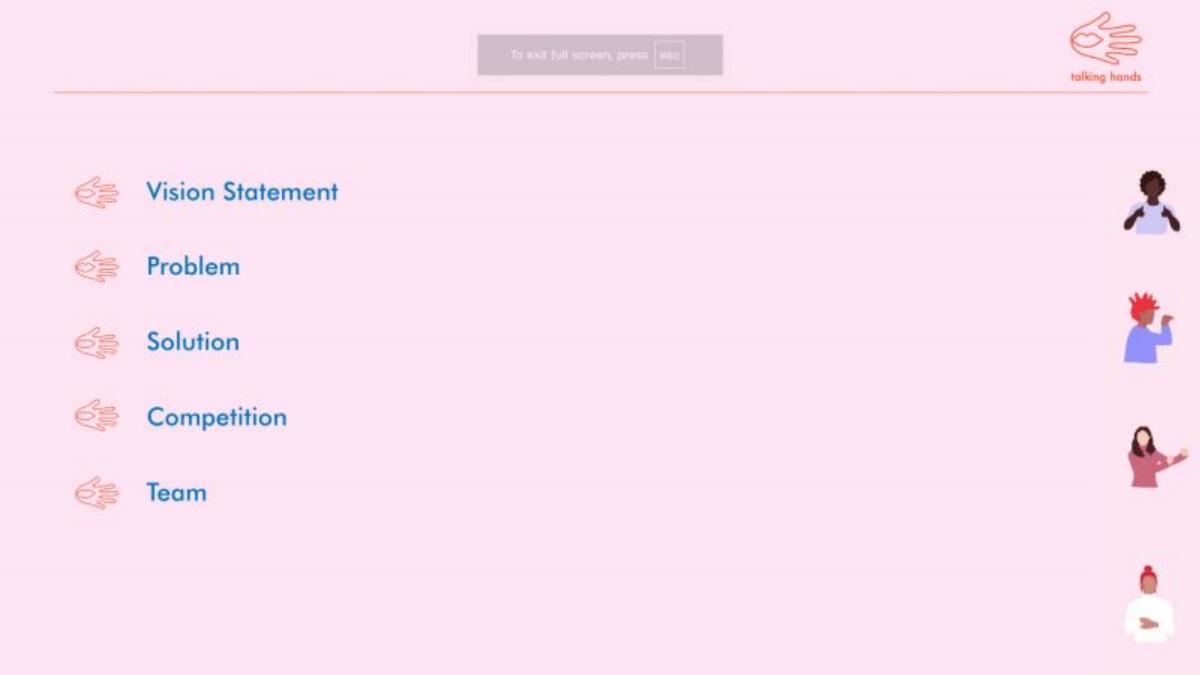
A standard roadmap for the presentation. It lists five key sections: Vision Statement, Problem, Solution, Competition, and Team. This indicates a traditional narrative structure designed to build empathy before presenting the product.
Slide 3: Vision Statement
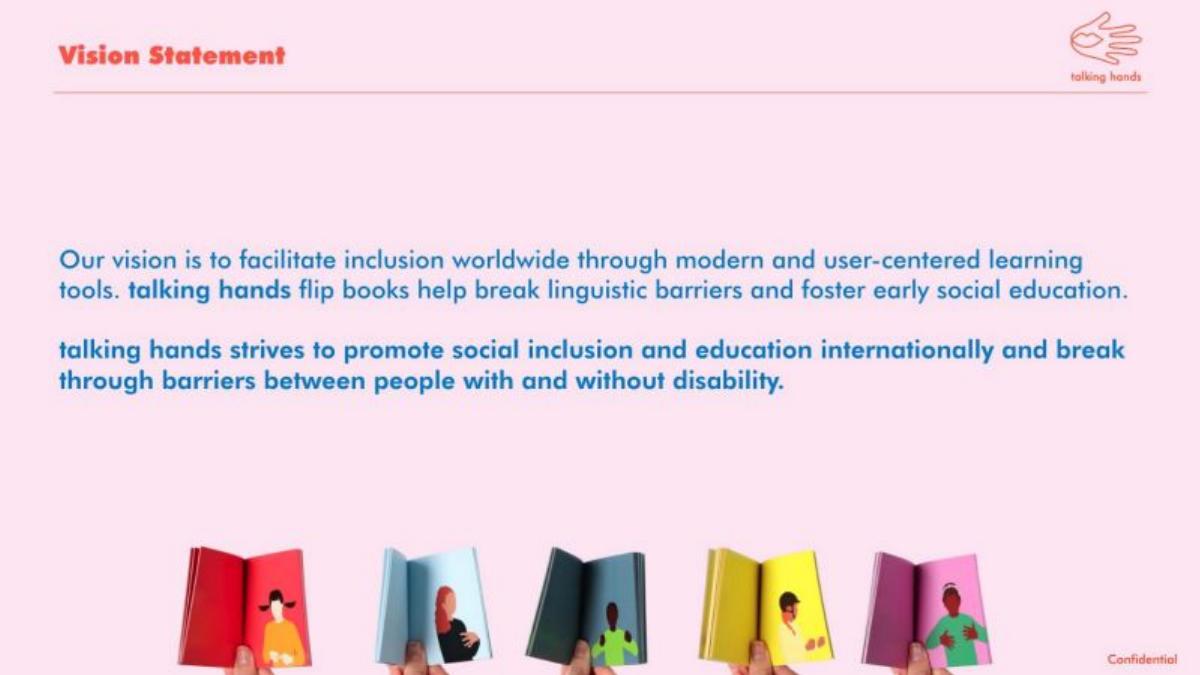
The vision is stated clearly: to facilitate inclusion worldwide through modern and user-centered learning tools. The slide explicitly mentions that their flip books help break linguistic barriers and foster early social education. It emphasizes a dual goal: helping those with disabilities and educating those without them to create a more inclusive society.
Slide 4: Problem - The Human Element
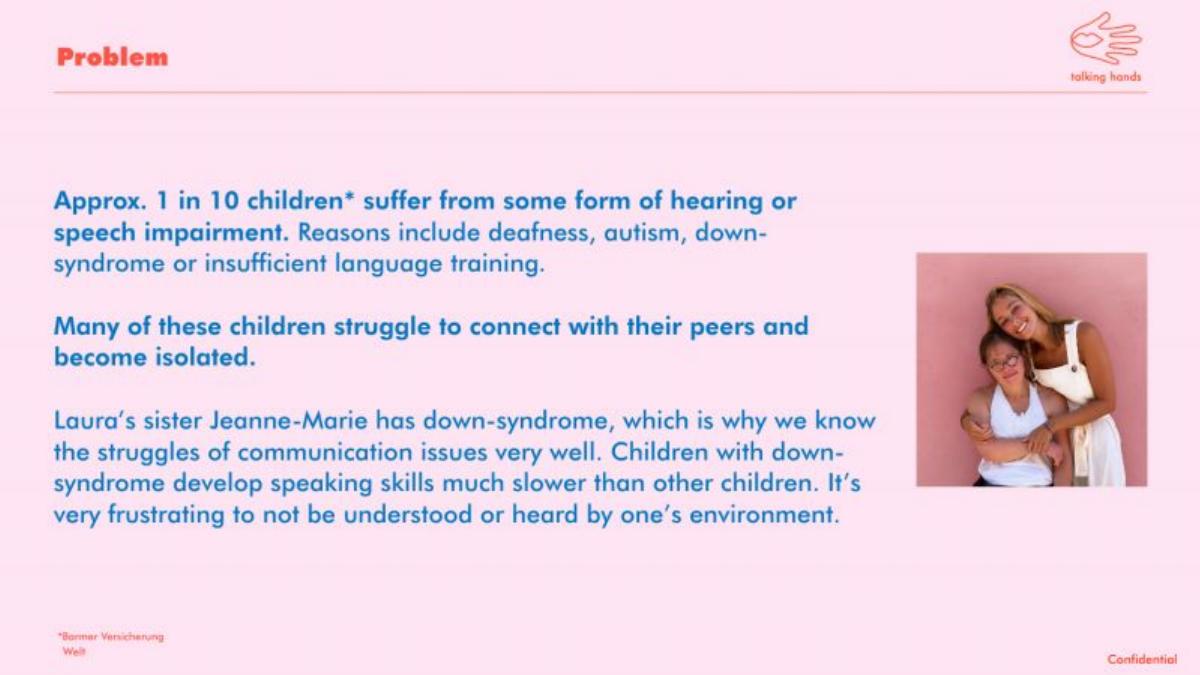
This slide introduces the 'Why.' It states that approx. 1 in 10 children suffer from some form of hearing or speech impairment , citing Barmer Versicherung as a source. Crucially, it introduces the personal motivation: co-founder Laura's sister, Jeanne-Marie, has Down syndrome. This establishes founder-market fit by showing the team has firsthand experience with the isolation caused by communication barriers.
Slide 5: Problem - The Industry Gap
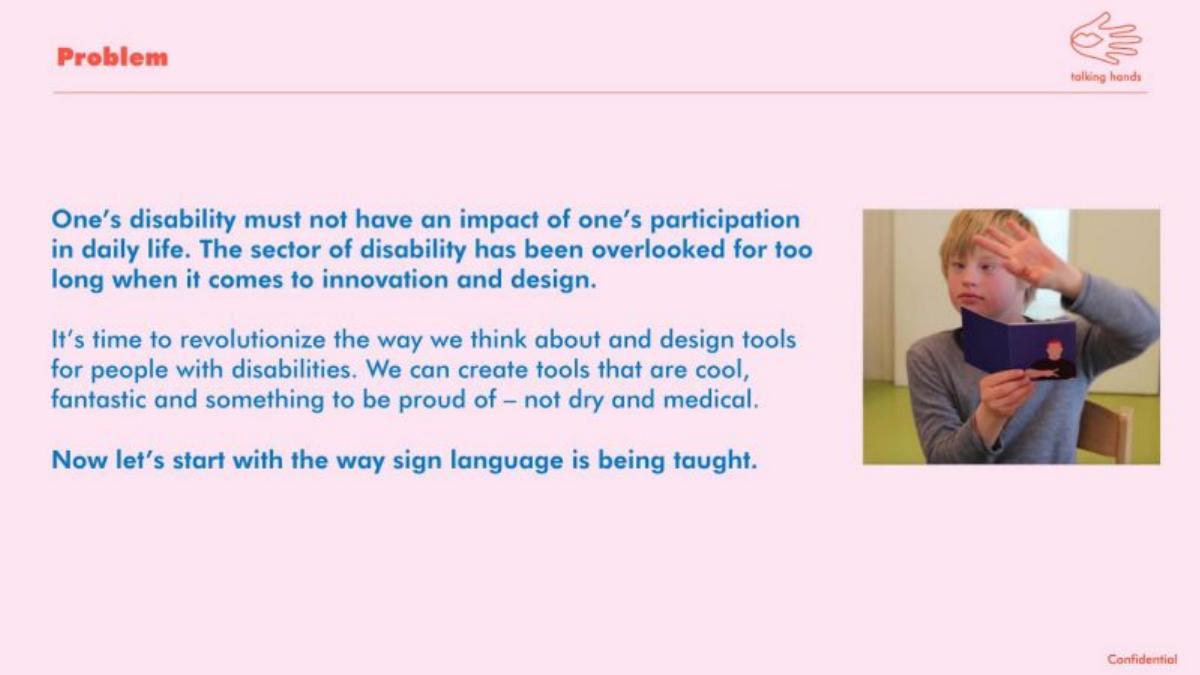
The deck argues that the disability sector has been overlooked for too long when it comes to innovation and design. It critiques existing tools for being 'dry and medical.' The goal is to create tools that are 'cool, fantastic and something to be proud of.' This is a positioning play, moving the product from a 'medical necessity' to a 'lifestyle educational tool.'
Slide 6: Problem - The Inclusion Barrier
The final problem slide focuses on the lack of 'fun' in current sign language tools. It posits that inclusion can only work if ALL children learn sign language , and children who don't rely on it won't learn it unless it is fun and exciting. This expands the Total Addressable Market (TAM) from just children with impairments to all children in early education.
Slide 7: Solution - The Flip Book
The solution is introduced as a system of flip books. The slide highlights modern design and usability. A photo shows a wooden tray holding dozens of colorful, small books, suggesting a comprehensive curriculum rather than a single product. The visual of a hand flipping a book to show a signing character demonstrates the 'analog animation' nature of the product.
Slide 8: Solution - Proof of Concept
This slide features a testimonial from Simona Trolio, a day-care teacher. She describes the product as a multi-sensual experience that has a positive impact on the learning process. The slide includes a play button overlay on a photo of children using the books, suggesting a video demonstration was part of the live pitch.
Slide 9: Solution - Product Variety
A grid of 15 different flip books is shown, each with a different color and character. This slide reinforces the scale of the product line. A secondary photo shows two children looking at a book together, emphasizing the social, peer-to-peer learning aspect of the tool.
Slide 10: Solution - Traction
This is the most important 'hard metric' slide in the deck. It states that about 1000 day care centers, schools and speech therapists use talking hands in daily life (in Germany). The accompanying photo shows a large group of children and the founders, creating a sense of community and real-world impact.
Slide 11: Competition
Talking Hands uses a comparison matrix against four competitors (including Makaton and GuK). They claim a 'thumbs up' in every category, most notably in learning incentive for ALL kids and visually appealing , where all competitors receive a 'thumbs down.' They also claim 'App Potential,' hinting at a digital roadmap that is not otherwise detailed in the deck.
Slide 12: Team
The team consists of three individuals: Laura Mohn (Product-Design), Jacob v. Bethmann (App Development & IT), and Maria Möller (Marketing, Distribution). The slide also features the logo for Unibator , the incubator of Goethe University Frankfurt am Main, which provides institutional credibility.
Slide 13: Public Relations
A collage of media appearances, including a prominent shot from Die Höhle der Löwen (the German version of Shark Tank). Other clippings from Frankfurter Rundschau and Gründerszene demonstrate that the company has successfully generated earned media and public interest.
Slide 14: Awards
The company lists four awards to validate their work: ADC Junior Wettbewerb 2020 , Hessen Ideen (3rd Place) , Kultur- und Kreativpiloten Deutschland , and Future Award 2019 (1st Place) . This slide serves as a final stamp of approval from the design and entrepreneurial communities.
Slide 15: Contact
A simple closing slide with a 'thank you,' a support email address, and the website URL. It maintains the consistent character illustration style used throughout the deck.
Slide 16: BestPitchDeck.com Outro
A promotional slide for the platform where the deck is hosted. It is not part of the original Talking Hands presentation.
What Talking Hands Does Well
The Talking Hands deck excels at emotional resonance . By starting with a personal story about a family member with Down syndrome, the founders immediately build trust and demonstrate a deep understanding of the problem space. The visual design of the deck is also a major strength; it is clean, colorful, and consistent with the product they are selling. This 'brand-product harmony' is essential for a company that claims 'design' as a primary differentiator.
Furthermore, the traction slide (Slide 10) is a powerful validator. Having 1,000 institutional users in a single country (Germany) proves that there is a B2B2C market for these tools and that the product has passed the 'pilot' stage and entered the 'adoption' stage.
What is Missing from the Talking Hands Deck
While the deck is excellent at explaining the 'Why' and the 'What,' it is almost entirely silent on the 'How' of the business . There are several glaring omissions that a typical venture capital investor would require for a seed round:
Business Model: There is no information on how much the flip books cost to produce, what they retail for, or if there is a subscription component for schools. · Unit Economics: The deck does not mention Customer Acquisition Cost (CAC) or Lifetime Value (LTV), which are critical for assessing the scalability of a physical-product business. · The Ask: The deck does not state how much capital the company is seeking. Without a clear 'Ask' and a 'Use of Funds' breakdown, the deck feels more like a brand presentation than a fundraising tool. · Financial Projections: There are no charts showing revenue growth or future targets. · Roadmap: While Slide 11 mentions 'App Potential,' there is no timeline or detail on how the company plans to transition from a physical flip book company to a digital EdTech platform.
Founder Takeaways
1. Leverage Personal Narrative: If you have a personal connection to the problem you are solving, lead with it. It is the most effective way to demonstrate founder-market fit and passion.
2. Institutional Traction Matters: For EdTech companies, showing that schools and therapists (the gatekeepers) have adopted your product is more valuable than showing a high number of individual app downloads. It proves the product works in a professional educational setting.
3. Design as a Differentiator: In sectors like disability services or medical tools, which are often 'dry and medical,' high-quality design can be a significant competitive advantage. Use your deck to showcase that aesthetic.
4. Don't Forget the Business: While this deck worked for Talking Hands (likely due to the strength of their traction and the founders' ability to fill in the gaps during live meetings), most founders should include at least one slide on unit economics and one slide on the specific funding request.
Frequently asked questions
- What is the core product of Talking Hands?
- The core product is a series of flip books designed to teach sign language to children in a playful, 'multi-sensual' way. As shown on Slide 7, these books use illustrations to demonstrate signs, allowing children to learn through physical interaction rather than just digital screens or medical textbooks. The deck also hints at 'App Potential' in its competitive matrix, suggesting a digital expansion of the physical product.
- How does the company demonstrate market traction?
- Talking Hands demonstrates traction through institutional adoption rather than raw revenue figures. Slide 10 states that approximately 1,000 day care centers, schools, and speech therapists in Germany already use the system in their daily lives. This is supplemented by a 'Public Relations' slide (Slide 13) showing appearances on television programs like 'Die Höhle der Löwen' (the German version of Shark Tank) and various print media features.
- Who are the key members of the team?
- As per Slide 12, the leadership team consists of Laura Mohn (Product-Design), Jacob v. Bethmann (App Development & IT), and Maria Möller (Marketing, Distribution). The slide also notes their affiliation with 'Unibator,' the business incubator of Goethe University Frankfurt am Main, providing academic and institutional backing to the founding team.
- What is missing from this pitch deck?
- The deck is missing several standard venture capital components. There is no slide detailing the business model (pricing, margins, or distribution costs), no financial projections, and no clear 'Ask' stating how much money is being raised or how it will be spent. Additionally, there is no detailed roadmap or go-to-market strategy for international expansion beyond the German market mentioned on Slide 10.
- How does Talking Hands differentiate itself from competitors?
- Talking Hands uses Slide 11 to differentiate itself from four other sign language and speech tools. It claims to be the only solution that provides a 'learning incentive for ALL kids' (not just those with disabilities) and the only one that is 'visually appealing.' They also claim superior 'App Potential' and 'comprehensibility' compared to established systems like Makaton.