Tanbii presents a gamified ecosystem designed to incentivize low-carbon lifestyles, specifically targeting Gen Z. The deck outlines a 'Web5' approach—combining Web 2.0 real-world tracking with Web 3.0 decentralized identity and blockchain encryption. With a team boasting multiple exits and a robust advisor board from companies like Google and Apple, Tanbii positions itself as a bridge between environmental impact and digital entertainment. The business model transitions from affiliate marketing and in-app purchases to long-term carbon credit trading. While the deck provides a clear vision for…
Key takeaways
- The platform uses EPA-verified methods to measure and reward over 30 real-life carbon reduction activities (Slide 3).
- Tanbii defines 'Web5' as the intersection of Web 2.0 real-world tracking and Web 3.0 virtual incentives like tokens and decentralized identity (Slide 4).
- The target market is Gen Z, citing 2.6 billion individuals with $143 billion in buying power, 81% of whom are gamers (Slide 9).
- The company estimates the Global Personal Carbon Market at $8.91 billion, targeting a Serviceable Obtainable Market (SOM) of $7.13 billion (Slide 11).
- Tanbii has established partnerships with Eden Reforestation Projects and claims over 150 sustainable brand partners including Amazon and Disney+ (Slide 12).
- The roadmap projects reaching 10 million users and enabling government-level carbon asset trading by 2030 (Slide 15).
- The founding team includes Robert Luo (2 exits) and Robert Grajewski (3 exits), supported by advisors from TikTok, Google, and Zara (Slides 16-17).
- The deck omits a specific breakdown of the $1.5M pre-seed ask and detailed financial projections beyond user growth targets.
Tanbii Pitch Deck Analysis
Tanbii positions itself at the intersection of climate tech and gaming, utilizing a 'Web5' framework to incentivize sustainable behavior. The deck focuses heavily on the psychological drivers of Gen Z and the massive potential of the personal carbon market. While the vision is expansive, reaching into government-level asset trading, the deck functions primarily as a high-level conceptual roadmap rather than a data-heavy performance report.
Slide 1: Cover Page
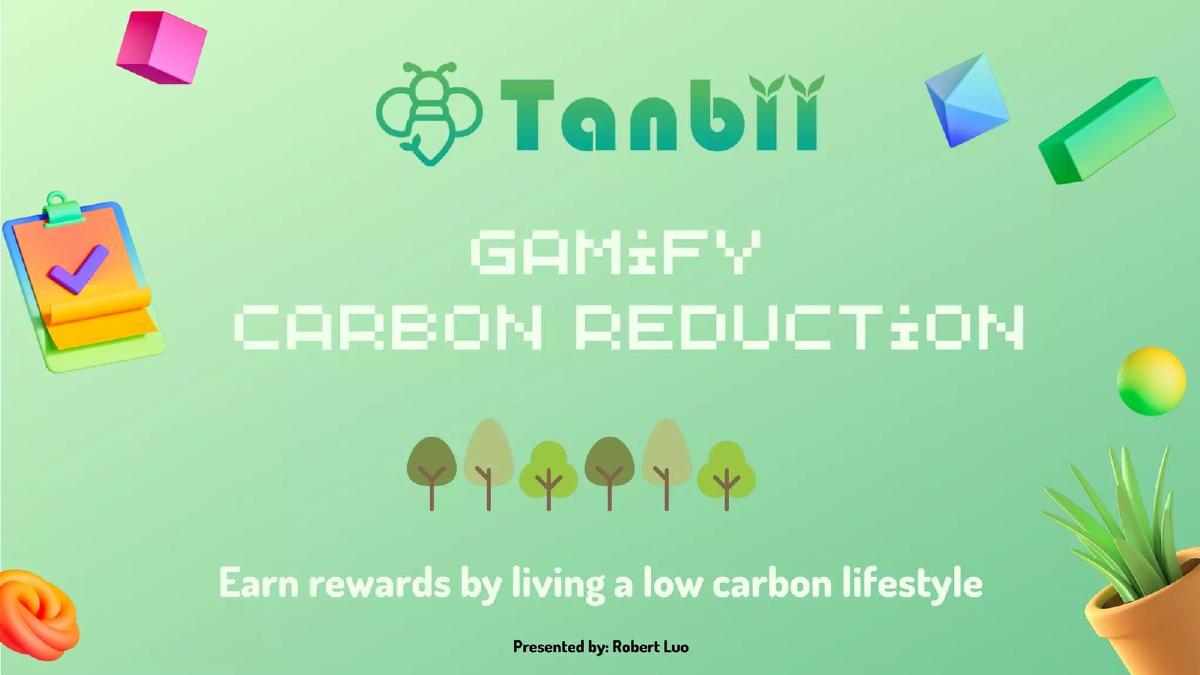
The cover slide introduces the brand with the tagline "Gamify Carbon Reduction" and the value proposition: "Earn rewards by living a low carbon lifestyle." The visual style is playful and consistent with a gaming app, featuring 3D icons and a nature-themed color palette. It identifies Robert Luo as the presenter.
Slide 2: Urgent Problem - Consumer
This slide quantifies the environmental impact of individuals. It notes that individuals lack an "easy pathway and tangible incentives" to be sustainable. Key figures cited include 6.6 billion tons of CO2 emitted in the U.S. in 2019, with 17% generated by U.S. households. It highlights that the average American generates 14 tons of CO2 annually.
Slide 3: Tanbii is the Solution
The solution is presented as a three-pillar platform: gamified climate impact (exchanging play-to-earn currency for rewards from 150+ brands), rewarding individuals by integrating real-life behaviors with in-app actions, and using EPA-verified methods to measure over 30 different carbon reduction activities.
Slide 4: Tanbii Web 5.0 Metaverse
Tanbii defines its technical stack as Web 5.0, a combination of Web 2.0 (Real World: footprint tracking, sustainability, education) and Web 3.0 (Virtual World: tokens, badges, blockchain encryption, decentralized identity). This slide attempts to bridge the gap between traditional app utility and the emerging decentralized web.
Slide 5: Making Sustainability Fun
This slide reiterates the gameplay loop. It mentions a "Social Village Expansion" where users can connect and compete with friends for rankings and badges. It emphasizes converting Tanbii Tokens into game coins to build the metaverse and unlock hidden rewards.
Slide 6: How Tanbii Works
A simplified three-step process is shown: 01 Activities, 02 Tokens, 03 Rewards. A screenshot of the app interface shows a 3D avatar in a virtual environment, suggesting a high-fidelity gaming experience compared to standard utility apps.
Slide 7: How Tanbii Connects Virtual & Reality
This slide is largely visual, showing a pattern of blue and yellow dots. It serves as a transition slide to emphasize the data connection between the physical and digital realms, though it lacks specific text or data points.
Slide 8: More Than Just Gameplay
This slide focuses on the backend technology. It claims to be AI-powered (designing and programming new games to personalize the experience), secure (high-level blockchain encryption), and accurate (using Machine Learning on carbon reduction data with EPA-verified algorithms).
Slide 9: Target Market: Gen Z
The deck makes a strong case for its demographic focus. Gen Z is described as a population of 2.6 billion with $143 billion in buying power. Crucially for Tanbii, 81% are gamers and 64% favor green brands. The slide notes they spend 7.2 hours playing games weekly.
Slide 10: Future: Personal Carbon Credits
This slide maps out the long-term vision of turning individual actions into tradeable assets. It moves from Phase 1 (Gaming Metaverse and e-commerce discounts) to Phase 2 (Personal Carbon Credit Accounts) and finally Phase 3 (Carbon Asset Trading with governments).
Slide 11: Carbon Market Size
The market opportunity is broken down into TAM, SAM, and SOM. The Total Addressable Market (Global Carbon Market) is $891 billion. The Serviceable Addressable Market (Global Personal Carbon Market) is $8.91 billion. Tanbii targets a Serviceable Obtainable Market (SOM) of $7.13 billion, which they define as 80% of the personal carbon market.
Slide 12: Our Partnerships
Tanbii lists two types of partners. Reforestation Partners include Eden Reforestation Projects (planting a real tree for every virtual one). Business Partners include logos for Amazon, Apple, Priceline, EarthHero, Disney+, and SK-II. The slide claims 150+ sustainable partners in total.
Slide 13: Tanbii vs. Competitors
A competitive matrix compares Tanbii against Joro/Common, Aerial, Carbn, Capture, Klima, and Liquidation.com. Tanbii claims to be the only one offering "Web5" universe, gamification, and Decentralized Identity (DID), while others are limited to Web2 carbon management.
Slide 14: Tanbii University Ambassador Program
To drive growth, Tanbii plans to collaborate with the "National-wide University Community," targeting 20+ universities in 2024. Logos for USC, Harvard, UCLA, and Vanderbilt are displayed as part of this outreach strategy.
Slide 15: Roadmap & Business Model
The timeline spans from 2022 to 2030. 2022 focused on product-market fit and the pre-seed round. 2023 is for official launch. 2024 targets 100,000+ users. 2025 aims for 1,000,000+ users and bank carbon accounts. By 2026-2030, the goal is 10,000,000+ users and government-level trading.
Slide 16: Tanbii Dream Team
The team slide highlights significant experience. CEO Robert Luo has 2 successful exits and is a GreenBiz 30 Under 30 honoree. COO Robert Grajewski has 3 successful exits and is a former VC with a Wharton MBA. CTO Kent Chen has 10+ years in DevOps and was a former CTO of a publicly traded company. Marketing Director Neil Whitney spent 17 years in marketing, including a role as Sr. Manager at Apple.
Slide 17: Tanbii Advisor Board
The advisor board includes individuals from high-profile companies: Daniel Bulteel (ex-TikTok/Adidas), Davids Sobie (Founder of Happy Returns, acq. by PayPal), Mike McComb (SVP, Pitney Bowes), Nicole Warshauser (Growth Hacker), Aaron Davis (Google AI/ML), and Guill Lopez (Head of Zara.com).
Slide 18: Closing Slide
The final slide repeats the branding and provides contact information (hello@tanbii.com) and a LinkedIn handle. It summarizes the platform as a "decentralized Web 5 platform to track, play, earn, and redeem."
What Tanbii Does Well
Demographic Alignment: The deck does an excellent job of justifying why Gen Z is the right target, linking their gaming habits directly to their preference for sustainable brands (Slide 9). · Visionary Scope: By connecting simple app behaviors to the future of government-backed carbon trading (Slide 10), the founders present a massive upside that moves beyond a simple "loyalty app." · Team Credibility: The combination of five successful exits between the CEO and COO, plus a CTO with public company experience, provides significant de-risking for a pre-seed stage investment (Slide 16). · Partnership Strategy: Leveraging university ambassadors (Slide 14) is a low-cost, high-trust way to acquire their specific target demographic.
What is Missing from the Tanbii Deck
Specific Ask and Use of Funds: While the source listing mentions a $1.5M round, the deck itself does not state the amount being raised or how it will be spent. · Unit Economics: There is no mention of Customer Acquisition Cost (CAC) or Lifetime Value (LTV). For a consumer-facing app, these metrics are critical to prove scalability. · Current Traction: The roadmap (Slide 15) shows 2023 as the "Official Launch," but the deck provides no data on beta users, waitlist size, or early engagement metrics. · Verification Mechanics: The deck mentions "EPA Verified methods" multiple times but doesn't explain how the app actually collects data (e.g., via API integrations with utilities, credit card scraping, or manual user input).
Founder Takeaways
Define Your Tech Terms: If you use buzzwords like "Web5," follow Tanbii's example on Slide 4 by clearly defining what that means for your specific product. It prevents the term from feeling like empty hype. · Leverage Your Advisors: Tanbii's advisor slide (Slide 17) is a masterclass in "borrowed credibility." Listing specific roles at Google, Apple, and TikTok helps validate the technical and marketing claims made earlier in the deck. · Market Sizing with Logic: Instead of just showing a huge TAM, Tanbii breaks it down into the "Personal Carbon Market" (Slide 11), which feels much more attainable and relevant to their specific business model. · Visual Consistency: The use of 3D assets and a consistent color palette makes the deck feel like an extension of the product itself, which is vital for a company selling a "gamified" experience.
Frequently asked questions
- What exactly is 'Web5' in the context of Tanbii?
- Tanbii uses the term 'Web5' to describe the synthesis of Web 2.0 and Web 3.0. According to slide 4, this involves taking real-world carbon footprint tracking and education (Web 2.0) and merging it with virtual world elements like tokens, reward badges, blockchain encryption, and decentralized identity (Web 3.0). It is essentially their branding for a decentralized platform that connects physical actions to digital assets.
- How does Tanbii verify that users are actually reducing carbon?
- Slide 3 and slide 8 state that the platform utilizes 'EPA Verified methods' and 'EPA Verified carbon calculation algorithms.' The deck mentions that more than 30 real-life activities can be measured. Slide 8 further specifies that Machine Learning (ML) is applied to carbon reduction data to ensure accuracy, though the specific hardware or data sources used for this tracking are not detailed in the slides.
- What is the primary revenue model for the company?
- The business model evolves over three phases as shown on slide 15. In the short term (2022-2023), revenue comes from affiliate marketing and in-app purchases. The mid-term (2024-2025) introduces freemium subscriptions and advertising. The long-term goal (2026-2030) is to generate revenue through merchandise and, most significantly, carbon credit trading and 'bank carbon accounts' in collaboration with governments.
- Who is the intended user base for this platform?
- Tanbii is specifically targeting Gen Z. Slide 9 highlights that this demographic spends an average of 7.2 hours gaming weekly and that 64% favor green brands. To reach this audience, slide 14 outlines a 'University Ambassador Program' intended to collaborate with over 20 universities in 2024, including Harvard, USC, UCLA, and Vanderbilt.
- What is missing from this pitch deck?
- The deck is missing a detailed 'Use of Funds' slide. While the source listing mentions a $1.5M pre-seed round, the slides do not specify how that capital will be allocated between engineering, marketing, or operations. Additionally, there are no slides covering unit economics (CAC/LTV), current traction metrics (active users or revenue to date), or specific financial projections beyond user count milestones.