Tappa’s 8-slide deck represents a highly specialized update focused on programmatic advertising and SDK partnerships rather than a traditional top-to-bottom company overview. The company, which raised $4.9M in a 2024 Seed round led by Alicorn Venture Partners, positions its mobile keyboard technology as a solution to the data loss caused by 2021 mobile privacy changes. By offering SDK partners a 50% share of advertising and search income, Tappa aims to scale its audience through third-party apps. The deck is notable for its heavy emphasis on technical roadmaps and specific monetization pilots…
Key takeaways
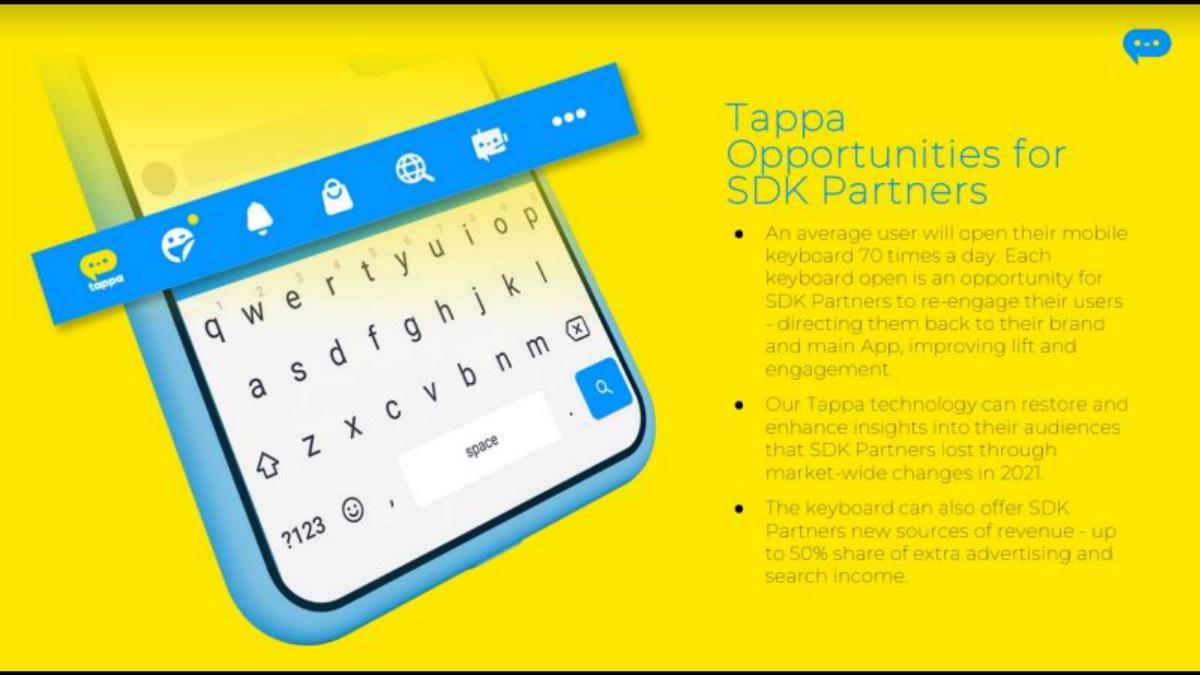
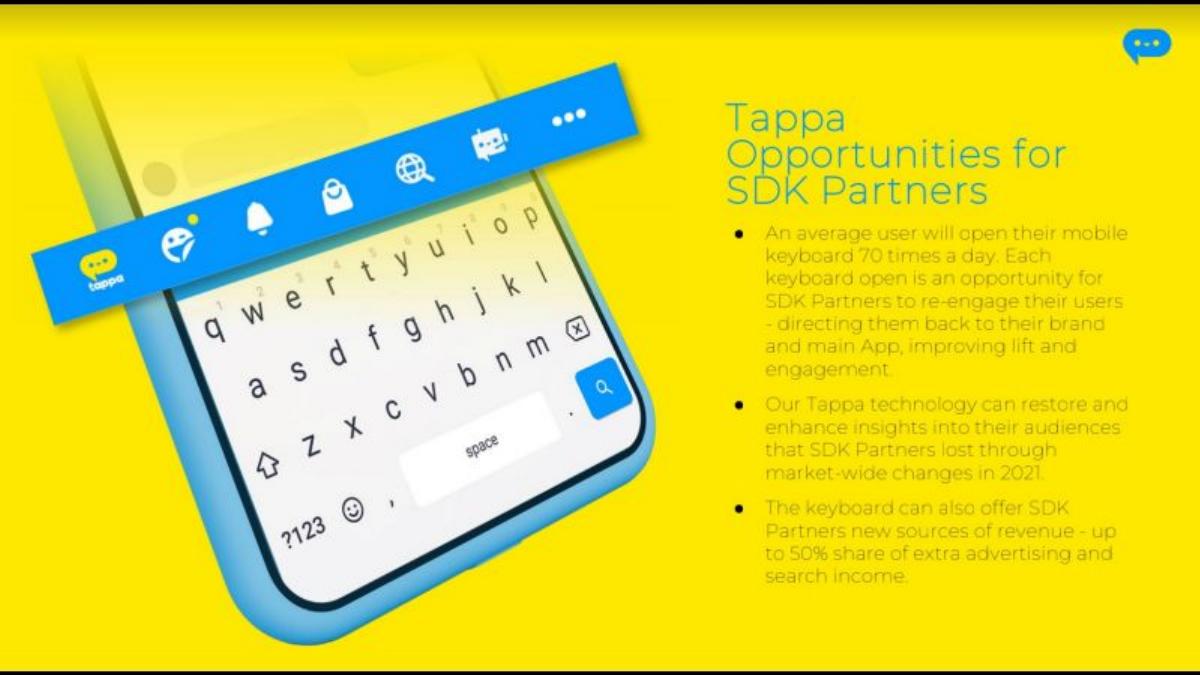
- The average user opens their mobile keyboard 70 times per day, providing high-frequency engagement opportunities (Slide 1).
- Tappa offers SDK partners up to a 50% share of extra advertising and search income generated through the keyboard (Slide 1).
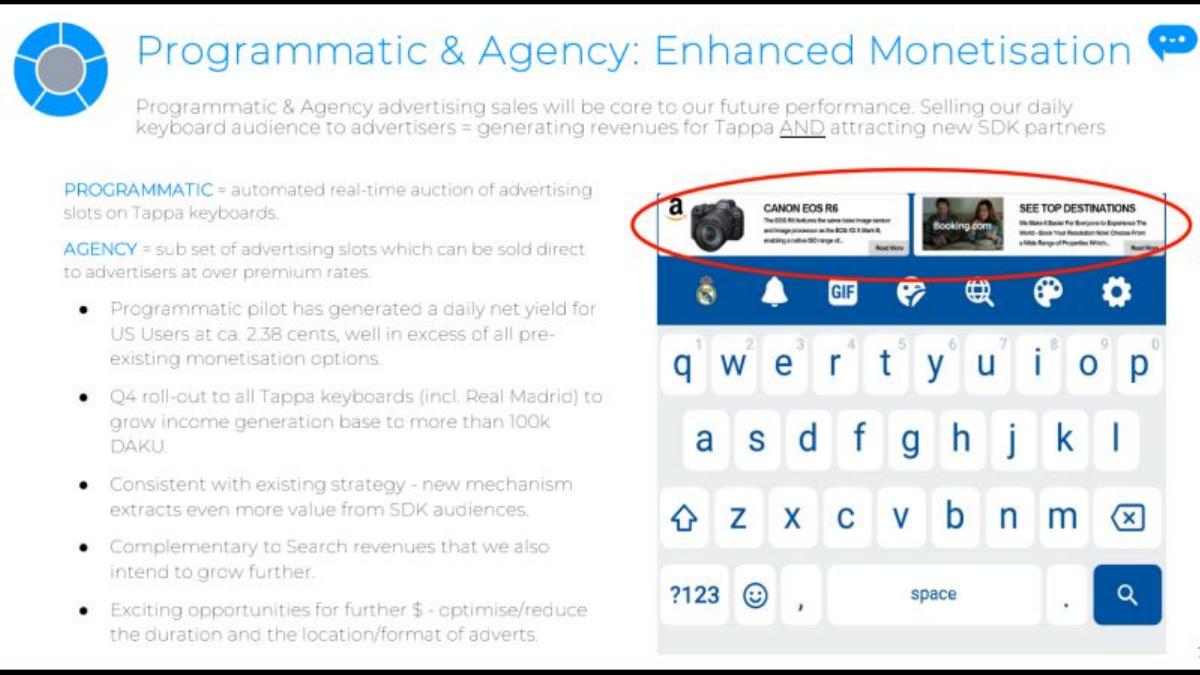
- A programmatic pilot for US users generated a daily net yield of approximately 2.38 cents (Slide 3).
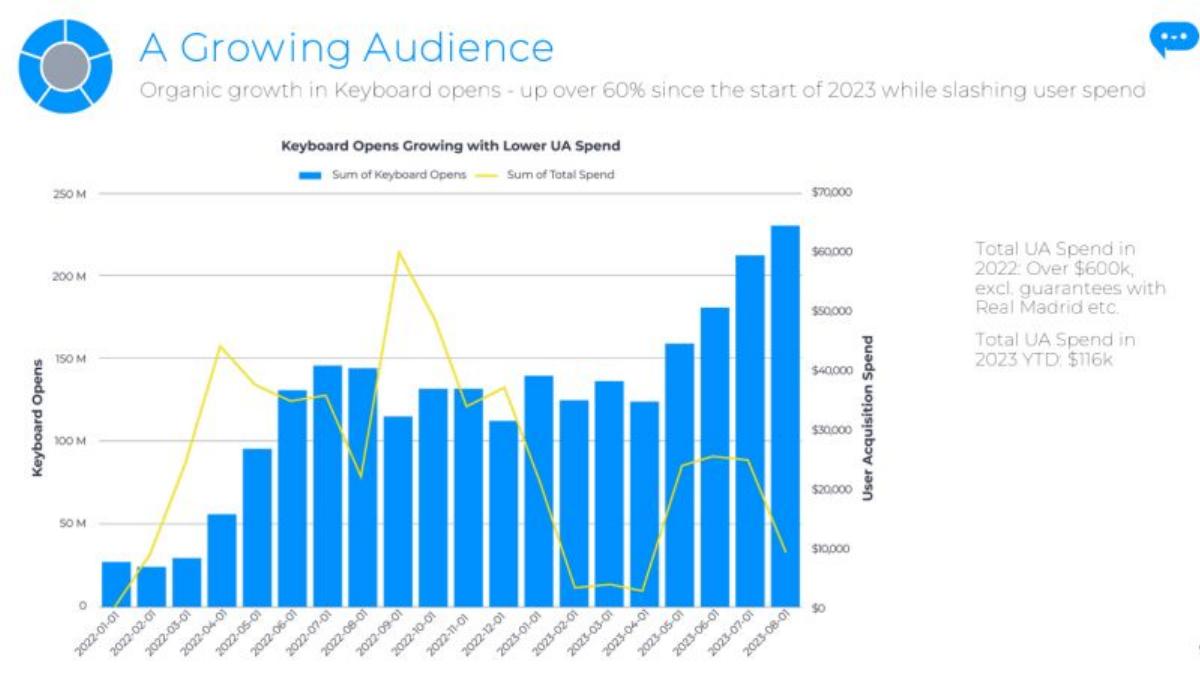
- Keyboard opens grew over 60% since the start of 2023, while user acquisition spend was reduced from over $600k in 2022 to $116k YTD in 2023 (Slide 4).
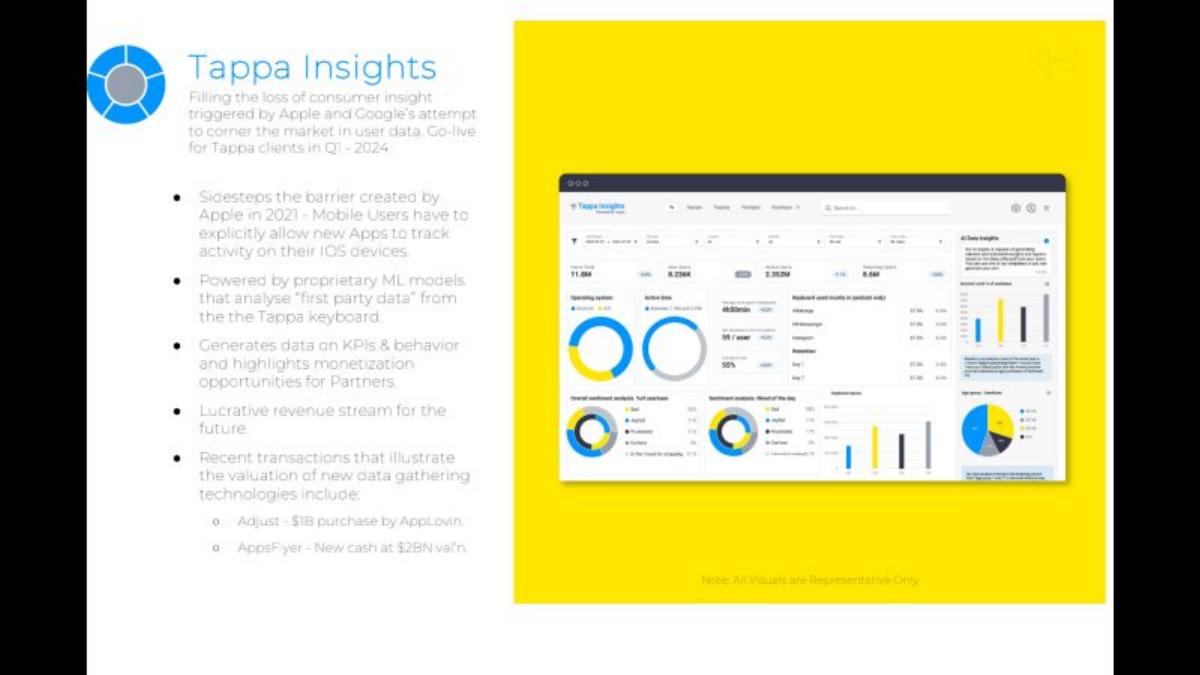
- The platform positions itself as a way to sidestep Apple's 2021 privacy barriers by using proprietary ML models to analyze first-party keyboard data (Slide 5).
- Tappa cites the $1B purchase of Adjust and AppsFlyer's $2B valuation as evidence of the market value for data-gathering technologies (Slide 5).
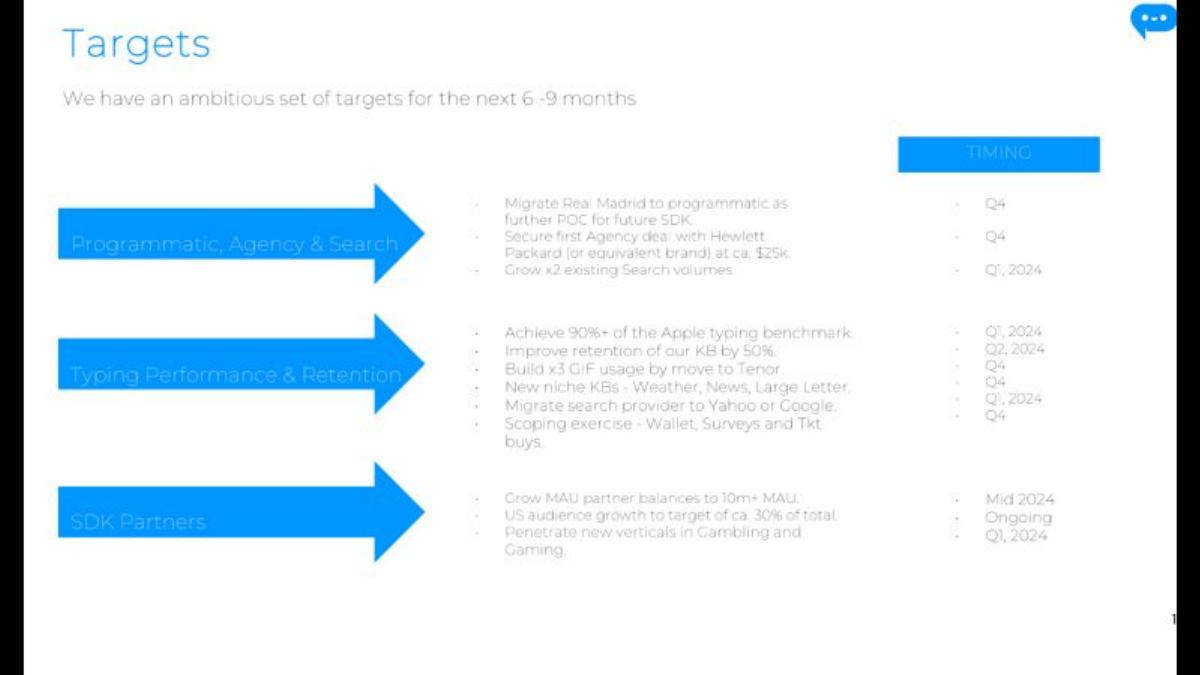
- The company set a specific target to secure its first Agency deal with Hewlett Packard or an equivalent brand for approximately $25k in Q4 (Slide 6).
- The 2024 roadmap includes integrating rewarded videos, non-latin language support, and LLM-based 'Custom Insights' for partners (Slide 7).
Tappa Pitch Deck Teardown: A Strategy-Heavy Update
Tappa's 2024 pitch deck is a concise, 8-slide presentation that secured $4.9M in Seed funding. Unlike many early-stage decks that spend time introducing the founders or the general market problem, Tappa’s deck reads more like a strategic update for sophisticated investors. It focuses heavily on unit economics, technical roadmaps, and the specific mechanics of their B2B2C distribution model. The company operates in the MarTech space, specifically focusing on branded mobile keyboards that serve as a persistent touchpoint for users and a data source for brands.
Slide 1: Opportunities for SDK Partners
The deck opens by defining the core utility of the Tappa keyboard. It establishes a high-frequency engagement metric: the average user opens their keyboard 70 times a day. This slide sets the stage for the B2B2C model, explaining that the keyboard is a tool for SDK partners to re-engage users and drive them back to their main apps. A key financial incentive is introduced here: partners can receive up to a 50% share of advertising and search income. This is a clear "hook" designed to explain why a third-party app would want to integrate Tappa's technology.
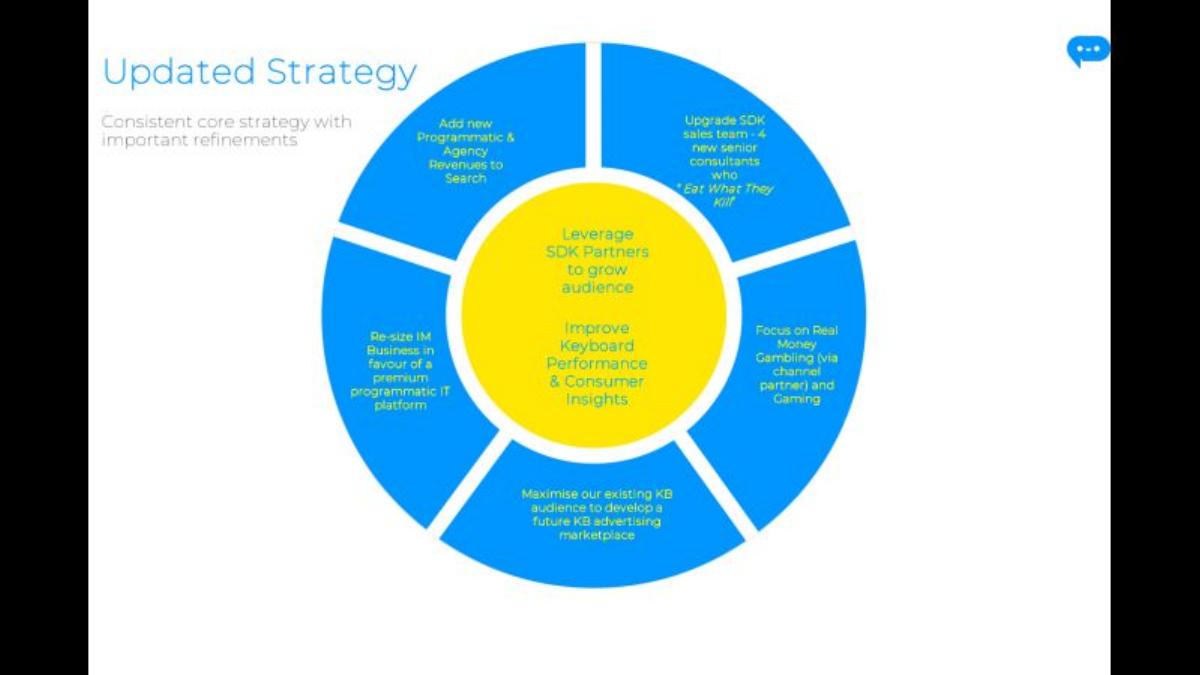
Slide 2: Updated Strategy
Slide 2 uses a circular diagram to outline the company's strategic refinements. The central focus is on leveraging SDK partners to grow the audience and improving keyboard performance. The outer ring details five specific tactical shifts: adding programmatic and agency revenues to search, upgrading the SDK sales team with four new senior consultants, focusing on real-money gambling and gaming via channel partners, maximizing the existing keyboard audience for a future advertising marketplace, and re-sizing the IM business in favor of a premium programmatic IT platform. This slide is dense and assumes the reader is already familiar with Tappa's previous business iterations.
Slide 3: Programmatic & Agency Monetization
This slide provides a deep dive into the revenue model. It defines "Programmatic" as automated real-time auctions and "Agency" as direct sales at premium rates. The most important data point here is the result of a programmatic pilot: a daily net yield of approximately 2.38 cents for US users. Tappa claims this exceeds all pre-existing monetization options. The slide also mentions a Q4 rollout to all keyboards, including a partnership with Real Madrid, aimed at growing the base to more than 100,000 Daily Active Keyboard Users (DAKU).
Slide 4: A Growing Audience
Slide 4 presents a dual-axis bar and line chart comparing "Keyboard Opens" to "User Acquisition (UA) Spend." The visual narrative is strong: keyboard opens are trending upward (over 60% growth since the start of 2023) while UA spend is trending sharply downward. The slide notes that total UA spend in 2022 was over $600,000, whereas the 2023 YTD spend was reduced to $116,000. This is intended to demonstrate the efficiency of their growth model and the potential for high margins as they move away from paid acquisition.
Slide 5: Tappa Insights
This slide addresses the "Privacy Problem" in mobile marketing. Tappa positions its "Insights" product as a way to recover consumer data lost due to Apple and Google's privacy changes in 2021. By using proprietary ML models to analyze first-party data directly from the keyboard, Tappa claims to provide KPIs and behavioral highlights that other apps can no longer access. To justify the potential valuation of this data play, the slide cites two major industry benchmarks: AppLovin’s $1B purchase of Adjust and AppsFlyer’s $2B valuation.
Slide 6: Targets for the Next 6-9 Months
Slide 6 outlines specific milestones across three categories: Programmatic/Agency/Search, Typing Performance/Retention, and SDK Partners. Notable targets include securing a $25k agency deal with Hewlett Packard (or equivalent), achieving 90% of the Apple typing benchmark, and growing the MAU partner balance to over 10 million by mid-2024. The inclusion of specific brand names like Hewlett Packard and Real Madrid adds credibility to these projections.
Slide 7: 2023/24 IT Roadmap in Detail
The final content slide is a detailed technical roadmap spanning Q4 2023 through Q4 2024. It breaks down tasks into three workstreams: Revenue Support, Keyboard Performance, and SDK Partner Leverage. Key upcoming features include rewarded video integration, non-latin language support, and an LLM-powered "Custom Insights" tool that allows partners to "ask an LLM about your user base." This slide demonstrates a clear path for product evolution and technical maturity.
Slide 8: Closing Slide
The deck concludes with a standard promotional slide for the platform where the deck was hosted, rather than a Tappa-specific closing or contact slide. This is common in publicly shared versions of pitch decks.
What Tappa Does Well
Tappa excels at demonstrating capital efficiency . Slide 4 is the strongest slide in the deck because it visually proves that the company can grow its primary engagement metric (keyboard opens) while significantly reducing its reliance on paid user acquisition. For a Seed-stage company, showing a 60% increase in activity alongside an 80% reduction in spend is a powerful signal of product-market fit or at least a highly effective distribution strategy.
The deck also does a great job of quantifying the opportunity for partners. By stating a specific revenue share (50%) and a specific yield per user (2.38 cents), Tappa makes the business case for their SDK partners very clear. This isn't just a "cool technology" pitch; it is a financial partnership pitch. Furthermore, their positioning as a solution to the post-2021 privacy landscape (Slide 5) gives them a timely and relevant "why now" narrative.
What is Missing from the Tappa Deck
The most glaring omission in this deck is a Team slide . In a Seed round, the pedigree and experience of the founders are usually the most important factors for investors. There is no mention of who is building this technology or their background in MarTech or mobile development. Similarly, there is no Ask slide . The deck does not specify how much money is being raised, the valuation, or how the funds will be allocated across the roadmap items mentioned on Slide 7.
The deck also lacks a Competitive Landscape analysis. While they mention the value of data companies like Adjust and AppsFlyer, they do not address other keyboard competitors (like Gboard or SwiftKey) or other SDK-based monetization platforms. Finally, the Problem slide is somewhat buried. While Slide 5 touches on privacy changes, a traditional deck usually starts with a clear pain point for the end consumer or the brand, which is missing here in favor of immediate strategic updates.
Founder Takeaways: What to Copy
Use specific pilot data: Tappa’s use of the "2.38 cents" figure on Slide 3 is excellent. It moves the conversation from theoretical revenue to actual, tested results. Founders should always include specific metrics from pilots or early tests to ground their projections in reality.
Show the inverse relationship between growth and spend: If your startup has managed to grow while cutting costs, make that the centerpiece of your traction slide. The chart on Slide 4 is a textbook example of how to show that a business is becoming more sustainable and less dependent on venture dollars for every new user.
Align with macro trends: Tappa successfully aligns itself with the massive industry shift toward first-party data. By explicitly mentioning the 2021 privacy changes by Apple and Google, they make their product feel like a necessary evolution of the market rather than just another app. Founders should always identify the "macro tailwind" that makes their specific solution more valuable today than it was two years ago.
Detail your roadmap: The level of detail on Slide 7 is impressive. It shows that the team has thought through the specific features required to hit their targets. A detailed roadmap reduces perceived execution risk for investors by showing a clear plan for the next 12 months.
Frequently asked questions
- What is Tappa's primary value proposition for partners?
- Tappa provides a mobile keyboard SDK that allows partner apps to re-engage users every time they type. According to Slide 1, the average user opens their keyboard 70 times a day. Tappa incentivizes adoption by offering partners a 50% revenue share from advertising and search income, while also providing first-party data insights that were lost following Apple's 2021 privacy updates.
- How does Tappa generate revenue?
- Revenue is primarily driven through programmatic and agency advertising sales. Slide 3 defines programmatic as an automated real-time auction for slots on the keyboard, while agency sales involve direct deals at premium rates. They also generate income through search revenue, with plans to migrate search providers to Yahoo or Google in 2024 as noted on Slide 7.
- What evidence of growth does the deck provide?
- Slide 4 shows a significant increase in 'Keyboard Opens,' which grew by over 60% since the beginning of 2023. Crucially, this growth occurred while the company aggressively reduced its User Acquisition (UA) spend from over $600,000 in 2022 to $116,000 in 2023 YTD, suggesting a shift toward organic or partner-led growth.
- How does Tappa handle mobile privacy restrictions?
- Slide 5 explicitly states that Tappa 'sidesteps the barrier created by Apple in 2021' regarding App Tracking Transparency. Because the keyboard collects first-party data directly from user input, Tappa uses proprietary machine learning models to analyze KPIs and behavior without relying on the cross-app tracking that Apple and Google have restricted.
- What are the company's short-term technical goals?
- As detailed in Slides 6 and 7, Tappa aims to achieve 90% of the Apple typing benchmark, grow its partner balance to over 10 million Monthly Active Users (MAU) by mid-2024, and expand into new verticals like gambling and gaming. Their IT roadmap also includes launching an LLM-powered 'Custom Insights' tool for partners to query their user base.