Golpo AI’s deck is a study in 'founder-market fit' and velocity. Raising a reported $4.1M Seed round in 2024, the company utilized just seven slides to convey a high-conviction narrative. The deck leans heavily on the academic and technical achievements of its co-founders—two Stanford CS dropouts with backgrounds at the Stanford AI Lab and Harvard Medical AI. Instead of lengthy industry deep-dives, Golpo AI presents a single, startling traction chart showing growth from near-zero to $30,346.18 MRR in under four weeks. The technical hook is a cost-efficiency claim: their approach is 45 times c…
Key takeaways
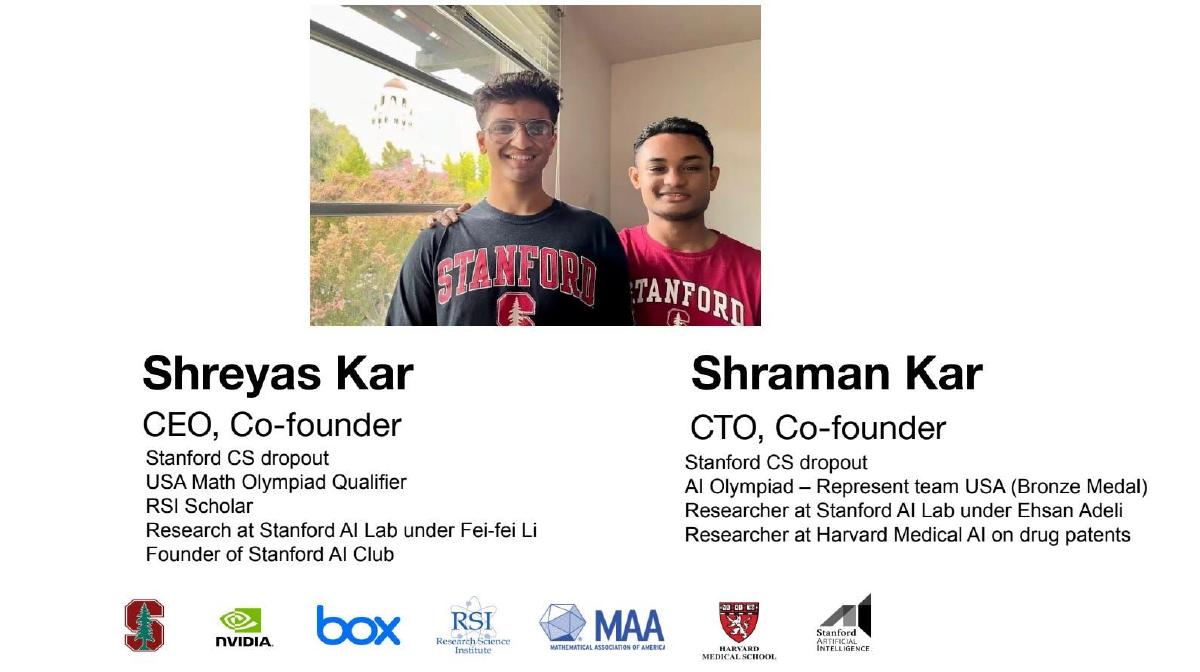
- The deck relies on a 'pedigree-first' strategy, placing the team slide immediately after the title to establish technical authority (Slide 2).
- Traction is the primary validator, showcasing a jump to $30,346.18 MRR in less than 30 days (Slide 3).
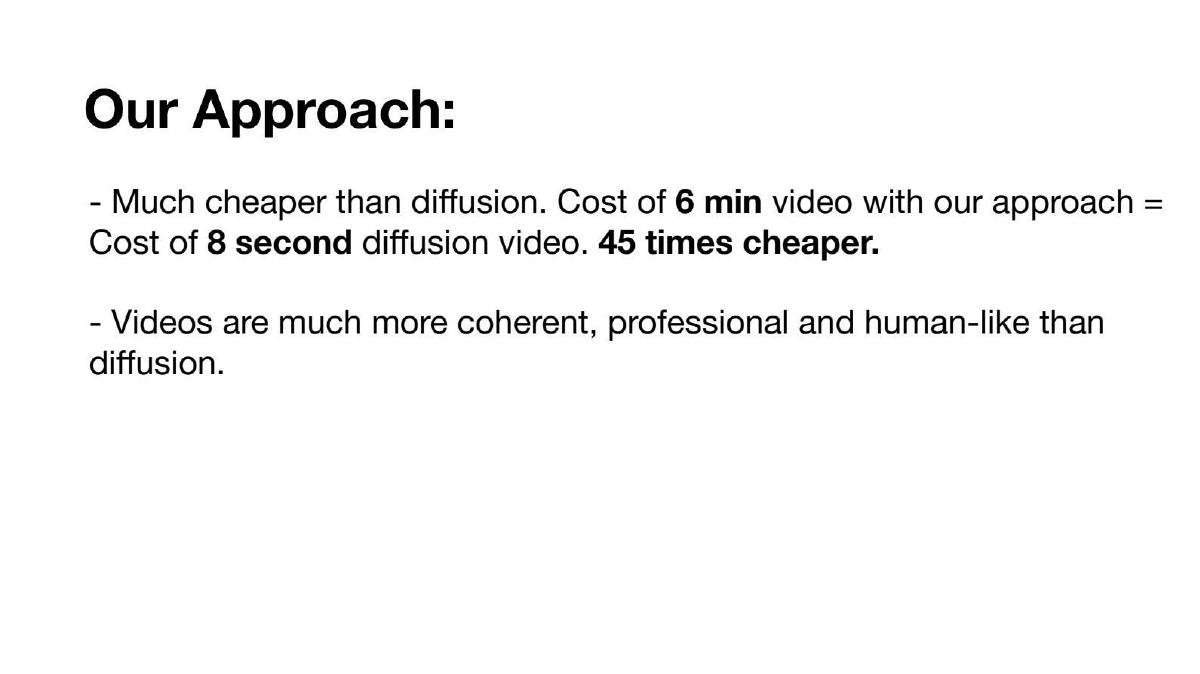
- The core value proposition is built on a specific cost comparison: a 6-minute Golpo video costs the same as an 8-second diffusion video (Slide 4).
- The founders claim a 45x cost advantage over diffusion-based competitors while promising higher coherence (Slide 4).
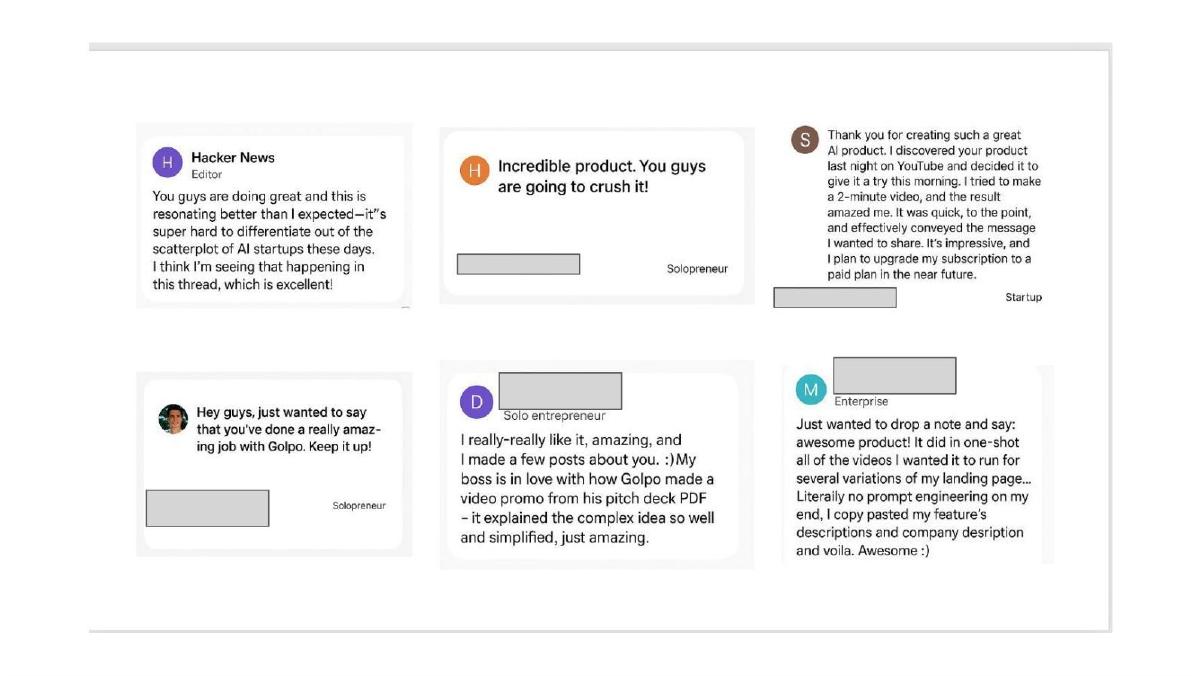
- Social proof is aggregated from diverse sources, including Hacker News and enterprise users, to demonstrate broad product-market fit (Slide 5).
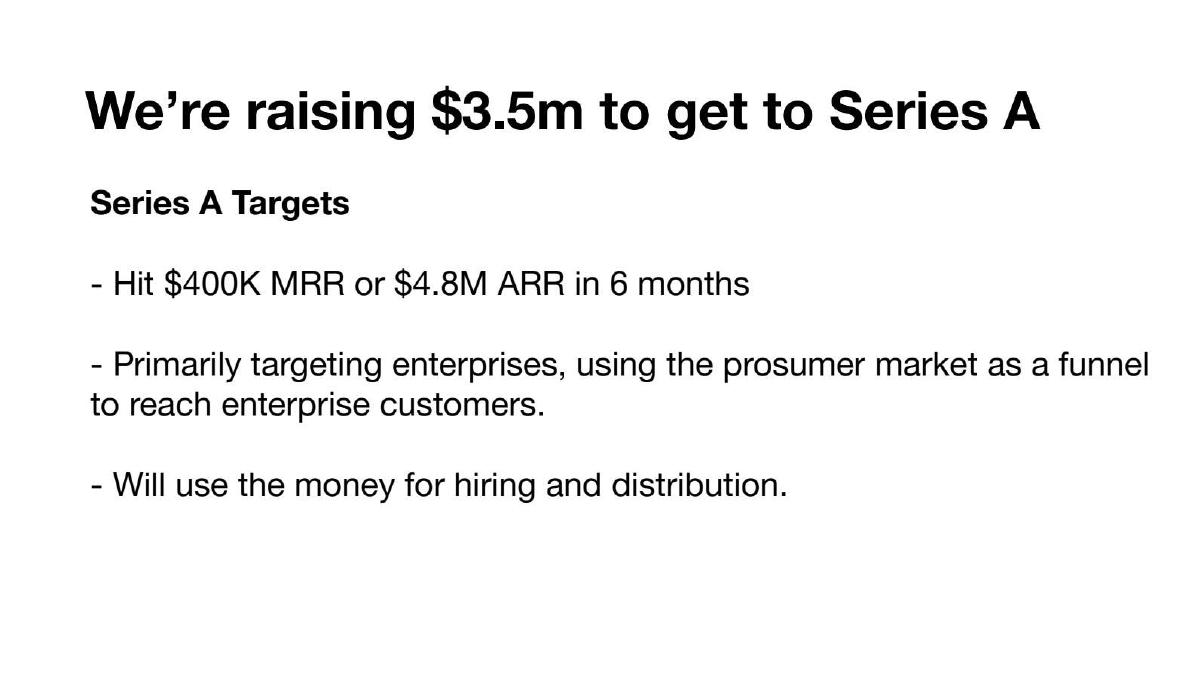
- The fundraising ask of $3.5M is tied to a specific, aggressive milestone: reaching $400K MRR within six months (Slide 6).
- The deck completely omits a market size (TAM) slide, a competitor matrix, and a detailed product roadmap.
- Golpo AI positions itself as a product of 'Red Tree Inc,' suggesting a corporate structure beyond the single AI tool (Slide 1).
The Power of Brevity in AI Fundraising
Golpo AI’s pitch deck is an anomaly in a world of 20-page presentations. With only seven slides, it managed to secure a reported $4.1M Seed round. This teardown examines how the founders used extreme technical pedigree and explosive early revenue to replace the traditional, exhaustive business plan. In the current AI venture climate, speed and technical depth are the primary currencies, and this deck spends both liberally.
Slide 1: The Hook
The title slide is functional and minimalist. It identifies Golpo AI as the "World's best AI Video Generation Engine for Explainer Videos." Notably, it includes a footer stating the company is "A product of Red Tree Inc." This suggests a parent-subsidiary structure or a pivot from a previous entity. The branding is clean, using a simple pink logo, signaling a focus on the product rather than flashy design.
Slide 2: The Pedigree Play
Most decks save the team slide for the end. Golpo AI puts it second. This is a strategic choice. For an AI startup claiming a massive technical breakthrough, the founders must first prove they are capable of building it. Shreyas Kar (CEO) and Shraman Kar (CTO) list credentials that are highly valued by Silicon Valley investors: Stanford CS dropouts , USA Math Olympiad qualifiers, and researchers at the Stanford AI Lab under Fei-fei Li and Ehsan Adeli. The inclusion of logos from NVIDIA, Box, and Harvard Medical School reinforces their technical standing. This slide effectively says: "We are the top 0.1% of technical talent; you can trust our math."
Slide 3: The Traction Shock
Slide 3 provides the quantitative validation for the team's pedigree. It displays a Stripe-style revenue chart showing a climb to $30,346.18 MRR ($364K ARR) in less than four weeks. The headline metric— 39,150% growth —is a classic 'vanity-but-effective' metric used to highlight a launch from zero. The chart shows a consistent upward slope from August to September, suggesting that the revenue isn't just a single one-off contract but a series of recurring subscriptions. This slide eliminates the 'market risk'—people are clearly willing to pay for this tool.
Slide 4: The Technical Differentiator
This is the 'Secret Sauce' slide. Instead of explaining the underlying neural network architecture, the founders focus on the economic outcome of their technology. They compare their approach to "diffusion," the current standard for AI video. The claim is bold: 45 times cheaper than diffusion. Specifically, they state the cost of a 6-minute video with their approach equals the cost of an 8-second diffusion video . They also claim their videos are more "coherent, professional and human-like." This addresses the two biggest pain points in AI video: high compute costs and the 'hallucination' or lack of temporal consistency in long-form content.
Slide 5: Social Proof and Use Cases
Slide 5 utilizes customer testimonials to define the product's utility. Rather than a list of features, we see how users interact with the tool. One user mentions making a video promo from a pitch deck PDF , while another notes there was "literally no prompt engineering" required. The testimonials are categorized by user type: Hacker News Editor , Solopreneur , Startup , and Enterprise . This demonstrates that the product has a broad appeal, from individual creators to corporate entities, supporting the 'prosumer-to-enterprise' funnel mentioned later.
Slide 6: The Ask and The Roadmap
The penultimate slide outlines the fundraising goal: $3.5M to get to Series A . (Note: Publisher reports indicate they eventually closed $4.1M). The founders set a clear, measurable target for the next round: hitting $400K MRR ($4.8M ARR) in 6 months . This is an incredibly aggressive timeline, implying a 13x growth requirement in half a year. The strategy for achieving this is to use the "prosumer market as a funnel to reach enterprise customers," with the funds allocated toward "hiring and distribution."
Slide 7: Conclusion
The final slide is a simple "Thank You!" with a URL: video.golpoai.com . It maintains the minimalist aesthetic of the rest of the deck, leaving the focus on the traction and team credentials established in the previous six slides.
What Golpo AI Does Exceptionally Well
The strength of this deck lies in its Signal-to-Noise Ratio . In a crowded AI market, investors are fatigued by generic 'AI for X' pitches. Golpo AI avoids this by focusing on two undeniable facts: the founders are technically elite, and the product is generating cash immediately. By lead-loading the team and traction slides, they create a sense of inevitability. The cost-comparison on Slide 4 is also brilliant; it translates a complex technical advantage into a simple business advantage (45x cheaper), which is much easier for a General Partner at a VC firm to defend to their investment committee.
What is Missing from the Golpo AI Deck
While the deck was successful, it leaves several critical questions unanswered. There is no Competitive Landscape slide. In a world where OpenAI (Sora), Runway, and Pika are raising hundreds of millions, how does Golpo AI maintain its 45x cost advantage? There is also no Product Demo or visual examples of the videos generated. For a video generation company, the absence of visual output in the deck is surprising. Furthermore, the deck lacks Unit Economics . We know the revenue is $30K, but we don't know the Customer Acquisition Cost (CAC) or the churn rate. If the growth was driven by a viral moment on Hacker News, the sustainability of that $400K MRR target is highly speculative.
Lessons for Founders
Lead with your strongest asset: If you have a world-class team, don't hide them on Slide 12. Golpo AI put their credentials front and center to build immediate trust. · Quantify the technical advantage: Don't just say your AI is 'better' or 'faster.' Use a specific comparison, like Golpo’s '6 minutes vs. 8 seconds' cost metric. · Traction trumps projections: A chart showing $30K in real revenue is worth more than ten slides of financial projections. If you have revenue, make it the hero of the deck. · Keep it lean: You don't need 20 slides to raise a Seed round. If your core narrative is strong enough, 7 slides can be more impactful than 20. · Define the 'Next Milestone': By stating exactly what MRR they need for a Series A, the founders show they understand the venture capital lifecycle and are focused on the specific metrics that trigger the next round of funding.
Frequently asked questions
- How did Golpo AI raise $4.1M with only 7 slides?
- The deck succeeds by focusing on 'signal' over 'noise.' In the 2024 AI market, technical pedigree (Stanford CS dropouts, AI Lab researchers) and immediate revenue ($30K MRR in 4 weeks) are the two strongest signals possible. By proving they can build a product people pay for instantly, they removed the need for speculative slides about market size or future features.
- Why is the team slide placed so early in the deck?
- For deep-tech or AI startups, the 'who' is often more important than the 'what.' By placing their credentials on Slide 2, the founders establish that they have the mathematical and research background (Math Olympiad, Stanford AI Lab) to actually deliver on the 45x cost-efficiency claim made later in the deck.
- Is the 39,150% growth rate sustainable?
- Likely not, and investors know this. The figure represents the move from $0 to $30K in a single month. However, the purpose of this metric isn't to project infinite growth, but to prove 'product-market resonance'—the idea that the market was waiting for this specific solution and adopted it immediately upon release.
- What is the significance of the 45x cost advantage claim?
- In AI video generation, compute costs are the primary barrier to scale. By claiming that a 6-minute video costs the same as an 8-second diffusion video, Golpo AI is signaling they have a proprietary architectural advantage that allows for significantly higher margins and lower prices than incumbents like Sora or Runway.
- What are the biggest risks missing from this deck?
- The deck ignores the 'moat' question. It doesn't explain how they will defend against Big Tech or other well-funded AI startups. It also lacks a breakdown of unit economics; while they mention production costs are low, they don't disclose customer acquisition costs (CAC) or churn rates, which are critical for a prosumer-to-enterprise strategy.