GoodShip’s 10-slide Series B deck is a concise exercise in narrative-driven fundraising. Rather than overwhelming investors with complex logistics diagrams, the company focuses on the 'Cost of Silos,' citing an analysis of $3B+ in transportation spend to prove their value proposition. The deck leans heavily on the founders' deep industry roots at companies like Convoy and Coyote, establishing immediate credibility. By positioning themselves as the 'orchestration' layer between existing legacy systems like SAP and Oracle, GoodShip avoids the 'rip and replace' objection. The deck concludes with…
Key takeaways
- The founders leverage extreme domain expertise, citing roles at three unicorns including Coyote and Convoy (Slide 2).
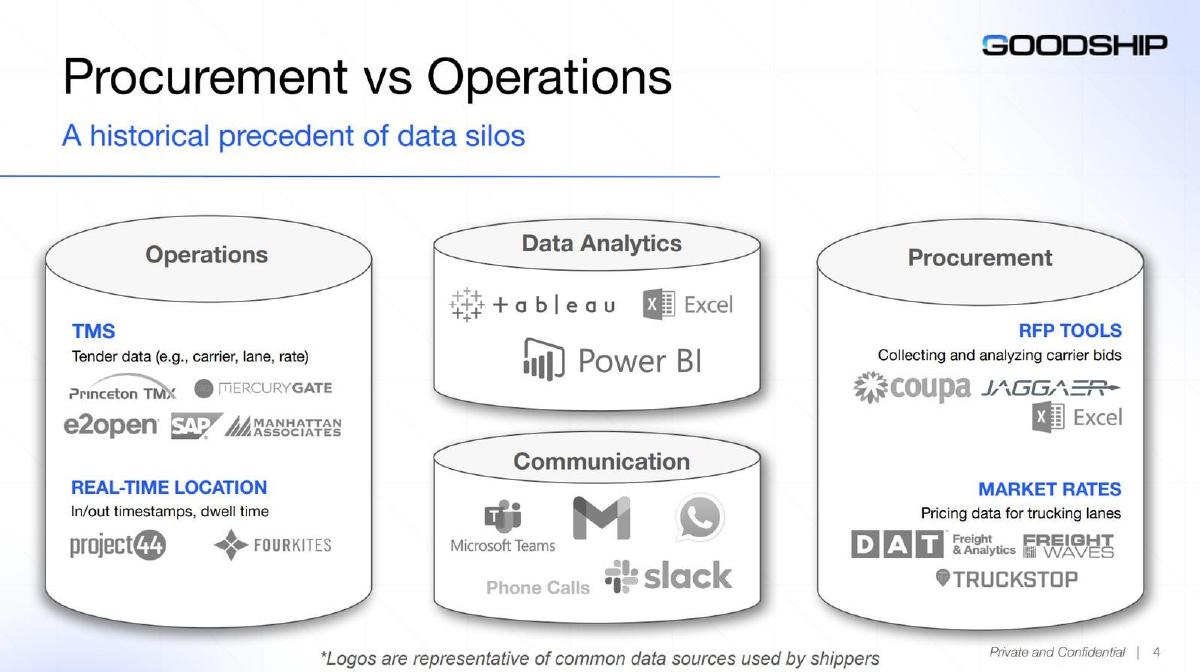
- The deck identifies a specific 'historical precedent of data silos' across operations, analytics, and procurement (Slide 4).
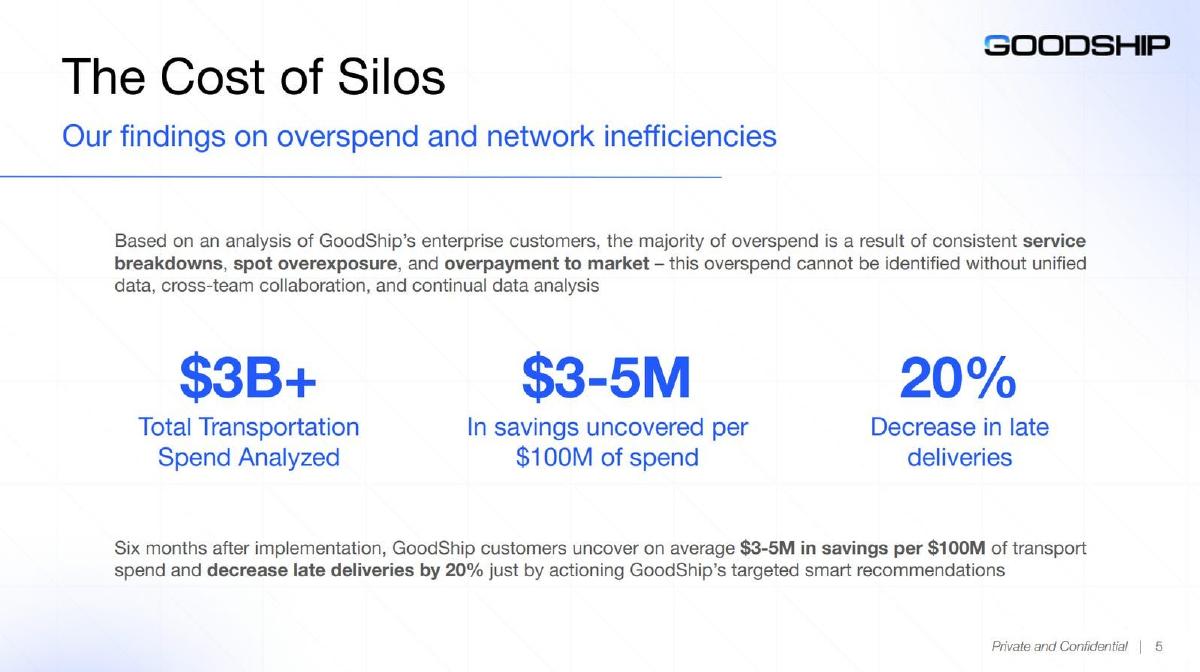
- GoodShip quantifies the problem by stating they have analyzed over $3B in total transportation spend (Slide 5).
- The platform claims to uncover $3-5M in savings for every $100M of spend within six months of implementation (Slide 5).
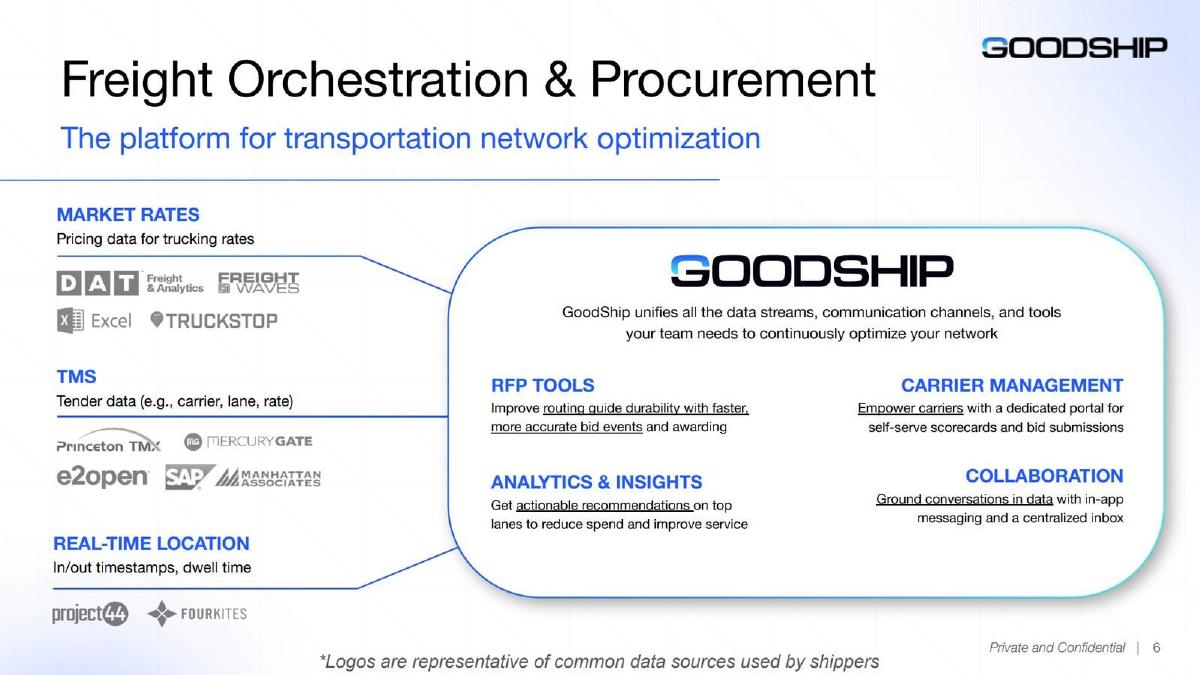
- Product positioning is defined as 'Freight Orchestration,' acting as a unified layer over existing TMS and market rate tools (Slide 6).
- The deck lists five core features including real-time carrier scorecarding and digital bidding (Slide 7).
- Customer testimonials from KeHE and Central Garden & Pet validate the platform's ability to automate manual processes (Slide 9).
- A single dashboard screenshot on Slide 10 serves as the primary visual proof of the AI-powered interface.
The Narrative of Orchestration
GoodShip’s Series B deck, as reported by Business Insider, is a masterclass in brevity. In just 10 slides, the company manages to frame a complex logistics problem as a simple data silo issue. By 2024, the 'AI-powered' label has become standard, but GoodShip backs it up with a focus on 'Freight Orchestration'—a term that suggests they aren't trying to replace the industry's existing infrastructure, but rather make it work better together. The deck is clean, professional, and relies heavily on the pedigree of its team to carry the weight of the $25M raise.
Slide 1: Title and Positioning
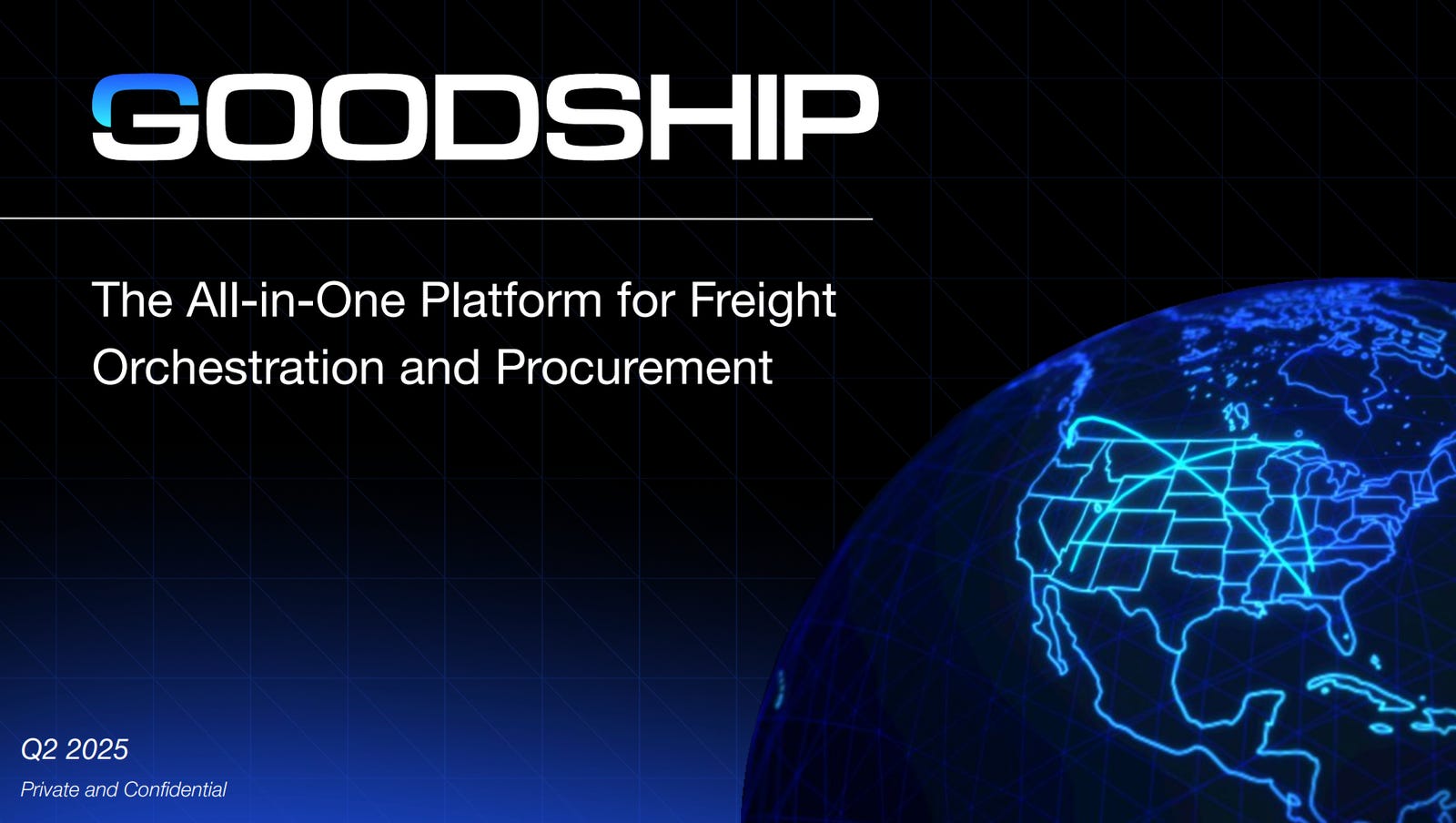
The deck opens with a clear value proposition: 'The All-in-One Platform for Freight Orchestration and Procurement.' The use of the term 'Orchestration' is a strategic choice. In the crowded transportation tech sector, many startups fail by trying to replace legacy Transportation Management Systems (TMS). By positioning as an orchestrator, GoodShip signals that it sits on top of existing stacks. The slide is dated Q2 2025, suggesting this version of the deck was used for late-stage discussions or updated for post-raise presentations.
Slide 2: The Team
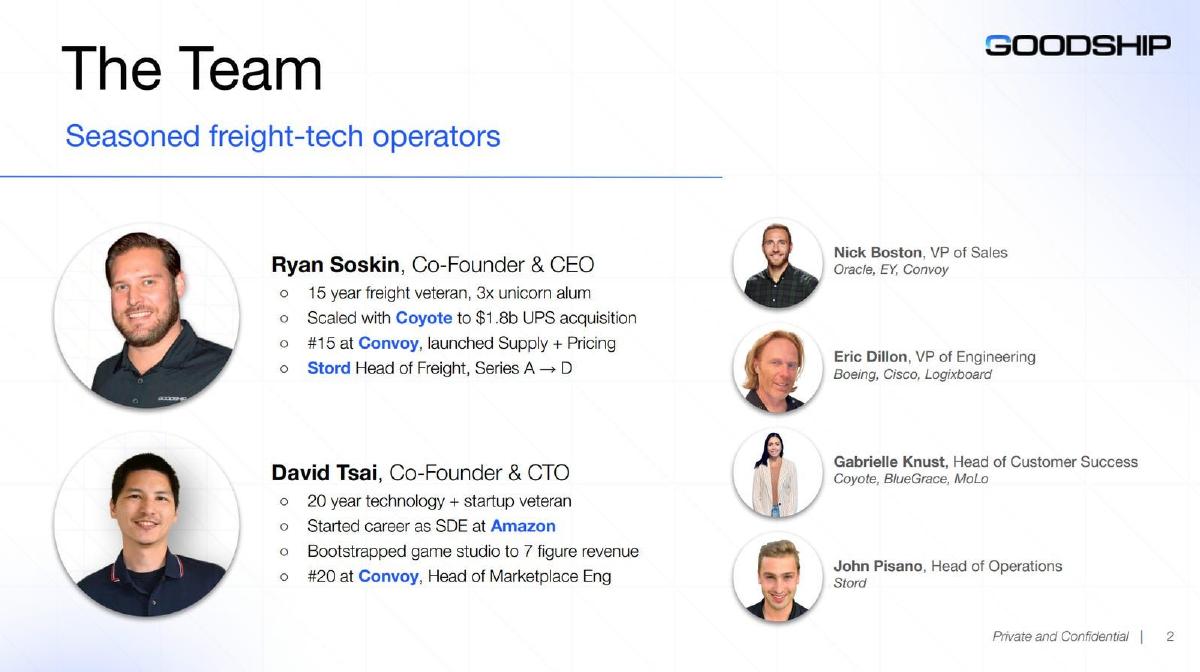
For a Series B, the team slide is often moved to the back, but GoodShip puts it front and center. This is a 'bet on the jockey' move. Ryan Soskin (CEO) is listed as a '15 year freight veteran' and '3x unicorn alum,' specifically highlighting his time at Coyote (acquired by UPS for $1.8B) and Convoy. David Tsai (CTO) complements this with 20 years of tech experience, including a stint as Head of Marketplace Engineering at Convoy. The supporting cast includes VPs from Oracle, Boeing, and Stord. This slide screams 'founder-market fit,' which is essential when asking for $25M in a volatile logistics market.
Slide 3: Featured Investors
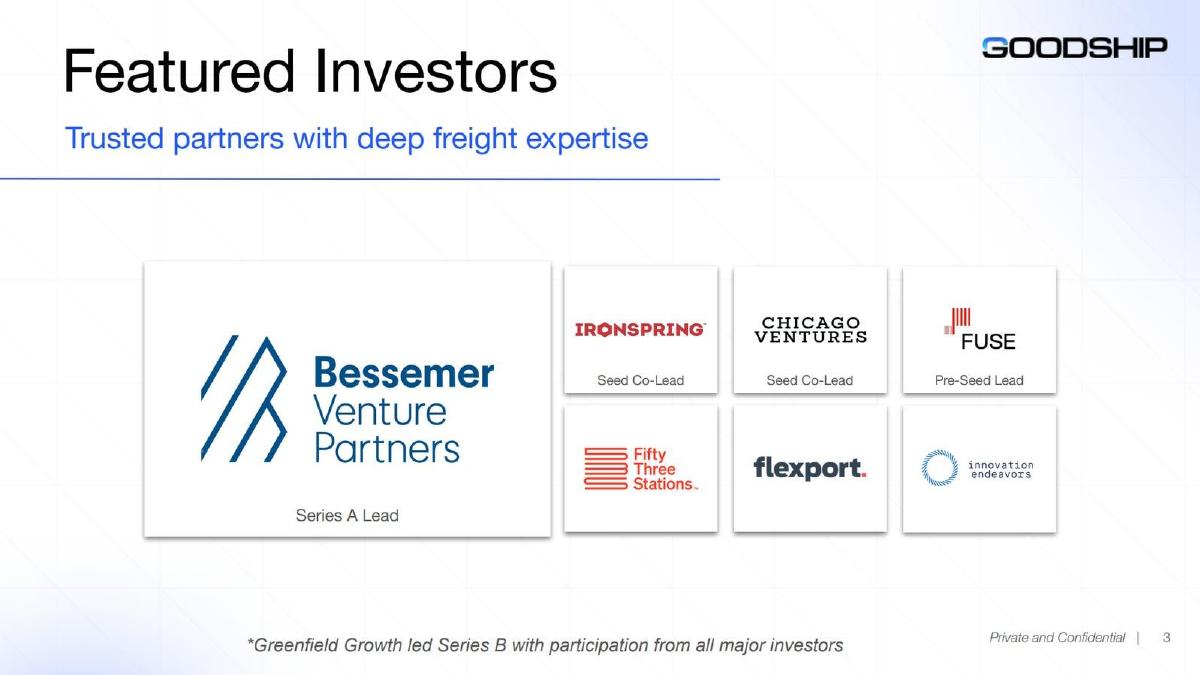
Social proof is the theme of Slide 3. By listing Bessemer Venture Partners as the Series A lead and Greenfield Growth as the Series B lead (in the footer), GoodShip demonstrates that they have passed the due diligence of top-tier firms. The inclusion of Flexport as an investor is also a strategic signal, as it suggests alignment with one of the biggest disruptors in the space.
Slide 4: The Problem (Procurement vs Operations)
This slide visualizes the 'historical precedent of data silos.' It categorizes the current landscape into four buckets: Operations (TMS like SAP and Manhattan Associates), Data Analytics (Tableau, Power BI), Communication (Slack, Teams), and Procurement (Coupa, Jaggaer). By showing these as separate silos, GoodShip creates a visual gap that their product is designed to fill. It’s a classic 'before' picture that sets up the 'after' solution.
Slide 5: The Cost of Silos
This is the most important slide in the deck for a Series B investor. It moves from abstract problems to hard numbers. GoodShip claims to have analyzed $3B+ in total transportation spend . They translate this into a clear ROI: $3-5M in savings uncovered per $100M of spend . They also claim a 20% decrease in late deliveries . These metrics are critical because they provide a 'hard' ROI that a CFO can understand, moving the platform from a 'nice to have' to a 'must have.'
Slide 6: The Solution (Freight Orchestration)
Slide 6 mirrors Slide 4 but shows GoodShip as the unifying force. It illustrates how the platform pulls in data from Market Rates (DAT, Truckstop), TMS (SAP, MercuryGate), and Real-Time Location (Project44, FourKites). The 'GoodShip' box in the center highlights four pillars: RFP Tools, Analytics & Insights, Carrier Management, and Collaboration. This effectively communicates that GoodShip is the 'brain' connecting the various 'limbs' of a logistics operation.
Slide 7 & 8: Features and Outcomes
These two slides are minimalist, perhaps to a fault. Slide 7 lists five features: Performance analytics, Market rate benchmarking, Real-time carrier scorecarding, Procurement recommendations, and Digital bidding. Slide 8 lists four outcomes: Decreased freight spend, Increased service levels, Stronger carrier relationships, and More durable contracts. While clear, these slides lack the visual punch of the earlier diagrams and could have been combined to save space for more technical depth or market analysis.
Slide 9: Select Testimonials
GoodShip provides two high-quality enterprise testimonials. Andrew Dafnos from KeHE mentions 'real-time market visibility' and 'self-serve scorecards,' while Kevin Norris from Central Garden & Pet notes that the platform 'eliminated many of the old, manual processes.' Having two recognizable enterprise names in the logistics space provides the necessary validation that the product works at scale.
Slide 10: The Product Interface
The final slide shows a screenshot of the GoodShip dashboard. It displays metrics like 'Total Spend ($9,704,443),' 'Average Cost ($2,451),' and 'Spot Exposure (7%).' A map view shows freight lanes across the United States. This slide serves as the 'proof of life' for the software, showing a clean, modern UI that contrasts with the clunky legacy systems mentioned on Slide 4.
What GoodShip Does Well
The deck excels at problem framing . By focusing on 'silos' rather than just 'inefficiency,' they identify a specific structural flaw in how large companies manage freight. The ROI quantification on Slide 5 is also exceptionally strong; giving investors a specific dollar-for-dollar savings ratio ($3-5M per $100M) makes the business case much easier to defend. Finally, the team pedigree is used effectively to build trust, which is the primary currency in Series B rounds.
What is Missing from the Deck
Despite raising $25M, this version of the deck is missing several standard Series B components. There is no competitive landscape slide; while they mention legacy systems, they don't address other modern freight-tech competitors. There is no financial data —no mention of ARR, growth rates, or burn. There is also no roadmap showing how the $25M will be spent or what the product will look like in three years. Most notably, there is no 'Ask' slide , which is common in decks shared publicly but usually present in the versions shown to investors.
Founder Takeaways
Quantify the 'Cost of Doing Nothing': GoodShip doesn't just say silos are bad; they say silos cost $3-5M per $100M of spend. If you can put a price tag on your customer's pain, you have a much stronger pitch. · Position as an 'Orchestrator': If you are entering a market with entrenched legacy players, don't try to kill them all at once. Position your tool as the layer that makes their existing investments more valuable. · Lead with Pedigree: If your team has 'been there, done that' at successful companies in the same niche, make that your second slide. It lowers the perceived risk for the investor immediately. · Use Logos Strategically: Slide 4 uses competitor/legacy logos to define the problem, while Slide 9 uses customer logos to define the success. This 'logos as language' approach is very effective for quick comprehension.
Frequently asked questions
- What is the primary problem GoodShip solves according to the deck?
- GoodShip targets the fragmentation between freight procurement and operations. Slide 4 illustrates how data is currently trapped in silos across TMS systems (like SAP), analytics tools (like Tableau), and communication channels (like Slack). This lack of unification leads to overspend and network inefficiencies, which GoodShip aims to solve through its orchestration platform.
- How does GoodShip quantify its value proposition?
- On Slide 5, the company provides specific ROI metrics. They claim that six months after implementation, customers uncover an average of $3M to $5M in savings per $100M of transport spend. Additionally, they cite a 20% decrease in late deliveries achieved by actioning the platform's 'smart recommendations.'
- Who are the key investors mentioned in the deck?
- Slide 3 highlights a strong cap table. Bessemer Venture Partners is listed as the Series A lead, while Ironspring and Chicago Ventures co-led the Seed round. Other featured investors include FUSE (Pre-Seed lead), Fifty Years, Flexport, and Innovation Endeavors. The footer notes that Greenfield Growth led the Series B.
- What is the background of the founding team?
- The team is positioned as 'seasoned freight-tech operators' on Slide 2. CEO Ryan Soskin is a 15-year veteran who was an early employee at Convoy and Stord. CTO David Tsai is a 20-year tech veteran and former Head of Marketplace Engineering at Convoy. The broader leadership includes alumni from Oracle, Boeing, and Coyote.
- Does the deck include a roadmap or financial ask?
- No. This 10-slide version of the deck focuses entirely on the problem, solution, team, and social proof. It lacks a slide detailing the specific use of funds for the $25M Series B, a multi-year product roadmap, or a detailed breakdown of current revenue and growth rates.