GoPlug positions itself as the creator of the 'world’s first smart power bank,' targeting a convergence between the $67 billion luggage market and the portable power sector. The deck relies heavily on a feature-comparison strategy, highlighting technical specifications like 110V AC outlets, GPS tracking, and movement alarms that traditional competitors lack. While the deck provides strong market context—citing a shift from one mobile device per person to an average of three—it suffers from significant omissions common in hardware pitches. There is no mention of manufacturing costs, unit econo…
Key takeaways
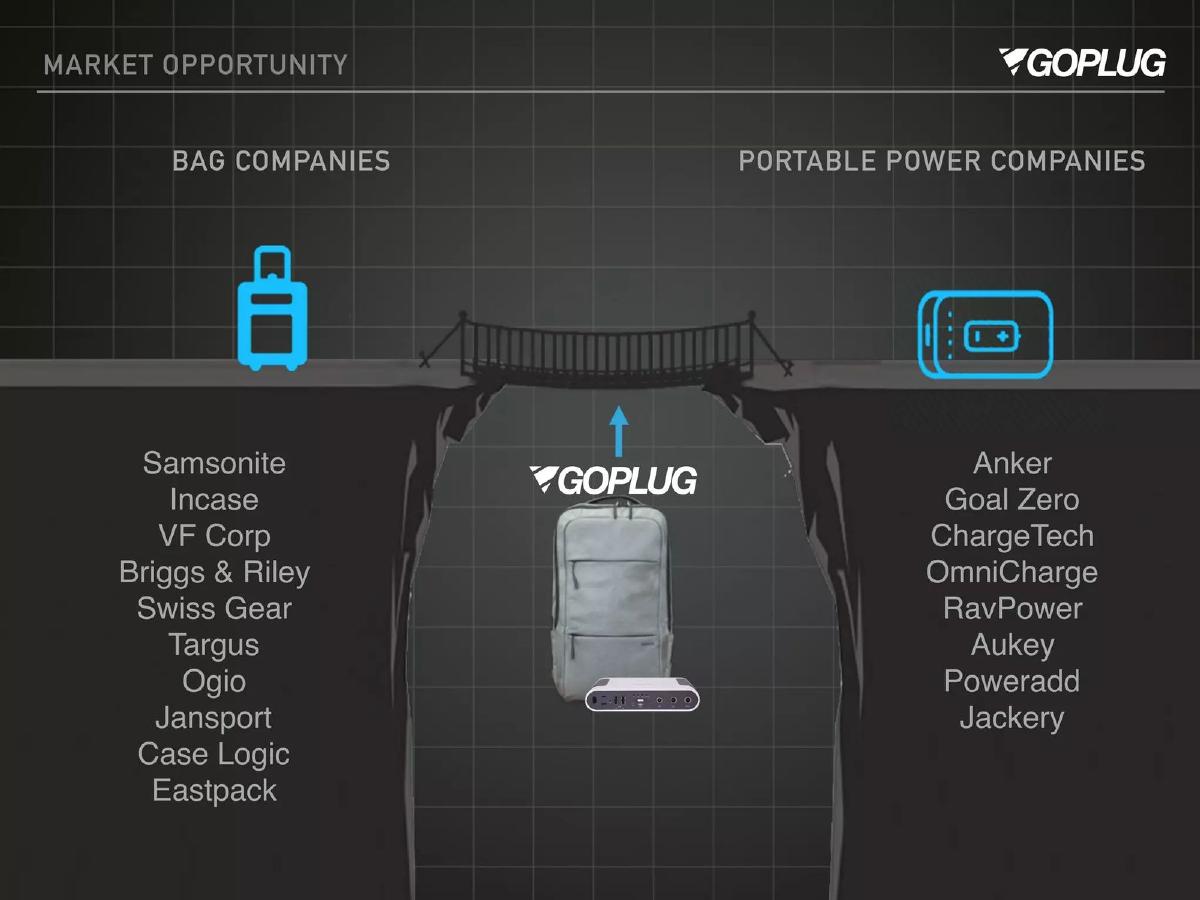
- The company identifies a market gap between traditional bag companies like Samsonite and power companies like Anker (Slide 3).
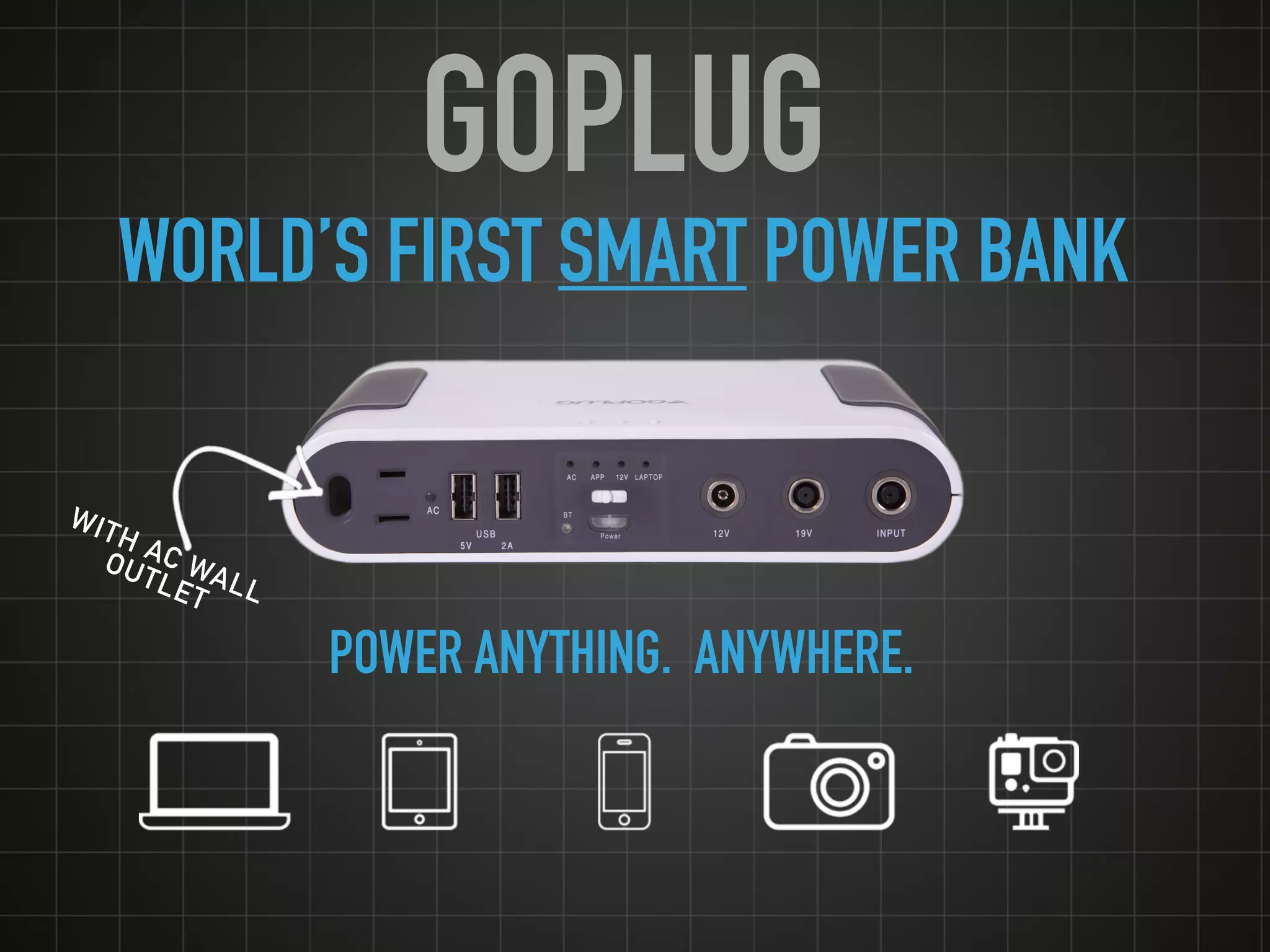
- GoPlug claims to be the 'World’s First Smart Power Bank' featuring an integrated AC wall outlet (Slide 1).
- Market data forecasts the global backpacks and luggage market to exceed $67 billion by 2020 (Slide 4).
- The product includes unique 'smart' features such as GPS tracking, movement alarms, and a proximity sensor (Slide 5).
- Intellectual property is a core defense, with three issued patents and three pending patents cited (Slide 8).
- The deck highlights a trend toward 'embedded technology' in travel goods, citing competitors like Tylt and Gregory (Slide 7).
- The team slide lists board members with backgrounds in venture capital and corporate retail but lacks a dedicated CEO or CTO profile (Slide 10).
- There is a complete absence of financial projections, manufacturing status, or a specific investment ask in the provided slides.
Executive Summary: The Convergence of Power and Portability
GoPlug enters the market with a hardware-centric pitch that attempts to redefine the portable power bank as a 'smart' device. The deck focuses heavily on the evolution of consumer behavior—specifically the transition from carrying a single mobile phone to a suite of power-hungry devices including laptops and cameras. By positioning itself at the intersection of the luggage industry and the electronics industry, GoPlug seeks to capture value in a growing $67 billion market. However, the deck relies more on feature lists and market macro-trends than on business model specifics or operational traction.
Slide 1: Title and Value Proposition
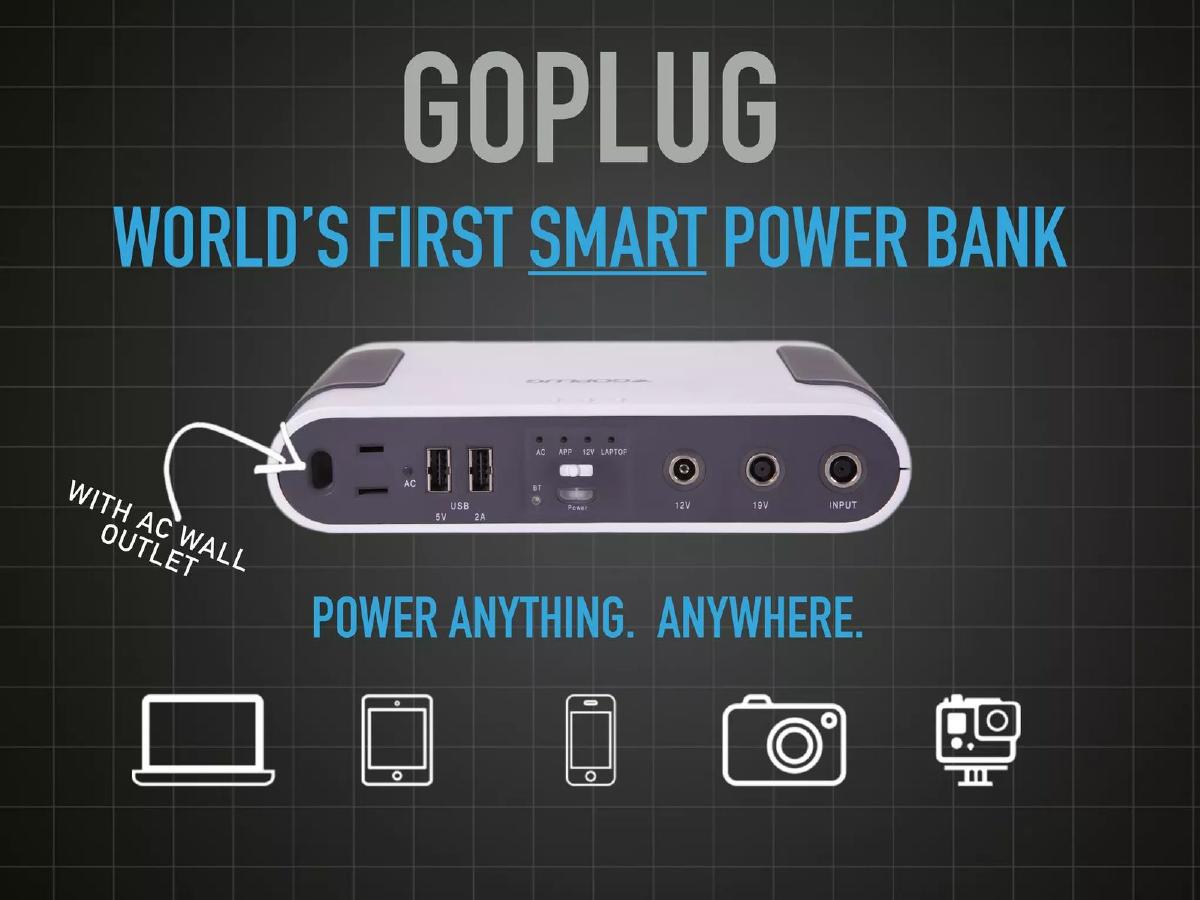
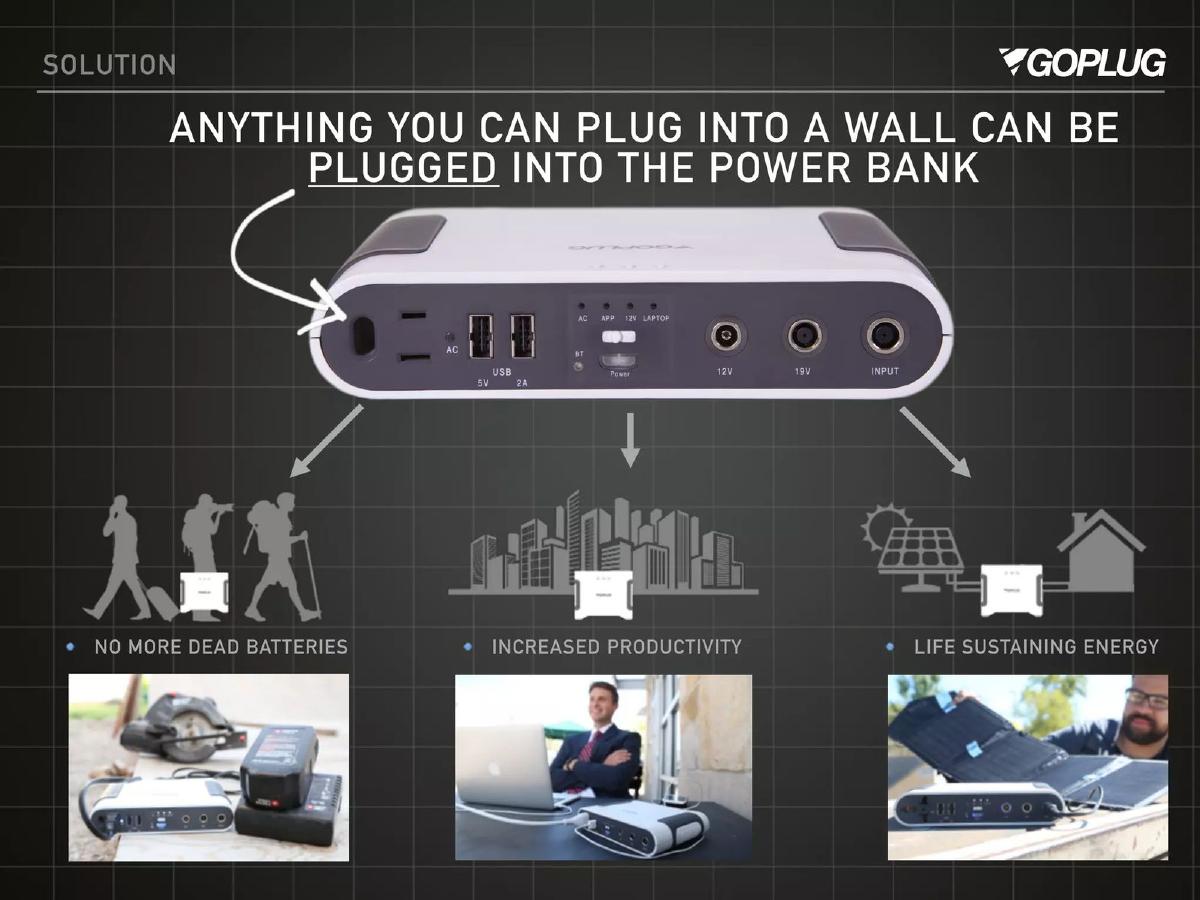
The cover slide introduces GoPlug as the "World's First Smart Power Bank." It immediately highlights a key hardware differentiator: an integrated AC wall outlet. The imagery shows a device with multiple ports, including USB, 12V, and 19V inputs/outputs. The tagline "Power Anything. Anywhere." combined with icons for laptops, tablets, phones, and cameras, sets a clear expectation that this is a high-capacity, multi-functional tool rather than a simple phone charger.
Slide 2: The Evolution of Market Problems
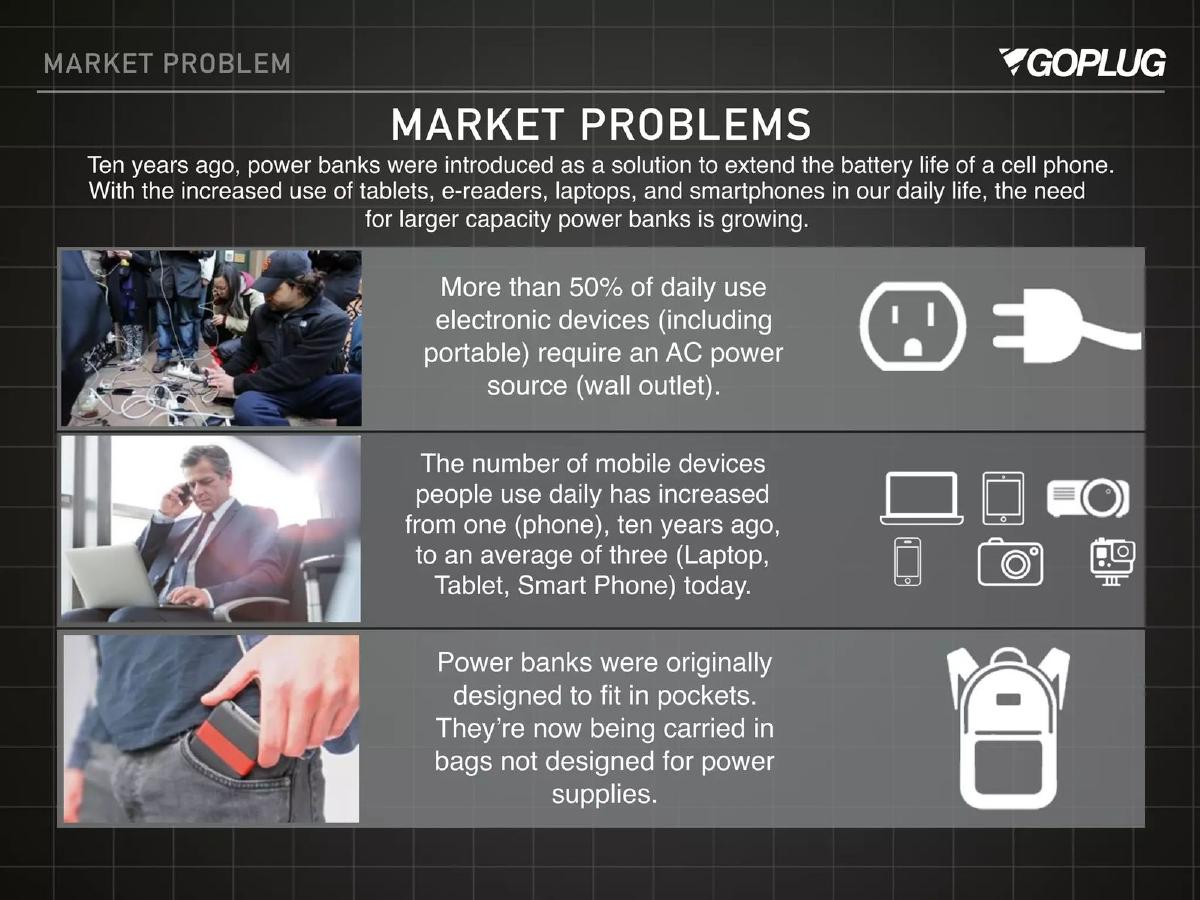
This slide provides the 'Why Now' for the investment. It argues that power banks were originally designed for phones and pockets, but consumer needs have shifted. It cites three specific problems: 1) Over 50% of daily devices require AC power; 2) The average number of mobile devices per person has tripled from one to three in ten years; and 3) Power banks are now carried in bags that aren't designed to accommodate them. This sets the stage for a product that is larger, more powerful, and integrated into luggage.
Slide 3: The Market Opportunity Gap
Slide 3 uses a visual metaphor of a bridge over a canyon. On one side are "Bag Companies" like Samsonite, Tumi, and JanSport. On the other are "Portable Power Companies" like Anker and Jackery. GoPlug positions itself as the bridge between these two sectors. This suggests a dual business model: selling standalone hardware and potentially licensing technology or partnering with luggage manufacturers to create 'smart' bags.
Slide 4: Global Market Projections
To justify the scale of the opportunity, Slide 4 presents a bar chart of the "Global Backpacks and Luggage" market from 2015 to 2020. Citing Global Industry Analysis, Inc., it shows revenue growing from $24 billion to $67 billion. The text notes that this growth is driven by "product design and functionality advancements," which aligns with GoPlug's value proposition of adding technology to traditional goods.
Slide 5: Detailed Competitive Landscape
This is the most data-dense slide in the deck. It compares GoPlug ($299) against seven competitors including GoalZero, OmniCharge, and Anker. While many competitors share basic features like USB ports and 110V AC power, GoPlug claims a monopoly on a specific set of "Competitive Advantages" listed at the bottom: External Docking, Mounting Brackets, Bluetooth, GPS Tracking, Alert Notifications, Programmable features, Movement Alarms, and Proximity Sensors. This slide is intended to prove that GoPlug is the only truly 'smart' option in a sea of 'dumb' batteries.
Slide 6: Market Share Distribution
Slide 6 breaks down the 2016 luggage market share. It notes that "Others" account for 81% of the $27 billion revenue, with Samsonite holding 9.6%. A key detail included here is the acquisition of Tumi by Samsonite for $1.8 billion in February 2016. This serves as a signal to investors regarding potential exit opportunities via acquisition by major luggage conglomerates.
Slide 7: Industry Trends and Validation
Citing Reportlinker.com and Travel Goods Magazine, this slide validates the trend of embedding technology into backpacks. It mentions specific competitors like Tylt (Energi+ bag) and Gregory Mountain Products (solar panels). By showing that other brands are moving in this direction, GoPlug validates the category while implying that their specific power bank technology is the superior engine for these types of products.
Slide 8: Competitive Advantages and IP
This slide summarizes the product's strengths. It uses bold descriptors: POWERFUL (multiple voltage options), SMART (app-enabled), MODULAR (removable), and BLEEDING EDGE . Crucially, it mentions "Intellectual Property: Three issued Patents / Three Pending Patents." For a hardware startup, this is a vital piece of information that protects the company from being easily commoditized by larger manufacturers.
Slide 9: Conclusion and Brand Positioning
The conclusion slide reinforces the message: "This is not just a commodity." It repeats the core imagery of the device and the "Power Anything. Anywhere." slogan. It serves as a final branding beat to ensure the investor remembers the product's physical form and its primary utility.
Slide 10: The Board and Leadership
The final slide in this set lists the board members and partners. Ben Eyre (Chairman) has a background in corporate retail and education. Derrin Hill is a CEO of a foundation with an MBA from Duke. Chris Eyre is the most notable name for VCs, described as a pioneering venture capitalist and founding partner of MPAE, whose partners went on to form Benchmark Capital. Dave Southwick serves as CFO. While the board has significant pedigree, the slide is notably missing a traditional 'Founding Team' section that highlights the engineers or product designers who built the hardware.
What GoPlug Does Well
The deck is highly effective at identifying a specific, relatable pain point: the frustration of having multiple devices and no way to charge them away from a wall outlet. By focusing on the AC outlet as a primary feature, they immediately distance themselves from the thousands of cheap USB power banks on the market. The use of market data from Frost & Sullivan and GIA provides a professional veneer and suggests the founders have done their homework on the broader luggage industry. The competitive matrix is also a strong inclusion, as it anticipates the 'Why not Anker?' question by listing specific smart features that Anker does not offer.
What is Missing from the Deck
Despite the strong market context, the deck has several critical omissions that would make a professional investor hesitant:
Unit Economics: There is no mention of the Cost of Goods Sold (COGS). For a $299 retail product, investors need to know the margin. · Traction: The deck does not state if the product is currently shipping, in prototype phase, or how many pre-orders have been secured. · Manufacturing and Supply Chain: Hardware is notoriously difficult to scale. The deck lacks information on manufacturing partners or logistics. · The Ask: There is no slide detailing how much money is being raised, the valuation, or how the funds will be allocated (e.g., R&D vs. Marketing). · Operational Team: While the board is impressive, the lack of a clear CEO, CTO, or Head of Product suggests the company may be top-heavy with advisors rather than builders.
Founder's Guide: What to Copy and What to Avoid
Copy the 'Bridge' Strategy: If you are building a product that sits between two established industries, use a visual like Slide 3 to show exactly where you fit. It helps investors categorize your business and understand your potential acquisition path. Also, copy the use of specific competitor acquisition data (like the Tumi/Samsonite mention on Slide 6) to show that your sector has a history of high-value exits.
Avoid the 'Advisor-Only' Team Slide: Investors fund teams, not just boards. If your team slide only features people with 'Partner' or 'Board Member' titles, it signals that the people actually doing the work might not be equity-aligned or high-level enough to lead the company. Ensure your core executors are front and center. Additionally, never leave out the 'Ask' slide. A pitch deck without a request for capital is just a brochure.
Final Assessment
GoPlug presents a compelling case for a 'Smart' hardware category in the travel space. The product features are well-aligned with modern traveler needs, and the IP protection mentioned provides a necessary moat. However, the deck feels more like a strategic overview than a fundraising document. To secure investment, the company would need to supplement these slides with a rigorous financial model, a clear manufacturing roadmap, and a dedicated operational leadership team.
Frequently asked questions
- What is the primary problem GoPlug is trying to solve?
- GoPlug addresses the increasing power demands of modern travelers who now carry an average of three devices (laptop, tablet, smartphone) compared to just one a decade ago. Slide 2 notes that over 50% of daily-use electronics require an AC power source, which standard USB power banks cannot provide. They also highlight that power banks have outgrown pockets and are now carried in bags not designed for them.
- How does GoPlug differentiate itself from competitors like Anker or Goal Zero?
- According to the competitive landscape on Slide 5, GoPlug differentiates through 'Smart' features. While competitors offer USB and sometimes AC power, GoPlug claims exclusivity on external docking, mounting brackets, Bluetooth connectivity, GPS tracking, alert notifications, movement alarms, and proximity sensors. It positions itself at a $299 price point, which is mid-range compared to Goal Zero ($349) but higher than mass-market brands like Anker ($149).
- What is the 'Bridge' strategy mentioned in the deck?
- Slide 3 uses a bridge metaphor to show GoPlug occupying the space between 'Bag Companies' (Samsonite, JanSport, Case Logic) and 'Portable Power Companies' (Anker, Jackery, RavPower). The implication is that GoPlug is not just a battery manufacturer, but a technology integrator that can partner with or disrupt the luggage industry by embedding power solutions directly into carry-goods.
- What intellectual property does the company hold?
- Slide 8 explicitly states that GoPlug has three issued patents and three pending patents. This is a critical slide for a hardware startup, as it suggests a level of defensibility against larger consumer electronics manufacturers who might attempt to replicate the 'smart' features of the power bank.
- Who is leading the company according to the deck?
- The 'Board' slide (Slide 10) lists Ben Eyre as Chairman, Derrin Hill and Chris Eyre as Board Members/Partners, and Dave Southwick as CFO. Notably, Chris Eyre is highlighted for his background as a founding partner of Merrill Pickard Anderson & Eyre, a firm that preceded Benchmark Capital. However, the deck does not clearly identify a full-time founder/CEO or a technical lead responsible for the hardware engineering.