GoStudent presents a compelling case for the institutionalization of the private tutoring market. Founded in 2016, the company evolved from a WhatsApp-based service into a sophisticated platform offering 1:1 video-based tuition. The deck highlights a significant market opportunity, noting that the EU spends over EUR 850 billion on education, with more than 20% coming from private households (Slide 3). Their strategy centers on a membership model (6/12/24 months) and a proprietary technology stack that includes AI-powered matching and facial expression analysis to track student engagement (Sli…
Key takeaways
- The company identifies a massive addressable market in Europe, valued at USD 32bn in 2021 and projected to reach USD 49bn by 2027 (Slide 14).
- GoStudent utilizes a sustainable membership model with packages ranging from 6 to 24 months to ensure recurring revenue (Slide 8).
- A core technical differentiator is their AI-emotions tracking, which analyzes 32 facial expressions to measure student engagement and satisfaction (Slide 12).
- The platform has achieved significant scale, boasting over 50,000 tutor-student matches and a selective ~5% tutor pass-rate (Slide 10).
- The business model evolved from a free WhatsApp chat to a paid 1:1 model after realizing students would not pay for group chat services (Slide 7).
- GoStudent emphasizes operational excellence through an in-house tele-sales force to build trust in the education sector (Slide 16).
- The leadership team is highly experienced, featuring VPs with 15-20+ years of experience in sales, product, and marketing (Slide 18).
- The deck lists high-profile investor partners including Coatue, Left Lane, DN Capital, and Speedinvest (Slide 19).
GoStudent Pitch Deck Teardown
GoStudent is a Vienna-based EdTech company that has rapidly scaled to become a dominant player in the European online tutoring space. This 19-slide deck serves as a masterclass in presenting a transition from a simple MVP to a complex, AI-driven global platform. It focuses heavily on market fragmentation, technological moats, and the shift from offline to online education.
The Vision and the Problem
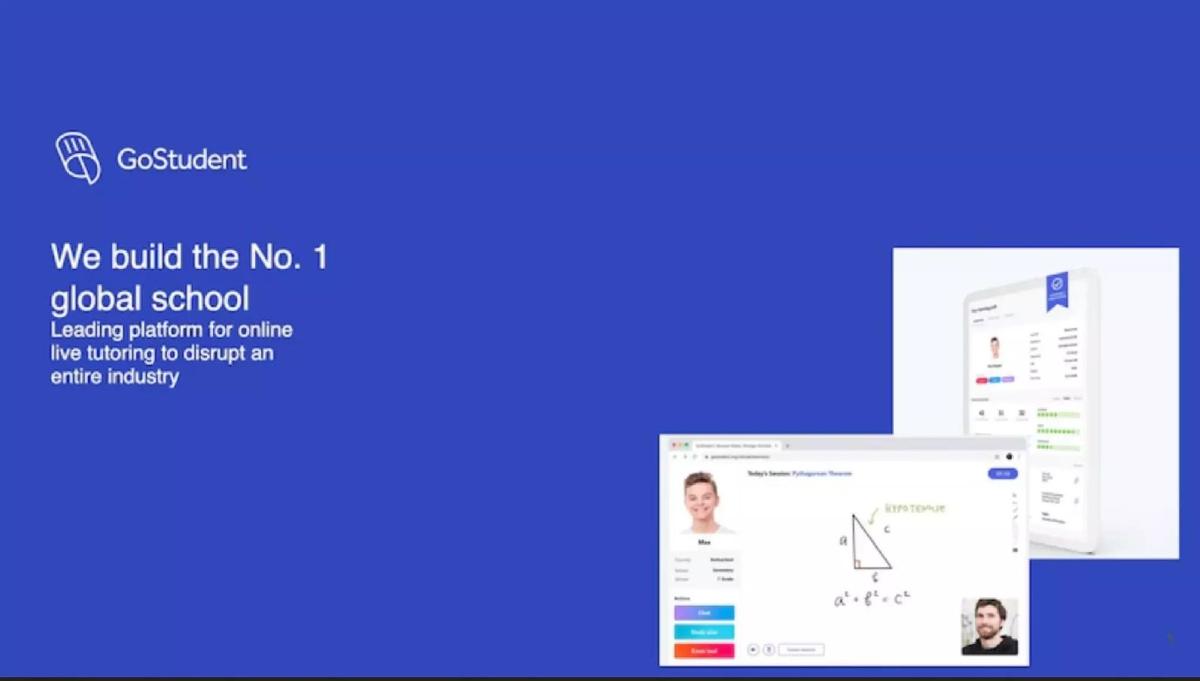
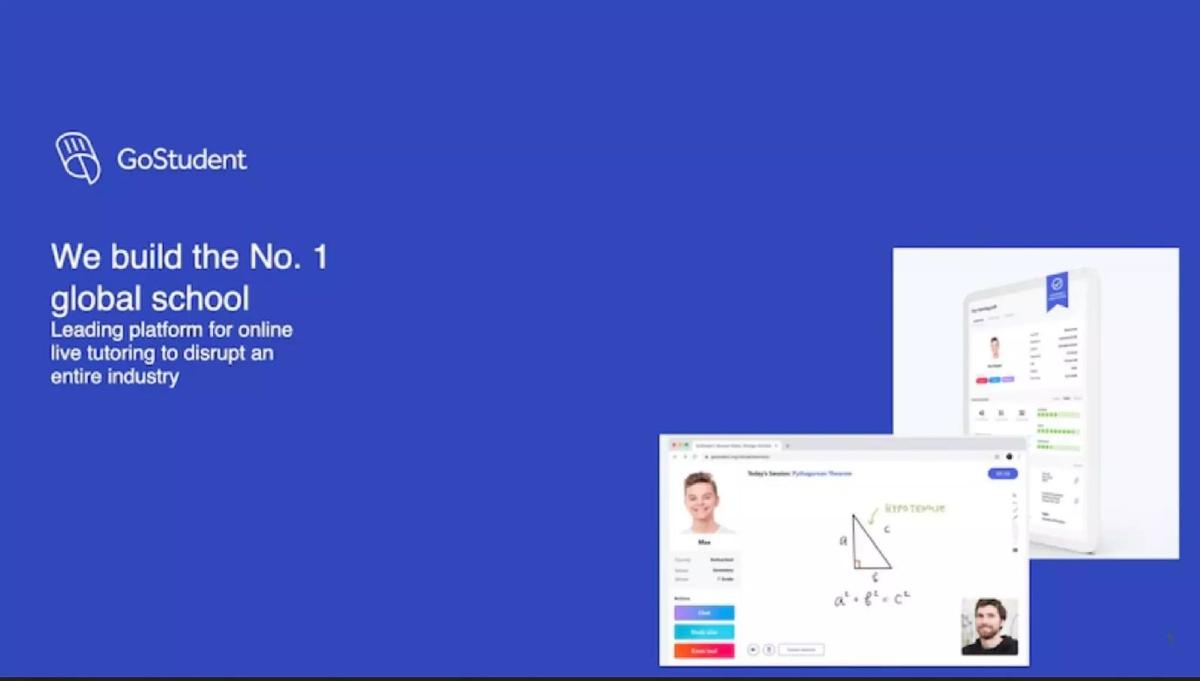
Slide 1: Title Slide The deck opens with a bold claim: "We build the No. 1 global school." It positions GoStudent as a leading platform for online live tutoring designed to disrupt an entire industry. The visual includes a clean interface of their virtual classroom, showing a tutor and student interacting over a digital whiteboard.
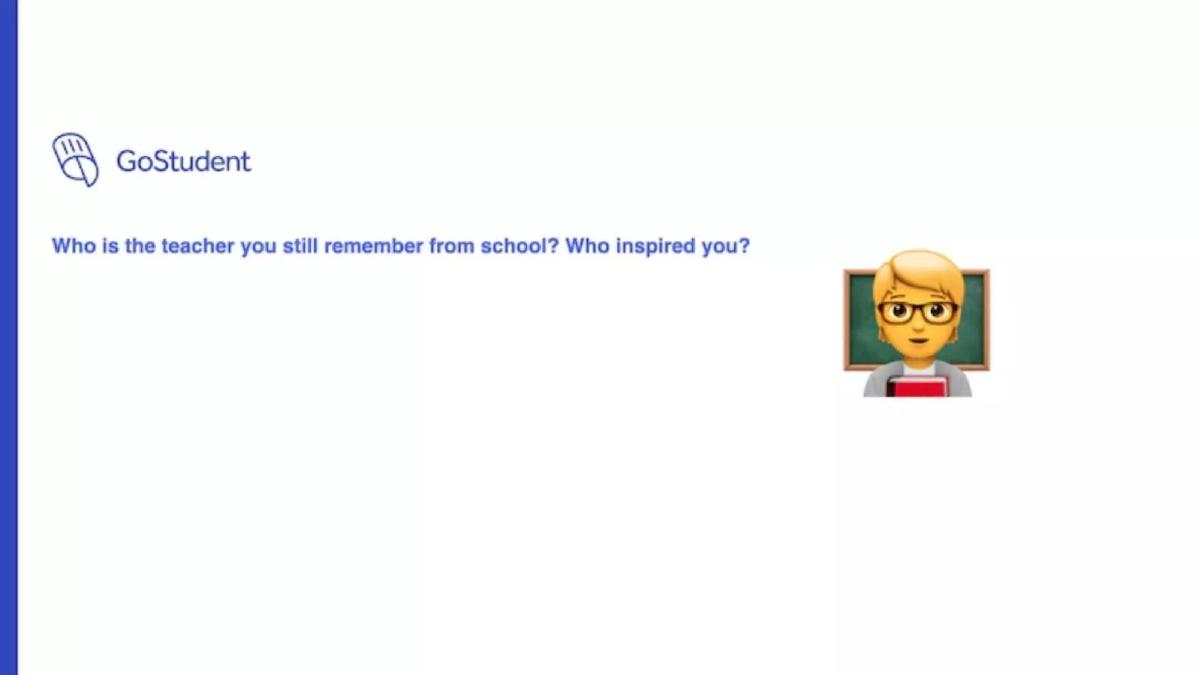
Slide 2: The Hook This slide asks a rhetorical question: "Who is the teacher you still remember from school? Who inspired you?" It uses a simple emoji-style graphic to humanize the mission before diving into hard data.
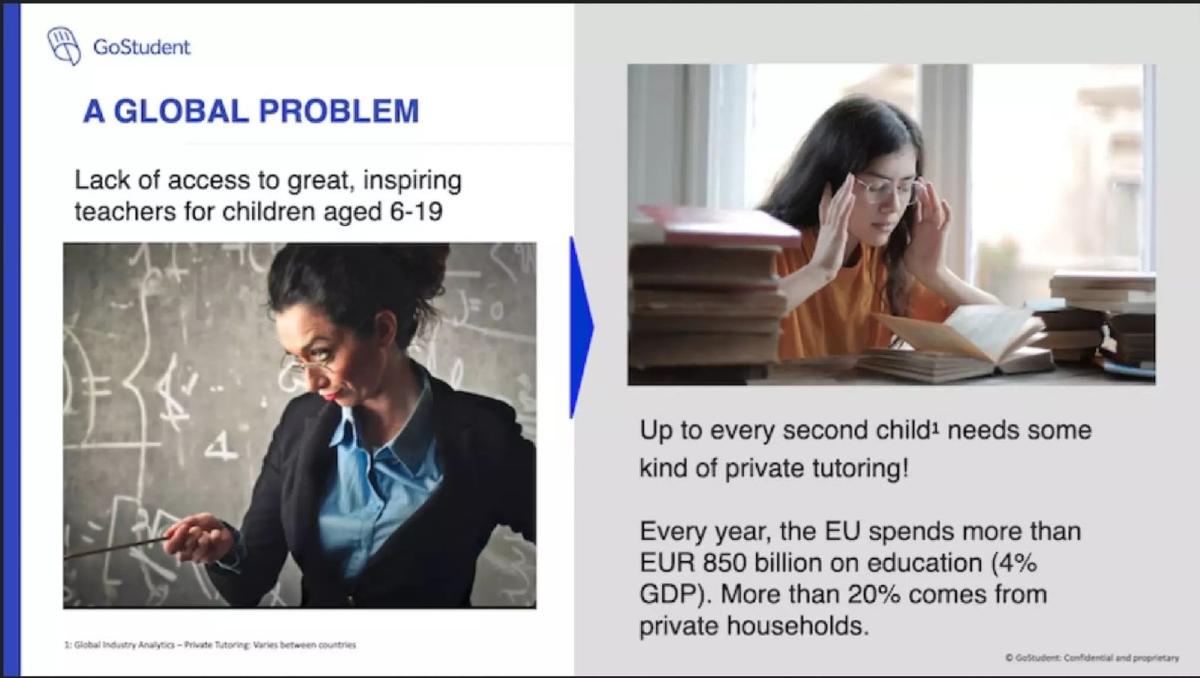
Slide 3: A Global Problem The problem is defined as a "Lack of access to great, inspiring teachers for children aged 6-19." Key statistics are provided: up to every second child needs private tutoring, and the EU spends over EUR 850 billion on education annually, with more than 20% coming from private households. This establishes the massive financial scale of the sector.
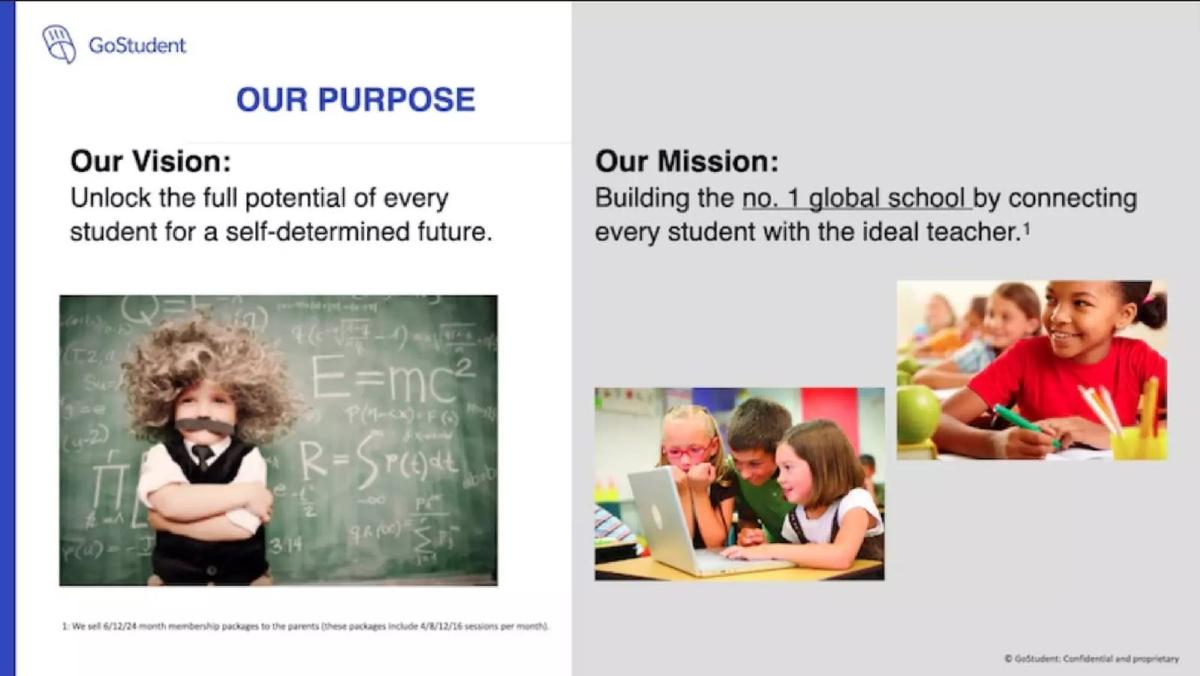
Slide 4: Our Purpose The vision is to "Unlock the full potential of every student," while the mission is "Building the no. 1 global school by connecting every student with the ideal teacher." A footnote mentions their membership packages (6/12/24 months), which is the first hint at their business model.
The Product and Infrastructure
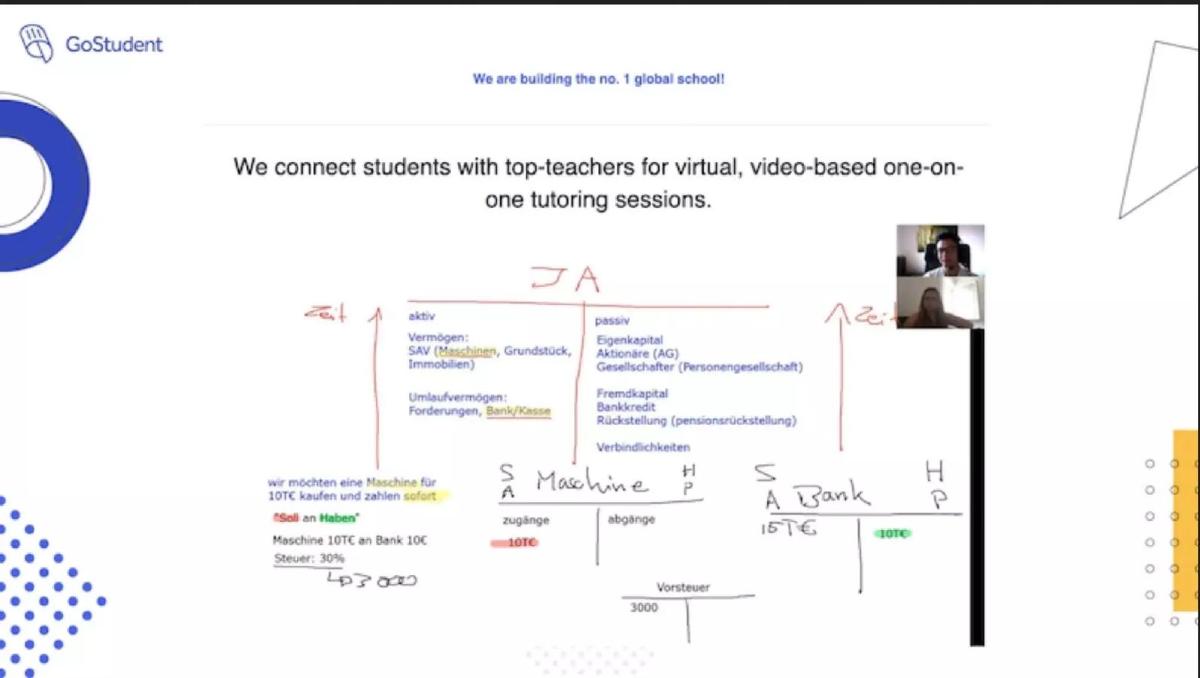
Slide 5: Virtual One-on-One Sessions This slide shows a real-world example of a tutoring session in progress. The screen capture displays a tutor explaining accounting principles (German text: "Vermögen," "Eigenkapital") on a digital whiteboard. It emphasizes the 1:1, video-based nature of the service.
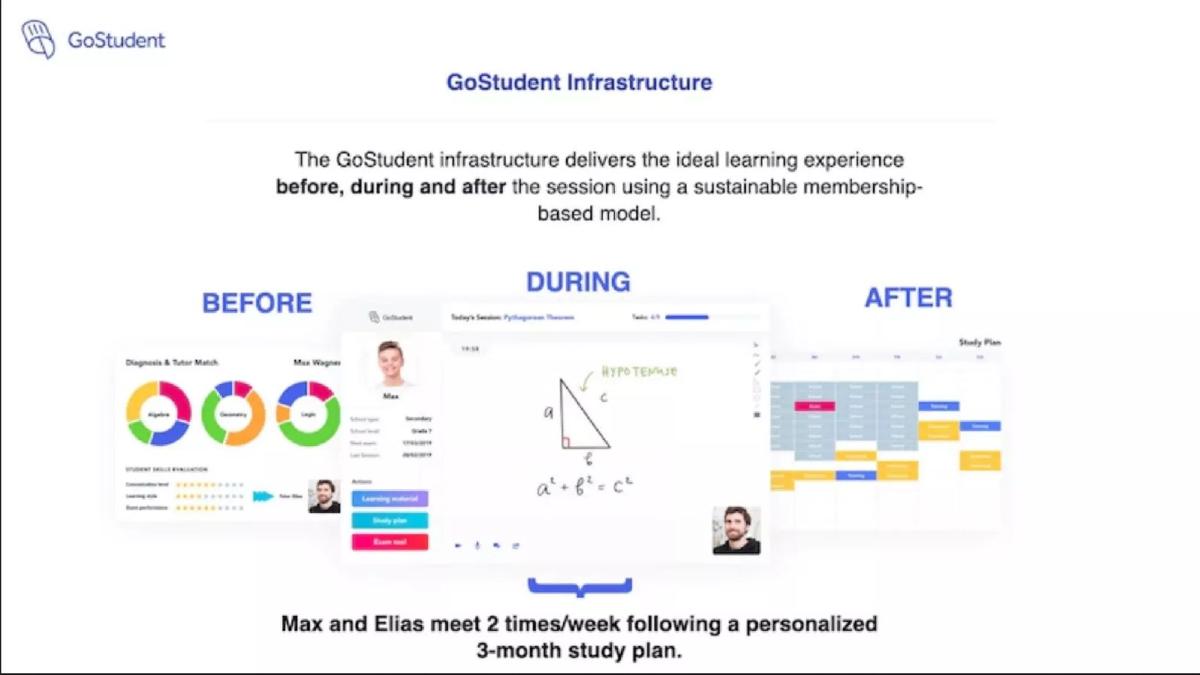
Slide 6: GoStudent Infrastructure The infrastructure is broken down into three phases: Before, During, and After the session. "Before" includes diagnosis and tutor match; "During" is the live session with a study plan; "After" involves progress tracking. It highlights that students typically meet twice a week following a personalized 3-month study plan.
The Journey and Business Model
Slide 7: Idea Generation to Business Model (Part 1) This timeline tracks the company's evolution. It started with a WhatsApp homework chat inspired by the founder's younger brother. They experienced a "chat explosion" but realized students wouldn't pay for it. This led to the development of their own app and a shift in the target audience to parents, which enabled the 1:1 paid tutoring model.
Slide 8: Idea Generation to Business Model (Part 2) The timeline continues, showing the launch of membership models (6 to 24 months), team growth from 40 to over 160 employees, and rapid international expansion into France, Spain, the UK, Italy, and eventually Mexico, Canada, and Russia.
Slide 9: Our Investment Thesis A summary slide titled "7x WHY?" lists their core strengths: compelling value proposition, scalable platform, attractive unit economics, large TAM, market leadership in Europe, being at a tipping point, and an experienced team.
Value Proposition and Technology
Slide 10: Our Customer Value Proposition GoStudent claims higher quality (~5% tutor pass-rate), more convenience (collaborative workspace), and affordable pricing. They cite over 50,000 tutor-student matches and a Trustpilot score of 4.7 based on 1,114 reviews.
Slide 11: The Tutor Community This slide focuses on the supply side of the marketplace. Tutors are primarily students (~50% math, ~30% languages). Testimonials from tutors in Germany and France emphasize supplemental income and flexibility. The slide notes that GoStudent builds loyalty through on-time payment and a strong platform experience.
Slide 12: AI-Technologies This is a key technical slide. It details three AI applications: 1) A matching algorithm using 25+ attributes. 2) A personalized interaction layer. 3) AI-emotions tracking. The latter uses an algorithm to analyze 32 facial expressions to track attention, engagement, and satisfaction scores. This represents a significant technological moat compared to traditional tutoring.
Market Opportunity and Competition
Slide 13: Market Size The European private tutoring market is valued at USD 32bn in 2021, which they note is comparable to the market in China (USD 34bn). They aim to cover 90% of the addressable market in the EU by entering 15+ countries by the end of 2021.
Slide 14: The Shift to Online This slide argues that the shift to online is "inevitable." In 2021, the market was 47.1% online/blended; by 2027, they project it will be 64.4% online. They note that COVID accelerated this trend and that the market remains extremely fragmented, with local players holding less than 1% share.
Slide 15: Competitive Landscape A comparison matrix pits GoStudent against legacy centers (Studienkreis), marketplaces (Superprof), and the shadow market. GoStudent claims to be the only one offering high-quality tutors regardless of location, personalized live instruction, and customer support at an affordable price point (indicated by a solid black circle vs. empty or partial circles for others).
Strategy and Team
Slide 16: Secret Sauce The "secret sauce" is identified as four pillars: Operational excellence (scalable processes), a trust-building sales engine (in-house tele-sales), data (AI-based matching), and an internationalization playbook.
Slide 17: Strategic Roadmap 2021 The roadmap focuses on international expansion, strengthening the core DACH market, building a trusted brand, and hiring fast (targeting 5-6x FTE growth in 2021).
Slide 18: The Team The team slide features the founders and six key executives. Notable experience includes BCG, Google, HelloFresh, McKinsey, and Citi. Several VPs are noted to have 15-20+ years of experience in their respective fields.
Slide 19: Advisory Board and Investors The final slide lists an impressive array of advisors, including the former CEO of Udemy and the founders of HelloFresh and BlaBlaCar. Investor partners include Coatue, Left Lane, DN Capital, and Speedinvest.
What Works
The Evolution Narrative: The deck clearly explains how the company pivoted from a free chat to a paid model, demonstrating founder adaptability and market responsiveness (Slide 7). · Technological Moat: The inclusion of AI-emotions tracking (Slide 12) elevates the platform from a simple video conferencing tool to a sophisticated educational data company. · Market Fragmentation: By highlighting that no competitor has more than 1% market share (Slide 14), GoStudent makes a compelling case for the "land grab" opportunity in Europe. · Recurring Revenue: The explicit mention of 6-24 month membership packages (Slide 8) addresses the common investor concern regarding high churn in tutoring.
What is Missing
Unit Economics: While Slide 9 claims "very attractive unit economics," the deck does not provide specific figures for Customer Acquisition Cost (CAC) or Lifetime Value (LTV). · Financial Performance: There are no slides showing historical revenue growth, GMV figures, or burn rate. The roadmap mentions growth in GMV but lacks a baseline. · The "Ask": The deck does not state how much capital is being raised or how it will be specifically allocated beyond general "international expansion." · Tutor Retention: While they mention tutor motivations (Slide 11), they do not provide data on tutor churn or the average tenure of a tutor on the platform.
What a Founder Should Copy
The "7x Why" Slide: Slide 9 is an excellent way to summarize the investment thesis in a single, high-impact view. It tells the investor exactly what to look for in the subsequent slides. · Visualizing the User Journey: Slide 6 effectively uses a "Before, During, After" framework to explain a service-based product, making it easy to understand the full user experience. · Comparative Market Sizing: Comparing the European market to the Chinese market (Slide 13) provides a helpful benchmark for investors who may be more familiar with the highly developed EdTech landscape in Asia. · Strategic Use of Footnotes: GoStudent uses footnotes to provide technical details (like membership lengths or data sources) without cluttering the main slide design.
Frequently asked questions
- What is GoStudent's primary business model?
- GoStudent operates on a membership-based model, selling 6, 12, or 24-month packages to parents. These packages typically include 4, 8, 12, or 16 sessions per month. This approach, as detailed on Slide 4 and Slide 8, moves away from one-off transactions toward a more sustainable and predictable recurring revenue stream.
- How does GoStudent use AI in its tutoring platform?
- According to Slide 12, GoStudent uses AI in three main ways: an AI-powered matching algorithm that considers over 25 attributes to pair students and tutors, a personalized interaction layer within the study portal, and AI-emotions tracking. The latter analyzes 32 facial expressions to provide a satisfaction score and identify training needs for tutors.
- What is the size of the market GoStudent is targeting?
- GoStudent targets the European private tutoring market, which they valued at USD 32 billion in 2021. They project this market will grow at a CAGR of 8% to reach USD 49 billion by 2027. Slide 13 notes that the European market size is comparable to the total tutoring market in China.
- Who are the key competitors identified in the deck?
- Slide 15 identifies three categories of competitors: legacy offline learning centers (Studienkreis, Acadomia), traditional marketplaces (Superprof, CleverMate), and the 'shadow market' (informal tutoring). GoStudent differentiates itself by offering high-quality tutors regardless of location and personalized live instruction at a relatively affordable price point.
- What is the background of the founding team?
- The company was founded by Felix Ohswald (CEO) and Gregor Müller (COO). Felix has a background with BCG and the University of Cambridge, while Gregor attended the University of St. Gallen. They are supported by a broader executive team with deep experience at companies like Google, HelloFresh, and McKinsey (Slide 18).