Key Insight Slide in a Pitch Deck: How to State What You
Investors ask what a founder understands that others don't. Five real slides, from a sourced data insight to a "secret sauce" list of strengths.
Key Insight Slide: State What You Know That Others Miss, and Show Why It Is True
Investors often ask a founder some version of one question: what do you understand about this market that other people don't? Some decks answer it on a slide titled "insight", "earned secret" or "secret sauce"; most leave it implied somewhere between the problem and the solution. The question is easy to answer badly. An insight that everyone already agrees with is not an insight, and a list of company strengths is an answer to a different question. This guide uses five slides from five startup decks to show what a useful insight looks like, where it can sit in a deck, and the common ways it turns into something else.
TL;DR
State one specific, checkable belief that most people in your market would not assume, show the evidence for it, and make clear how your product follows from it. Inato does this best: "Our unique insight: Only 5% of healthcare sites run 70% of trials", with a chart of trials per site and a named source, which explains why it builds for the roughly 90,000 "community sites" that are left out. Goodword gives each founder an "Earned Secret" on the team slide, tying the belief to experience. PlusPlus puts its insight in one line of its back story: it "was born out of Twitter University with the insight that technical teams were underserved and siloed". Spill's "The Insight" describes something everyone already knows, that people comment on social media. GoStudent's "secret sauce" is a list of four strengths, not a belief about the market.
Five insight slides, read in full
Each example shows how the slide states the insight, what it gets right and what to change. Quotes are taken from the slide images at full size.
Inato deck, slide 4. Exact stored slide matched to this analysis.
Our analysis: A specific, sourced, non-obvious belief.
Evidence and limitation: Public registry named as source; data cut and date not given.
What a founder can adapt: Mark the headline numbers on the chart and date the data.
Supporting analysis
What the deck claims: "Our unique insight: Only 5% of healthcare sites run 70% of trials"; chart of trials per site across ~90,000 sites; "The same academic hospitals run the majority of trials"; "Source: Clinical Trials Gov".
Presentation choice: The product follows from the insight without being stated.
When it does not fit: A source with no time period or scope.
Professional networking product. Team slide with an "Earned Secret" per founder.
Goodword deck, slide 7. Exact stored slide matched to this analysis.
Our analysis: Ties the belief to the experience that earned it.
Evidence and limitation: Founder experience self-reported.
What a founder can adapt: Keep one real insight; drop general principles.
Supporting analysis
What the deck claims: CEO: "A high willingness to pay for a powerful network is thwarted by the pain and friction of activating it." beside "Scaled Chief to 20K members and $120M+ in ARR in four years." CTO: "The most powerful technology is the one that allows customers to do something they couldn't do before."
Presentation choice: Answers how the founder knows.
When it does not fit: Giving every founder a secret to fill the format.
Onboarding and knowledge tools for technical teams. Slide titled "About us".
PlusPlus deck, slide 2. Exact stored slide matched to this analysis.
Our analysis: A light-touch insight placed in the origin story.
Evidence and limitation: Origin stated; no evidence for the insight.
What a founder can adapt: Add one figure from what the team saw inside.
Supporting analysis
What the deck claims: "PlusPlus was born out of Twitter University with the insight that technical teams were underserved and siloed."; investors "behind Airtable, BetterUp, Carta, Clubhouse, Intercom and many others".
Presentation choice: The origin gives the belief credibility.
When it does not fit: An insight that only restates the problem.
Comment-centred social app. Slide titled "The Insight".
Spill deck, slide 4. Exact stored slide matched to this analysis.
Our analysis: Leads with the obvious; the real insight comes last.
Evidence and limitation: Tweet volume unsourced and undated.
What a founder can adapt: Lead with the non-obvious claim and measure it.
Supporting analysis
What the deck claims: "Social media has unleashed our inherent human desire to communicate - aka gossip"; "More than 500 million Tweets are sent out every single day"; "Often, these exchanges are more informative or entertaining than the original post itself."
Presentation choice: Shows how an insight gets lost behind a premise.
When it does not fit: Spending the slide proving what no one disputes.
Online tutoring platform, later stage. Slide asking "What is our secret sauce".
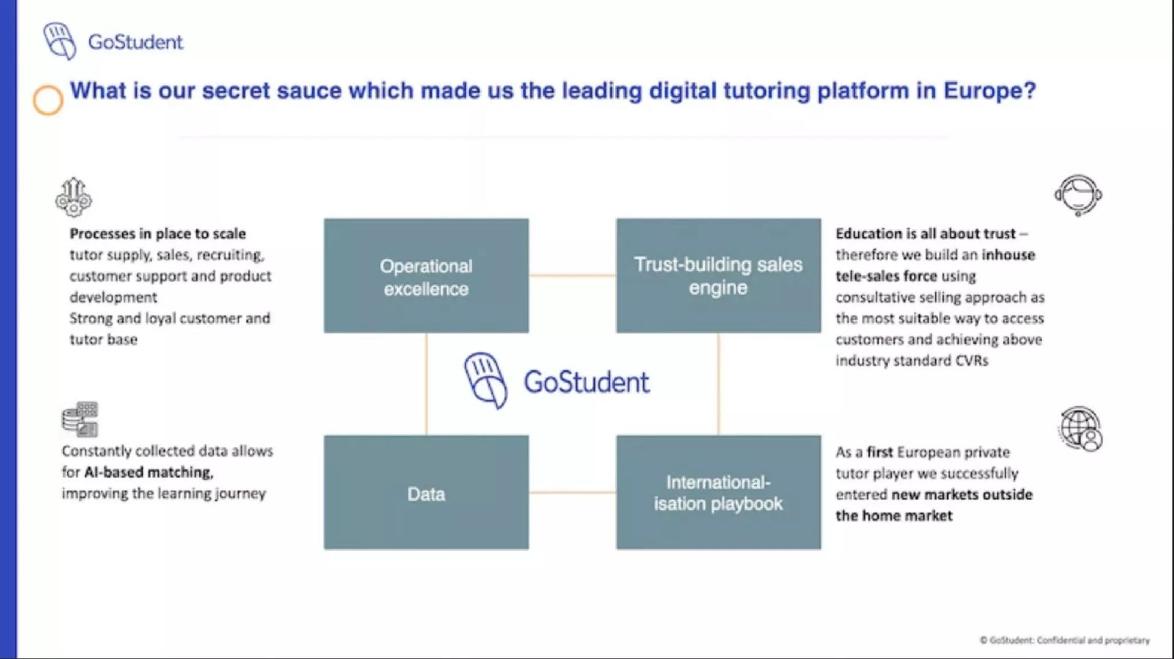
GoStudent deck, slide 16. Exact stored slide matched to this analysis.
Our analysis: A strengths list with one real insight inside it.
Evidence and limitation: Self-reported; conversion and leadership claims have no figures.
What a founder can adapt: Pull out the trust insight and back it with the conversion figure.
Supporting analysis
What the deck claims: Four boxes: "Operational excellence", "Trust-building sales engine", "Data", "Internationalisation playbook"; "Education is all about trust – therefore we build an inhouse tele-sales force ... achieving above industry standard CVRs".
Presentation choice: Shows the difference between strengths and insight.
When it does not fit: Four equal boxes where one belief matters.
Whether the insight is one specific belief, has evidence and connects to the product.
Example
Single specific belief
Evidence shown
Link to product
Inato
Yes
Chart and named source
Implied, clear
Goodword
CEO yes; CTO general
Founder experience
Implied
PlusPlus
Close to the problem
Origin only
Stated
Spill
Last sentence only
Unsourced volume
Not stated
GoStudent
Buried in a list
No figures
Stated for sales only
Key Takeaways
One belief, stated in a sentence.
It should surprise someone in the market.
Show the evidence and its source.
Draw the line from the insight to the product.
Strengths are not an insight.
Write your insight
Answer each prompt before putting an insight in the deck.
Belief. What do you believe about this market that most people in it would not assume?
Test. Would a competitor disagree, or just nod?
Evidence. What figure, source or experience shows it is true?
Origin. How did your team come to see it?
Link. How does the product follow from it?
Copyable framework: Our insight: [specific belief]. [Evidence, with source and date]. That is why we [product choice].
Illustrative example 1 — written by us
Before: Our secret sauce: great team, strong data, customer obsession.
After: Our insight: 80% of small-clinic no-shows happen when the reminder arrives by email, not text (our data, 14,000 appointments, 2025). That is why we built a text-first scheduler.
What improved: Our illustrative rewrite; the figures are invented for the example. It states one checkable belief, gives its evidence and source, and links it to a product choice.
The question this guide answers
Founders ask whether a deck needs an insight slide and what should go on it. The problem guides in this library cover how to describe the pain and size it; the why-now guide covers what has changed in the world to make the company possible; the competition and moat guides cover how the company differs from others and what protects it. None covers the founder's own non-obvious belief: the thing the team understood that led it to build this product rather than another.
The distinction matters because the insight is often the reason an investor believes a small team can beat larger companies. If incumbents saw the market the same way, they would already have built the product. An insight explains why they haven't. Why now explains timing, and a moat explains what keeps competitors out later; the insight explains why you saw the opportunity first.
How we chose and read the examples
We searched the extracted text of the slide library for "insight", "unique insight", "earned secret", "secret sauce", "our secret" and "non-obvious", removed investment funds, public companies, listed-company presentations and slides where "insight" described a product feature (an analytics dashboard, for example), and viewed the remaining candidates. We kept five slides from five startup decks, each showing a different way the insight is stated or confused with something else.
Every slide was rendered from the original deck at full size and read in full before we wrote about it. We quote what is visible on each slide. We have not checked the data behind any insight, and we make no claim that the slide affected any company's fundraising.
An insight backed by data
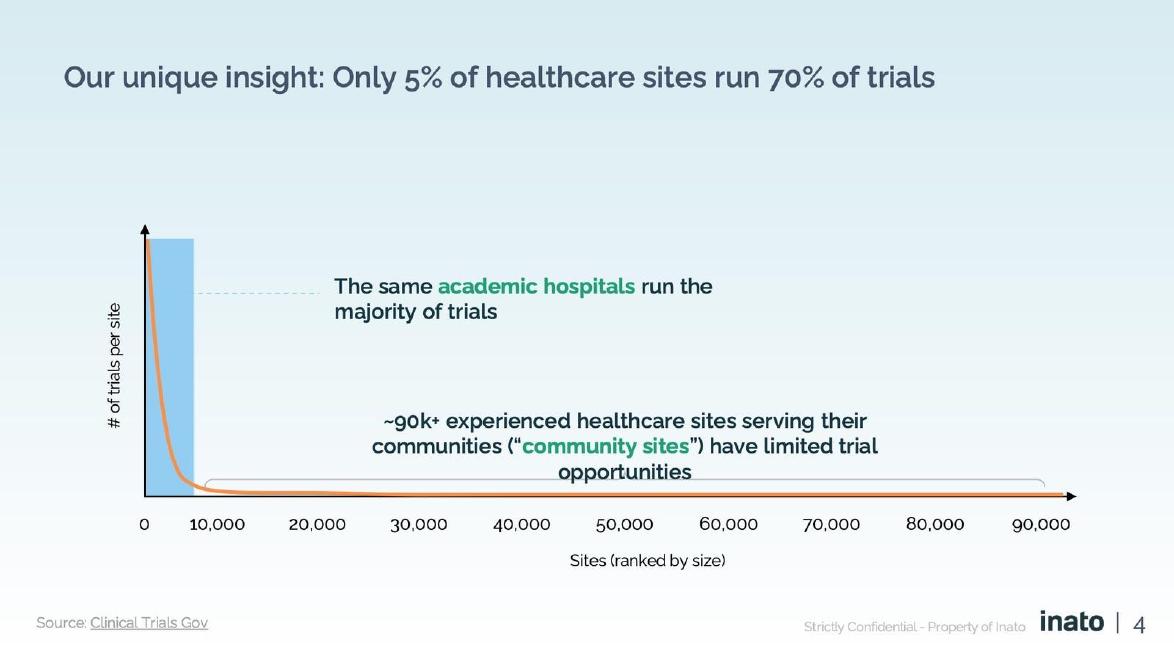
Inato, a company that helps bring clinical trials to more hospitals, titles its fourth slide "Our unique insight: Only 5% of healthcare sites run 70% of trials". A chart plots the number of trials per site against sites ranked by size, from 0 to 90,000. A steep spike at the left is labelled "The same academic hospitals run the majority of trials"; the long flat tail is labelled "~90k+ experienced healthcare sites serving their communities ('community sites') have limited trial opportunities". The footnote reads "Source: Clinical Trials Gov".
This is the strongest example in the set because it does three things in one slide. The insight is a single sentence with two numbers that someone could check. It is non-obvious to an outsider, and arguably to many in the industry, who think of trial capacity as scarce rather than concentrated. And the product follows from it without being stated: if most trials run at a few hospitals, there is unused capacity at the rest, and someone needs to connect it.
Two things would strengthen it. The headline numbers are not marked on the chart itself, so a reader has to trust that the shaded bar is the 5%. And "Clinical Trials Gov" names the registry but not the date or the cut of data used. A footnote such as "ClinicalTrials.gov, trials registered 2015–2020, US sites" would let an investor reproduce it.
An insight earned through experience
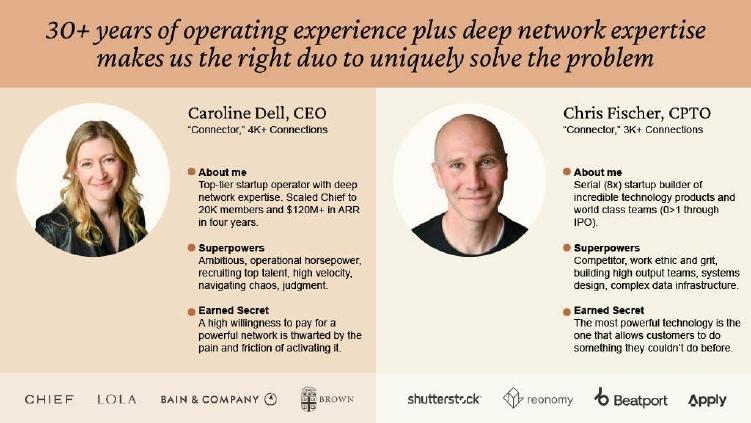
Goodword, a professional networking product, puts its insight on the team slide. The headline reads "30+ years of operating experience plus deep network expertise makes us the right duo to uniquely solve the problem". Each founder has three blocks: "About me", "Superpowers" and "Earned Secret". The CEO's earned secret is "A high willingness to pay for a powerful network is thwarted by the pain and friction of activating it." Her "About me" says she "Scaled Chief to 20K members and $120M+ in ARR in four years." The CTO's earned secret is "The most powerful technology is the one that allows customers to do something they couldn't do before."
The CEO's line is a useful model. It is a belief about customers, it is specific (people will pay for a network but struggle to use it), and it sits right beside the experience that earned it: building a large paid membership network. That pairing answers the follow-up question an investor will ask, which is how the founder knows.
The CTO's line shows the risk of the format. It is a general principle that could apply to any technology company, not a belief about this market. If every founder on a team slide must have an earned secret, some will be filler. One real insight, owned by the person who earned it, is better than two where one is a slogan.
An insight in one line of the story
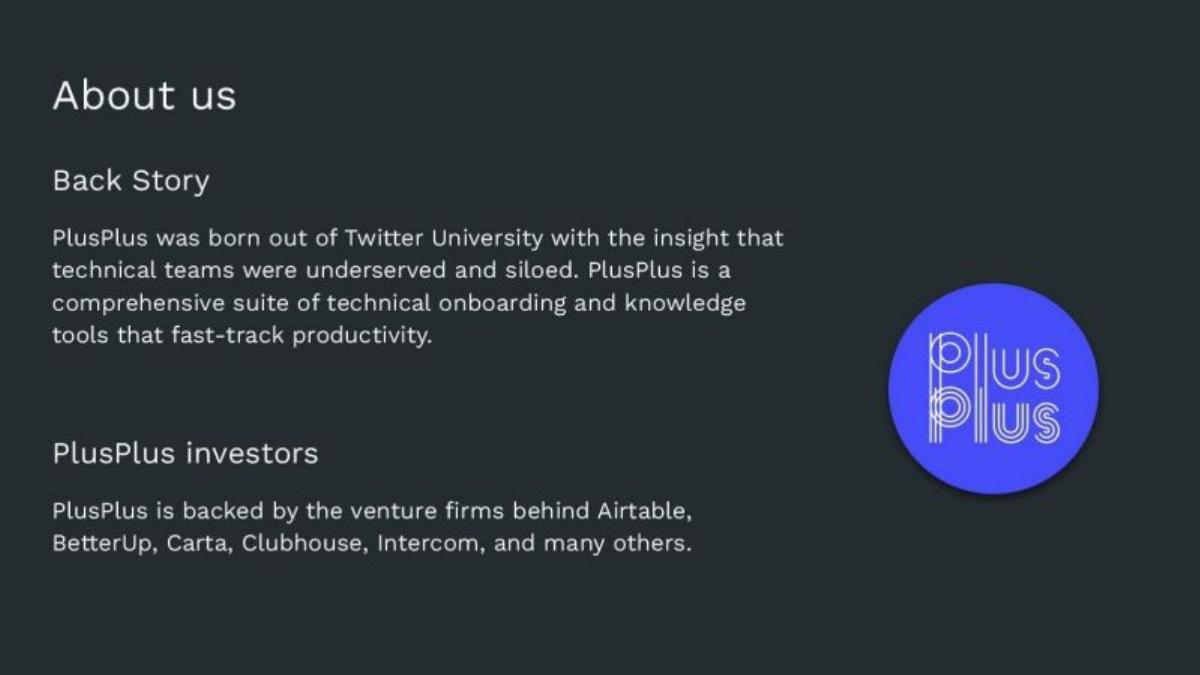
PlusPlus, a set of onboarding and knowledge tools for technical teams, has an "About us" slide with two short sections. Under "Back Story": "PlusPlus was born out of Twitter University with the insight that technical teams were underserved and siloed. PlusPlus is a comprehensive suite of technical onboarding and knowledge tools that fast-track productivity." Under "PlusPlus investors" it says it is backed by the firms behind Airtable, BetterUp, Carta, Clubhouse, Intercom and others.
Not every deck needs a separate insight slide. PlusPlus shows the light-touch version: one sentence placing the insight where it came from, Twitter's internal training programme, with the product named straight after. The origin gives the belief credibility, because the team saw the problem from inside a large engineering organisation.
The weakness is that "underserved and siloed" is close to a description of the problem rather than a surprising belief, and there is no evidence attached. If the team learned something specific at Twitter, for example what share of new engineers' time went to finding information, that figure would turn the sentence into an insight an investor could weigh.
When the insight is something everyone knows
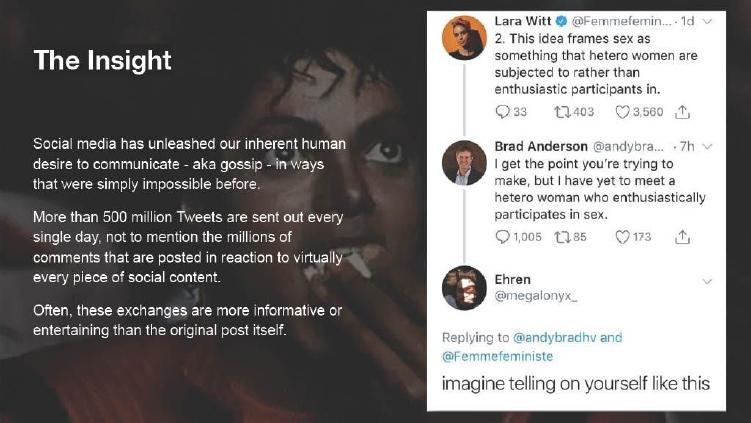
Spill, a social app built around comments, titles its slide "The Insight". Three short paragraphs read: "Social media has unleashed our inherent human desire to communicate - aka gossip - in ways that were simply impossible before.", "More than 500 million Tweets are sent out every single day, not to mention the millions of comments that are posted in reaction to virtually every piece of social content." and "Often, these exchanges are more informative or entertaining than the original post itself." A screenshot of a reply thread fills the right side.
The last sentence is the closest thing to an insight: the conversation under a post can be worth more than the post. It is a fair observation and could support a product. But the slide leads with the general statement that people like to talk online, which no investor would dispute, and the tweet volume has no source or date. The slide spends most of its space proving something obvious.
The fix is to lead with the non-obvious part and support it. "Replies outperform the original post" is a claim that could be measured, for example by comparing engagement on replies and posts in a sample. One figure like that would do more than the total daily tweet count. The example thread should also be chosen with care, since a screenshot sets the tone for the whole slide.
When the insight becomes a list of strengths
GoStudent, an online tutoring platform, asks on its slide "What is our secret sauce which made us the leading digital tutoring platform in Europe?" Four boxes answer: "Operational excellence", "Trust-building sales engine", "Data" and "Internationalisation playbook". Each has a note, for example "Education is all about trust – therefore we build an inhouse tele-sales force using consultative selling approach as the most suitable way to access customers and achieving above industry standard CVRs" and "As a first European private tutor player we successfully entered new markets outside the home market".
This is a later-stage company describing what it does well, which is a legitimate slide. But it answers "why are you winning?" rather than "what do you understand that others don't?" One box contains a real insight: "Education is all about trust", which led the company to build an in-house telephone sales team rather than rely on online sign-ups. That belief is specific and explains a choice competitors might not make. It is buried as one of four equal boxes.
If a strengths slide contains an insight, pull it out and lead with it. "Parents buy tutoring on trust, so we sell by phone" followed by the conversion figure behind "above industry standard CVRs" would be more memorable than the four boxes together. The claim to be "the leading" platform also needs a measure and a source.
How to write your insight
Write the insight as one sentence a smart outsider might disagree with. Test it: if every competitor would nod, it is a premise, not an insight. Attach the evidence, ideally a figure with a source and date, or the experience that taught it to you. Then make the link to your product explicit in the next line or the next slide.
Place it where it fits the story. A data insight can stand on its own slide between the problem and the solution, as Inato's does. A belief learned through work belongs beside the founder who learned it, as on Goodword's team slide. A light version can sit in the company story, as PlusPlus's does. Wherever it goes, keep it to one belief; a deck with five insights has none.
Common mistakes
Stating the obvious. If no one would disagree, it is a premise.
A list of strengths. Strengths answer a different question.
No evidence. Add a sourced figure or the experience behind it.
General principles. An insight is about your market, not about technology in general.
Too many insights. Keep one.
Diagnostic checklist
One belief in one sentence.
Someone in the market might disagree.
Evidence with source and date, or the experience behind it.
Clear link to the product.
Placed where it fits the story.
Frequently asked questions
Is an insight the same as why now?
No. Why now explains what changed to make the company possible today. The insight explains what you understood that others missed.
Does every deck need an insight slide?
No. It can sit in one line of your story or beside a founder on the team slide. It needs to be somewhere, because investors will ask.
Can a later-stage company use a secret sauce slide?
Yes, to explain why it is winning. If one of its points is a real belief about customers, lead with that one and back it with a figure.
How we chose these examples
Corpus: published pitch deck teardowns on StartupFundraising.com. Founder-uploaded private decks are excluded.
Selection (2026-10-01): we searched extracted slide text for insight, earned secret and secret sauce phrases, excluded investment funds, public companies, listed-company presentations and product-feature uses of "insight", and kept five slides from five startup decks that each show a distinct approach.
Review: all five slides were rendered from the source decks at full size on 2026-10-01 and read in full against company, deck and page number (editorial model review, with AI assistance in drafting). No person has yet completed an editorial review of this page. We did not check the data behind any insight.