Inato’s Series A deck focuses on the inefficiency of the $50B clinical trial industry, where 70% of trials are concentrated in just 5% of sites. By positioning themselves as a marketplace rather than a site owner, Inato demonstrates a scalable model for unlocking access to patient populations that are currently underserved. The deck highlights significant traction, including partnerships with one-third of the top 30 global pharma sponsors and a network of over 2,000 community sites. While the deck is strong on vision and marketplace dynamics, it lacks a traditional team slide and specific fin…
Key takeaways
- The clinical trial industry is valued at $50B, but 40% of expenditures are lost to inefficient patient recruitment (Slide 2).
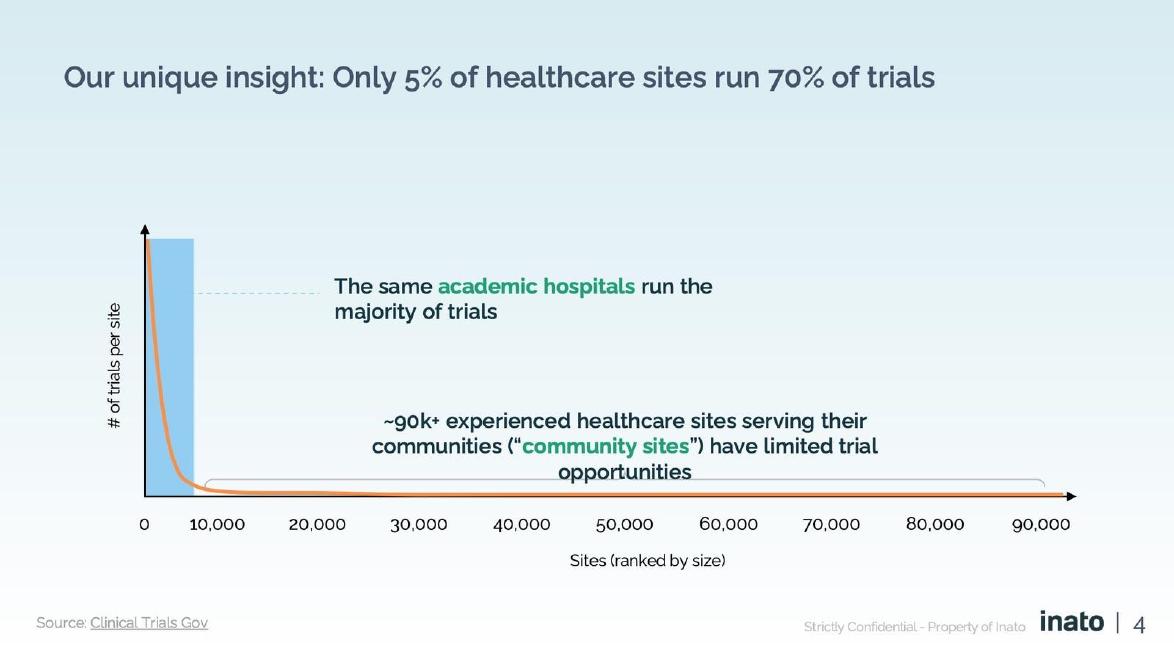
- Inato identifies a massive supply-demand mismatch where 70% of trials are funneled through only 5% of available sites (Slide 4).
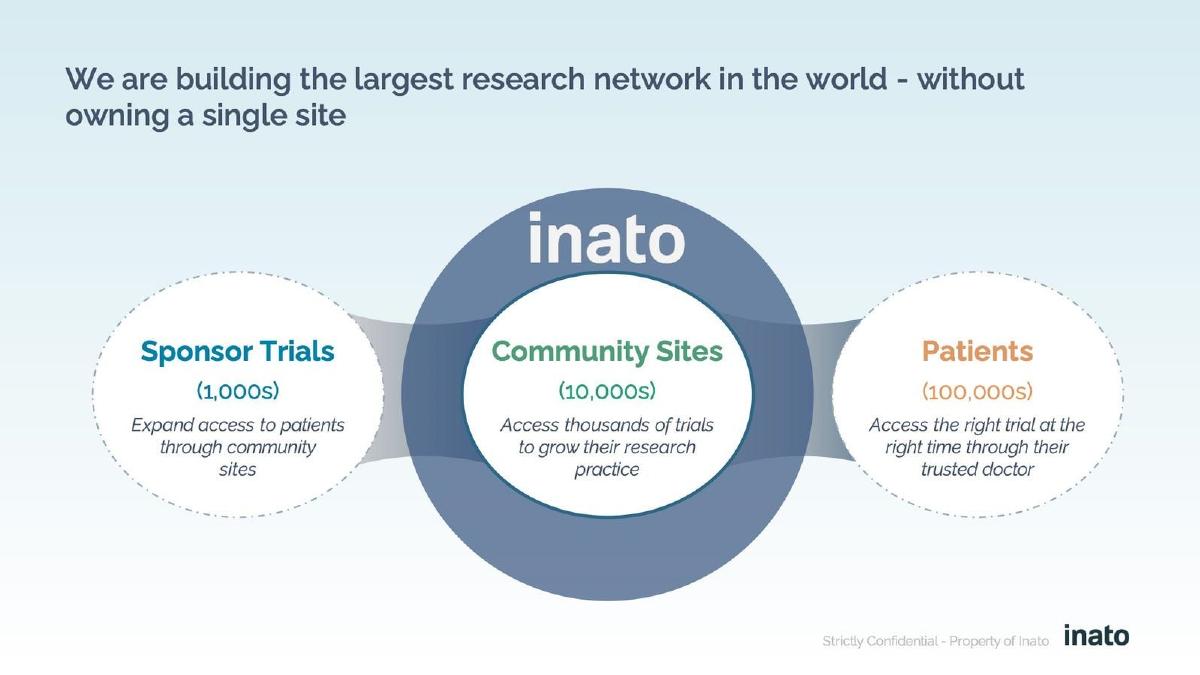
- The company utilizes an 'asset-light' model, aiming to build the world's largest research network without owning any physical sites (Slide 5).
- Traction is evidenced by a network of 2,000+ community sites reached within two years (Slide 8).
- Inato has secured 10 of the top 30 global pharma sponsors, achieving 100% sponsor retention and 100% contract expansion within six months (Slide 9).
- The platform introduces the 'Inato Verified Commitment' (IVC) to guarantee enrollment performance to sponsors (Slide 7).
- Future growth targets a $15B total addressable market by expanding from matching ($3B TAM) into site services ($12B TAM) (Slide 11).
- The deck omits a dedicated team slide, detailed unit economics, and a specific funding ask (Slides 1-16).
Introduction and Vision
Inato’s pitch deck begins with a clear, high-level value proposition: "Unlock access to trials in the community." This sets the stage for a narrative centered on democratization and efficiency in healthcare. As a Paris-based startup, Inato is tackling a global problem from a European HQ, focusing on the logistical and structural barriers that prevent life-saving treatments from reaching patients quickly. The 2022 dating on the intro slide suggests this deck was the foundation for their successful $20M Series A in 2023.
Slide 1: Title Slide
The title slide is minimalist, featuring the company logo and the core mission statement. The use of the phrase "in the community" is a strategic choice, signaling a move away from academic medical centers toward a more distributed, patient-centric model of research.
Slide 2: The $50B Problem
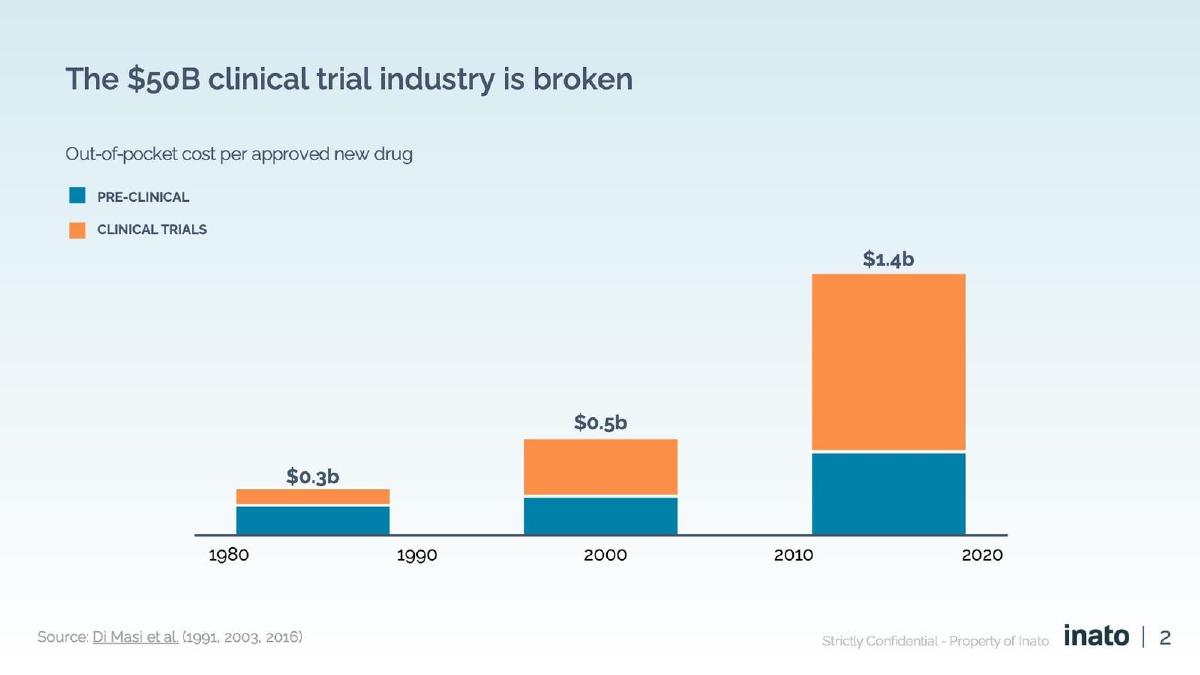
Slide 2 establishes the market size and the primary pain point. It identifies the clinical trial industry as a $50B sector that is "broken." The slide provides two critical data points: 40% of trial expenditures are spent on patient recruitment, yet less than 5% of patients participate in trials despite 70% being willing to do so. This creates a clear "efficiency gap" that the investor can immediately grasp.
Slide 3 & 4: The Bottleneck
These slides dive deeper into why the industry is failing. Slide 3 notes that pharma sponsors are competing for a "small subset of patients," while Slide 4 delivers the most shocking statistic in the deck: only 5% of healthcare sites run 70% of trials. This concentration creates a massive bottleneck, where a few elite institutions are overwhelmed while thousands of community sites are ignored. This is the "Why Now" and "Why Us" moment—Inato is positioning itself to unlock that untapped 95% of site capacity.
Slide 5: The Asset-Light Network
Slide 5 introduces the solution. Inato describes itself as "the largest research network in the world - without owning a single site." This is a classic marketplace play, reminiscent of Airbnb or Uber, applied to clinical research. The diagram shows Inato as the central hub connecting thousands of sponsor trials to tens of thousands of community sites, which in turn provide access to hundreds of thousands of patients through their "trusted doctor." This emphasizes the importance of the doctor-patient relationship in recruitment.
Slide 6 & 8: Traction and Scale
Slide 6 summarizes accomplishments within an 18-month window, though the specific text is brief. Slide 8 provides the hard numbers: 2,000+ community sites reached within two years. This rapid growth on the supply side of the marketplace is crucial for a Series A, as it proves that community sites are hungry for trial opportunities and that Inato’s onboarding process is scalable.
Slide 7: The Platform Mechanics
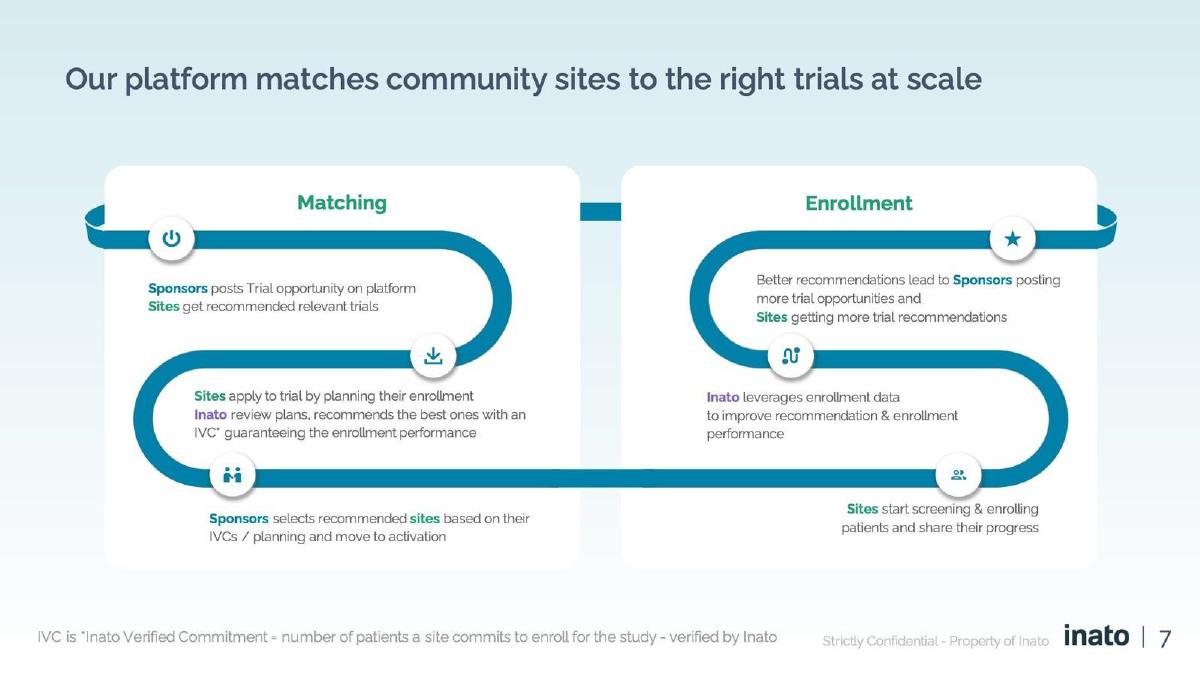
Slide 7 explains how the platform actually works, divided into "Matching" and "Enrollment." A key feature introduced here is the "Inato Verified Commitment" (IVC). By guaranteeing enrollment performance, Inato solves the primary fear sponsors have when moving away from established academic centers: the risk that a community site won't deliver the required number of patients. This verification layer is Inato’s proprietary "secret sauce."
Slide 9 & 10: Enterprise Validation
Slide 9 is perhaps the strongest in the deck for a Series A investor. It shows a clear bar chart of "Active Sponsor base per semester," growing from 2 of the Top 30 sponsors in H1-2021 to 10 of the Top 30 by H2-2022. Even more impressive are the bottom metrics: 100% sponsor retention and 100% contract expansion. Slide 10 reinforces this by stating they are expanding to "multimillion dollar annual contracts," moving from pilot phases to core infrastructure for big pharma.
Slide 11 & 12: Future TAM and Strategy
Slide 11 looks beyond 2024, projecting a path to unlocking access for hundreds of thousands of patients. It breaks down the Total Addressable Market (TAM) into two segments: a $3B market for "Matching" and a much larger $12B market for "Site services." This shows that Inato isn't just a matching tool; it intends to become a full-service platform for community research. Slide 12 articulates the goal to "own site selection and patient recruitment," signaling a move toward becoming the definitive gatekeeper for community-based trials.
Slide 13: Competitive Landscape
Slide 13 uses a comparison table to position Inato against "Other site platforms," "Integrated Research Organizations," "Patient recruitment" firms, and "Decentralized Clinical Trials." Inato claims a unique position by being a scalable, global model with strong network effects. They critique competitors for having low scalability, high churn, or a lack of relationships with the sites themselves.
Slide 14 & 15: Product Strategy
Slide 14 claims "strong product-market fit with sites," while Slide 15 details the product strategy. The strategy involves "flipping the model" so sites choose trials, using ML-powered matching, and providing "just-in-time activation" to streamline the process. This technical depth reassures investors that there is a robust product roadmap behind the sales success.
What Works in Inato's Deck
The Power Statistic: The fact that 5% of sites run 70% of trials (Slide 4) is a perfect "anchor" metric. it defines the problem so clearly that the solution becomes self-evident. Any investor looking at that slide understands the arbitrage opportunity: if you can make the other 95% of sites viable, you win.
Retention and Expansion: Showing 100% retention and 100% expansion among the Top 30 global pharma companies (Slide 9) is rare for a Series A company. It proves that the product is not just a "nice to have" but is becoming an essential part of the sponsor's workflow. The 3.5-month average time between the first trial and a re-order is a very healthy velocity for enterprise healthcare sales.
Asset-Light Scalability: By explicitly stating they do not own sites (Slide 5), Inato highlights their high-margin, software-driven potential. This distinguishes them from Integrated Research Organizations (IROs) which often have heavy capital expenditures and lower margins due to physical site management.
What is Missing from Inato's Deck
The Team Slide: Surprisingly, the provided slide list and images do not include a team slide. In a $20M Series A, the pedigree of the founders and the clinical expertise of the leadership team are usually paramount. Investors need to know that the team understands the regulatory and medical nuances of clinical trials.
The Ask and Use of Funds: There is no slide detailing how much capital is being raised or how it will be spent. While we know from external reports that they raised $20M, a standard pitch deck usually outlines whether the funds will go toward R&D, international sales expansion, or product development.
Unit Economics: While Slide 10 mentions multimillion-dollar contracts, the deck lacks a breakdown of Customer Acquisition Cost (CAC), Lifetime Value (LTV), or the specific take-rate Inato earns on each trial or patient recruited. For a marketplace, these metrics are vital to prove long-term profitability.
Founder Takeaways: What to Copy
Focus on the Supply Side: Inato spent significant time proving they could aggregate the "supply" (community sites). Founders building marketplaces should follow this lead: if you control the supply that everyone else is struggling to find, the demand (sponsors) will follow. The growth from 0 to 2,000 sites is a compelling narrative of market capture.
Define a Proprietary Metric: The "Inato Verified Commitment" (IVC) is a brilliant way to brand a standard business process (verification). It gives the platform a sense of authority and creates a standard that competitors must now meet. Founders should look for ways to name and claim their unique quality-control mechanisms.
Segment Your TAM: Slide 11 is a masterclass in showing a realistic path to a large market. By starting with a $3B niche (matching) and showing a clear bridge to a $12B adjacent market (site services), Inato makes their billion-dollar potential feel earned rather than just a theoretical number pulled from a market research report.
Visual Consistency: The deck uses a clean, professional blue-and-white palette that feels "medical" without being sterile. The diagrams are simple and avoid the "spaghetti mess" of many marketplace flowcharts. This clarity of design reflects a clarity of thought that appeals to institutional investors.
Frequently asked questions
- What is the core problem Inato is solving?
- Inato addresses the 'broken' clinical trial industry where pharmaceutical sponsors compete for a tiny subset of patients. According to Slide 4, only 5% of healthcare sites currently run 70% of trials, leading to high costs and slow recruitment. Inato aims to bridge this gap by connecting sponsors to the other 95% of sites located in local communities.
- How does Inato make money?
- While the deck does not explicitly detail the fee structure, Slide 10 mentions the expansion into 'multimillion dollar annual contracts' with sponsors. The business model is a marketplace where sponsors pay for access to a verified network of community sites and recruitment services, moving from simple matching to comprehensive site services.
- What is an 'Inato Verified Commitment' (IVC)?
- As described on Slide 7, an IVC is the number of patients a site commits to enroll for a specific study, which is then verified by Inato. This acts as a performance guarantee for sponsors, reducing the risk of selecting unproven community sites and ensuring the trial stays on schedule.
- Who are Inato's main customers?
- Inato operates a two-sided marketplace. Their primary paying customers (Sponsors) are global pharmaceutical companies; Slide 9 notes they work with 10 of the top 30. Their supply side consists of 'Community Sites'—local clinics and hospitals that have the patient access but lack the infrastructure to attract major pharma trials.
- What is missing from this pitch deck?
- The deck is missing several standard Series A components: there is no team slide highlighting founder expertise, no slide detailing the specific use of funds or the amount being raised, and no detailed breakdown of unit economics or burn rate. It functions more as a strategic narrative than a full financial disclosure.