Value Chain Slide: How to Show Where Your Startup Sits
How do you show investors which part of an industry your startup does? Five real slides show how to draw the value chain, mark the steps you own.
Value Chain Slide: Draw the Industry's Steps, Mark the Ones You Do, and Say Why There
Many founders describe their place in an industry with a phrase: "we restructure the value chain", "we own the entire value chain", "we are not selling software". Investors hear these lines often and cannot check them. A value chain slide turns the phrase into a picture: the steps that happen between a supplier and the final customer, which of those steps the startup does, and who does the rest. This guide uses five real slides to show how founders draw that picture, what makes it useful to an investor, and when the word "value chain" stands in for a plan the slide never shows.
TL;DR
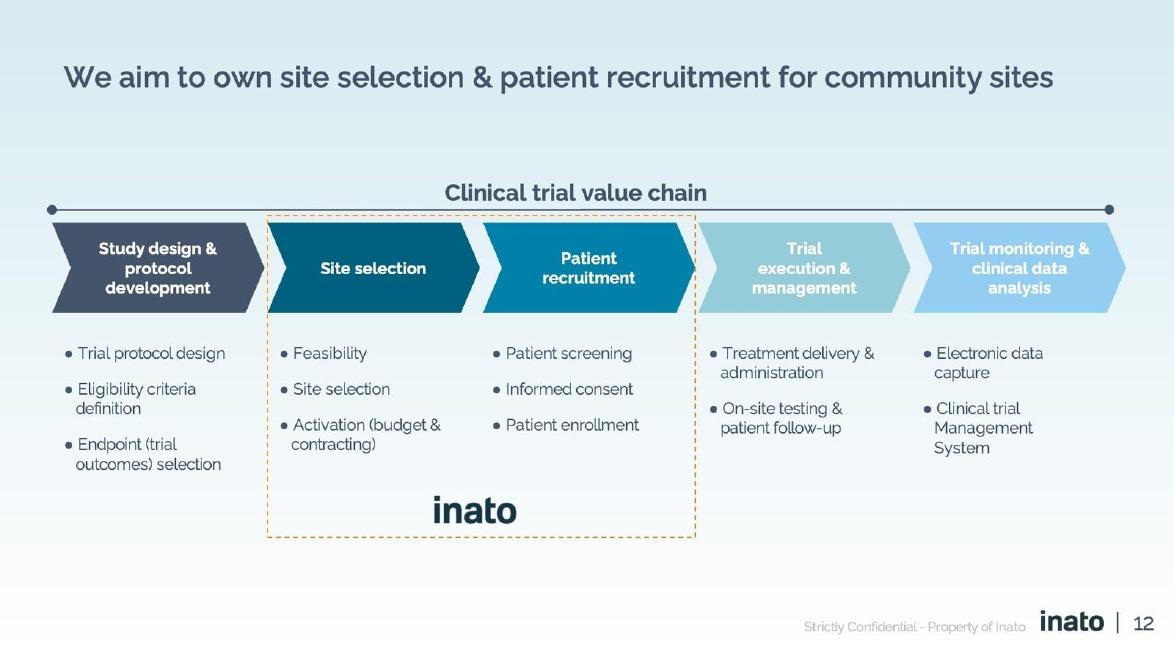
Draw the industry's steps from left to right in plain words, put a clear box around the steps you do, and say in the title why you start there. Inato does this best: five labelled steps of a clinical trial, with three tasks under each, and a dashed box around site selection and patient recruitment under the title "We aim to own site selection & patient recruitment for community sites".
Five value chain slides, read in full
Each slide was rendered from the original deck at full size and read in full. Claims about each industry are as the slides state them; we did not check them against outside sources.
Inato business model slide — slide 12
Clinical trial platform for community sites. Value chain slide.
Inato deck, slide 12. Exact stored slide matched to this analysis.
Our analysis: The clearest picture of a company's place in its industry in the set.
Evidence and limitation: All five steps named with tasks under each; Inato's two steps boxed and repeated in the title.
What a founder can adapt: Name who does the boxed steps today and add one figure for how much Inato already handles.
Supporting analysis
What the deck claims: "We aim to own site selection & patient recruitment for community sites"; "Clinical trial value chain": five steps from "Study design & protocol development" to "Trial monitoring & clinical data analysis", with a dashed box around "Site selection" and "Patient recruitment".
Presentation choice: A reader new to clinical trials can see the whole process and Inato's part in seconds.
When it does not fit: Leaving "aim to own" as a goal with no evidence of progress.
The Good Face Project business model slide — slide 4
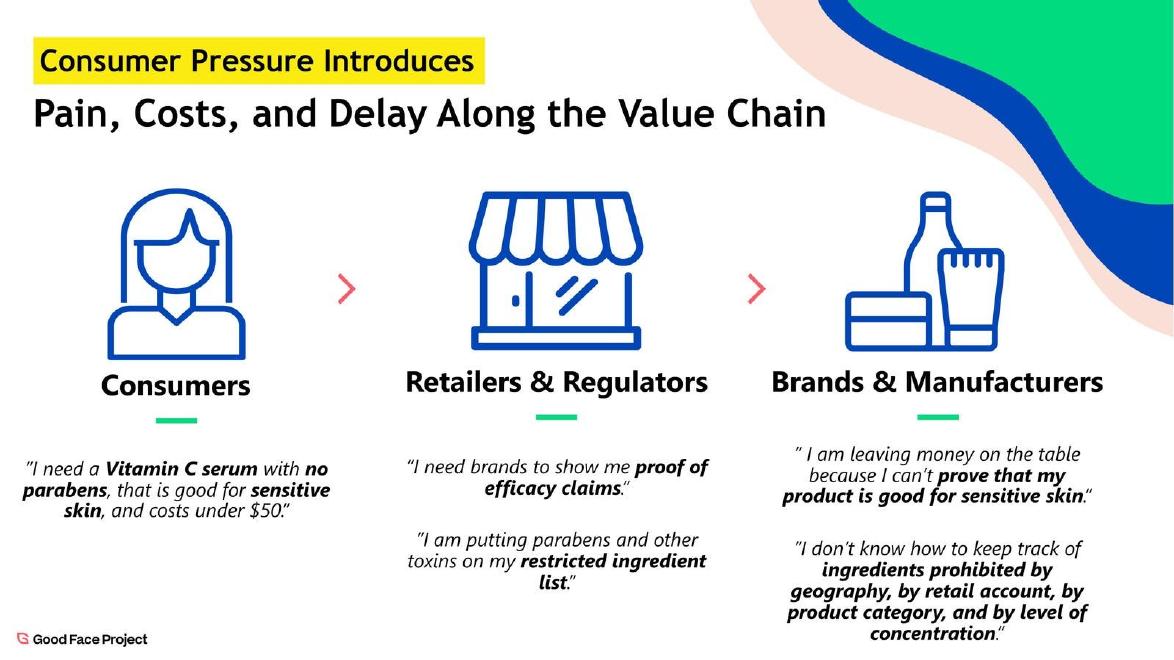
Ingredient-checking software for beauty brands. Problem slide drawn as a value chain.
The Good Face Project deck, slide 4. Exact stored slide matched to this analysis.
Our analysis: A clear way to show how demand at one end creates work at the other.
Evidence and limitation: Three parties with a problem quote each; no mark for where the product sits or who pays.
What a founder can adapt: Add a mark showing where the product fits, and say whether the quotes come from interviews.
Supporting analysis
What the deck claims: "Consumer Pressure Introduces Pain, Costs, and Delay Along the Value Chain"; "Consumers", "Retailers & Regulators", "Brands & Manufacturers"; "I am leaving money on the table because I can't prove that my product is good for sensitive skin."
Presentation choice: It shows which party feels the problem most, which points to the customer.
When it does not fit: Quotes that read as written by the company presented as customer voices.
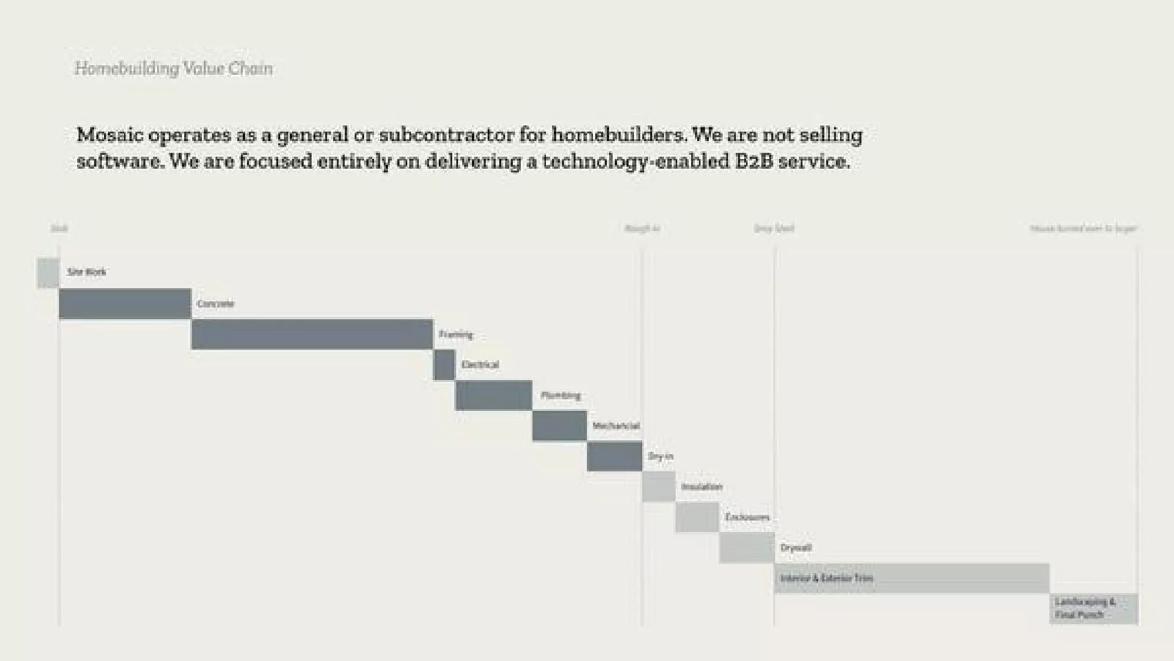
Homebuilding contractor using its own technology. Value chain slide.
Mosaic deck, slide 13. Exact stored slide matched to this analysis.
Our analysis: The sentence does the job; the chart leaves the reader guessing.
Evidence and limitation: Plain statement of business type; chart shading has no legend; milestone labels unreadable in the source file.
What a founder can adapt: Add a legend saying which shaded steps Mosaic does.
Supporting analysis
What the deck claims: "Homebuilding Value Chain"; "Mosaic operates as a general or subcontractor for homebuilders. We are not selling software. We are focused entirely on delivering a technology-enabled B2B service."; twelve build steps from Site Work to Landscaping & Final Punch.
Presentation choice: Ruling out software changes how an investor judges margins and growth.
When it does not fit: Using colour to mark your steps without saying what the colour means.
Contently deck, slide 10. Exact stored slide matched to this analysis.
Our analysis: A warning: a claim to own every step, with the one supporting figure hidden.
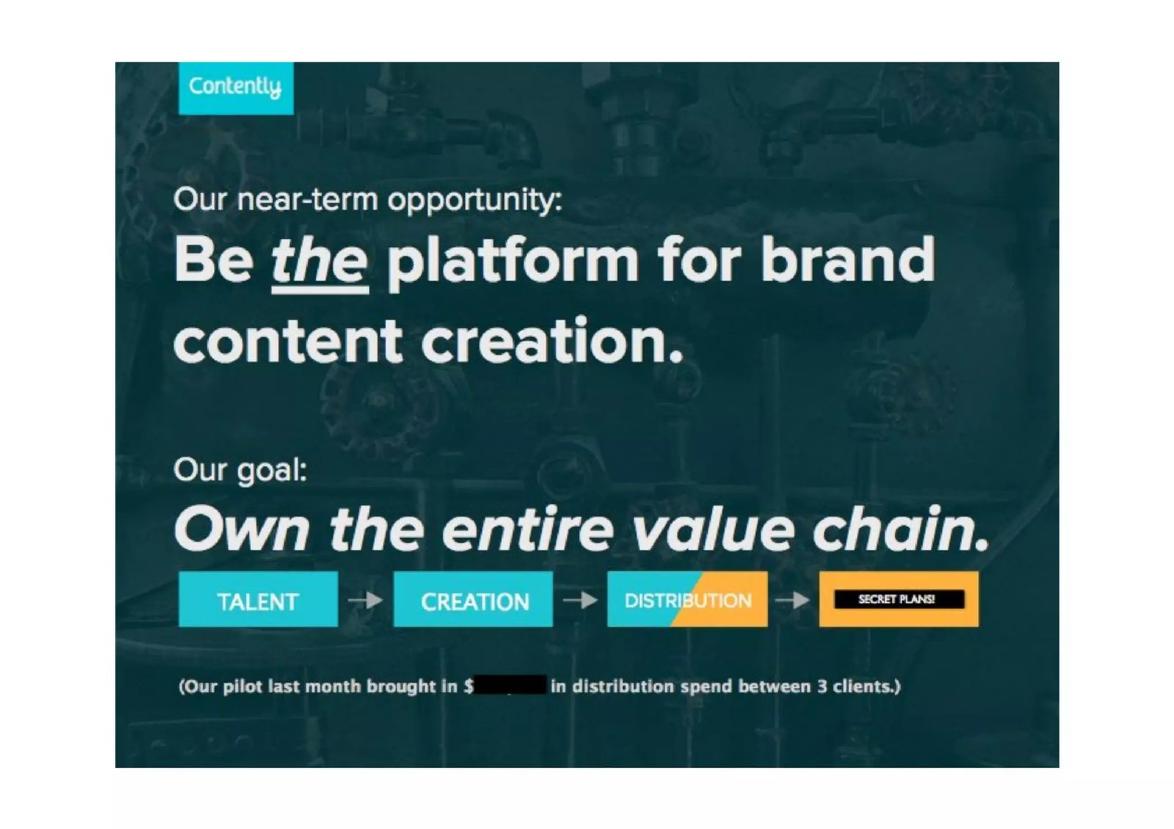
Evidence and limitation: Near-term and long-term separated; pilot figure blacked out; last step a joke.
What a founder can adapt: Say which steps are built, which are in pilot, and give the pilot figure.
Supporting analysis
What the deck claims: "Our near-term opportunity: Be the platform for brand content creation."; "Our goal: Own the entire value chain."; "TALENT", "CREATION", "DISTRIBUTION", "SECRET PLANS!"; "(Our pilot last month brought in $[blacked out] in distribution spend between 3 clients.)"
Presentation choice: Shows how a dated pilot can support a move into a new step, and how hiding it loses that support.
When it does not fit: "Own the entire value chain" with no reason one company should do every step.
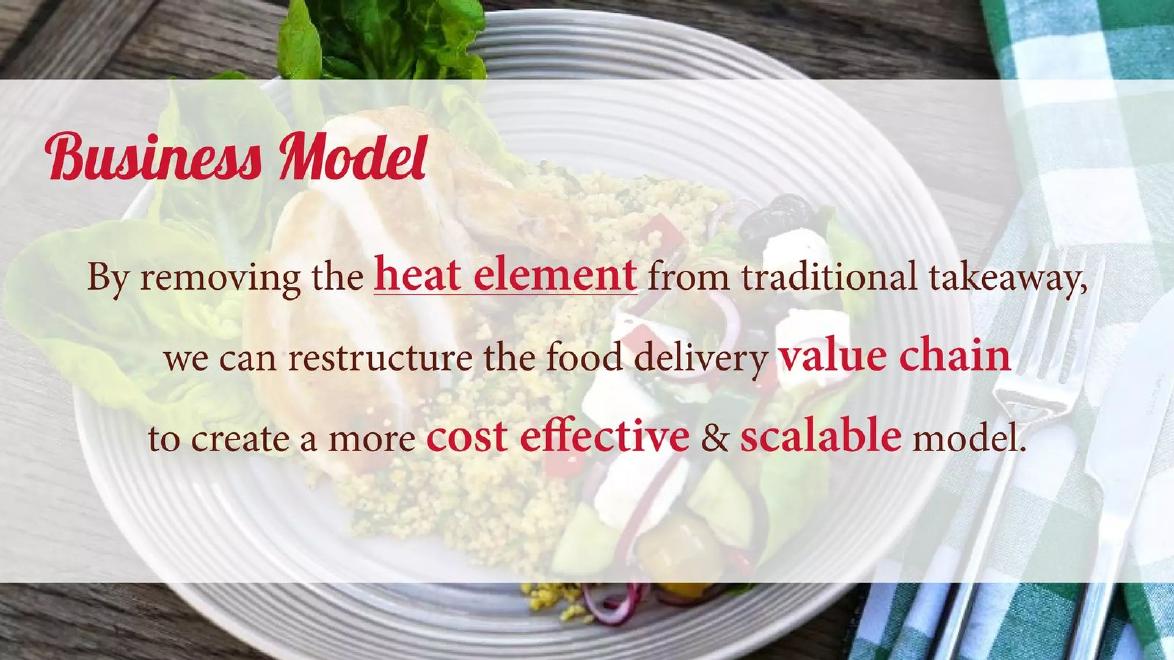
Cold-food delivery start-up. Business model slide.
LoveThyChef deck, slide 7. Exact stored slide matched to this analysis.
Our analysis: A warning: the phrase stands in for the diagram.
Evidence and limitation: One sentence over a photo; no steps, no costs, no position shown.
What a founder can adapt: Draw the hot takeaway chain above yours, cross out removed steps and give a cost for each.
Supporting analysis
What the deck claims: "By removing the heat element from traditional takeaway, we can restructure the food delivery value chain to create a more cost effective & scalable model."
Presentation choice: Shows the gap a simple before-and-after chain would fill.
When it does not fit: Saying you restructure the value chain without showing which steps change.
Whether each slide names the steps, marks the company's steps, names who does the rest and backs the position with a fact.
Example
Steps named
Own steps marked
Others named
Supporting fact
Inato
Yes, five with tasks
Yes, boxed and in title
No
No
Good Face Project
Three parties
No
Parties, not companies
No
Mosaic
Yes, twelve
Shading, no legend
No
No
Contently
Four boxes
Claims all
No
Pilot, figure blacked out
LoveThyChef
No
No
No
No
Key Takeaways
Name every step in the industry in plain words.
Mark the steps you do with a box or a legend.
Say in the title which steps you do and why there.
Say who does the other steps today.
Mark future steps as plans, with the next one first.
Build your value chain slide
Answer each prompt before drawing the slide.
Steps. What are the four to seven steps between the start of the work and the final customer, in industry words?
Your steps. Which steps do you do today, and which do you plan to add?
Others. Who does each other step today?
Why there. Why do you start at this step rather than another?
Fact. Which one figure shows your position is real?
Copyable framework: [Industry] runs [step 1] → [step 2] → [step 3] → [step 4]. We do [steps] today because [reason]; [others] do the rest. Proof: [figure, date]. Next: [step], planned for [date].
Illustrative example 1 — written by us
Before: "We own the entire value chain."
After: "Home repairs run diagnosis → quote → booking → repair → payment. We do diagnosis and quote today because that is where 40% of jobs are lost; local trades do the repair. Proof: 1,200 quotes issued in March 2024. Next: booking, planned for Q3."
What improved: Our illustrative rewrite; the figures are invented for the example. It names the steps, the company's part, who does the rest, the reason and one dated fact.
The question this guide answers
Founders ask how to show investors where their startup fits in an industry: which part of the work it does, which part it leaves to others, and why it starts where it does. The business model guides cover how a company charges and earns money. The competition guides cover who else sells a similar product. The market guides cover how big the opportunity is. None of them says how to draw the chain of steps in an industry and mark the startup's place in it.
The question matters because where a company sits decides much of what an investor cares about: who its customer is, who it depends on, how much of each sale it keeps and which companies might squeeze it. A clear value chain slide lets an investor see this in a few seconds. A vague one leaves them to guess, and the phrase "own the value chain" can sound like a company that has not yet chosen where to start.
How we chose and read the examples
We searched saved slide text in the teardown library for "value chain" and left out mining, resource, energy and listed-company presentations. Most matches used the phrase once in a sentence about something else. We kept five slides from five startup decks where the value chain is the subject of the slide: Inato (clinical trials), the Good Face Project (beauty ingredients), Mosaic (homebuilding), Contently (brand content) and LoveThyChef (food delivery).
Each slide was rendered from the original deck at full size and read in full. The Mosaic chart labels are small and low in quality in the source file, so we rendered that slide again at a larger size to read them. Quotes are the slides' own. We did not check any company's claims about its industry against outside sources; this guide is about how clearly each slide shows the company's place.
The strongest pattern: a labelled chain with your steps boxed
Inato, which helps drug companies run trials at community hospitals and clinics, draws the "Clinical trial value chain" as five arrows from left to right: "Study design & protocol development", "Site selection", "Patient recruitment", "Trial execution & management" and "Trial monitoring & clinical data analysis". Under each arrow are two or three plain tasks, such as "Feasibility", "Activation (budget & contracting)", "Patient screening" and "Informed consent".
A dashed orange box surrounds the second and third steps, with Inato's logo inside it. The title says the same thing in words: "We aim to own site selection & patient recruitment for community sites". A reader who knows nothing about clinical trials can see the whole process, see the two steps Inato does, and see that it leaves design, running the trial and data analysis to others.
Two things keep this from being perfect. The slide doesn't say who does site selection and recruitment for community sites today, so the reader can't tell whom Inato replaces. And "aim to own" is a goal; the slide doesn't say how much of either step Inato already handles. One line under the box, such as the number of trials where Inato ran recruitment, would turn the goal into evidence.
Showing the problem at each link
The Good Face Project, which builds ingredient-checking software for beauty companies, uses its value chain to explain the problem rather than its own position. The title reads "Consumer Pressure Introduces Pain, Costs, and Delay Along the Value Chain". Three groups sit left to right with arrows between them: "Consumers", "Retailers & Regulators" and "Brands & Manufacturers". Each has a quote in its own voice.
The consumer says: "I need a Vitamin C serum with no parabens, that is good for sensitive skin, and costs under $50." The retailer says: "I need brands to show me proof of efficacy claims." The brand says: "I am leaving money on the table because I can't prove that my product is good for sensitive skin" and "I don't know how to keep track of ingredients prohibited by geography, by retail account, by product category, and by level of concentration."
This works because the reader sees how demand at one end creates work at the other, and which party feels it most. The brand's two quotes point to the customer. But the slide doesn't mark where the Good Face Project sits or who pays it, and the quotes read as written by the company, not taken from named interviews. As a problem slide it is clear; as a value chain slide it needs one more mark showing where the product fits.
Saying what you are, and what you are not
Mosaic's slide, headed "Homebuilding Value Chain", opens with an unusually direct sentence: "Mosaic operates as a general or subcontractor for homebuilders. We are not selling software. We are focused entirely on delivering a technology-enabled B2B service." Below it is a chart of the steps in building a house, in order: Site Work, Concrete, Framing, Electrical, Plumbing, Mechanical, Dry-in, Insulation, Enclosures, Drywall, Interior & Exterior Trim, and Landscaping & Final Punch.
The sentence is the most useful part. It tells an investor which business Mosaic is in (construction services, paid like a contractor) and rules out the one they might assume (software). That changes how they will judge margins, hiring and growth.
The chart is weaker. Some bars are dark grey and some light grey, and the slide doesn't say what the shading means. A reader might guess the dark bars are the steps Mosaic does, but the slide never says so, and the milestone labels above the chart are too faint to read in the source file. A short legend, "Dark: steps Mosaic does", would make the chart do what the sentence promises.
Warning: claiming the whole chain
Contently's slide states "Our near-term opportunity: Be the platform for brand content creation" and then "Our goal: Own the entire value chain." Below are four boxes joined by arrows: "TALENT", "CREATION", "DISTRIBUTION" (half in a second colour) and a final box reading "SECRET PLANS!". A note at the bottom reads "(Our pilot last month brought in $[blacked out] in distribution spend between 3 clients.)"
The slide does several things right. It separates the near-term opportunity from the long-term goal, and it ties the move into distribution to a dated pilot with three clients. But the figure that would make the pilot meaningful is blacked out in the published version, so a reader can't judge it. The last step is a joke rather than a plan. And "own the entire value chain" is a large claim with no reason given for why one company should do all four steps.
Use the half-coloured box as the lesson. It hints that distribution is partly built. Saying that in words, with the pilot figure, would show a company moving one step at a time, which is easier to believe than a claim to own everything.
Warning: the phrase without the picture
LoveThyChef's slide is titled "Business Model" and has a single sentence over a photo of a salad: "By removing the heat element from traditional takeaway, we can restructure the food delivery value chain to create a more cost effective & scalable model."
The idea may be sound. Cold food can be made centrally and delivered without the timing pressure of hot takeaway. But the slide doesn't show the chain. It doesn't say which steps disappear when food is served cold, which steps LoveThyChef does, or where the cost saving comes from. The phrase "restructure the value chain" does the work a diagram should do.
A simple fix: draw the hot takeaway chain (restaurant kitchen, order, cook to order, rider, customer) above the LoveThyChef chain, cross out the steps that go, and put one cost figure beside each one removed.
How to build your value chain slide
Start with the steps. Write the four to seven things that happen between the start of the industry's work and the final customer, in the words people in the industry use. Put two or three tasks under each step if the steps are unfamiliar, as Inato does.
Mark your place. Use one clear device, a box, a colour or a bold outline, and explain it in a legend or in the title. If you do steps one and two today and plan to add step three, show that difference: a solid box for today, a dashed one for the plan.
Name the neighbours. Under each step you don't do, name who does it today: a type of company or two example names. This tells an investor whom you depend on, whom you sell to and whom you replace.
Say why there. The title should give the reason you start where you do: the step with the most waste, the step customers pay most for, or the step that gives you data for the next one. Inato's title names its steps; adding the reason would make it complete.
Add one fact. A value chain slide is a picture of a position, so it is easy to draw without evidence. Add one number that shows the position is real: customers served at that step, share of the step you handle, or the revenue a pilot produced.
When to use it, and where it goes
A value chain slide helps most when your industry has many steps that investors don't know, when your place in it is unusual, or when investors might mistake your business for another type, as Mosaic guards against. If your product is a simple tool sold to one obvious buyer, the slide may add little; one line on the business model slide can do the job.
It usually sits after the problem slide and before the business model slide, because it explains whom you serve and why you earn money where you do. Some decks, like the Good Face Project's, use it as the problem slide itself. Either works if the slide makes clear where your company sits.
If your plan is to add steps over time, keep the future steps on this slide clearly marked as plans, and put the details in the roadmap. Investors judge the step you do today; later steps are a reason to believe the company can grow, not proof that it will.
What a value chain slide cannot show
A diagram shows where a company says it sits. It doesn't show that the company does that step well, that customers pay for it, or that the margin there is good. Those need traction, pricing and unit economics slides.
It also can't show how the industry's steps will change. If you claim your product removes a step, as LoveThyChef does, show the cost of that step today and how you measured the saving, or label the saving as an estimate.
Finally, a value chain slide is drawn by the founder, so it tends to make the founder's step look central. A fair slide shows the other steps at their true size and names the companies that do them, even where they are large and well funded.
Common mistakes
Claiming every step. Show the step you do today; mark later steps as plans.
No legend. If colour marks your steps, say so on the slide.
Phrase, no picture. Draw the steps instead of saying you restructure them.
Neighbours missing. Name who does the steps you don't.
Position without proof. Add one figure showing you already do your step.
Diagnostic checklist
Every step named in plain words.
Your steps clearly marked and explained.
Reason for your starting point in the title.
Who does the other steps.
One dated fact supporting your position.
Frequently asked questions
Do I need a value chain slide in my pitch deck?
If your industry has many steps investors don't know, or your business could be mistaken for another type, yes. For a simple product sold to an obvious buyer, a line on the business model slide is enough.
Is it bad to say I want to own the whole value chain?
Not if you show the step you do today, the next step and why. Without those, the claim reads as an unchosen starting point.
Where does the value chain slide go?
Usually between the problem and business model slides. It can also serve as the problem slide, as long as it marks where your company sits.
How is this different from a competition slide?
A competition slide compares companies doing the same step. A value chain slide shows all the steps and which ones you and others do.
How we chose these examples
Corpus: published pitch deck teardowns on StartupFundraising.com. Founder-uploaded private decks are excluded.
Selection (2026-10-01): we searched extracted slide text for "value chain", excluded mining, resource, energy and listed-company presentations and slides that only mention the phrase in passing, and kept five slides from five startup decks.
Review: all five slides were rendered from the source decks at full size on 2026-10-01 and read in full against company, deck and page number; the Mosaic slide was also rendered at a larger size to read its chart labels (editorial model review, with AI assistance in drafting). No person has yet completed a human review. Industry claims were not checked against outside sources.