LoveThyChef is a London-based food technology startup targeting the 'weeknight dinner' pain point for busy professionals. By removing the 'heat element' from traditional takeaway—delivering chilled, chef-prepared meals instead of hot food—the company aims to restructure the delivery value chain for better scalability. The deck seeks £150,000 in SEIS funding to build out a commercial kitchen and transition from a pure delivery model to a retail presence in London Underground stations under the brand 'One Fine Meal.' While the deck provides clear financial targets, such as reaching 10,000 month…
Key takeaways
- The company identifies overworked London professionals as its primary target market, specifically solving the lack of motivation to cook weeknight dinners (Slide 2).
- The core business model relies on removing the 'heat element' to lower delivery costs and increase operational scalability (Slide 4).
- Market validation is drawn from Munchery, a San Francisco-based startup that raised over $40m and delivered 6,000 meals daily (Slide 5).
- The long-term vision involves a brand transition to 'One Fine Meal' and opening retail kiosks inside London Underground stations (Slide 6).
- The startup is seeking £150,000 in SEIS funding, with £50,000 already committed by a business angel (Slide 8).
- Financial projections target 500 meal sales per day at a £10 price point to reach breakeven (Slide 9).
- Projected monthly expenses are estimated at £80,000 against £100,000 in revenue, yielding a 20% net profit margin (Slide 9).
- The deck completely omits a team slide, leaving the founders' backgrounds and execution capabilities unknown.
LoveThyChef: The Chilled Delivery Playbook
The LoveThyChef deck, produced in December 2014, represents a specific era of the 'food-tech' boom where startups sought to optimize the logistics of the last mile by moving away from the traditional restaurant model. By focusing on a centralized kitchen and chilled delivery, the company aimed to capture the high-frequency weeknight dinner market in London. The deck is lean, focusing heavily on the operational efficiency of the model and the future retail vision, though it leaves significant gaps regarding the team and current traction.
Slide 1: Title Slide
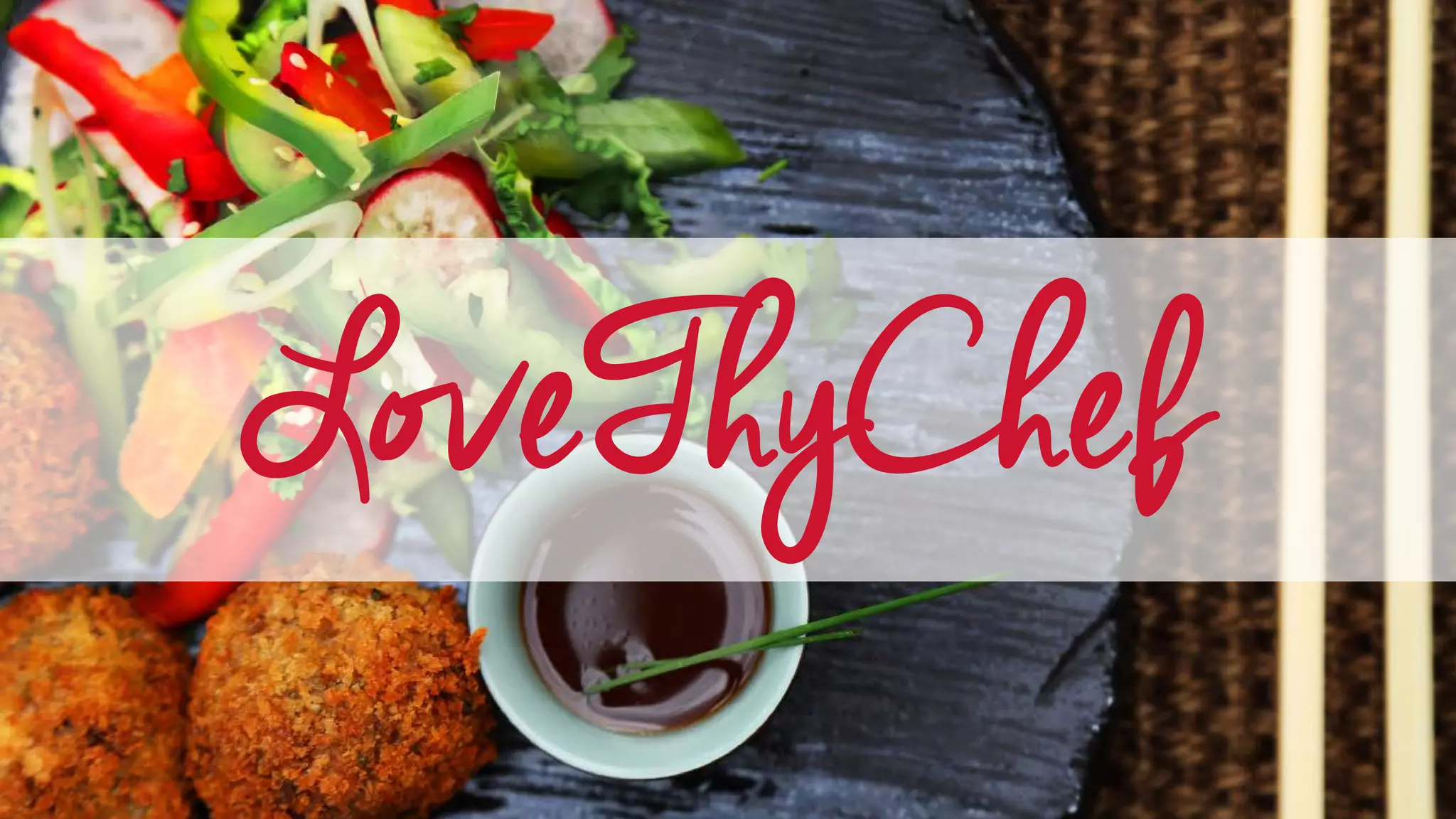
The deck opens with a high-resolution image of a plated meal, featuring falafel-like items, a salad, and a dipping sauce. The branding 'LoveThyChef' is displayed in a red, cursive script. There is no tagline or immediate value proposition on the cover, relying entirely on the visual of the food to set the tone for a premium culinary service.
Slide 2: The Pain Point
Slide 2 identifies the problem: 'The weeknight dinner.' It specifically calls out 'Busy London professionals' who are 'overworked, out of time and lack any motivation to cook at home.' The slide uses a crying emoji to emphasize the frustration of the target demographic. This is a classic 'convenience' play, positioning the product as a solution to a daily recurring struggle rather than a luxury treat.
Slide 3: The Solution
The solution is presented as a four-point service model: 1) A weekly rotating menu of healthy dinners, 2) freshly prepped each day by chefs, 3) ready to eat in 5-10 minutes, and 4) delivered Monday through Friday between 6-9pm. By specifying the delivery window and the preparation time, the company defines its operational boundaries and the specific consumer behavior it intends to serve.
Slide 4: Business Model Efficiency
This slide is the core of the investment thesis. It states that by 'removing the heat element from traditional takeaway,' the company can 'restructure the food delivery value chain.' The implication is that hot food delivery is logistically difficult and expensive due to the need for immediate transport. Chilled food allows for better delivery density and lower spoilage, which the deck claims creates a 'more cost effective & scalable model.'
Slide 5: Market Validation via Munchery
To prove the model works, the deck points to Munchery, a San Francisco-based dinner delivery service. It notes that Munchery raised over $40m, operates from a single commercial kitchen, and delivers 6,000 meals a day with only 50 delivery drivers. This slide serves to de-risk the operational concept by showing that a similar model has achieved significant scale and venture backing in a comparable metropolitan market.
Slide 6: The Vision - One Fine Meal
Slide 6 introduces a pivot or expansion strategy. The vision is to sell 'gourmet ready meals' in shops and kiosks inside London Underground stations. The branding on the 3D mockups changes from 'LoveThyChef' to 'One Fine Meal.' This suggests the founders recognized that delivery alone might have a ceiling and that capturing foot traffic in high-density transit hubs could be a more efficient acquisition channel.
Slide 7: Social Proof
Titled 'How we look on Twitter,' this slide shows two screenshots of customer tweets from October. One customer, Kiran Kishore, mentions the dinner was 'exactly what I needed after this day of work.' The images show the packaging: clear plastic containers with a 'One Fine Meal' sleeve and a 'heat. eat. love. repeat.' tagline. This provides evidence that the product exists and has at least some level of early customer satisfaction.
Slide 8: The Funding Ask
The company is seeking £150,000 in SEIS (Seed Enterprise Investment Scheme) funding. The stated purpose of the funds is to 'fit our kitchen & scale our service in London.' Crucially, the slide notes that £50,000 is already committed from a business angel, which provides a signal of external validation to other potential investors.
Slide 9: The Numbers
The final slide in this set provides a simplified financial forecast. The goal is to reach 500 meal sales per day (10,000 per month). At a £10 price point, this results in £100,000 in monthly revenue. With projected expenses of £80,000, the company forecasts a net monthly profit of £20,000. This slide is intended to show the path to breakeven, though it does not break down the £80,000 in expenses into COGS, marketing, or labor.
What Works in the LoveThyChef Deck
The deck is highly focused on a single, clear problem: the lack of time for London professionals to cook. By narrowing the target market geographically and demographically, the founders make the business feel manageable. The emphasis on the 'chilled' aspect of the business model (Slide 4) is a strong point, as it addresses the primary margin-killer in food delivery: the logistics of hot food. Furthermore, the inclusion of a committed angel investor (Slide 8) creates a sense of momentum that is vital for early-stage fundraising.
What is Missing from the LoveThyChef Deck
The most glaring omission is a Team Slide . In a pre-seed or SEIS round, investors are primarily betting on the founders' ability to execute. Without knowing if the founders have backgrounds in professional kitchens, logistics, or technology, it is difficult to assess the risk. Additionally, there is no Competition Slide . While Munchery is mentioned as validation, there is no mention of local London competitors like Gousto or HelloFresh (which were already active in 2014) or traditional high-end ready-meal retailers like Marks & Spencer. Finally, the Financials are overly simplified; a £20,000 profit on £100,000 revenue is a 20% margin, which is ambitious for a food business once customer acquisition costs and delivery labor are fully accounted for.
Founder Takeaways: What to Copy
Specific Use of Funds: Clearly stating that the money is for a kitchen fit-out and scaling gives investors a concrete understanding of where their capital is going (Slide 8). · Operational Differentiation: Explaining why the model is better (removing the heat element) is more effective than just saying the food is better (Slide 4). · Visualizing the Future: The 3D mockups of the Underground kiosks help investors visualize the 'end game' of the brand beyond just a delivery app (Slide 6). · Leveraging Tax Incentives: Explicitly mentioning SEIS eligibility is a smart move for UK-based startups, as it significantly reduces the downside risk for local angel investors.
Frequently asked questions
- What is the primary product offered by LoveThyChef?
- LoveThyChef offers a weekly rotating menu of healthy, chef-prepared dinners that are delivered chilled. These meals are designed to be ready to eat within 5 to 10 minutes of heating by the consumer. The service operates with a delivery window between 6 pm and 9 pm, Monday through Friday, specifically targeting the evening meal gap for professionals who do not have time to cook.
- How does the business model differ from traditional food delivery services?
- Unlike traditional takeaway services that deliver hot food, LoveThyChef removes the 'heat element' from the delivery process. By delivering chilled meals, the company can batch deliveries more efficiently and avoid the rapid degradation of food quality associated with hot transport. The deck claims this restructuring of the value chain makes the model more cost-effective and scalable than standard restaurant delivery.
- What is the significance of the Munchery reference in the deck?
- LoveThyChef uses Munchery as a 'Market Validation' case study. At the time of the deck, Munchery was a high-profile San Francisco startup that had raised over $40 million. LoveThyChef highlights Munchery's ability to deliver 6,000 meals a day from a single commercial kitchen using only 50 drivers to prove that the centralized, chilled-delivery model is viable at scale.
- What are the specific financial goals mentioned in the pitch?
- The company aims to reach 500 meal sales per day, totaling 10,000 meals per month. With a projected price of £10 per meal, they forecast monthly revenue of £100,000. After accounting for £80,000 in projected expenses, the company expects to generate a net monthly profit of £20,000, which they state will take them beyond the breakeven point.
- What is the 'One Fine Meal' brand mentioned in the later slides?
- 'One Fine Meal' appears to be the retail-facing brand for LoveThyChef's expansion. The deck shows a vision for selling 'gourmet ready meals' through branded kiosks and shops located inside London Underground stations. This indicates a strategic shift from a pure-play delivery service to an omni-channel food brand targeting commuters.