LTV.ai’s 10-slide Series A deck is a masterclass in comparative positioning. Rather than focusing on technical architecture, the company centers its narrative on the inefficiency of 'legacy spam' versus the revenue efficiency of 'AI-native marketing.' By citing a $20b+ waste in untargeted sends and showcasing a 5x improvement in conversion rates over legacy platforms, LTV.ai makes a compelling case for the replacement of traditional CRM tools. The deck successfully uses high-profile social proof from One Kings Lane and specific product visualizations to demonstrate how LLMs can personalize ou…
Key takeaways
- The deck claims AI-native marketing drives 3x more revenue than 'legacy spam' on slide 1.
- Slide 2 highlights a massive inefficiency in the market, stating that $20b+ is wasted in untargeted sends with legacy platforms.
- LTV.ai claims to reduce strategy and creative time from 5-8 hours down to just 15 minutes of approval time on slide 3.
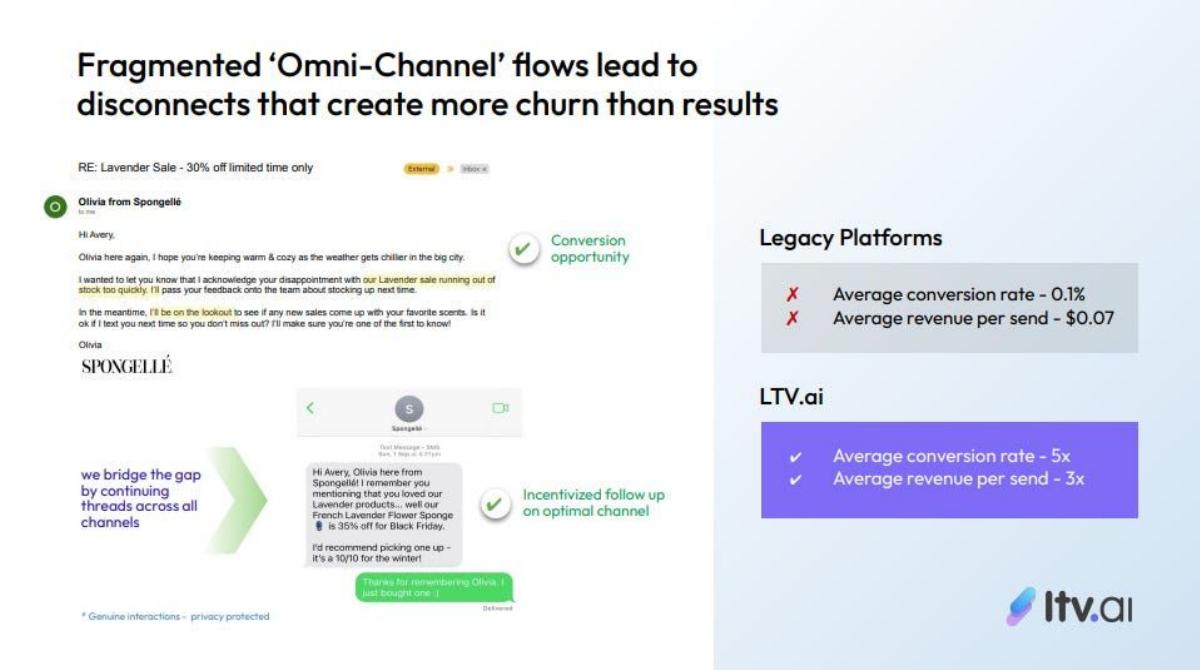
- The product achieves a 5x higher average conversion rate compared to the 0.1% industry average for legacy platforms, according to slide 4.
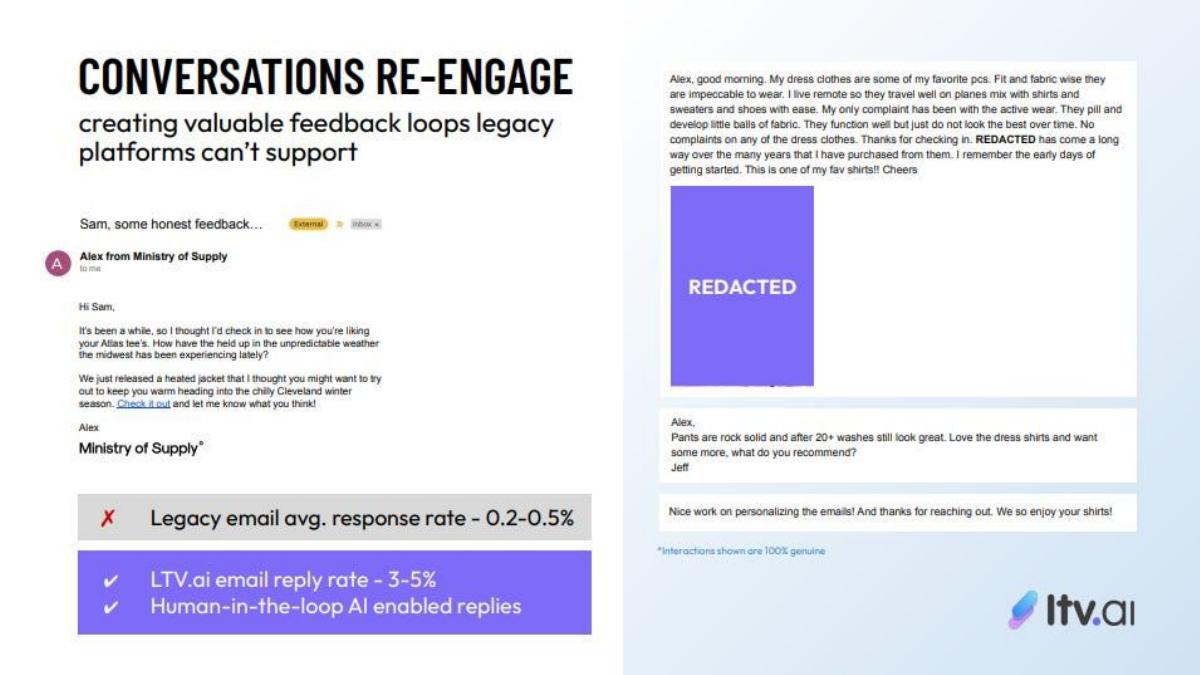
- Slide 5 introduces 'Human-in-the-loop AI enabled replies,' claiming a 3-5% email reply rate versus the 0.2-0.5% legacy average.
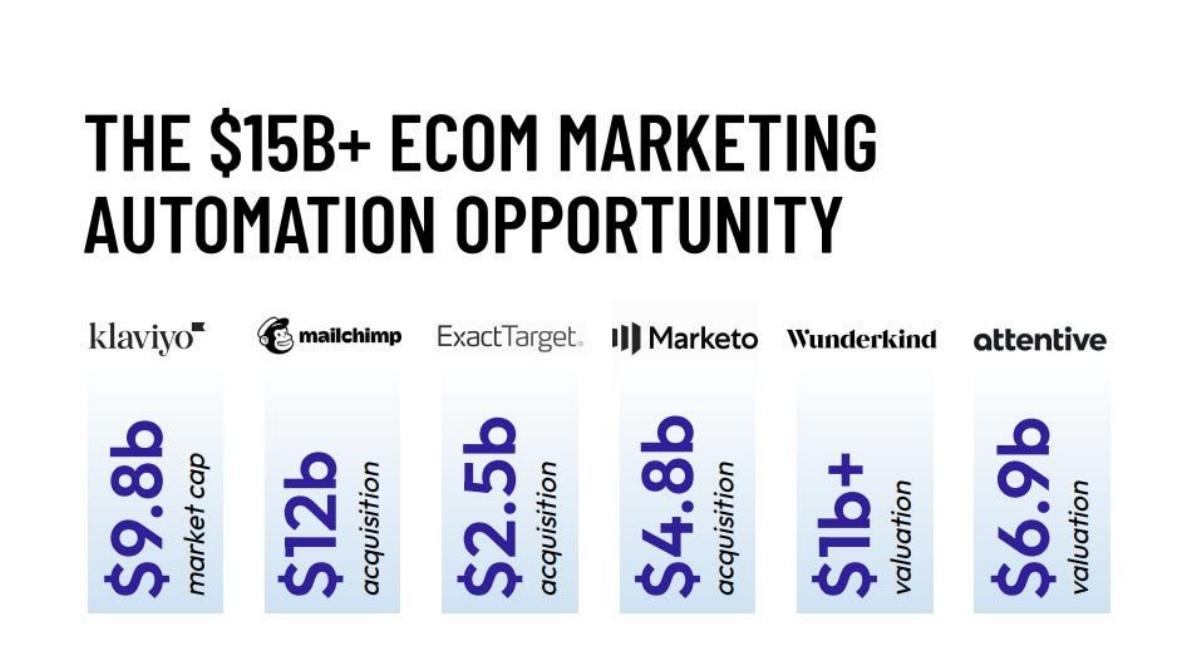
- The market opportunity is anchored against massive exits and valuations, including Mailchimp's $12b acquisition and Klaviyo's $9.8b market cap on slide 6.
- Slide 9 provides specific social proof from One Kings Lane, citing a 'double digit % increase in customer LTV.'
- The vision expands beyond e-commerce into hospitality, finance, and media, as shown on slide 10.
LTV.ai: The $5.2M Series A Pitch Deck Teardown
LTV.ai entered a crowded e-commerce marketing space in 2024 with a bold claim: that the giants of the industry—Klaviyo, Mailchimp, and Marketo—are effectively 'legacy spam' providers. By raising $5.2M in a Series A round, the company demonstrated that investors are hungry for AI-native replacements for established SaaS categories. This 10-slide deck is a focused, metrics-driven argument for why the old way of marketing is dead and why AI-driven personalization is the only way forward.
Slide 1: The Hook
The title slide sets an aggressive tone immediately. It doesn't just name the company; it states a thesis: "AI-NATIVE MARKETING DRIVES 3x MORE REVENUE THAN LEGACY SPAM." By using the word 'spam' to describe the current industry standard, LTV.ai creates a clear enemy. The sub-headline, "and we’ve built the platform that proves it," promises evidence for this claim in the following slides. This is a high-conviction opening that demands the reader's attention by promising significant ROI improvements.
Slide 2: The Market Problem
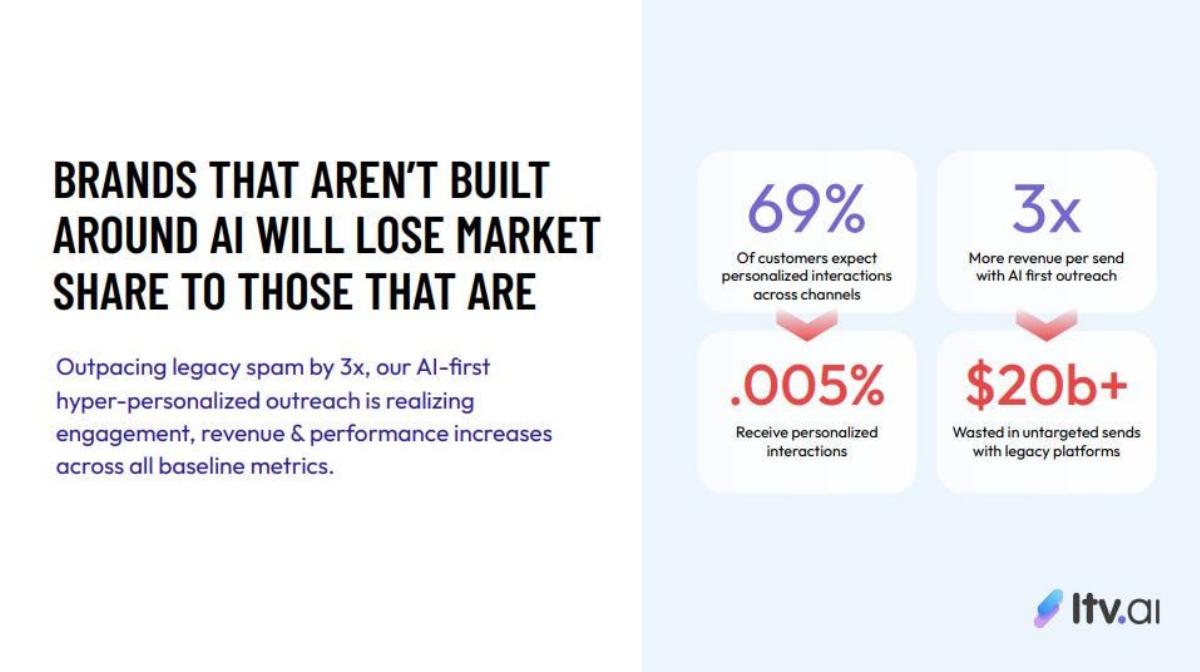
Slide 2 quantifies the 'spam' problem. It presents four key statistics to frame the market opportunity. First, it notes that 69% of customers expect personalized interactions, yet only .005% actually receive them. This massive gap represents the 'unmet need.' More importantly, it attaches a dollar value to the inefficiency: "$20b+ Wasted in untargeted sends with legacy platforms." By framing the problem as a multi-billion dollar waste, LTV.ai makes the adoption of their platform feel like a financial necessity rather than a luxury. The slide also reiterates the 3x revenue-per-send advantage for AI-first outreach.
Slide 3: Efficiency and Creative Burn
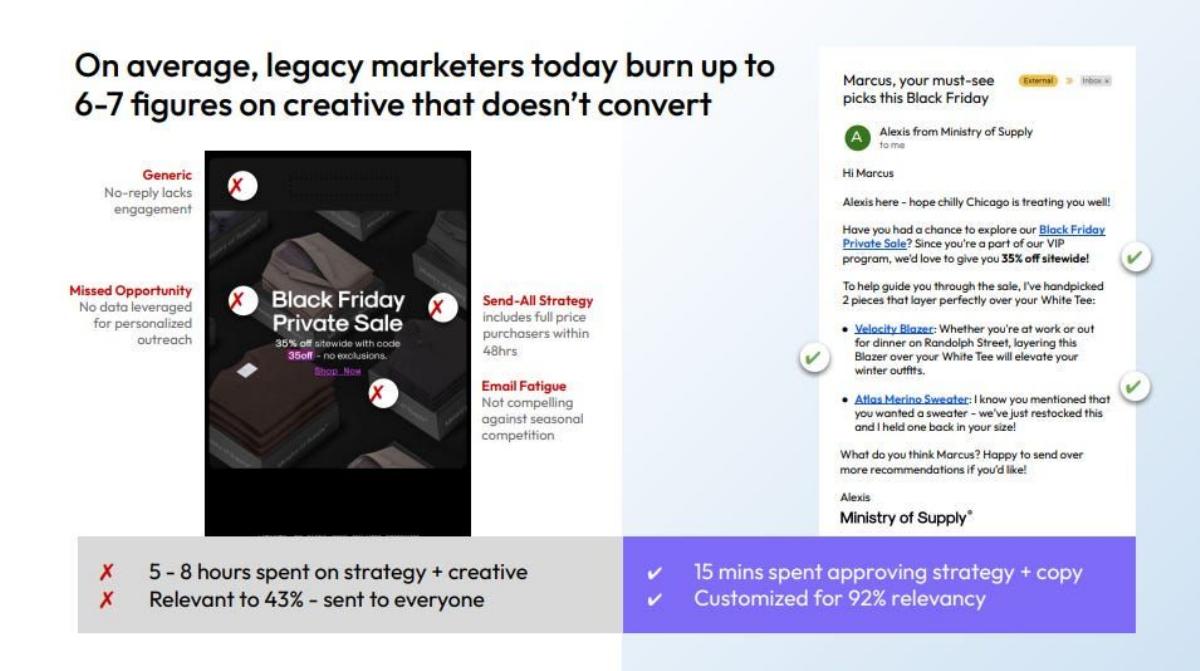
This slide addresses the operational pain points of marketing teams. It contrasts the 'Legacy' workflow with the 'LTV.ai' workflow. According to the slide, legacy marketers burn "6-7 figures on creative that doesn’t convert," spending 5-8 hours on strategy and creative that is only relevant to 43% of the audience. LTV.ai claims to flip this, requiring only 15 minutes for approval while achieving 92% relevancy . The visual comparison of a generic 'Black Friday' email versus a personalized, text-heavy AI email helps the investor visualize the product's output.
Slide 4: The Performance Gap
Slide 4 focuses on the 'Omni-Channel' disconnect. It argues that fragmented flows lead to churn. The core of this slide is the comparative table: legacy platforms have an average conversion rate of 0.1% and revenue per send of $0.07 . LTV.ai claims a 5x higher conversion rate and 3x higher revenue per send. The slide also shows a cross-channel interaction where an email conversation seamlessly transitions to an SMS follow-up, illustrating the 'bridge' the platform provides.
Slide 5: The Feedback Loop
One of the most unique claims in the deck appears on Slide 5: "Conversations Re-Engage." LTV.ai moves beyond one-way broadcasts to two-way dialogues. It highlights a 3-5% email reply rate , which is significantly higher than the 0.2-0.5% legacy average. The mention of "Human-in-the-loop AI enabled replies" is a critical technical detail; it suggests that the AI isn't just hallucinating responses, but is guided by human oversight to ensure brand safety and accuracy. The slide includes 'genuine interactions' from customers praising the personalization, providing qualitative proof to back up the quantitative claims.
Slide 6: The $15B+ Opportunity
To justify a Series A valuation, the company must show a massive exit potential. Slide 6 does this by listing the 'Legacy' giants and their valuations: Klaviyo at $9.8b , Mailchimp at $12b , and Attentive at $6.9b . By totaling these, LTV.ai identifies a $15B+ Ecom Marketing Automation Opportunity . The message is clear: if LTV.ai can replace even a fraction of these 'legacy' players with its superior AI technology, it will become a multi-billion dollar company.
Slide 7: Product Deep Dive - Personalization
Slide 7 shows the 'brain' of the operation. It displays a customer profile for 'Brendan' in Seattle, showing his 3-year history and last purchase data (2-5 packs of White Tees). The AI uses 'Conversational Insights'—such as the fact that Brendan is busy during weekdays and opens emails in the evening—to optimize the send time and content. The resulting email isn't just a template; it's a personalized note referencing his previous purchases and suggesting items that 'layer perfectly' over them. This slide effectively demonstrates how the LLM uses data to generate high-relevancy copy.
Slide 8: Optimization at Scale
Slide 8 expands on the optimization logic. It shows how the AI adjusts outreach based on customer segments: 'At-Risk,' 'Lapsed,' and 'Active.' For an At-Risk customer, the AI might say, "it’s been a while since the last we spoke," while for a Lapsed customer in NYC, it might mention the cold weather. This 'Climate Relative Recommendation' and 'Segment Aware Outreach' show that the platform isn't just sending one-off emails but is managing the entire customer lifecycle automatically.
Slide 9: Social Proof
Slide 9 is a dedicated testimonial slide featuring Andrew Templeton, Officer at One Kings Lane . The quote is powerful: "Our partnership with LTV.ai has already resulted in a double digit % increase in customer LTV , which has resulted in a nearly one to one increase in profitability." Having a high-profile retail brand vouch for a direct link between the software and profitability is perhaps the most important slide for a Series A investor concerned about product-market fit.
Slide 10: The Future Vision
The final slide addresses the 'What's Next?' question. While the current focus is email and SMS for e-commerce, LTV.ai aims to eliminate "repetitive, subpar marketing motions" across all industries. It lists logos for Hilton, American Express, Walgreens, Netflix, and Udemy as potential targets. This expands the TAM (Total Addressable Market) from just e-commerce to virtually every consumer-facing vertical, giving investors a reason to believe in the company's long-term growth potential.
What Works in This Deck
1. Aggressive Positioning: The deck doesn't play nice. By labeling industry leaders as 'legacy' and 'spam,' it creates a sense of urgency. It positions the transition to AI not as an upgrade, but as a survival requirement for brands.
2. Clear Comparative Metrics: Every claim is backed by a comparison. 5x conversion rates, 3x revenue, 15 minutes vs. 8 hours. These 'hard' numbers make the value proposition easy to digest and verify during due diligence.
3. Product Visualization: Instead of showing complex dashboard screenshots, the deck shows the output (the emails) and the input (the customer data profiles). This helps investors understand exactly what the customer sees and why it works.
4. Strong Social Proof: The One Kings Lane testimonial is specific. It doesn't just say "we like the tool"; it cites a "double digit % increase in LTV" and a "one to one increase in profitability."
What Is Missing from This Deck
1. The Team Slide: This is a glaring omission. In a Series A round, the pedigree of the founders is usually a primary selling point, especially in a technical field like AI. The deck provides no information on who is building this technology.
2. Financials and Traction: While the deck mentions percentage increases for clients, it does not list the company's own ARR (Annual Recurring Revenue), growth rate, or burn rate. Investors typically want to see the company's own financial health, not just their customers'.
3. The Ask: There is no slide detailing how much money is being raised or how the funds will be allocated. While the publisher reports a $5.2M raise, the deck itself is silent on the terms of the round.
4. Competitive Landscape: While it attacks 'legacy' players, it ignores the dozens of other 'AI-native' marketing startups that emerged in 2023 and 2024. A slide addressing why LTV.ai's LLM implementation is superior to other AI startups would have been beneficial.
What Other Founders Should Copy
1. The 'Enemy' Strategy: If you are entering a mature market, identify the 'Legacy' way of doing things and give it a negative label (like 'spam'). This makes your solution the obvious hero.
2. The 'Before and After' Workflow: Slide 3 is a perfect example of how to show time-savings. Don't just say you are faster; show the exact hours saved and the specific steps removed from the process.
3. Use 'Genuine Interactions': Including actual customer replies (as seen on Slide 5) is much more convincing than a generic marketing blurb. It proves that the product is actually resonating with the end-user.
4. Anchor to Big Exits: If you are in a space with massive incumbents, use their valuations to prove the market size. It reminds investors that if you win, the payout is enormous.
Frequently asked questions
- What is the primary value proposition of LTV.ai according to the deck?
- The primary value proposition is the transition from 'legacy spam' to 'AI-native marketing.' The deck argues that traditional platforms are inefficient, requiring 5-8 hours of creative work for low conversion rates. LTV.ai claims to automate this process, reducing work to 15 minutes of approval while increasing revenue per send by 3x and conversion rates by 5x.
- How does LTV.ai compare itself to competitors like Klaviyo and Mailchimp?
- LTV.ai positions these companies as 'legacy platforms' that facilitate untargeted, low-engagement 'spam.' On slide 6, it uses their high valuations (e.g., Mailchimp's $12b acquisition) to validate the size of the marketing automation market, while simultaneously arguing that their technology is becoming obsolete compared to AI-native solutions.
- What specific metrics does LTV.ai use to prove its effectiveness?
- The deck cites several key performance indicators: a 3-5% email reply rate (slide 5), a 5x increase in average conversion rates (slide 4), and a reduction in creative time from hours to 15 minutes (slide 3). It also mentions a 'double digit % increase in customer LTV' for specific clients like One Kings Lane.
- What is the 'Human-in-the-loop' feature mentioned in the deck?
- Mentioned on slide 5, 'Human-in-the-loop AI enabled replies' suggests that while the AI generates the content and handles the bulk of the conversation, there is a mechanism for human oversight. This is presented as a way to maintain quality and achieve significantly higher reply rates (3-5%) than traditional automated emails.
- Which industries does LTV.ai plan to enter next?
- Slide 10 outlines a vision to expand beyond e-commerce into Hospitality & Travel (citing Hilton), Financial Services (American Express), Healthcare & Wellness (Walgreens), Media & Entertainment (Netflix), and EdTech (Udemy).