LucidAct Health’s 2015 pitch deck is a masterclass in visual storytelling, albeit one that leans heavily on the presenter to fill in the gaps. With only 14 slides, the deck focuses on the massive $111 billion market opportunity and the company's early traction, including 30,000 patients and 100 nurses onboarded within eight months of launch. The narrative centers on solving the 'ball-drop' problem in chronic care through intelligent workflows and AI-driven smart notes. While the deck excels at showing product interfaces and team pedigree—featuring alumni from Stanford, IBM, and UCSF—it notabl…
Key takeaways
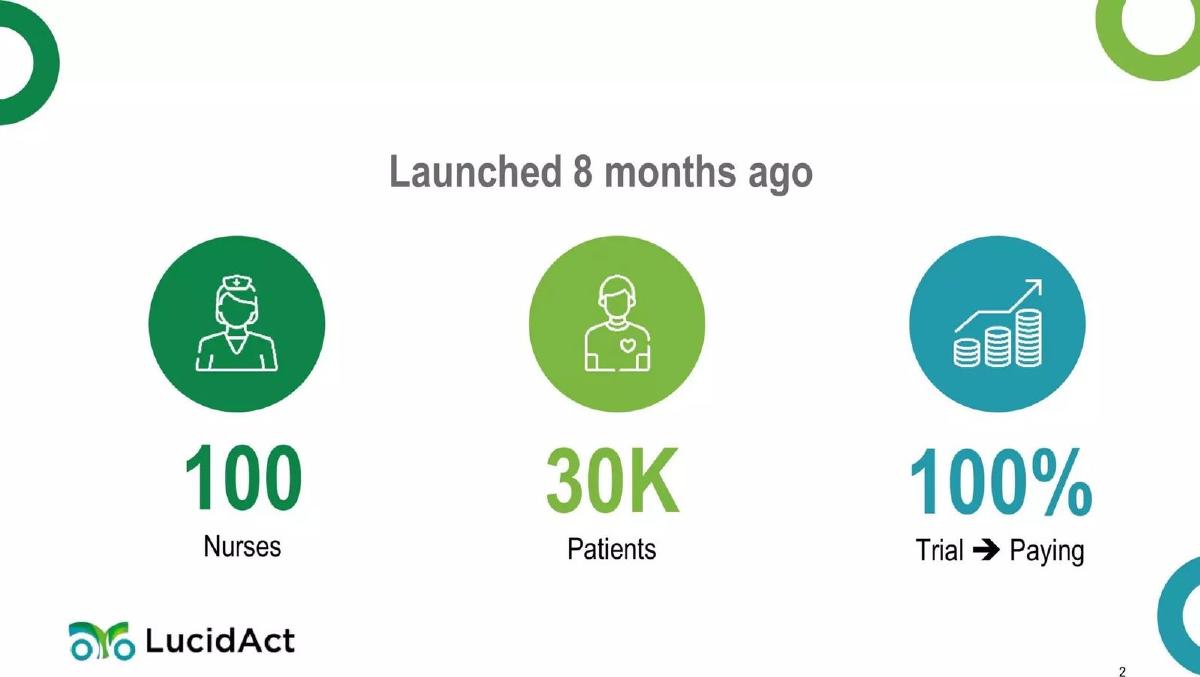
- The company achieved a 100% conversion rate from trial to paying customers within eight months of launch (Slide 2).
- LucidAct targets a massive $111 billion market in chronic care management (Slide 12).
- The platform manages 30,000 patients and 100 nurses as of the deck's publication (Slide 2).
- Product functionality includes 'Smart Notes' that identify risks like lack of transportation for elderly patients (Slide 8).
- The business model demonstrates a path to increase revenue per patient per month from $44 to $98 through add-on services (Slide 10).
- The team features significant healthcare and tech experience from institutions like Stanford Health Care, UCSF, and IBM (Slide 13).
- The deck uses a highly minimalist design, often omitting text entirely in favor of icons and workflow diagrams (Slides 3-6).
- There is no explicit 'Ask' slide detailing the amount of capital being raised or the intended use of funds.
Introduction: The Minimalist Approach to HealthTech
LucidAct Health’s 2015 pitch deck is a striking example of the 'less is more' philosophy. In an industry often bogged down by regulatory jargon and complex billing codes, LucidAct chooses to lead with icons, screenshots, and high-level metrics. The deck, consisting of 14 slides, was used to secure a $105,000 investment during a later stage of its early development. It focuses heavily on the 'Virtual Care Assistant' concept, positioning AI not as a futuristic replacement for doctors, but as a practical tool to prevent administrative ball-dropping in chronic care management.
Slides 1-2: Traction and Immediate Value
Slide 1 serves as the title page, introducing 'LucidAct AI Assistant for Chronic Care Management.' It establishes the co-founder, Cheong Ang, as the primary contact. The imagery of two nurses collaborating over a laptop sets a collaborative, clinical tone.
Slide 2 is the 'Traction' slide, and it is arguably the strongest in the deck. It states the company launched 8 months ago and already supports 100 nurses and 30,000 patients. The most critical figure here is the '100% Trial to Paying' conversion rate. For a seed or early-stage investor, this metric suggests that the pain point LucidAct is solving is so acute that every pilot program resulted in a contract.
Slides 3-6: The Silent Problem and Workflow
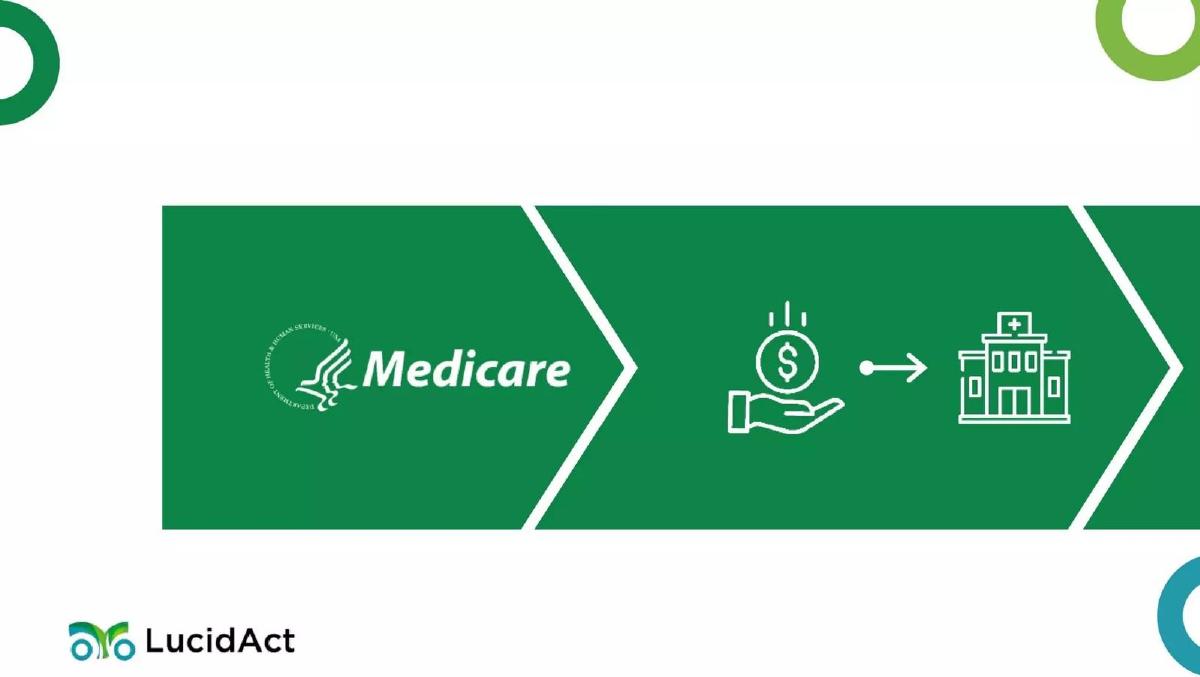
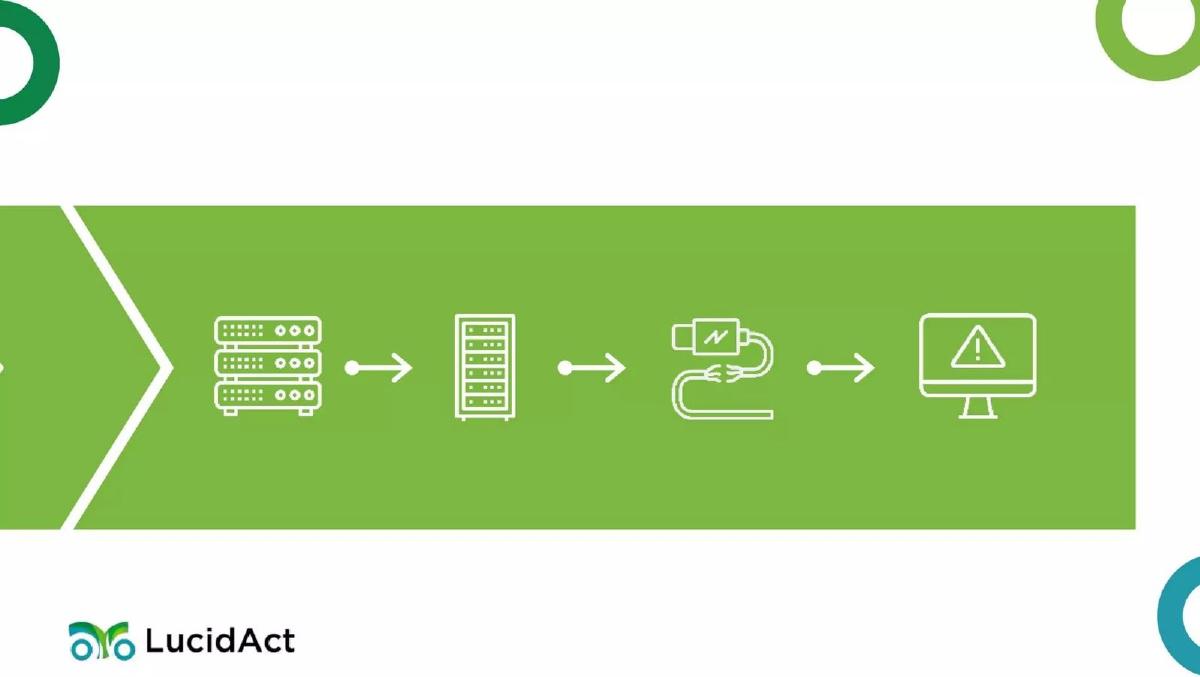
Slides 3 and 4 use a chevron-style workflow diagram to explain the ecosystem. Slide 3 shows the flow of Medicare funds to hospitals, while Slide 4 uses icons for servers, databases, and alerts to represent the technical backend. These slides are almost entirely devoid of text, relying on the presenter to explain how LucidAct integrates with existing hospital infrastructure and Medicare reimbursement cycles.
Slides 5 and 6 shift to the emotional and operational 'Problem.' Slide 5 shows a nurse in distress, head in hands, while Slide 6 is a blurred, high-motion shot of a medical team rushing a gurney. These visuals represent the 'chaos' of the current system. By not using bullet points to list problems like 'physician burnout' or 'care gaps,' the deck forces the audience to focus on the human element of the inefficiency.
Slides 7-9: Product and AI Capabilities
Slide 7 provides a clean look at the user interface. The 'My Tasks' screen shows a list of patients (e.g., Catherine Aagard, Chrissy Abbott) with specific action items like 'Check eligibility' or 'Send AWV reminder.' This demonstrates that the product is a functional workflow tool, not just a conceptual dashboard.
Slide 8 highlights the 'Smart Note' feature. This is the first real evidence of the 'AI' mentioned in the title. The system generates an alert for a patient named Eugene Abbott, noting he is at risk for a no-show because he is 78, lives alone, and has lacked transportation in the past. It provides a 'Yes/No' accuracy check, showing a feedback loop that helps the machine learning model improve—a detail that sophisticated tech investors look for.
Slide 9 is a conceptual illustration of automation, showing robotic arms interacting with a laptop. This is a bit of a departure from the clean UI shots and feels more like filler, but it serves to reinforce the 'Assistant' nature of the software.
Slides 10-12: Business Model and Market Size
Slide 10 breaks down the unit economics. It shows a 5x growth in patient volume alongside a revenue expansion path. The slide explicitly quotes a jump from '$44 to $98 per PATIENT Per MONTH' via an 'Add-On Service.' This is a vital slide because it shows that the company isn't just looking for more users; it has a strategy to increase the Lifetime Value (LTV) of each user.
Slide 11 is a placeholder for 'Medium to Large Health Care Customers.' In the version of the deck reviewed, the boxes are blank, which is a common tactic for decks shared publicly to protect client confidentiality, though in a live pitch, these would likely be populated with logos like Kaiser Permanente or Mayo Clinic.
Slide 12 presents the market opportunity: a massive '$111B Market.' Like many early-stage decks, this is a top-down market size. While it lacks a bottom-up calculation (TAM/SAM/SOM), the sheer scale of chronic care spending in the US makes the point that there is plenty of room for a dominant workflow player.
Slides 13-14: The Team and Closing
Slide 13 is the 'Team' slide, and it is impressive. It lists five key members, including CEO Grace Chen and CTO Cheong Ang. The logos beneath the names—Sutter Health, Stanford Health Care, UCSF Health, IBM, Intuit, and Cognizant—provide the 'pedigree' necessary to convince investors that this team has the clinical insight and technical chops to navigate the complex healthcare landscape.
Slide 14 concludes the deck by repeating the traction metrics (100 nurses, 30,000 patients) alongside a bar chart showing upward growth. It includes the company website and contact email, providing a clear call to action for follow-up.
What Works in This Deck
Clarity of Traction: By putting the 100% conversion rate on the second slide, LucidAct immediately answers the most important question: 'Does anyone want this?'
Visual UI: The screenshots in Slides 7 and 8 are crisp and professional. They show a product that is ready for deployment, which reduces 'execution risk' in the eyes of an investor.
Unit Economics: Slide 10 is excellent. It doesn't just say 'we will make money'; it gives specific dollar amounts ($44 to $98) and a mechanism for growth (Add-On Services). This allows investors to model out potential returns.
What is Missing
The Ask: There is no slide stating how much money the company is raising, the valuation they are seeking, or what the 'milestones' will be for the next 18 months. This is a significant omission for a fundraising deck.
Competitive Landscape: The deck assumes LucidAct is operating in a vacuum. There is no mention of Electronic Health Record (EHR) giants like Epic or Cerner, nor other care coordination startups. Investors need to know why a hospital wouldn't just use the built-in tools in their existing EHR.
Regulatory/Compliance: In healthcare, HIPAA compliance and Medicare billing codes are everything. The deck alludes to Medicare in Slide 3 but doesn't explain the specific regulatory hurdles the company has cleared or how it handles data security.
What a Founder Should Copy
The 'Smart Note' Example: Slide 8 is a perfect way to demonstrate AI. Instead of explaining 'natural language processing' or 'predictive analytics,' they show a specific note about a patient needing a ride. It’s tangible and easy to understand.
Logo Pedigree: The way the team slide (Slide 13) uses logos from former employers is a highly effective way to build instant credibility. If your team has worked at prestigious institutions, make those logos larger than the names.
Minimalist Design: The consistent use of the green and teal color palette, combined with plenty of white space, makes the deck feel 'medical' and 'clean.' It avoids the cluttered look that plagues many technical pitches.
Conclusion
LucidAct Health’s deck is a high-signal, low-noise presentation. It relies on the strength of its early numbers and the professional history of its founders to do the heavy lifting. While it leaves many questions unanswered—specifically regarding competition and the financial ask—it succeeds in its primary goal: proving that the team has built a product that healthcare providers are willing to pay for. For founders in the 'Intelligent Workflow' space, this deck provides a strong template for how to visualize a complex software solution without drowning the audience in text.
Frequently asked questions
- What is the core problem LucidAct Health is solving?
- LucidAct addresses the inefficiencies in chronic care management where patients often 'fall through the cracks.' Slides 5 and 6 visually depict the stress and chaos of healthcare environments, implying that manual tracking leads to burnout and missed interventions. The solution is an AI-driven workflow that automates reminders and coordinates actions between care teams, patients, and caregivers to ensure care plans are followed.
- How does LucidAct generate revenue?
- The deck outlines a per-patient, per-month (PPPM) revenue model. Slide 10 shows a base revenue of $44 per patient per month, with a clear upsell path to $98 through 'Add-On Services.' This suggests a SaaS-style recurring revenue model tied to the volume of patients managed through the platform, specifically targeting Medicare-reimbursable chronic care activities.
- What level of traction did the company have at the time of this deck?
- According to Slide 2, the company had been launched for eight months. In that time, they scaled to 100 nurses and 30,000 patients. Most importantly for investors, they claimed a 100% conversion rate from trial users to paying customers, indicating strong initial product-market fit and a compelling value proposition for healthcare providers.
- What technical capabilities does the LucidAct platform offer?
- The platform includes 'Intelligent Workflows' and 'Smart Notes.' Slide 8 demonstrates an AI-generated alert that identifies a patient's risk of a 'no-show' based on being 78 years old, living alone, and having a history of missed appointments due to transportation issues. It also features a task management interface (Slide 7) for care teams to track eligibility and reminders.
- Who are the founders and what is their background?
- The leadership team has deep roots in both clinical and technical fields. CEO Grace Chen brings experience from Sutter Health and Stanford Health Care, while CTO Cheong Ang has a background with UCSF Health and IBM. The broader team includes expertise in data science and engineering from companies like Intuit, Cognizant, and Pivotal (Slide 13).