Lumific’s 2013 seed deck is a study in extreme minimalism. Spanning only nine slides, the deck eschews traditional business sections like market size, competition, and financial projections in favor of a purely product-driven narrative. By focusing on the 'pain' of photo clutter—illustrated through a dense grid of unorganized images—and the 'relief' of automated curation, the founders successfully communicated the utility of their computer vision technology. Despite the lack of an explicit 'Ask' or business model, the deck leveraged early traction metrics, including 7,000 signups and 250,000…
Key takeaways
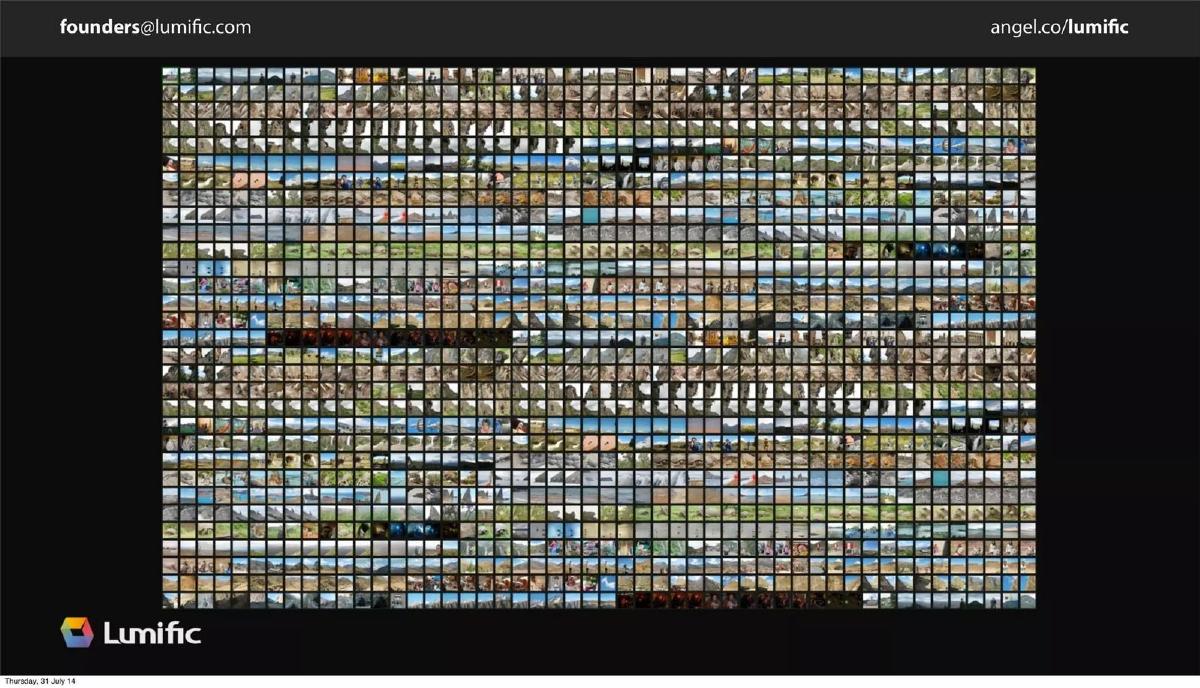
- The deck relies heavily on visual evidence, using a dense grid of 400+ thumbnails to illustrate the problem of photo clutter on slide 4.
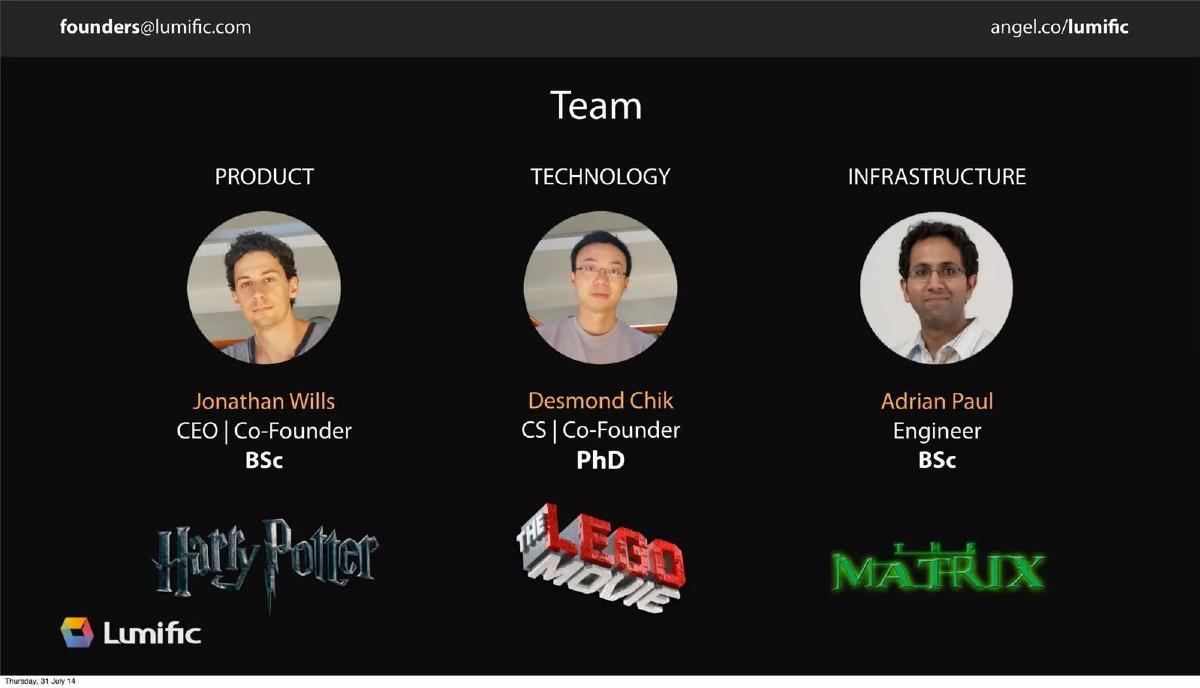
- The team slide (slide 2) emphasizes technical pedigree, highlighting a PhD in Computer Science and past work on major film franchises like The Matrix and The Lego Movie.
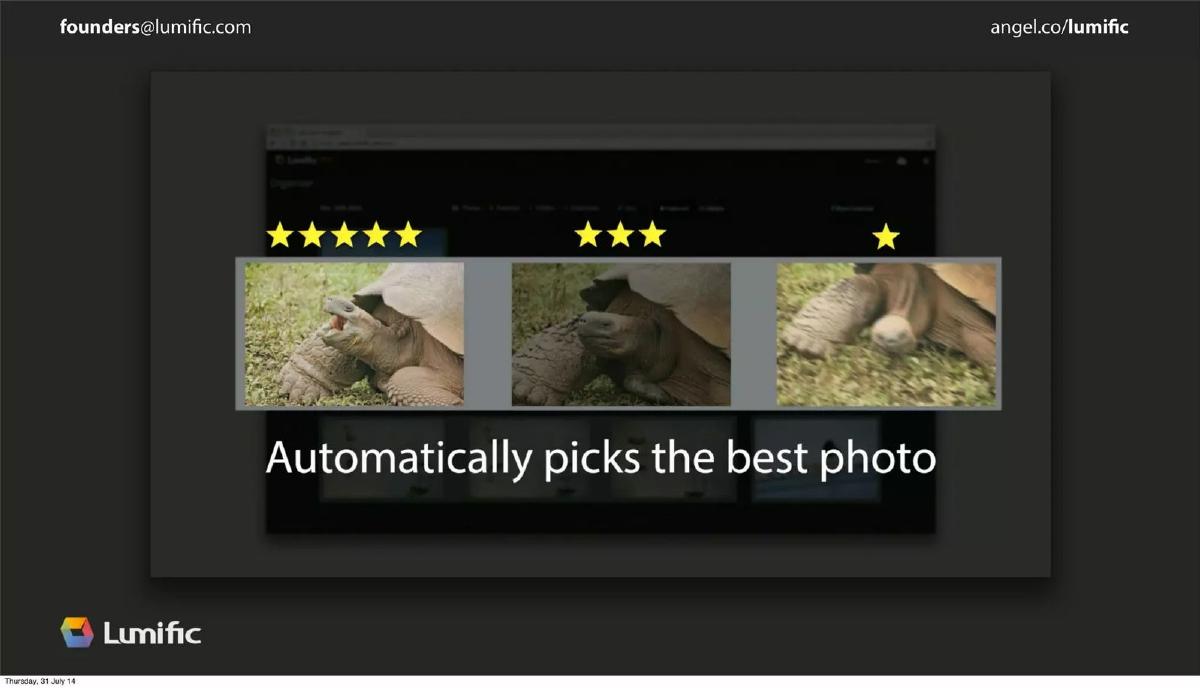
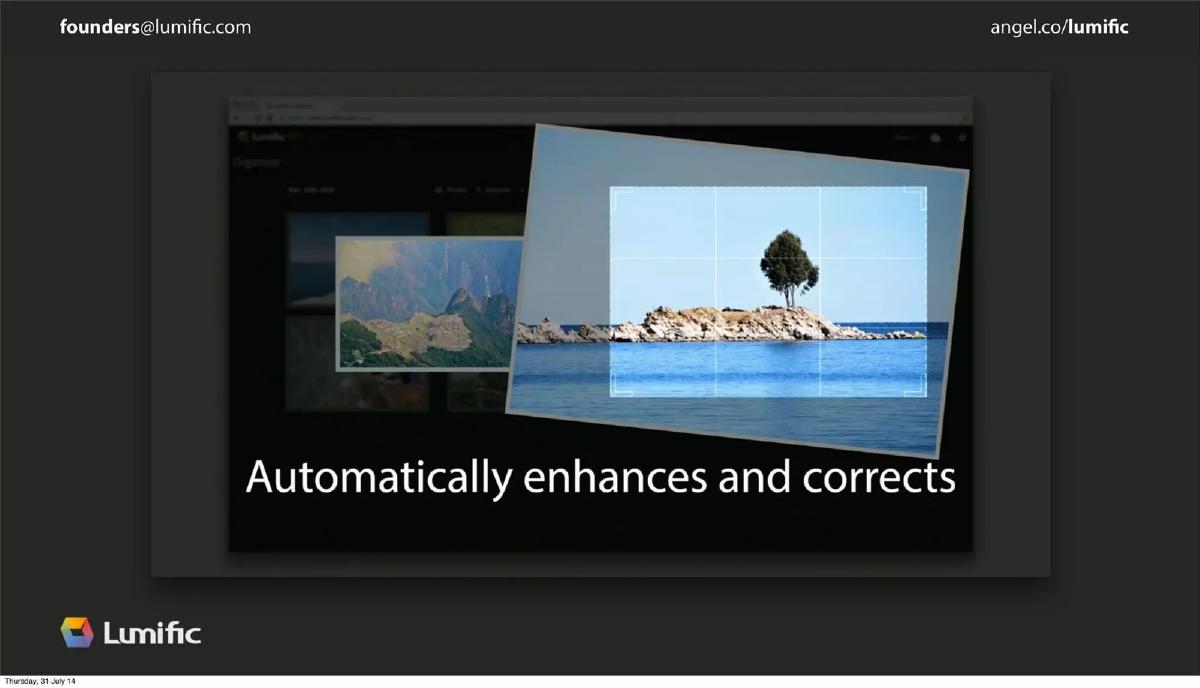
- Product functionality is distilled into two primary value propositions: automatic selection (slide 5) and automatic enhancement (slide 6).
- Traction is presented through two key metrics: 7,000 registered signups and 250,000+ photos processed (slide 7).
- The deck completely omits a market size (TAM/SAM/SOM) slide, leaving the scale of the opportunity to the investor's imagination.
- There is no business model or monetization strategy mentioned anywhere in the 9 slides.
- The 'Ask' is missing; the deck does not state how much capital is being raised or how it will be deployed.
- The presentation concludes with a simple platform announcement ('Now on Android') on slide 8, rather than a forward-looking roadmap.
The Lumific Teardown: A Masterclass in Visual Simplicity
Lumific’s 2013 seed deck is an anomaly in the world of fundraising. At just nine slides, it ignores almost every standard convention of the 'Sequoia-style' pitch deck. There is no mention of the market size, no competitive analysis, no financial projections, and no formal 'Ask.' Instead, the deck functions as a visual walkthrough of a single, powerful utility: making photos look better with zero effort.
Founded to bridge the gap between computer-automated and user-driven creativity, Lumific arrived at a time when smartphone photography was exploding, leading to the 'messy gallery' problem. This deck successfully raised $350,000 by proving the team could build a technical solution to a universal consumer pain point.
The Opening: Identity and Pedigree
Slide 1: Title Slide The deck opens with a clean, dark aesthetic. The logo is a multi-colored geometric cube, and the tagline is simple: 'Your smart photo assistant.' The inclusion of an AngelList URL and a direct 'founders@' email address in the header and footer of every slide signals that this was a deck designed for outreach and platform-based fundraising.
Slide 2: Team The team slide is strategically placed second, which is common for technical founders whose background is the primary 'why' for the investment. We see Jonathan Wills (CEO), Desmond Chik (CS/PhD), and Adrian Paul (Engineer). Rather than listing corporate logos, they use movie titles: Harry Potter , The Lego Movie , and The Matrix . This is a highly effective way to communicate that the team has handled complex visual data and infrastructure at the highest level of the entertainment industry. It establishes technical authority without a wall of text.
The Problem: The Photo Glut
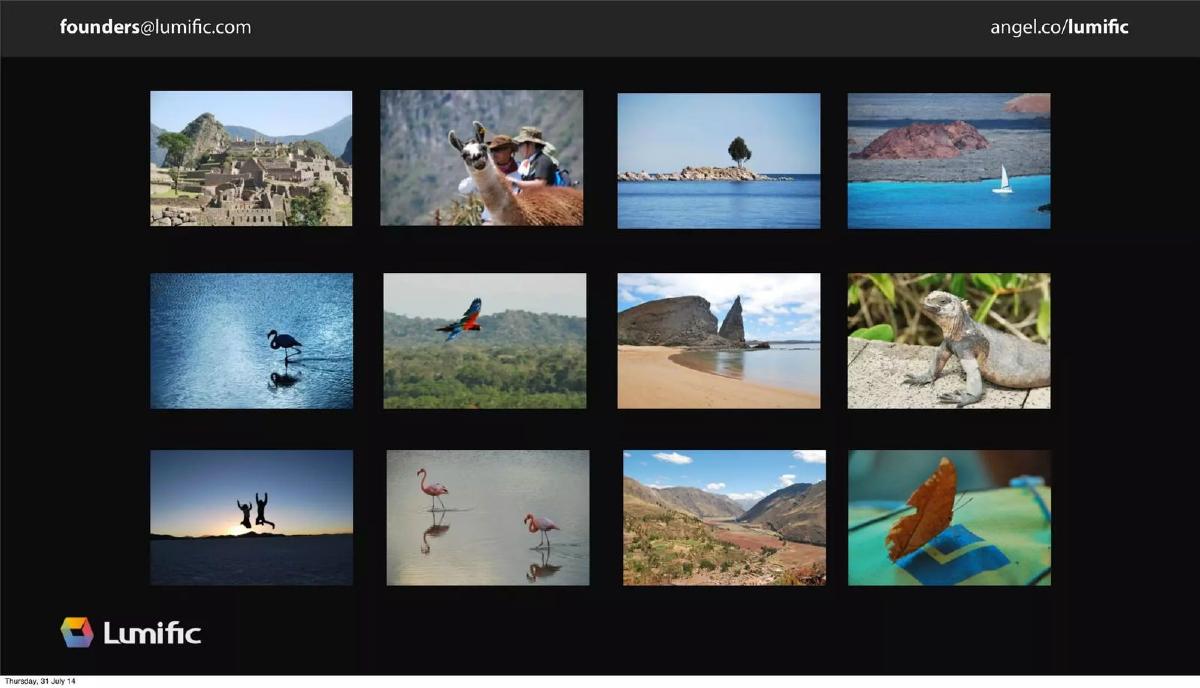
Slide 3: The Ideal This slide shows a clean 3x4 grid of twelve beautiful, distinct travel photos. It represents the 'end state'—what a user wants their photo gallery to look like: curated, high-quality, and diverse.
Slide 4: The Reality In stark contrast, slide 4 shows a massive, overwhelming grid of approximately 400 tiny thumbnails. Many are duplicates, many are poorly framed, and many are unedited. This is the 'Problem' slide, though it isn't labeled as such. It relies on the investor’s personal experience of having a cluttered camera roll to create an emotional connection to the product's necessity.
The Solution: Automation via Computer Vision
Slide 5: Selection Lumific introduces its first core feature: 'Automatically picks the best photo.' The slide uses a simple star-rating graphic over three similar photos of a tortoise. The best shot gets five stars, the mediocre one gets three, and the blurry one gets one. This clearly communicates the value of the algorithm in reducing clutter.
Slide 6: Enhancement The second feature is 'Automatically enhances and corrects.' The visual shows a 'Rule of Thirds' grid being applied to a photo, suggesting that the software doesn't just change colors, but understands composition and cropping. By showing the 'before' and 'after' logic, the founders demonstrate that their 'smart assistant' actually has an aesthetic 'eye.'
Traction and Availability
Slide 7: Traction This is the only data-heavy slide in the deck. It features a blue area chart showing a growth trend up to 7,000 registered signups . Next to it, a gear icon denotes 250,000+ photos processed . For a $350k seed round in 2013, these were respectable numbers that proved the technology worked at scale and that there was initial user interest.
Slide 8: Platform Expansion The penultimate slide simply states 'Now on Android' with a screenshot of the app interface. This shows the product is cross-platform and ready for a wider audience, moving beyond a mere web demo or iOS beta.
Slide 9: Contact A repeat of the title slide with contact information. The deck ends as abruptly as it began.
What Works in the Lumific Deck
1. Visual Storytelling: The transition from Slide 3 to Slide 4 is a perfect 'Before and After' for a problem/solution narrative. It requires no reading to understand exactly what the company does.
2. Technical Credibility: By highlighting a PhD and high-end film industry experience, the founders answer the 'Can they build it?' question immediately. In a computer vision startup, the team is often the most important asset.
3. Focus: The deck does not get distracted by secondary features. It does two things—picks photos and fixes photos—and it hammers those points home repeatedly.
What is Missing from the Lumific Deck
1. The Market Opportunity: There is no mention of how many people take photos, the rise of smartphone usage, or the potential for a 'prosumer' market. Investors are left to calculate the TAM (Total Addressable Market) themselves.
2. Business Model: How does Lumific make money? Is it a subscription? A freemium model with paid storage? A B2B API for other photo apps? The deck is silent on revenue, which is a significant risk for any pitch.
3. Competitive Landscape: In 2013, companies like Google and Apple were already starting to integrate basic 'Auto-enhance' features into their OS. Lumific doesn't explain how it stays ahead of the platform giants.
4. The Ask: A pitch deck is a sales tool. Failing to include a slide that says 'We are raising $X to achieve Y' is a missed opportunity to set the terms of the conversation.
What Founders Should Copy
1. The 'Show, Don't Tell' Approach: If your product is visual, your deck should be visual. Lumific uses almost no bullet points, which keeps the viewer focused on the product's output.
2. Simplified Traction: Slide 7 is a great example of how to present early-stage metrics. It focuses on 'Signups' and 'Activity' (photos processed), which are the two most important indicators of product-market fit for a utility app.
3. Logo-Based Credibility: If you have worked on famous projects, use their logos. It is much more evocative than writing 'I worked as a software engineer on a major film franchise.'
Final Thoughts
Lumific’s deck is a 'Product First' pitch. It assumes that if the utility is high enough and the technology is defensible, the business case will follow. While this approach is risky and omits critical financial data, it succeeded in raising a seed round by clearly defining a problem and demonstrating a working solution. For founders with a highly technical product, this minimalist approach can be a powerful way to cut through the noise, provided the product's 'wow factor' is as clear as it is in these slides.
Frequently asked questions
- What is the primary problem Lumific is trying to solve?
- Lumific addresses the 'photo glut' problem. As shown on slide 4, users often have hundreds of nearly identical or unedited photos that are difficult to manage. The deck positions Lumific as a 'smart photo assistant' that uses computer vision to automatically curate the best shots and apply necessary edits, reducing the manual labor required for photo management.
- How does the team establish credibility without a long list of prior startups?
- The team uses 'cultural shorthand' on slide 2. Instead of listing previous employers in text, they use the logos of Harry Potter, The Lego Movie, and The Matrix. This suggests they have high-level experience in visual effects or digital infrastructure for major media properties, which directly correlates to the technical challenges of automated photo editing.
- Is there any mention of competition in the Lumific deck?
- No. The deck does not include a competitive landscape or a 'magic quadrant' slide. In 2013, the space for automated photo curation was relatively new, but the omission is still notable. The founders chose to focus entirely on their own product's ease of use rather than comparing themselves to existing tools like Instagram or Flickr.
- What stage of development was the product in when this deck was used?
- The product was live and functional. Slide 7 shows a growth curve reaching 7,000 signups, and slide 8 specifically announces the launch of the Android version. This indicates the deck was used for a seed round intended to scale an existing, albeit early-stage, mobile and web application.
- Why would an investor fund a deck that lacks a business model?
- In 2013, many seed-stage consumer apps focused on 'utility and growth' first, with the assumption that a large enough user base managing a primary data source (photos) would lead to monetization opportunities later (e.g., printing, storage, or premium features). The $350,000 raised suggests investors were betting on the team's technical ability to solve a difficult computer vision problem.