Lunio’s 12-slide Series A deck is a clinical example of how to frame an adtech problem as a cybersecurity mission. By anchoring the narrative in the $85bn lost annually to bots and fraud (Slide 1) and highlighting a leadership team with roots in Israel's elite Unit 8200 (Slide 2), the company moves beyond simple 'click fraud' into the broader category of 'Go-To-Market Security.' The deck demonstrates significant momentum, transitioning from a Google-only tool in 2019 to a cross-platform SaaS platform by late 2021 (Slide 3). While the deck is light on specific financial unit economics or a det…
Key takeaways
- The deck identifies a massive $85bn annual loss for go-to-market teams due to bots and fraud on Slide 1.
- Lunio positions itself as 'Go-To-Market Security' rather than just adtech, citing that 39% of web traffic is from bad bots on Slide 2.
- The company highlights a technical pedigree from Unit 8200, Israel’s elite cyber unit, to establish immediate trust on Slide 2.
- A clear timeline on Slide 3 shows the evolution from 'PPC Protect' in 2019 to the re-branded 'Lunio' in Q2 2022.
- The product vision 'Analyze One, Protect All' is visualized on Slide 4, showing integrations with Google, Meta, LinkedIn, and Twitter.
- Technical differentiation is centered on WASM analysis for client-side processing, which ensures no PII is transmitted, as stated on Slide 5.
- The leadership team features founders who scaled 7-figure agencies and a CMO with experience from Series A to post-IPO at Datto on Slide 6.
- The deck omits a specific 'Ask' slide, detailed financial projections, and a direct competitor comparison table.
The Hook: A Multi-Billion Dollar Hemorrhage
Slide 1: The Mission
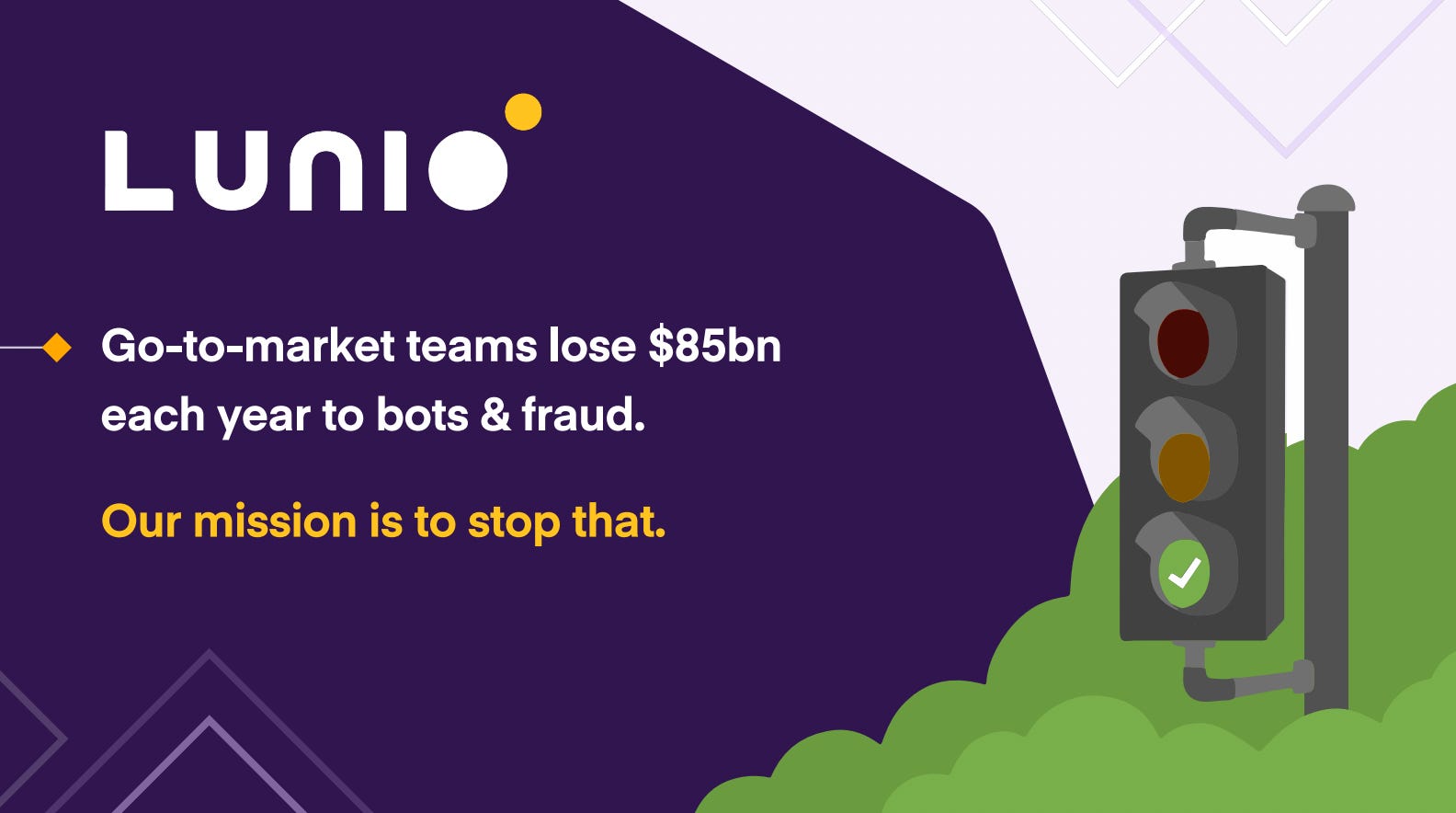
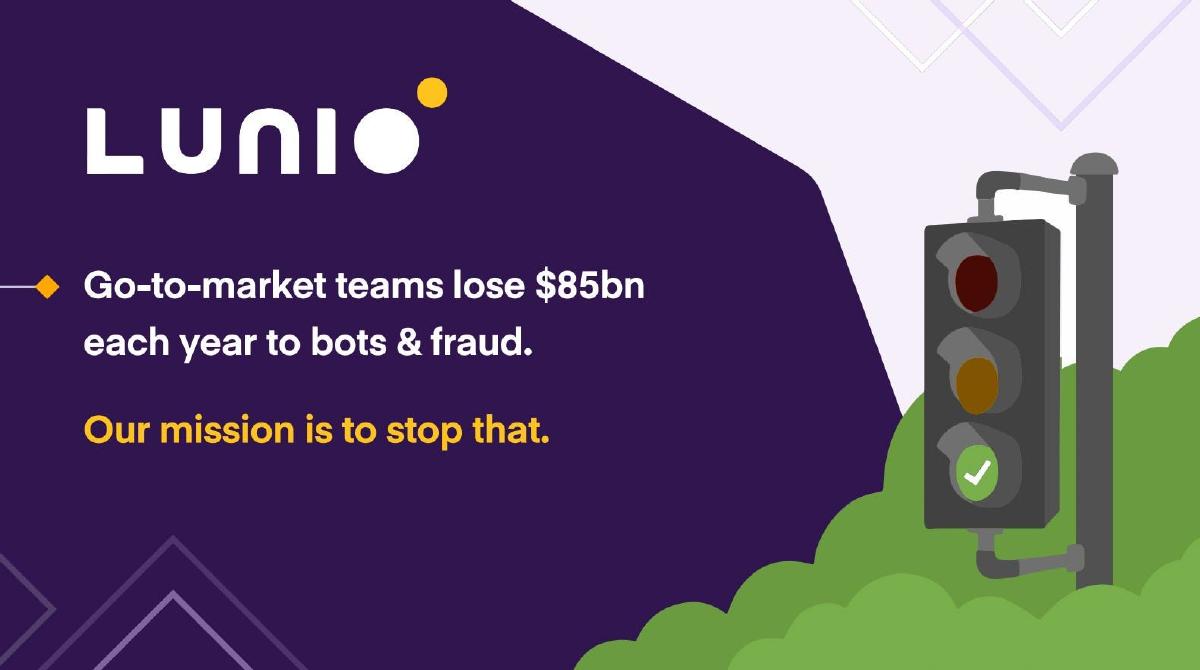
Lunio opens with a stark, high-contrast slide that defines the stakes. The headline states that Go-to-market teams lose $85bn each year to bots & fraud. This is a classic 'hair on fire' problem statement. By framing the mission as 'to stop that,' Lunio positions itself not as a luxury tool, but as a financial recovery mechanism. The visual of a traffic light with a green checkmark reinforces the concept of 'clearing' traffic for safety and efficiency.
Slide 2: The Cybersecurity Pedigree
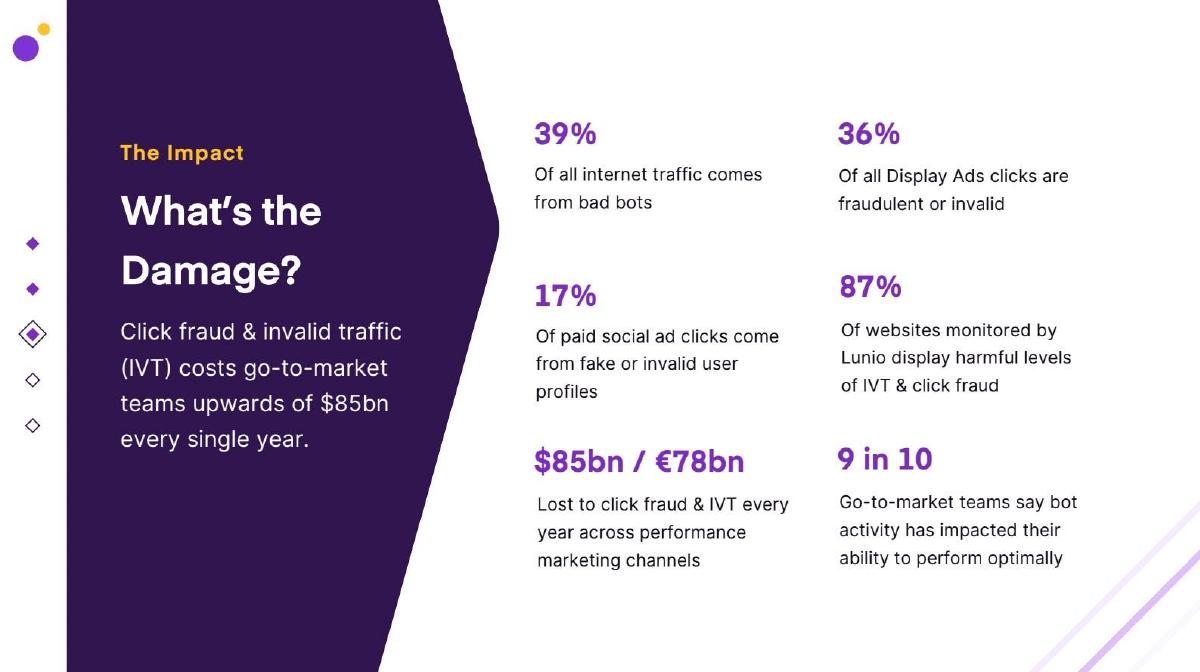
This slide is arguably the most important for establishing technical credibility. It introduces the term Go-To-Market Security , a clever category-creation play that elevates the product from a simple marketing plugin to a security necessity. The slide claims the tech is Powered by the Top Minds out of Unit 8200 , Israel’s elite cyber unit. This is a powerful signal to VCs, as Unit 8200 is globally recognized for producing top-tier cybersecurity startups. The slide also provides a data point: 39% of all web traffic is from bad bots , explaining that this traffic skews analytics and infects CRM data with fake leads.
Slide 3: The Journey and Momentum
Slide 3, titled The Story so far , provides a chronological roadmap of the company's execution. Key milestones include:
Q1 2019: Launched Google invalid traffic prevention. · Q4 2020: Raised $2.8m seed round led by Fuel Ventures. · Q1 2021: Reached a specific ARR milestone (redacted in the provided text). · Q4 2021: Launched cross-platform invalid traffic prevention. · Q2 2022: Re-branded PPC Protect to Lunio.
This timeline demonstrates that the team can execute on product development 'at rapid speed' and has successfully transitioned from a single-channel tool to a cross-platform SaaS platform.
Slide 4: Product Visualization - Analyze One, Protect All
This slide explains the mechanics of the platform. The 'Analyze One, Protect All' tagline suggests a unified dashboard for fragmented ad spend. The visual shows a central hub (represented by a red panda icon) connecting to major platforms: Google, Meta (Facebook/Instagram), Twitter, and LinkedIn. The screenshot of the dashboard displays metrics like Re-Allocated Budget ($79,144.59) and Prevented Invalid Clicks (27,191) . This makes the value proposition tangible: the software literally shows the user how much money it is saving them in real-time.
Slide 5: Technical Differentiation and Privacy
Slide 5 answers the 'Why Lunio?' question by breaking it down into four quadrants: Technology, Results, Privacy, and Analytics. The technical highlight is the use of highly efficient WASM (WebAssembly) analysis . This is a specific technical choice that allows for powerful client-side processing. The privacy angle is equally strong, stating that no sensitive PII (Personally Identifiable Information) is transmitted or stored by Lunio. In a post-GDPR world, this is a critical selling point for enterprise clients who are wary of third-party data handlers.
Slide 6: The Leadership Team
The final slide in the provided set showcases the 'Incredible Leadership Team.' The profiles are designed to prove they have 'been there, done that':
Neil (CEO): Scaled a 7-figure marketing agency; built his first revenue-generating site at 13. · Segev (COO): Exited a successful Ecom startup; Ex-IDF working in classified electronic warfare. · Alex (CBO): Scaled a 7-figure marketing agency; top 1% national grade in Chemistry. · David (CTO): Captain in the IDF; national chess champion at age 10. · Pete (CMO): Ex-Datto CMO (Series A to post-IPO); Ex-Malwarebytes CMO.
The inclusion of Pete, a CMO with post-IPO experience, suggests the company is preparing for significant scale, while the IDF and agency backgrounds of the others provide a mix of technical grit and market knowledge.
What Works in the Lunio Deck
Category Creation: By calling themselves 'Go-To-Market Security,' Lunio moves out of the crowded 'AdTech' bucket and into the higher-multiple 'Cybersecurity' bucket. This is a strategic framing choice that likely helped justify a $15M Series A valuation.
Pedigree as a Proxy for Quality: The repeated mentions of Unit 8200 and the IDF (Slides 2 and 6) serve as a powerful proxy for technical excellence. In a field like ad fraud, where the 'bad actors' are constantly evolving, investors want to know the 'good actors' have military-grade experience.
Quantifiable Value: The dashboard screenshot on Slide 4 isn't just a UI flex; it shows the 'Re-Allocated Budget.' This tells investors that the product has a built-in ROI calculator, making it a 'must-have' during budget cuts.
What is Missing from the Lunio Deck
The Competitive Landscape: The deck does not mention competitors like DoubleVerify, Integral Ad Science, or CHEQ. Investors would want to know how Lunio's WASM-based approach specifically beats the incumbents.
Unit Economics: While Slide 3 mentions 'highly capital efficient growth,' there are no specific figures for CAC (Customer Acquisition Cost), LTV (Lifetime Value), or Churn. At the Series A stage, these metrics are usually mandatory.
The Ask: The provided slides do not include a slide detailing the $15M raise or the specific allocation of those funds (e.g., 50% R&D, 30% Sales, 20% Marketing). This was likely handled in a separate document or a later slide not included in the primary narrative deck.
Founder's Guide: What to Copy
The 'Story So Far' Format: Slide 3 is an excellent template for showing progress. It doesn't just list dates; it shows a logical progression from a niche tool (Google PPC) to a broad platform (Lunio). Founders should use this to show they have a long-term vision but can hit short-term milestones.
Technical Transparency: Slide 5 mentions 'WASM analysis.' Even if an investor doesn't fully understand WebAssembly, the specificity provides a 'reason to believe' that the tech is superior. Don't just say your tech is 'AI-powered'; name the specific architecture or method that gives you an edge.
The 'Problem-Mission' Slide: Slide 1 is a masterclass in brevity. One big number ($85bn), one clear problem (bots & fraud), and one simple mission. If you can't explain your company's reason for existing in under 20 words, your pitch is too complex.
Frequently asked questions
- What is the core problem Lunio solves?
- Lunio addresses the financial drain caused by invalid traffic (IVT) and ad fraud. According to Slide 1, go-to-market teams lose $85bn annually to bots. Slide 2 further specifies that 39% of all web traffic originates from bad bots, which skews analytics, wastes marketing budgets, and infects CRM data with fake leads.
- How does Lunio differentiate its technology from other ad fraud tools?
- Lunio emphasizes two main technical pillars on Slide 5: WASM (WebAssembly) analysis and privacy. By using highly efficient WASM for client-side data processing, they can detect fraud without transmitting or storing sensitive Personally Identifiable Information (PII), which is a significant advantage for compliance-heavy enterprises.
- What is the significance of the 'Unit 8200' mention?
- Mentioned on Slide 2 and Slide 6, Unit 8200 is Israel's elite military intelligence unit. By highlighting that their technology is powered by minds from this unit and featuring a CTO who was a Captain in the IDF, Lunio signals to investors that their fraud detection capabilities are built on world-class cybersecurity foundations.
- Does the deck show evidence of product-market fit?
- Yes, Slide 3 outlines a clear growth trajectory. It shows the launch of Google invalid traffic prevention in Q1 2019, a $2.8m seed round in Q4 2020, and the expansion to a cross-platform solution by Q4 2021. The rebranding to Lunio in 2022 suggests a move toward a broader market identity beyond just 'PPC protection'.
- What key fundraising elements are missing from this deck?
- The deck is missing a specific 'Ask' slide detailing how the $15M will be spent. It also lacks a detailed slide on unit economics (LTV/CAC), a comprehensive competitor matrix, and a clear breakdown of the Total Addressable Market (TAM) beyond the initial $85bn loss figure.