M30's 15-slide deck focuses on solving the fragmentation of the public API ecosystem by offering a unified platform with consolidated billing and a single framework. The company highlights significant early traction, reporting 6,500 signups and 1 million monthly API calls within months of launch. By leveraging the open-source success of 'Micro,' which sees 1 billion requests per day, M30 positions itself as a developer-first utility. The deck clearly outlines a tiered business model and a specific $5 million funding ask to scale their team and API catalog. While it lacks detailed market size…
Key takeaways
- The platform aims to be a single source for exploring and consuming public APIs with consolidated billing (Slide 3).
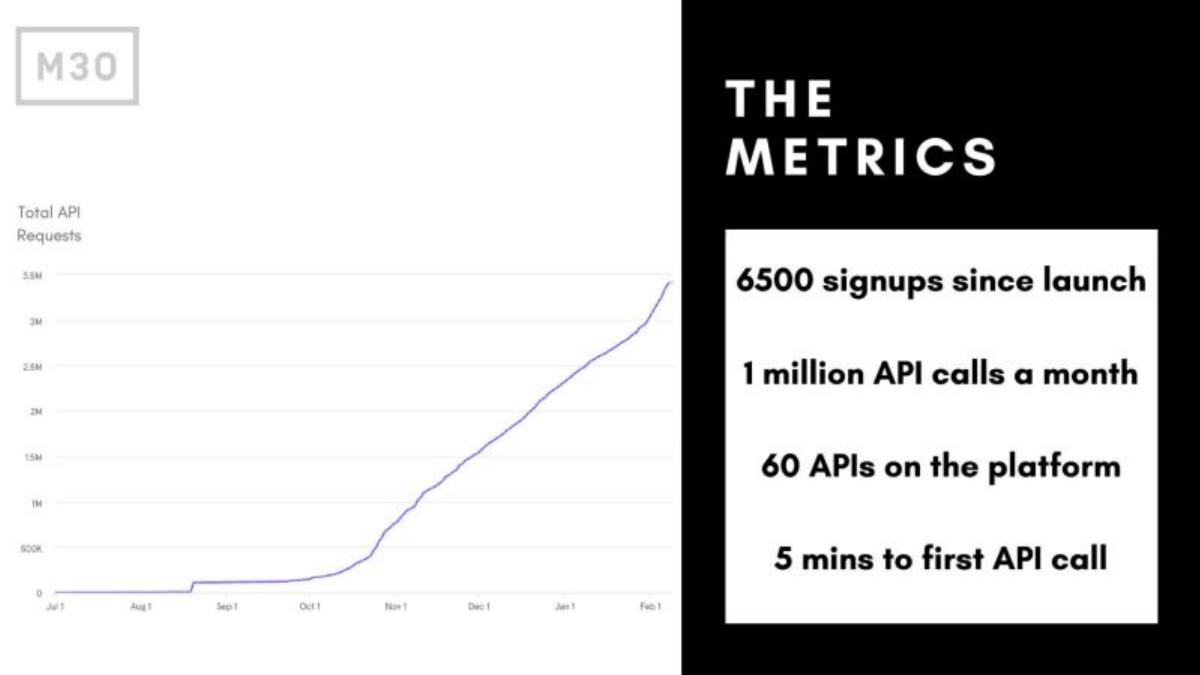
- M30 reported 6,500 signups and 1 million monthly API calls as of February 2021 (Slide 5).
- The technology is powered by 'Micro,' an open-source project with over 10k GitHub stars and 1 billion daily requests (Slide 7).
- The business model includes a free tier for the first 1 million calls, then $1 per million calls thereafter (Slide 8).
- Future recurring subscriptions are planned at $25/month for Pro and $45/month per user for Team tiers (Slide 9).
- A case study with OpenBooking shows migration from Twilio, Sendgrid, and AWS S3 to M30 for reduced complexity (Slide 10).
- The founding team includes the CEO of Micro, the former CTO of Monzo, and a Dev UX lead from Cisco (Slide 12).
- The deck explicitly asks for $5 million to reach milestones like a 100-API catalog and 100,000 users (Slide 13).
Executive Summary: The Unified API Layer
M30 positions itself as the "Next Generation Cloud" in its opening slide. The core thesis is that the modern web is increasingly built on third-party APIs, but the management of these disparate services has become a bottleneck for developers. By providing a single platform for discovery, integration, and billing, M30 aims to become the utility layer for the API economy. The deck is characterized by a minimalist aesthetic—black backgrounds with white text—and a heavy reliance on technical traction metrics and open-source pedigree.
Slides 1-3: The Vision and The Consolidation Play
Slide 1 serves as the title card, introducing the brand and the tagline "Next Generation Cloud." It is simple and establishes the high-level category the company intends to own.
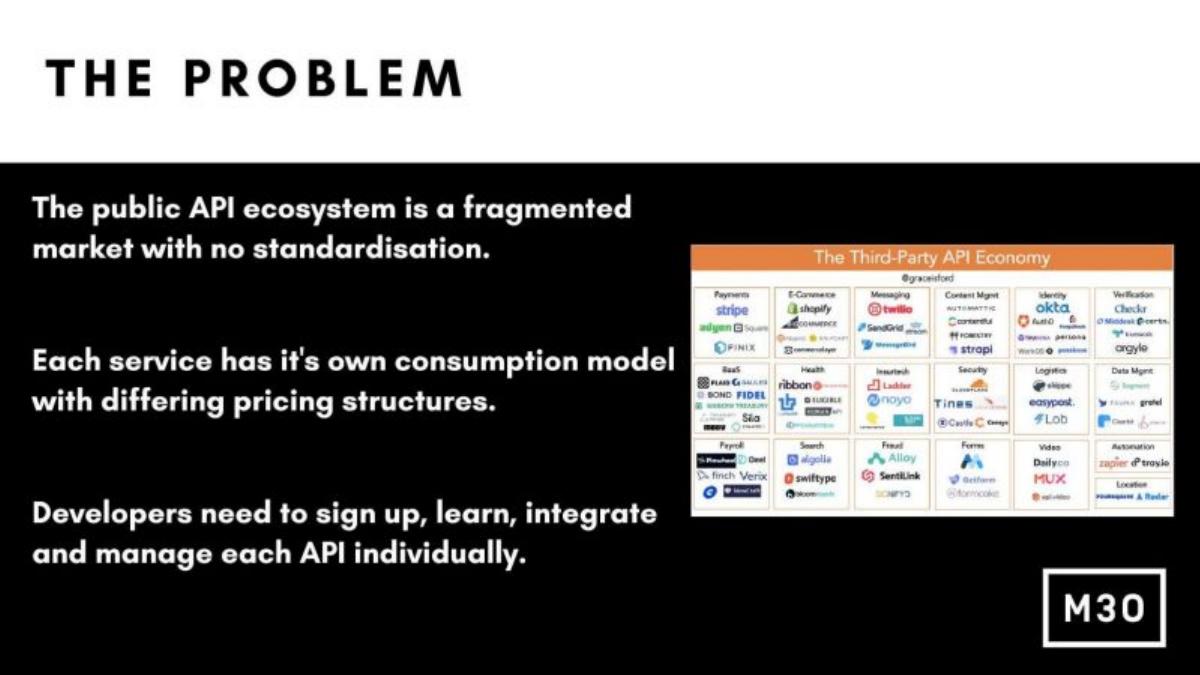
Slide 2 , titled "The Problem," uses a well-known industry graphic of the "Third-Party API Economy" to illustrate market fragmentation. The slide lists three pain points: no standardization, differing pricing structures for every service, and the manual effort required for developers to manage each API individually. This is a classic "hair-on-fire" problem for engineering teams who spend significant time on plumbing rather than core product features.
Slide 3 presents "The Solution." M30 proposes a three-pronged approach: one platform to explore and consume APIs, one account for consolidated billing, and one framework to integrate everything as a service. By repeating the word "ONE," the slide emphasizes simplicity and the reduction of cognitive load for the end user.
Slides 4-6: Product and Early Momentum
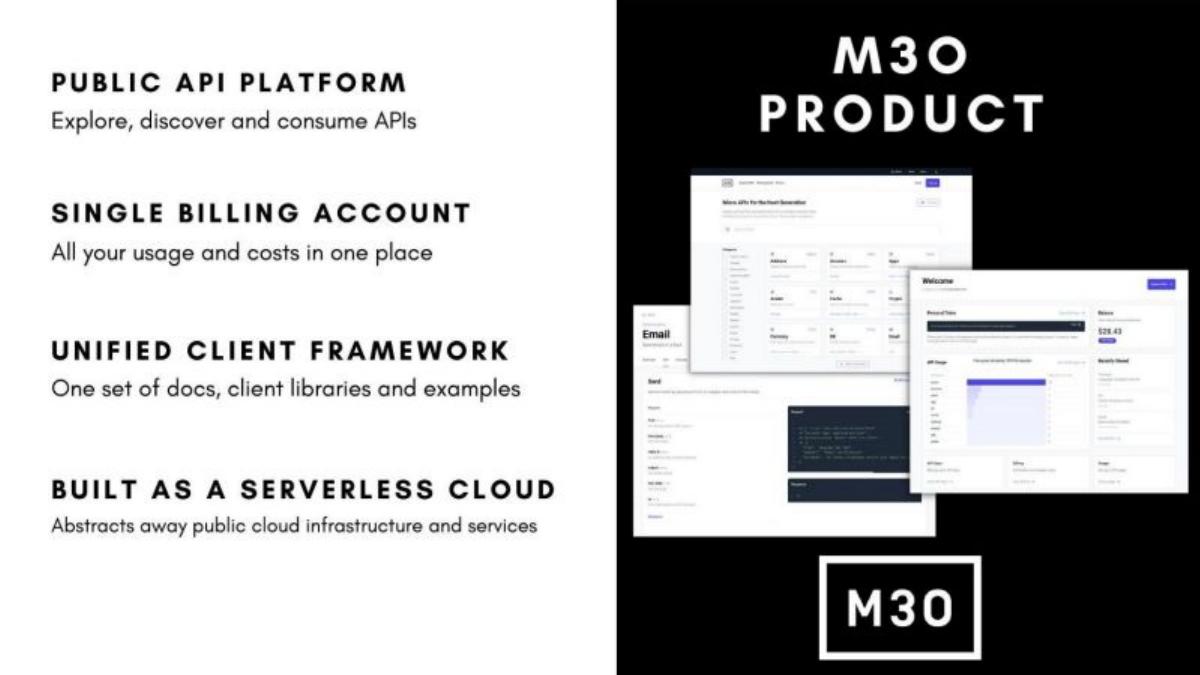
Slide 4 provides a glimpse into the "M30 Product." It lists four key features: the Public API Platform, the Single Billing Account, the Unified Client Framework (which includes one set of docs and client libraries), and the fact that it is built as a serverless cloud. The screenshots show a clean dashboard with API usage charts and a catalog of available services like 'Address', 'Avatars', and 'Cache'.
Slide 5 is the "Metrics" slide, which is arguably the strongest in the deck. It shows a steep upward curve for "Total API Requests" from July to February. Key figures quoted include 6,500 signups since launch, 1 million API calls a month, 60 APIs currently on the platform, and a "5 mins to first API call" time-to-value metric. This last metric is particularly important for developer tools, as low friction is a primary driver of adoption.
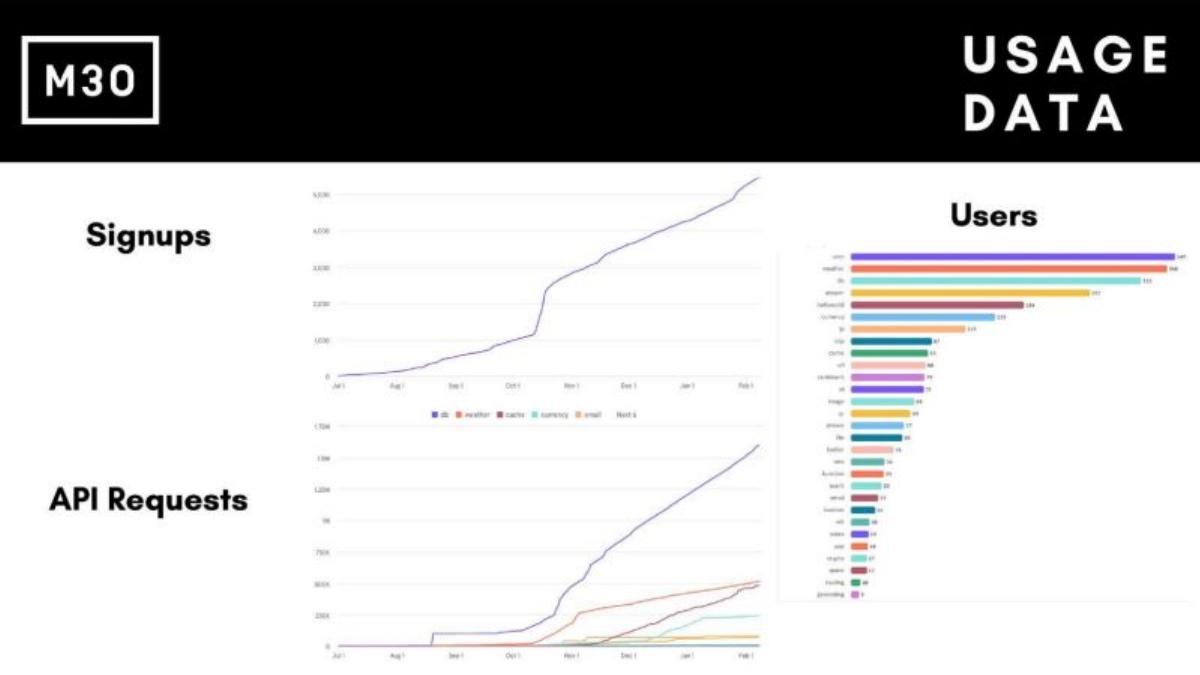
Slide 6 dives deeper into "Usage Data." It breaks down signups and API requests by category. The bar chart for "Users" shows that 'db' (database), 'weather', and 'cache' are the most frequently utilized services. This data validates that developers are using M30 for core infrastructure needs, not just niche utilities.
Slide 7: The Open Source Foundation
Slide 7 introduces the "Open Source" element, stating the platform is "Powered by Micro." It shows a GitHub star history chart for the 'micro/micro' repository, which surpassed 10,000 stars by 2021. The slide claims 1 billion requests per day for the open-source project. This is a critical piece of social proof; it suggests that the underlying technology is already battle-tested at massive scale and has a pre-existing community of developers to tap into.
Slides 8-10: Monetization and Validation
Slide 8 outlines "The Business Model." It follows a standard SaaS/Utility hybrid: free to start (1 million calls), pay-as-you-grow ($1 per million calls), and premium services for high-value APIs like SMS and geocoding. It also hints at future recurring subscriptions starting at $20/month.
Slide 9 expands on these tiers, showing a "Solo" (Free), "Pro" ($25/month), and "Team" ($45/mo per user) structure. The Team tier introduces collaborative features, higher usage limits (100 million requests), and SLAs. This indicates a clear path from individual developer adoption to enterprise-level contracts.
Slide 10 is a "Case Study" featuring OpenBooking. The slide quotes CEO Louis Brauer on the cumbersomeness of building REST API wrappers. It lists the specific migrations: Twilio SMS to M30 SMS, Sendgrid/Postmark to M30 Email, and AWS S3 to M30 Space. The reasons for migration are cited as ease of use, a single billing partner, and reduced complexity. This slide is vital because it proves that M30 can replace established giants like Twilio and AWS in a production environment.
Slides 11-13: The Market, The Team, and The Ask
Slide 11 asks "Why Now?" It argues that modern apps are relying more on cloud APIs and that developers are currently "stuck" managing them in different places. It positions M30 as the intermediary between web developers and API providers.
Slide 12 introduces "The Team." The pedigree here is high: Asim Aslam (CEO) from Micro/OSS, Dominic Wong (CTO) from Monzo, and Martin Virando (Dev UX) from Cisco. For a seed-stage infrastructure startup, having a former CTO of a major fintech (Monzo) and the creator of a popular OSS project (Micro) is a significant advantage in terms of technical execution and recruiting.
Slide 13 covers "Funding." It lists existing investors, including Blossom Capital and Lightspeed Venture Partners, along with angels like Ross Mason (MuleSoft), Luke Kanies (Puppet), and Spencer Kimball (CockroachDB). The company is "Raising $5 million" to accelerate growth, hire engineers, and build more integrations. The milestones are specific: grow the team to 10, reach 100 APIs, and hit 100,000 users.
Slides 14-15: Closing
Slide 14 is a simple "Thank You" with the website URL (m3o.com). Slide 15 is a promotional slide for bestpitchdeck.com and is not part of the M30 presentation itself.
What Works in the M30 Deck
1. Strong Technical Pedigree: The team slide is a standout. For an infrastructure play, investors look for founders who have built at scale before. The Monzo and Micro connections provide immediate credibility.
2. Time-to-Value Metric: Highlighting "5 mins to first API call" on Slide 5 is excellent. It addresses the developer's biggest frustration—complex onboarding—and turns it into a competitive advantage.
3. Open Source Leverage: By showing the 10k+ GitHub stars and 1 billion daily requests for the underlying 'Micro' framework, M30 proves that their technology isn't just a prototype; it's a commercialization of a successful open-source project.
4. Clear Migration Path: The case study on Slide 10 is very specific. It doesn't just say "they liked us"; it lists exactly which services (Twilio, Sendgrid, AWS) were replaced. This demonstrates that M30 is a viable alternative to established market leaders.
What is Missing from the M30 Deck
1. Market Size (TAM/SAM/SOM): The deck lacks a traditional market size slide. While the "Third-Party API Economy" graphic hints at a large market, there are no dollar figures attached to the opportunity. Investors usually want to see a path to a multi-billion dollar market.
2. Competitive Landscape: M30 isn't the only player in the API management or "API as a service" space. A slide comparing M30 to competitors (like RapidAPI or traditional API gateways) would help clarify their unique positioning.
3. Unit Economics: While the business model is clear, there is no mention of the costs associated with providing these APIs. Since M30 is an intermediary, their margins depend on the spread between what they charge users and what they pay (or spend to build) the underlying services.
4. Long-term Moat: The deck explains why the product is useful now, but it doesn't explicitly state what prevents a giant like AWS or a competitor from aggregating these same APIs. The "Unified Client Framework" is a start, but a deeper dive into the technical defensibility would be beneficial.
Founder Takeaways: What to Copy
1. Use Real Usage Data: If you have traction, show it in detail. Slide 6's breakdown of which specific APIs are being used is much more convincing than a generic "users are growing" chart.
2. Quantify the 'Ask' Milestones: Don't just say you are raising money for "growth." Copy M30's approach on Slide 13 by listing exact numbers (10 employees, 100 APIs, 100k users) you intend to hit with the capital.
3. Leverage Open Source: If your product is built on an open-source project, make that a centerpiece of your credibility. GitHub stars and daily request volumes are powerful proxies for market demand in the developer tools space.
4. Keep the Design Focused: M30 uses a high-contrast, text-light design. This forces the audience to focus on the key metrics and the team's background rather than getting lost in complex diagrams or marketing fluff.
Frequently asked questions
- What is the primary problem M30 is trying to solve?
- According to Slide 2, M30 addresses the fragmentation of the public API market. Currently, there is no standardization, meaning every service has a unique consumption model and pricing structure. This forces developers to manually sign up for, learn, and integrate each API individually, creating significant overhead and management complexity for modern software teams.
- How does M30 plan to make money?
- Slide 8 and 9 detail a multi-layered business model. It starts with a 'Pay as you grow' utility model where the first 1 million calls are free, followed by $1 per million calls. They also offer premium services for SMS and geocoding. Additionally, they have planned recurring subscriptions: a Solo/Free tier, a $25/month Pro tier, and a $45/month per user Team tier.
- What kind of traction did M30 have at the time of this deck?
- Slide 5 and 6 show rapid growth from July to February. They achieved 6,500 signups and 1 million API calls per month. The 'Usage Data' slide shows that their most popular APIs include 'db', 'weather', 'cache', and 'currency'. They also emphasize that it takes only 5 minutes for a new user to make their first API call.
- Who are the key people behind M30?
- The team, shown on Slide 12, consists of three core members with deep technical backgrounds. CEO Asim Aslam comes from the open-source project Micro. CTO Dominic Wong was previously the CTO at the challenger bank Monzo. Martin Virando, leading Dev UX, previously worked at Cisco. This combination of infrastructure, fintech, and UX experience is a central pillar of their pitch.
- What are the specific goals for the $5 million funding round?
- Slide 13 outlines three clear milestones for the new capital: growing the internal team to 10 people, expanding their catalog to include 100 public APIs, and reaching a user base of 100,000 on the platform. The funds are earmarked for hiring engineers and developer evangelists to accelerate growth and build more integrations.