Macrometa’s Series A deck is a rare example of a highly technical product being sold through a simple, non-technical analogy. By comparing global data distribution to Amazon Prime’s logistics evolution, the founders bridged the gap between deep-tech complexity and investor intuition. The deck highlights a team with over 20 years of experience and multiple startups together, providing a 'safe' bet for a $20M round. While the deck uses anonymized logos for its pipeline, it compensates with specific ARR growth figures and a clear path to $100M. The inclusion of a 'post-mortem' style reflection o…
Key takeaways
- The deck uses an Amazon Prime logistics analogy (Slides 9-13) to explain 'edge distribution' to non-technical investors.
- Founders Chetan Venkatesh and Durga Gokina emphasize a 20-year working relationship and 17 combined patents (Slide 7).
- The company reported scaling from $0 to $1.5M ARR in just 9 months using a founder-led sales model (Slide 33).
- Macrometa claims its Global Data Network (GDN) offers 100x better performance compared to traditional cloud (Slide 15).
- The technical architecture supports sub-50ms RTT latency across database, streams, and functions (Slide 17).
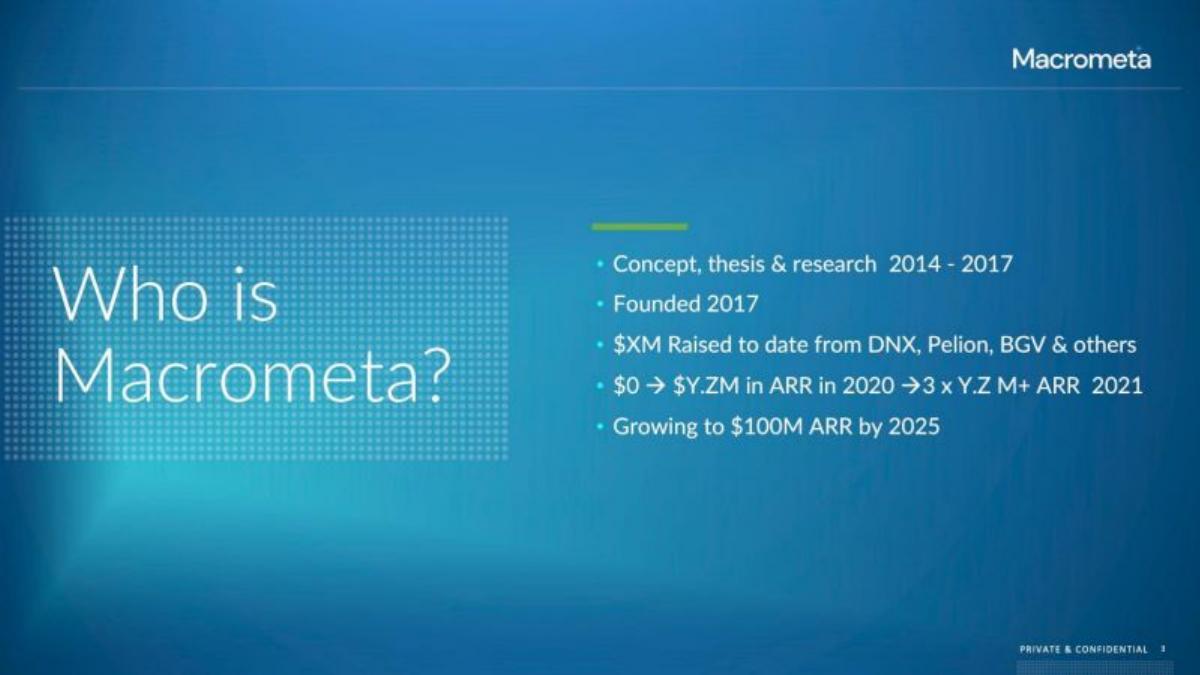
- The deck projects a growth trajectory reaching $100M ARR by 2025 (Slide 3).
- A unique 'What's the secret?' section (Slide 27) outlines the cultural and strategic philosophy behind their rapid Series A transition.
- The deck includes a specific case study of 'falling in love' with investor Pelion, involving a strategic convertible note (Slide 31).
The Narrative Power of the Edge
Macrometa’s Series A deck, presented in April 2021, is a study in how to pitch 'hard' infrastructure. In a world of abstract cloud diagrams, Macrometa chose to ground its value proposition in the physical world of logistics. This teardown covers the 19 slides provided from their 37-slide deck, revealing a strategy that prioritizes founder pedigree and narrative clarity over raw feature lists.
Slides 1-3: The Hook and the Velocity
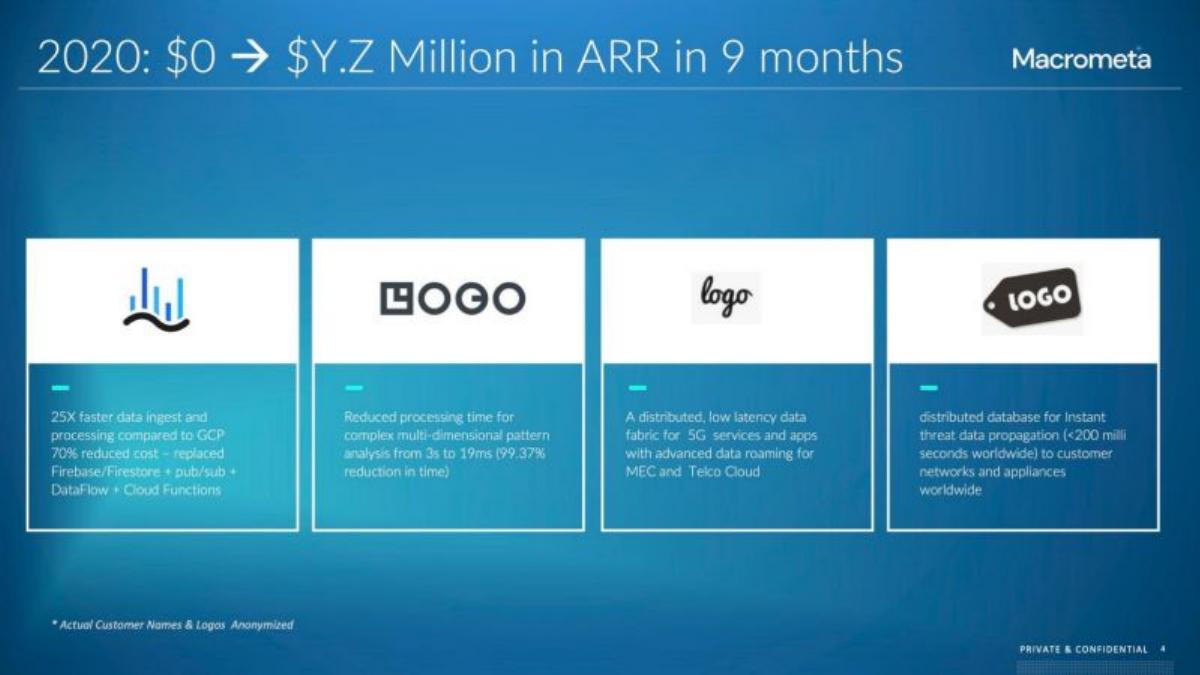
The deck opens with a clean, corporate blue aesthetic. Slide 1 establishes the 'Series A Investor Deck' branding for April 2021. By Slide 3 , the company immediately addresses the 'Who is Macrometa?' question with a timeline and hard metrics. They note that research began in 2014, with the company founded in 2017. Crucially, they highlight a massive jump in ARR: moving from $0 to '$Y.ZM' in 2020, with a projection to triple that in 2021. The slide ends with a bold North Star: 'Growing to $100M ARR by 2025.'
Slide 5: Validating Demand
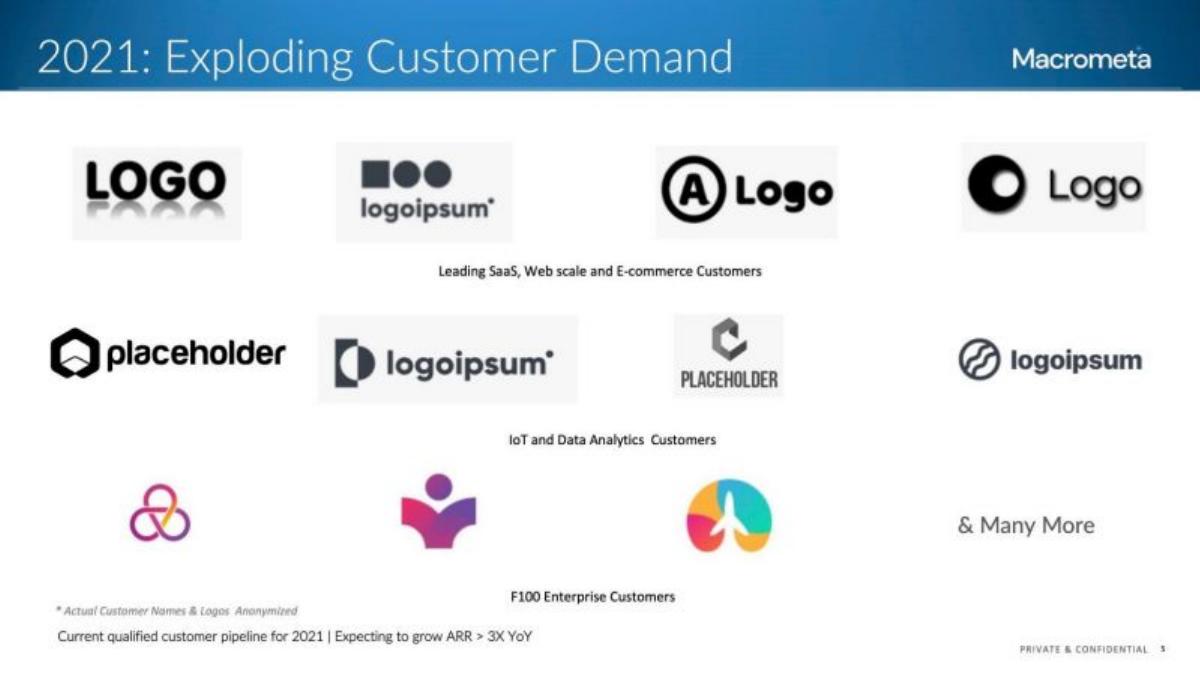
Slide 5 , titled '2021: Exploding Customer Demand,' uses three tiers of logos to show market breadth. While the logos are anonymized (using 'logoipsum' and 'placeholder' text), the categorization is specific: Leading SaaS/E-commerce, IoT/Data Analytics, and F100 Enterprise Customers. The footer notes a 'Current qualified customer pipeline for 2021 | Expecting to grow ARR > 3X YoY.' This slide serves to prove that despite the technical complexity, the market is buying.
Slide 7: The 'Safe Bet' Team
In deep-tech, the team is often the primary collateral. Slide 7 introduces Chetan Venkatesh and Durga Gokina. The headline is powerful: '20+ years & multiple startups together in data infrastructure.' Venkatesh is credited with 14 patents and $50M in direct sales to global enterprises. Gokina is credited with 3 patents and a background at LoudCloud/Opsware and Nutanix. This slide tells investors that the founders have the technical depth to build the product and the commercial experience to sell it.
Slides 9-13: The Amazon Prime Analogy
This is the heart of the deck’s narrative. Instead of explaining 'distributed stateful serverless computing,' Macrometa uses Slide 9 to ask, 'Remember when?' regarding 5-7 day shipping. Slide 11 features Jeff Bezos, illustrating the strategic shift to an 'air fleet' and 'drones.' Slide 13 brings it home: Amazon uses 'Edge Distribution' to keep localized merchandise for 3-hour delivery. Macrometa positions itself as the digital equivalent of this infrastructure—moving data to the 'edge' so it is available instantly to the consumer. This is a masterclass in using a known success story to explain a new technology.
Slides 15-19: Technical Superiority and Product Architecture
Once the analogy is set, Slide 15 introduces the technical claim: '100x better performance compared [to] Cloud.' It shows Macrometa 'disintermediating' spend from giants like Oracle, VMware, and Salesforce by redirecting it to the edge. Slide 17 details the 'Macrometa GDN' (Global Data Network), which includes Edge DB, Streams, Functions, Pipelines, and Search. The key metric here is ' Slide 19 summarizes the value props: Web & Mobile Acceleration, Real-Time Analytics, In-region Data Processing (for GDPR/regulatory issues), and a '70% reduction in cloud data ops costs.'
Slides 21-25: The Future and the 'Journey'
Slide 21 paints a picture of 'The world in 5 years,' envisioning 1,000s of enterprise customers and billions of devices using Macrometa as the 'default' for edge apps. Slide 23 marks a transition in the deck, titled 'Series A: Our journey to finding, partnering and closing a financing with exceptional investors.' This section is unusual; it’s a meta-commentary on the fundraise itself, likely used for later-stage investors or as a 'lessons learned' for the board.
Slides 27-31: The Fundraising Strategy
Slide 27 asks 'What’s the secret?' and lists cultural values like 'Humble, Honest and Heartful.' Slide 29 gets back to business, noting they 'did $XX.5M ARR and beat plan by 50% in 2020.' Slide 31 provides a specific anecdote about Pelion Venture Partners. It describes how they 'fell in love' but had no room in the round, leading the board to create a 'convertible note... with no cap on valuation' just to let Pelion participate. This is a high-signal slide that demonstrates extreme investor FOMO.
Slides 33-35: Founder-Market Fit and Advice
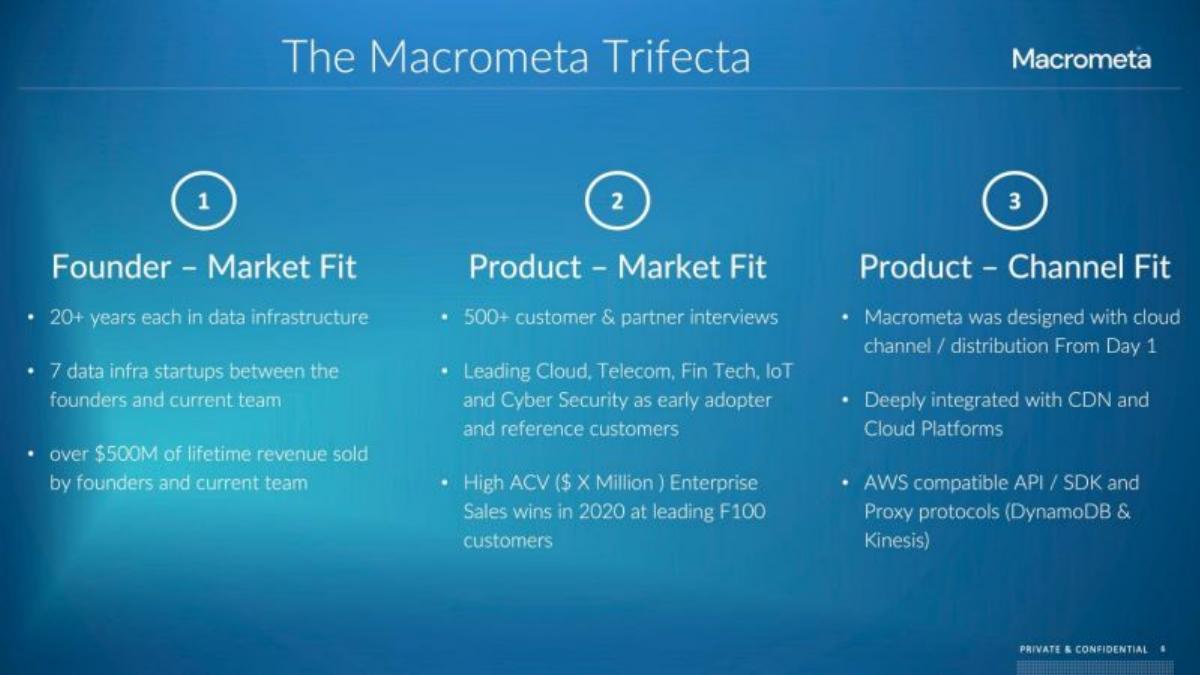
Slide 33 explicitly defines 'Founder-Market Fit' (20+ years in infra) and 'Product-Market Fit' (500+ customer interviews). It highlights a 'Proven founder lead sales model' that scaled the business from $0 to $1.5M ARR in 9 months. Finally, Slide 35 offers a reflective list of advice, including the candid admission that 'Fund raising is FUING HARD.'
What Works in This Deck
The Analogy: The Amazon Prime comparison is the strongest element. It takes a concept that is difficult to visualize (latency in distributed databases) and makes it a matter of 'delivery speed,' which every investor understands.
The Pedigree: The deck leans heavily on the fact that the founders have worked together for two decades. This mitigates 'co-founder conflict' risk, which is a leading cause of early-stage failure.
The Transparency: Including a slide about a convertible note with no cap and the 'heartache' of fundraising makes the founders seem mature and battle-tested rather than just 'pitchy.'
What Is Missing
Unit Economics: While ARR growth is mentioned, there is no mention of CAC (Customer Acquisition Cost), LTV (Lifetime Value), or gross margins. For a Series A, investors usually want to see the efficiency of the 'money-in, growth-out' machine.
Competitive Landscape: The deck mentions 'Cloud' (Oracle, VMware) as the legacy to be disrupted, but it ignores direct edge competitors like Cloudflare Workers, Fastly, or Vercel. A sophisticated investor would want to know why Macrometa’s 'stateful' approach wins against these incumbents.
The 'Ask' Slide: In the provided 19 slides, there is no final 'The Ask' slide detailing exactly how much they are raising (though we know from the catalogue it was $20M) and how they plan to spend the capital (e.g., % to engineering vs. % to sales).
What a Founder Should Copy
The 'Who is [Company]?' Slide: Slide 3 is a perfect executive summary. It gives the history, the current traction, and the long-term goal in five bullet points. Every deck should have this early on.
The Narrative Bridge: If you are building something technical, find your 'Amazon Prime.' Use 3-4 slides to explain the evolution of a physical industry that mirrors your digital disruption.
The 'Why We Are Ready' Slide: Slide 33 is an excellent way to summarize why the company is a 'de-risked' investment. Dividing it into 'Founder-Market Fit' and 'Product-Market Fit' with specific evidence (patents, revenue, interviews) is highly persuasive.
Frequently asked questions
- How much did Macrometa raise with this deck?
- According to the catalogue facts, Macrometa raised $20M in its Series A round in 2021.
- What is Macrometa's core product?
- Macrometa provides a Global Data Network (GDN) that includes an edge database, caching, streams, and serverless functions, designed to offer sub-50ms latency for distributed apps (Slide 17).
- Who are the founders and what is their background?
- The founders are Chetan Venkatesh (CEO) and Durga Gokina (CTO). They have worked together for over 20 years in data infrastructure, holding 17 patents between them and having founded or led multiple startups like Atlantis Computing (Slide 7).
- What is the 'Amazon Prime' analogy used in the deck?
- Macrometa compares the old way of data storage to 5-7 day shipping from central warehouses. They liken their edge distribution to Amazon's use of local depots and predictive inventory to achieve 3-hour delivery (Slides 9-13).
- What are the company's financial goals?
- The deck states a goal of reaching $100M ARR by 2025, having already beaten their 2020 plan by 50% (Slides 3 and 29).