The Magic Leap Series A deck from 2014 is a high-concept presentation that prioritizes vision and intellectual property over traditional business metrics. Raising $50M at this stage required convincing investors that 'Cinematic Reality' was a distinct, superior category to existing VR and AR. The deck leans heavily on third-party market data from Digi-Capital, forecasting a $120B AR market by 2020, and emphasizes a defensive moat consisting of 120 filed patents. While it lacks unit economics, a clear revenue model, or a specific 'Ask' slide in this 20-slide sample, it successfully frames the…
Key takeaways
- The deck defines 'Cinematic Reality' as a superior alternative to VR, claiming it provides 'neurological effects as real-life objects' (Slide 6).
- Magic Leap relies on a Digi-Capital forecast predicting the AR market will reach $120B by 2020, with hardware as the primary driver (Slide 3).
- Intellectual property is the primary defensive strategy, with 120 patents filed to protect the 'key enabling technology' (Slide 17).
- The company positions itself as a vertically integrated player, covering R&D, hardware design, OS development, and marketing (Slide 16).
- The 'Current State' of AR is dismissed as 'simple apps for smartphones' like Snapchat, creating a contrast with Magic Leap's 'First Person AR' (Slide 11).
- The team is presented through archetypes—'rocket scientists' and 'software ninjas'—rather than traditional resumes or past exits (Slide 4).
- Targeted customer segments are broad, ranging from 'Special Needs' and 'Vocational Training' to 'Market Research Companies' (Slides 13, 15).
- The deck emphasizes 'Cloud is KEY,' showing a system that constantly adjusts virtual content to fit the user's environment (Slide 5).
The Vision of Cinematic Reality
Magic Leap’s Series A deck is a fascinating artifact from the peak of the 2014 augmented reality hype cycle. It doesn't sell a product so much as it sells a paradigm shift. At this stage, the company was operating in high secrecy, and the deck reflects this by focusing on the 'Magic' and the 'IP' rather than the nitty-gritty of manufacturing costs or customer acquisition rates. The narrative is built on the idea that existing technology (VR and basic AR) is insufficient, and only Magic Leap has the 'rocket scientists' and the patent portfolio to bridge the gap between digital and physical worlds.
Slides 1-3: Defining the Opportunity
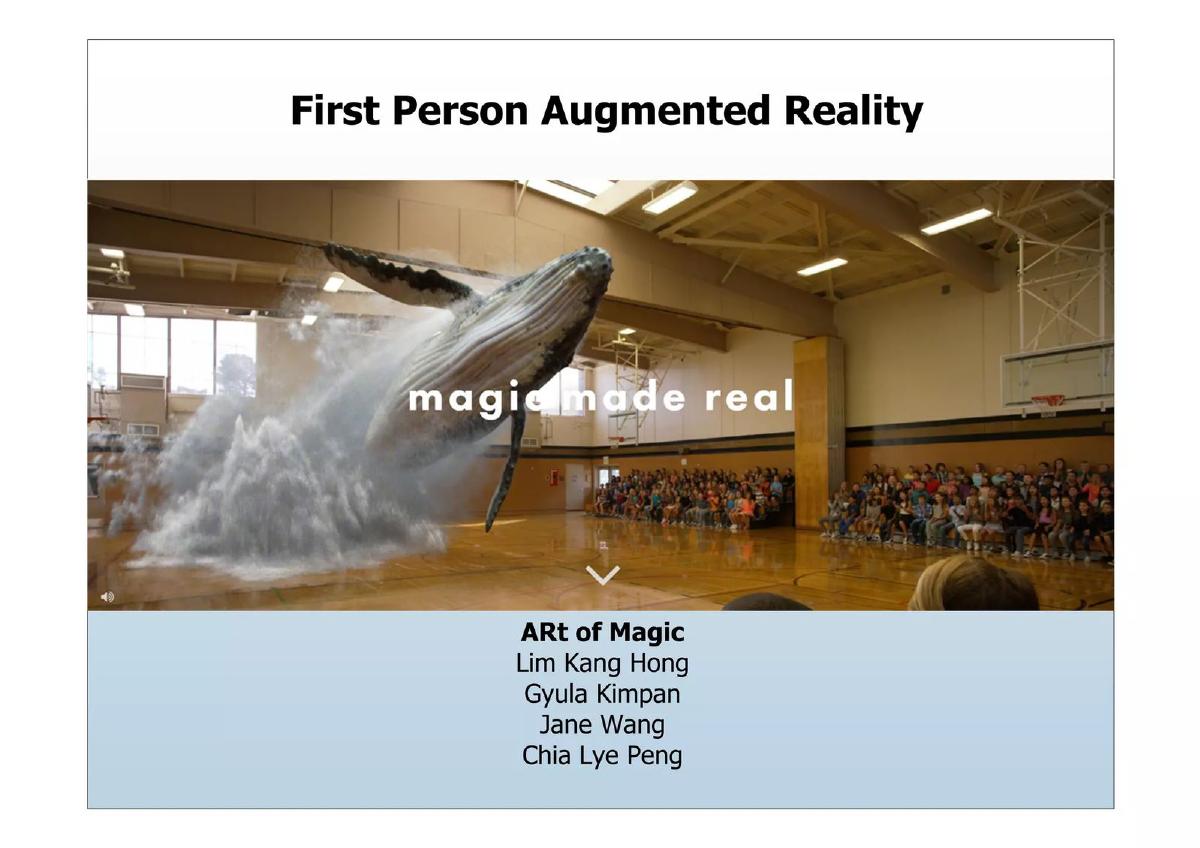
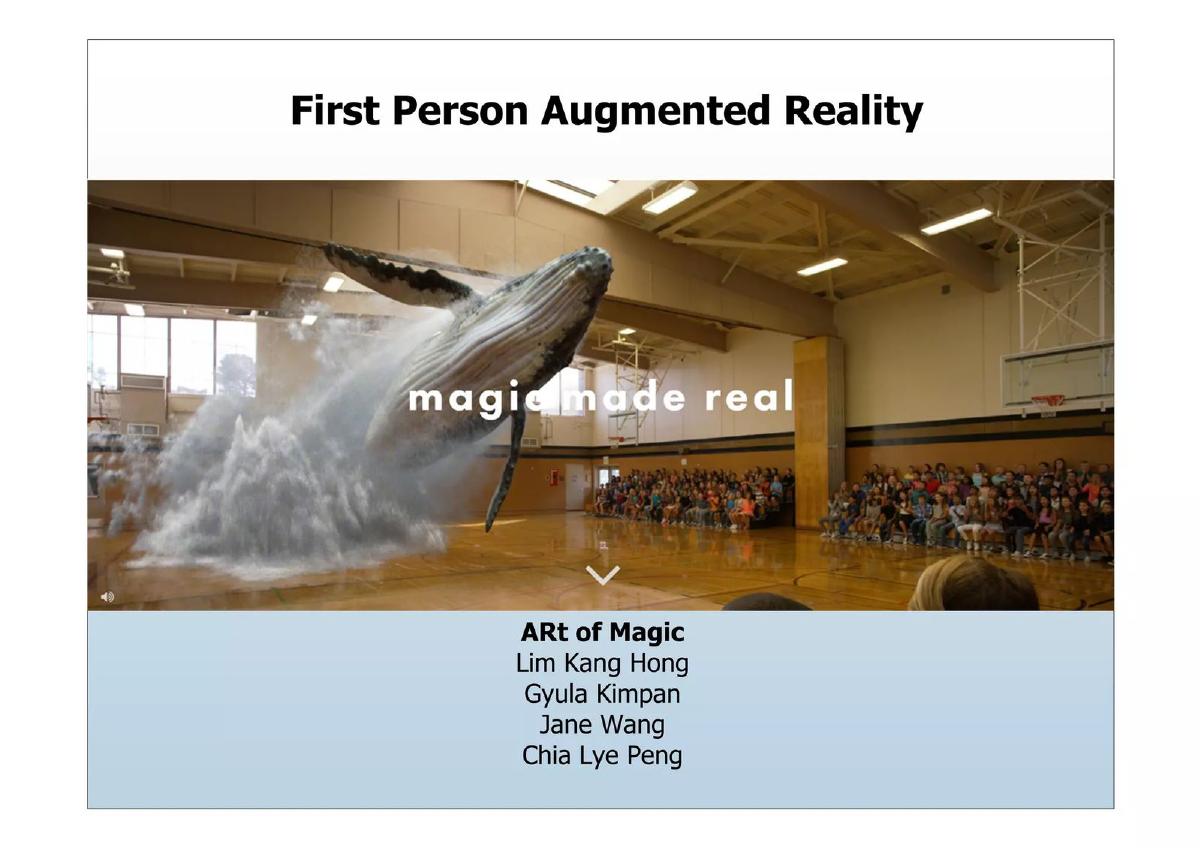
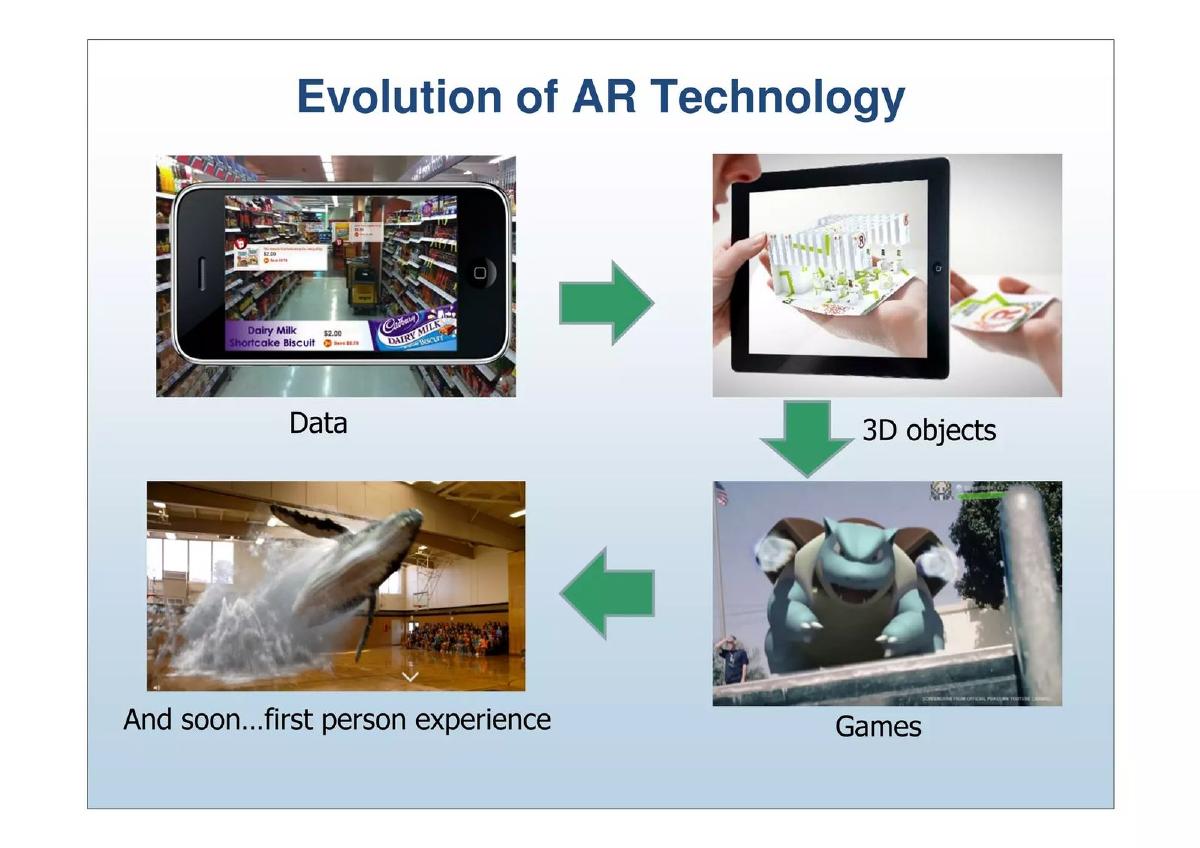
Slide 1 serves as the cover, featuring the now-famous image of a whale breaching in a school gymnasium. The tagline 'magic made real' and the title 'First Person Augmented Reality' set the stage. It lists four names: Lim Kang Hong, Gyula Kimpan, Jane Wang, and Chia Lye Peng, though it doesn't specify their roles or backgrounds on this slide.
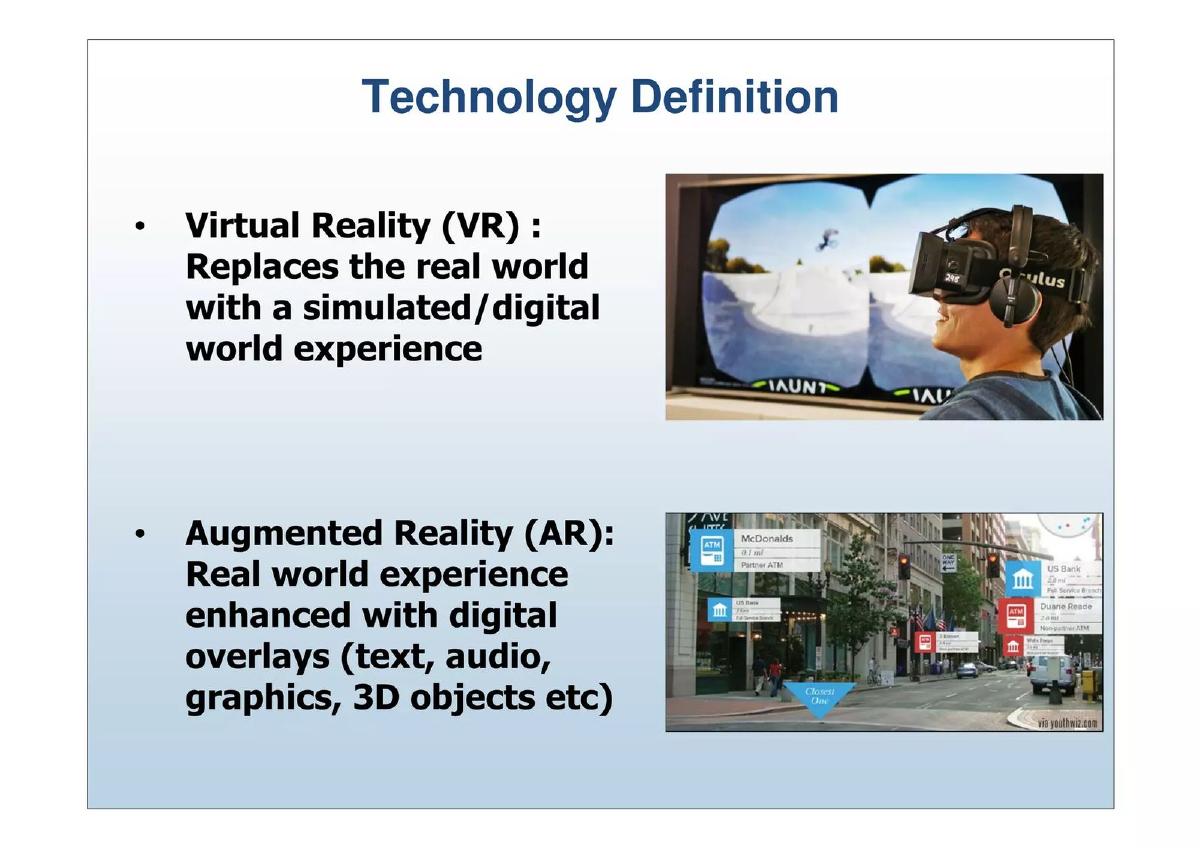
Slide 2 attempts to educate the investor on the 'Technology Definition.' It contrasts Virtual Reality (VR), which 'replaces the real world,' with Augmented Reality (AR), which provides a 'real world experience enhanced with digital overlays.' This is a standard educational slide for 2014, intended to ensure the investor understands that Magic Leap is not just another Oculus Rift competitor.
Slide 3 brings in the heavy hitters of market validation. Using data from Digi-Capital, it forecasts a massive $120B AR market by 2020. Crucially, the chart shows that 'AR hardware' and 'aCommerce' (augmented commerce) are expected to be the largest revenue drivers. This justifies Magic Leap’s focus on building its own hardware rather than just software. The contrast with the much smaller $30B VR market forecast is a deliberate move to position AR as the 'bigger' opportunity.
Slides 4-7: The Team and The Tech
Slide 4 asks 'Who is Magic Leap?' Instead of a traditional team slide with logos of former employers like Google or Apple, it uses a stylized image of a busy transit hub with text overlays describing the team as 'story-tellers,' 'rocket scientists,' 'artificial intelligence gurus,' and even 'computing hobbits' and 'psychedelic physicists.' This leans into the 'Magic' branding but provides zero professional verification for a Series A investor.
Slide 5 dives into the technical moat. It highlights that 'Cloud is KEY' and shows a patent diagram (Fig. 20) illustrating how the system detects a user's location and adjusts virtual content to fit the environment. This slide is critical because it suggests the technology is not just a local display but a spatially aware, cloud-connected system.
Slide 6 outlines the 'Value Proposition.' It introduces the term 'Cinematic Reality' and claims it provides 'neurological effects as real-life objects.' It promises eye-tracking, natural hand gestures, and a 'non-nausea' experience that can be worn all day. These are bold technical claims that directly address the pain points of 2014-era VR.
Slide 7 is a placeholder for a video from October 2015 (notably a year after the stated 2014 round, suggesting this deck was updated or used for ongoing fundraising). It mentions a 'robot under table and solar system' video with 'no special effects,' which was a key part of Magic Leap's early viral marketing to prove the tech was real.
Slides 8-12: Use Cases and Competition
Slide 8 and Slide 9 focus on gaming. Slide 8 is a high-gloss marketing image of a child fighting a dragon in a living room with the text 'your new way to play.' Slide 9 shows what appears to be actual 'First Person' footage of a robot combat game, labeled as a 'truly immersive first person action game.'
Slide 10 references a collaboration with 'WETA Workshop,' a world-renowned special effects studio. This adds significant creative credibility to the project, suggesting that the 'Magic' will be backed by Hollywood-grade content.
Slide 11 defines the 'Current State' of the market. It shows Snapchat filters and simple mobile AR apps. By labeling these as 'simple apps for smartphones,' Magic Leap effectively dismisses the existing competition as toys, positioning its own hardware as the only 'real' solution.
Slide 12 uses conceptual sketches to show 'Magic Leap and Entertainment.' It depicts a user sitting on a couch, with virtual screens for Netflix and ESPN floating in the room, alongside 3D models of athletes and products. This moves the narrative from 'gaming' to 'general computing replacement.'
Slides 13-15: Customer Selection
Slide 13 and Slide 15 (separated by a commerce slide) break down the target markets. Slide 13 focuses on education and 'Special Needs,' citing a 2014 systematic review on AR trends in education. It lists 'Science, Humanities & Arts,' 'Early Childhood,' and 'Vocational Training' as key segments.
Slide 14 addresses 'Magic Leap and Commerce.' It shows a conceptual drawing of a user customizing furniture in a room. The text 'Place your goods anywhere, with customization!' highlights the B2B2C potential of the platform for retailers.
Slide 15 expands the customer base to 'Companies' (for advertising and branding), 'Consumers' (tech-savvy shoppers), and 'Market Research Companies' (for consumer data). This slide suggests a multi-sided business model where data and advertising are as important as hardware sales.
Slides 16-20: Strategy and IP Protection
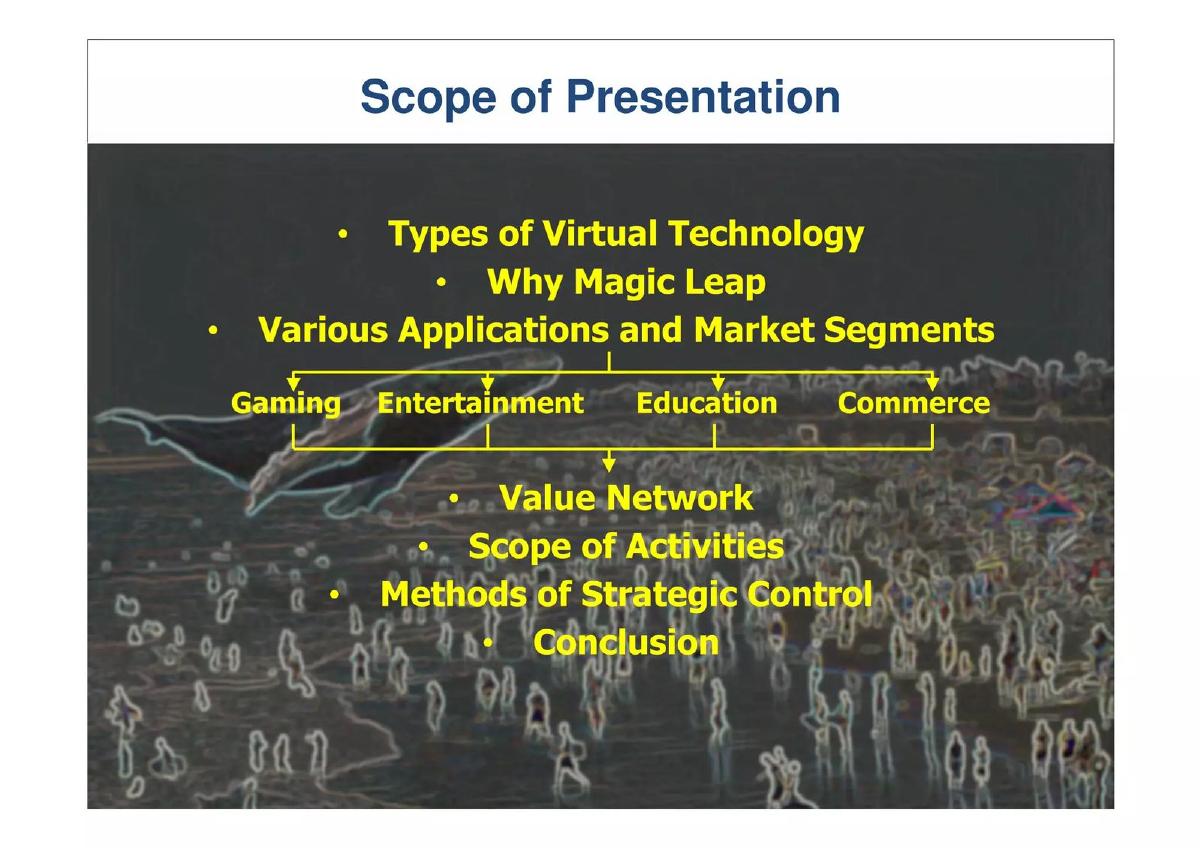
Slide 16 defines the 'Scope of Activities.' It shows a vertically integrated model: Internal R&D, Hardware and Architectural Design, OS and Software Development, and finally Marketing and Sales. This is an incredibly ambitious (and expensive) scope for a Series A company, signaling why they needed $50M.
Slide 17 is perhaps the most important slide for a Series A investor: 'Strategic Control - IP Protection.' It explicitly states that 120 patents have been filed . It claims protection over the OS, software apps, slogans, logos, and industrial design. The slide concludes that this 'Protects the key enabling technology from copying.'
Slide 18 reinforces this with 'Establishing Standard.' It lists 'Manufacturing millions of devices' and 'Hiring top talents' as ways to control the install base and maintain a first-mover advantage. The goal here is to convince investors that Magic Leap will be the 'Windows' or 'iOS' of the AR world.
Slide 19 summarizes the 'Potential to Dominate AR' through vertical integration, strategic control, and 'game-changing innovation.' It’s a victory lap slide intended to consolidate the previous points.
Slide 20 is a standard Q&A slide with the Magic Leap logo and a 3D character, ending the presentation on a whimsical note consistent with the brand.
What Magic Leap Does Well
The deck is exceptional at category creation . By refusing to call itself 'AR' and instead using 'Cinematic Reality,' Magic Leap avoided direct comparisons to failing or limited AR products of the time (like Google Glass). They framed the technology as a fundamental breakthrough in physics and neurology, not just a better screen.
The emphasis on IP is another strength. For a hardware-heavy startup, the threat of being copied by Apple or Samsung is a primary investor concern. Claiming 120 patents at the Series A stage provides a significant 'defensive moat' that justifies a high valuation and a large capital injection.
Finally, the market sizing is handled effectively. By using a third-party source (Digi-Capital) and breaking the $120B down into specific sub-sectors like hardware and commerce, they made a futuristic vision feel like an inevitable economic shift.
What is Missing from the Deck
The most glaring omission in these 20 slides is unit economics . There is no mention of the Bill of Materials (BOM), the expected retail price of the headset, or the manufacturing partners required to reach the 'millions of devices' mentioned on Slide 18. Hardware is notoriously difficult to scale, and the deck glosses over the 'Valley of Death' between R&D and mass production.
The revenue model is also vague. While it mentions 'aCommerce' and 'Advertising,' it doesn't explain how Magic Leap takes a cut of those transactions. Is it a hardware margin business, a software licensing business, or an ad-supported platform? The deck suggests 'all of the above,' which can be a red flag for lack of focus.
Lastly, the team slide is purely aesthetic. In a $50M Series A, investors usually want to see the specific pedigrees of the engineering leads. Referring to them as 'software ninjas' and 'computing hobbits' is a branding choice that hides the actual human capital risk.
What Founders Should Copy
Founders building in 'frontier tech' should copy Magic Leap’s use of archetypes and vision . If you are building something that doesn't exist yet, you cannot rely on traction metrics. You must sell the 'future state' of the world and then show how your IP makes you the only company that can own that future.
The vertical integration slide (Slide 16) is also a strong move for ambitious startups. It shows that the company understands the entire value chain and isn't just a 'feature' that can be easily Sherlocked by a platform owner. By owning the OS, the hardware, and the content distribution, you position yourself as a platform, not a peripheral.
Finally, differentiating from 'the current state' (Slide 11) is a vital tactic. By explicitly showing why current solutions (Snapchat) are 'simple' or 'limited,' you create a gap in the market that only your product can fill. It forces the investor to choose between the 'small' current market and your 'large' future market.
Frequently asked questions
- How much did Magic Leap raise with this deck?
- According to the catalogue facts from failory.com, Magic Leap raised $50M in a Series A round in 2014. This round included participation from both Corporate and Venture Capital investors, following the vision of 'Cinematic Reality' presented in this deck.
- What is the 'Cinematic Reality' mentioned in the deck?
- Magic Leap uses the term 'Cinematic Reality' on Slide 6 to differentiate its technology from standard AR and VR. It claims to provide neurological effects identical to real-life objects and offers different depths of focus, which supposedly prevents the nausea often associated with traditional head-mounted displays.
- Does the deck show a working prototype?
- The deck includes several slides (Slides 7, 9, 10) that reference videos of the technology in action, including a 'robot under table' and 'A Day in the office.' However, it also uses conceptual sketches (Slide 12) and marketing images (Slide 8) to illustrate the potential of the technology rather than just raw prototype footage.
- What is Magic Leap's competitive advantage according to the slides?
- The primary advantage cited is 'Strategic Control.' On Slide 17, the company highlights 120 filed patents covering its operating system, software apps, industrial design, and branding. Slide 18 further emphasizes a 'First Mover Advantage' and the ability to establish a new industry standard by manufacturing millions of devices.
- Who are the target customers for Magic Leap?
- The deck identifies a wide array of sectors on Slides 13 and 15. These include education (Science, Humanities, Early Childhood), healthcare (Special Needs), and enterprise (Market Research, Advertising Firms). The catalogue facts also list GovTech and Manufacturing as relevant industries for the company's B2B and B2G model.