Sano Genetics' Series A deck is a concise 13-slide presentation that focuses on the massive inefficiencies in the $1T personalized medicine market. The company identifies that 80% of clinical trials are delayed, costing pharma companies up to $8M per day. Sano positions itself as the connective tissue between patients, biobanks, and pharmaceutical developers. With a network of over 1.1 million people and a track record of doubling revenue every six months, the deck provides strong evidence of product-market fit. The presentation is notable for its clear business model—combining SaaS recurring…
Key takeaways
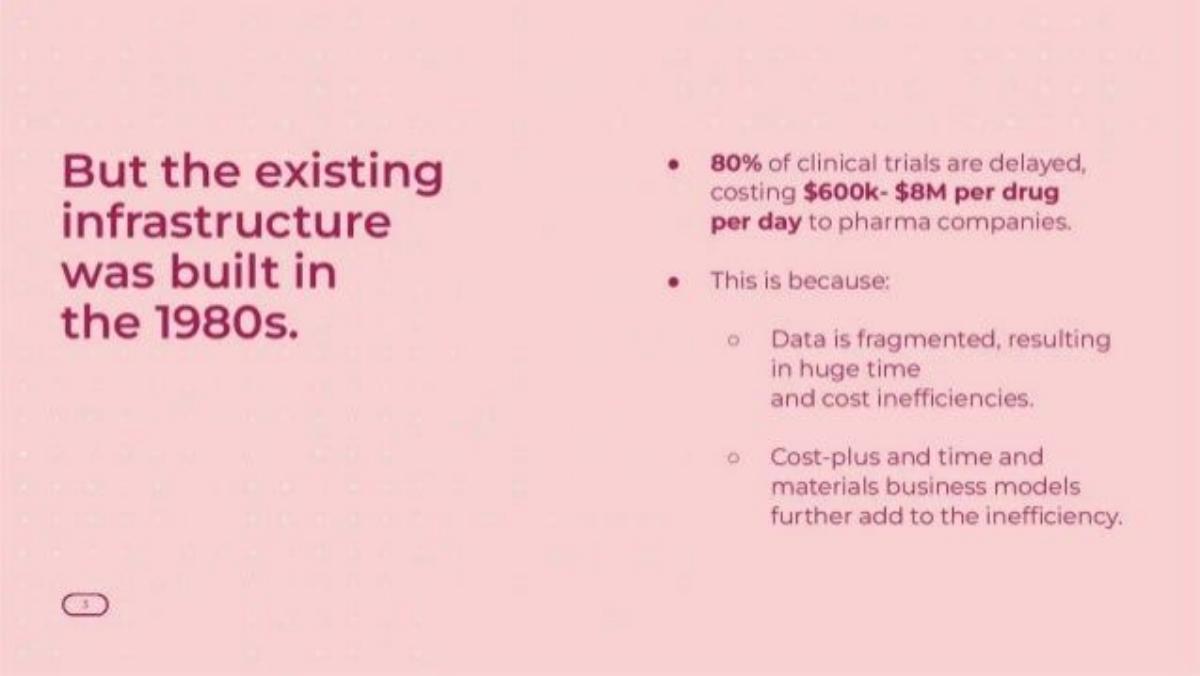
- The deck identifies a massive financial pain point: clinical trial delays cost pharma companies $600k to $8M per drug per day (Slide 3).
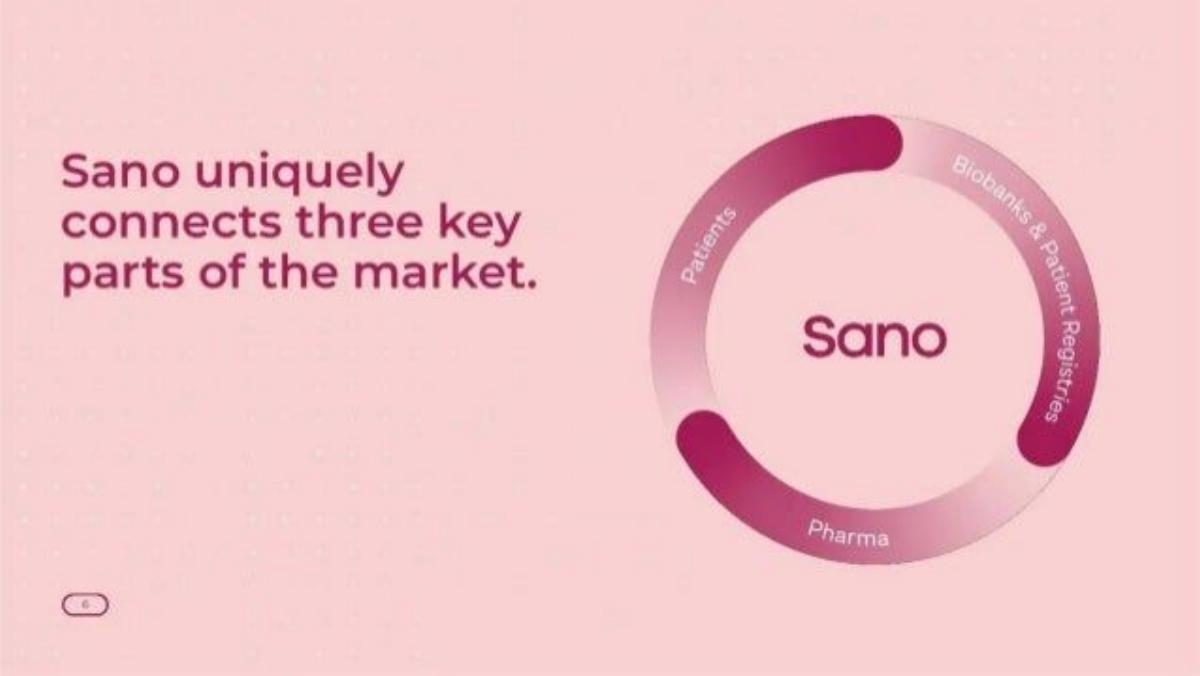
- Sano positions itself as a three-sided marketplace connecting patients, biobanks/registries, and pharma companies (Slide 6).
- The company demonstrates significant scale with a genetic data network encompassing over 1.1 million people (Slide 5).
- Revenue growth is a primary highlight, with the company stating they are doubling revenue every six months (Slide 10).
- The business model is diversified, utilizing monthly recurring revenue, volume-based recruitment fees, and revenue-sharing with partners (Slide 9).
- User validation is strong, citing an 83% recommendation rate among patients using the platform (Slide 7).
- The team slide emphasizes deep domain expertise, featuring founders from the Sanger Institute and EBI Cambridge (Slide 11).
- The $11M ask is explicitly tied to clear milestones, including reaching 50+ diseases and 6+ countries by mid-2023 (Slide 12).
The Anatomy of a $11M Series A: Sano Genetics Teardown
Sano Genetics operates at the intersection of healthcare, genetics, and data science. Their Series A deck, used to raise $11M in 2022, is an example of how to present a complex B2B2C model with clarity and urgency. By focusing on the 'personalized medicine' trend, they anchor their solution in a high-growth sector while addressing a specific, expensive bottleneck: clinical trial recruitment.
Slide 1: The Vision Statement
The cover slide is clean and professional, featuring a grid of diverse faces to emphasize the 'patient-centric' nature of the business. The tagline, "Powering recruitment and relationship management for personalized medicine research," immediately defines the category and the core function of the product. It sets the stage for a data-driven narrative about the future of medicine.
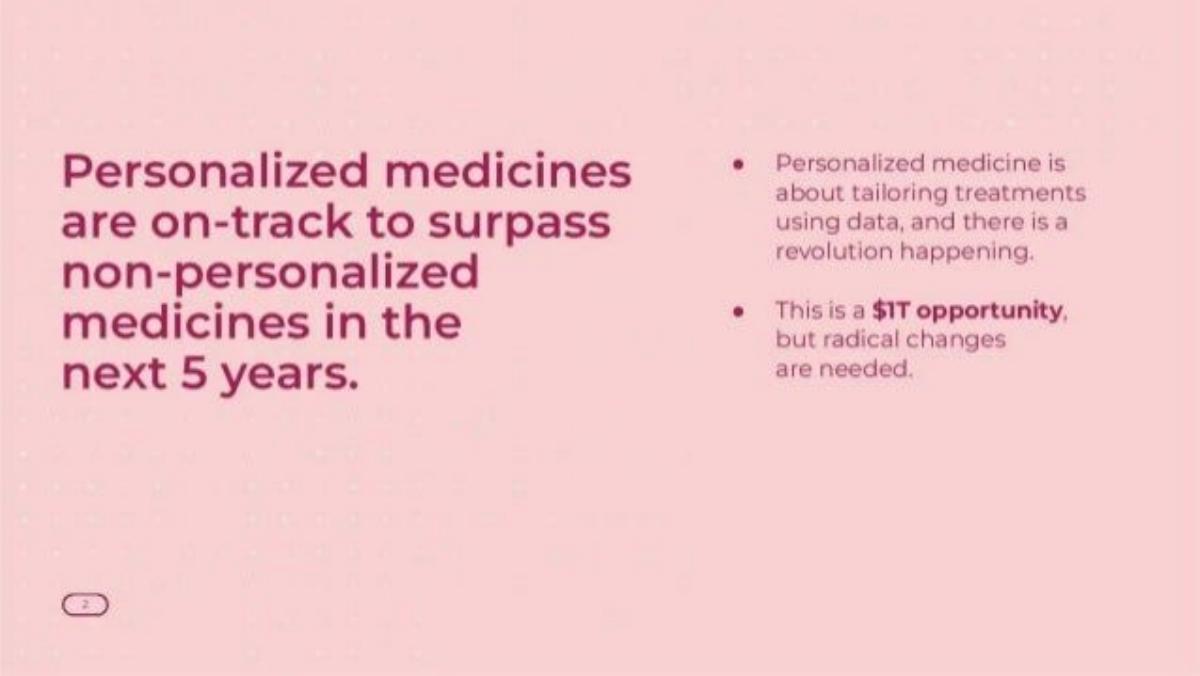
Slide 2: The $1T Opportunity
Sano wastes no time in establishing the market size. They state that personalized medicines are on track to surpass non-personalized medicines within five years. Crucially, they quantify the opportunity as a "$1T opportunity," but qualify it by saying "radical changes are needed." This creates a 'gap' in the market that only a new type of infrastructure can fill.
Slide 3: The Problem – 1980s Infrastructure
This is the 'villain' of the story. Sano points out that existing infrastructure was built in the 1980s. They provide a staggering statistic: "80% of clinical trials are delayed, costing $600k- $8M per drug per day to pharma companies." By attaching a specific daily dollar amount to the problem, they make the ROI of their solution obvious. They attribute this to fragmented data and outdated "cost-plus" business models.
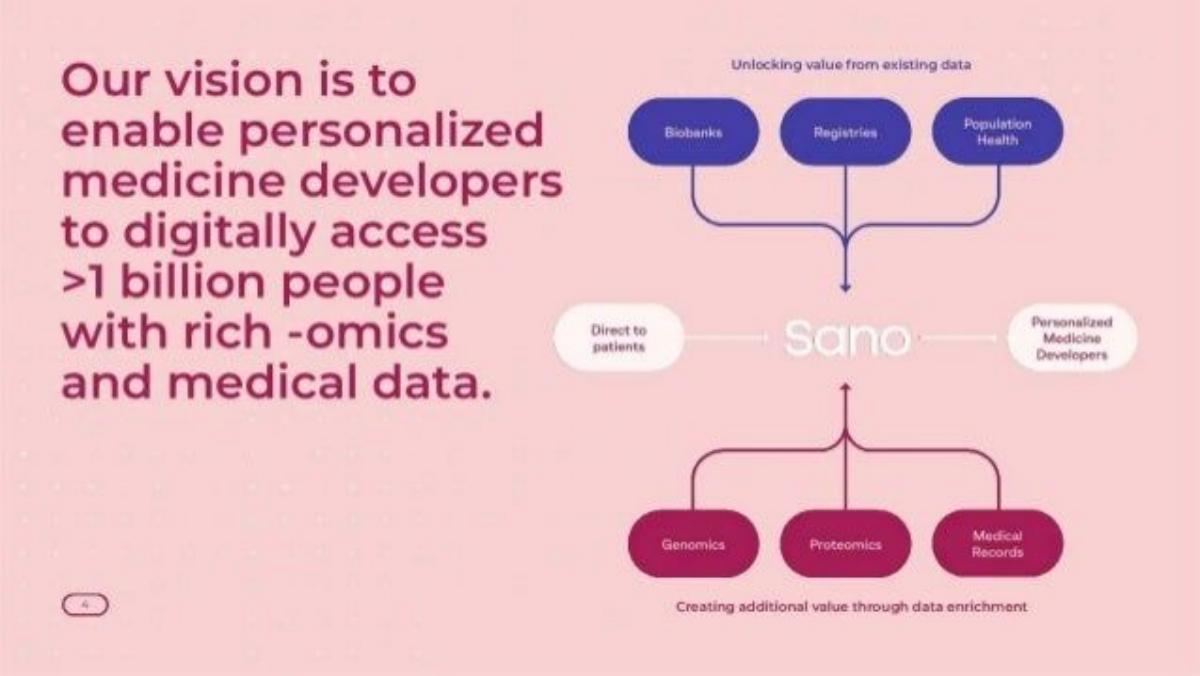
Slide 4: The Vision – Connecting the Dots
Slide 4 introduces the Sano platform as the central hub. The visual shows Sano sitting between data sources (Biobanks, Registries, Population Health) and data enrichment (Genomics, Proteomics, Medical Records). The goal is to enable developers to "digitally access >1 billion people with rich -omics and medical data." This slide effectively illustrates their role as the 'connective tissue' of the industry.
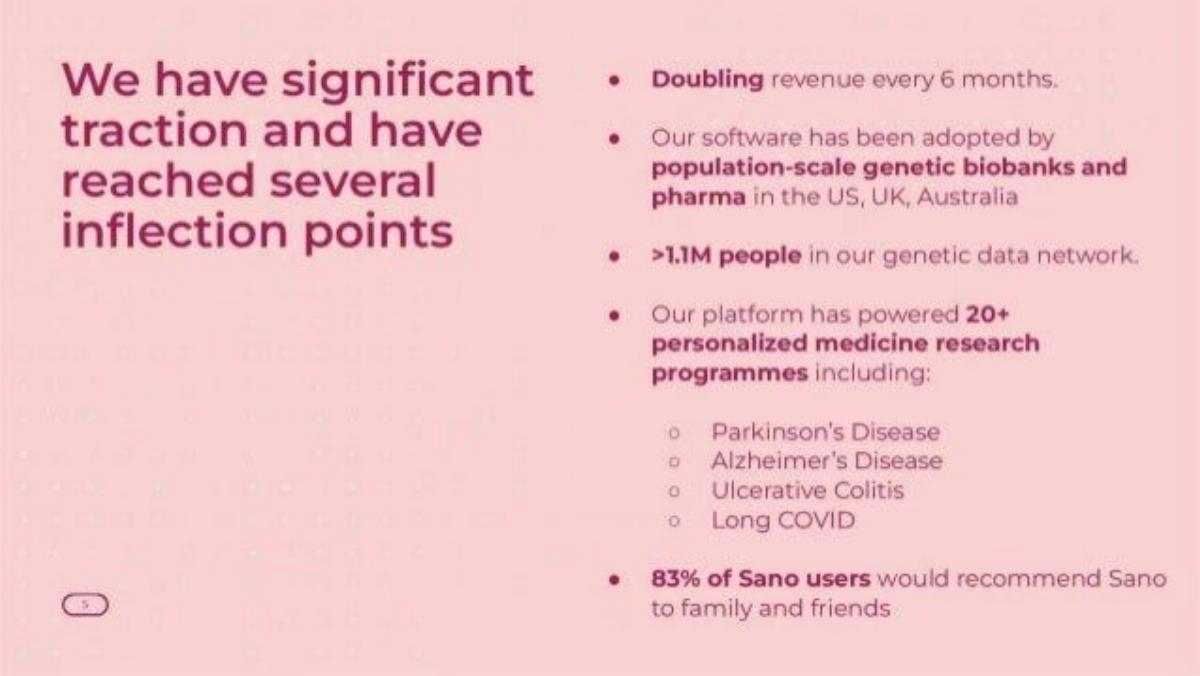
Slide 5: Traction and Inflection Points
This is a high-density proof slide. Sano lists five major achievements:
Doubling revenue every 6 months. · Software adoption by biobanks and pharma in the US, UK, and Australia. · A network of >1.1M people. · Powering 20+ research programmes (including Parkinson's and Alzheimer's). · An 83% recommendation rate from users.
This combination of financial growth, scale, and user satisfaction is a powerful signal to VCs.
Slide 6: The Three-Sided Market
Sano clarifies its unique position by showing a circular diagram. They connect Patients, Biobanks & Patient Registries, and Pharma. This slide is essential for a B2B2C company because it explains how they provide value to every stakeholder in the ecosystem, not just the one paying the bills.
Slide 7: The Patient Experience
Focusing on the 'C' in B2B2C, this slide shows the mobile interface. It emphasizes that the platform is "Private-by-design," putting users in control of their data. This addresses a major hurdle in genetic testing: privacy concerns. The 83% recommendation rate is repeated here to reinforce the idea that patients actually enjoy using the platform.
Slide 8: Biobanks and Registries
This slide targets the data providers. It mentions partnerships with Genomics England and others in the US and Australia. It frames Sano as a tool for these organizations to "deliver a superior user experience and generate revenue," turning a potential competitor into a partner.
Slide 9: The Business Model
Monthly recurring revenue for the platform (SaaS). · Volume and performance-based revenue for DNA testing and recruitment. · Revenue-share with patient registries and biobanks.
This shows investors that Sano has both predictable income and high-upside transactional revenue.
Slide 10: The Growth Curve
Slide 10 provides a bar chart showing revenue from H1 2020 to H2 2021. While the Y-axis lacks specific dollar amounts (a common practice in public decks), the trend is clear: consistent, significant growth. They claim a "repeatable sales playbook" and "positive unit economics," which are the two things Series A investors look for most.
Slide 11: The Team
The team slide is a major strength. It highlights a team of 20 with a heavy emphasis on Tech (6x) and Marketing/Partnerships (5x). The founders' pedigree—Sanger Institute, EBI Cambridge, and JP Morgan—provides the necessary scientific and financial credibility to operate in the highly regulated healthcare space.
Slide 12: The $11M Ask
The ask is clear: $11M to scale. They provide three specific milestones they intend to hit with this funding:
Triple revenue year over year. · Sign flagship partners in six key international markets. · Develop the platform to meet demand in 50+ diseases and 6+ countries by mid-2023.
This gives investors a clear roadmap of what their capital will buy.
Slide 13: Contact Information
The deck ends with a simple contact slide, repeating the patient-centric imagery from the cover. It provides the CEO's direct email, maintaining the professional and accessible tone of the entire presentation.
What Sano Genetics Does Well
The Sano Genetics deck is a masterclass in quantifying the pain. Many healthcare decks talk about 'saving lives' or 'improving outcomes' in vague terms. Sano explicitly states that trial delays cost up to $8M per day. This shifts the conversation from a 'nice-to-have' clinical tool to a 'must-have' financial efficiency tool for Big Pharma.
Furthermore, the deck handles the multi-stakeholder problem exceptionally well. By dedicating individual slides to Patients (Slide 7), Biobanks (Slide 8), and Pharma (Slide 9), they demonstrate a deep understanding of the incentives required to make a marketplace work. They don't just have a product; they have an ecosystem strategy.
What is Missing from the Sano Genetics Deck
Competitive Landscape: There is no slide addressing competitors like 23andMe (on the consumer side) or traditional CROs (on the recruitment side). Investors would likely ask how Sano defends its position against these incumbents. · Unit Economics Detail: While they mention "positive unit economics" on Slide 10, they don't provide the LTV/CAC ratios or payback periods that many Series A investors expect to see. · Regulatory Path: Given the sensitivity of genetic data and clinical trials, a slide on HIPAA/GDPR compliance or specific regulatory certifications would have added another layer of de-risking.
Founder's Guide: What to Copy
The 'Villain' Slide: Copy the way Sano frames their problem on Slide 3. Don't just say the industry is old; say it was built in the 1980s. Don't just say it's expensive; give a daily cost range. This creates immediate urgency.
The Traction Mix: Use Slide 5 as a template. Notice how they mix financial metrics (revenue doubling) with scale metrics (1.1M people) and quality metrics (83% recommendation). This 'triangulation' of traction is much more convincing than a single revenue graph.
The Clear Ask: Slide 12 is a perfect example of a Series A ask. It doesn't just say "we need money for hiring." It lists specific, measurable goals (50+ diseases, 6+ countries) that the funding will enable. This allows investors to hold the founders accountable to a specific plan.
Final Verdict: Sano Genetics' deck is successful because it translates complex genetic science into a straightforward business problem: efficiency. By focusing on the massive financial waste in the current system and proving they have the network to fix it, they made the $11M investment seem like a logical necessity rather than a risky bet.
Frequently asked questions
- What is Sano Genetics' primary value proposition?
- Sano Genetics provides a digital platform that accelerates personalized medicine research by connecting pharmaceutical companies with the right patients and high-quality genetic data. They solve the 'fragmented data' problem by integrating biobanks, registries, and direct-to-patient recruitment into a single ecosystem, reducing the time and cost of clinical trials.
- How does Sano Genetics make money?
- According to slide 9, the company employs a multi-stream business model. This includes monthly recurring revenue (MRR) for platform access, volume and performance-based revenue for DNA testing and patient recruitment, and a revenue-share model with patient registries and biobanks that opt into their partner network.
- What traction did Sano Genetics show in their Series A deck?
- Sano highlighted several key metrics: doubling revenue every six months, a network of over 1.1 million people, and powering 20+ research programs in areas like Parkinson's and Alzheimer's. They also showcased international expansion with software adoption in the US, UK, and Australia.
- Who are the key members of the Sano Genetics team?
- The executive team consists of experts from prestigious institutions. CEO Patrick Short and CTO William Jones have backgrounds from the Sanger Institute and EBI Cambridge, respectively. COO Charlotte Guzzo brings experience from JP Morgan, and the broader team includes veterans from GSK, Hello Fresh, and nVIVO.
- What was the specific funding ask and its intended use?
- Sano Genetics sought $11M to scale their operations. The funds were earmarked for tripling revenue year-over-year, expanding the team in the US and Europe, signing flagship partners in six international markets, and expanding their disease coverage to over 50 categories by mid-2023.