Localeikki presents a focused solution for active travelers who struggle to find running and cycling routes while away from home. The deck positions the company at the intersection of a $244 billion business travel market and a $12 billion trail gear market, citing 460 million annual business person-trips (Slide 3). With 4,200 downloads in 60 days and 16% month-over-month growth (Slide 5), the startup demonstrates early product-market fit. The team, led by Tracy McMillan and Taylor Thomas, is seeking $300,000 to scale, having already secured $135,000 in previous funding (Slide 9). While the d…
Key takeaways
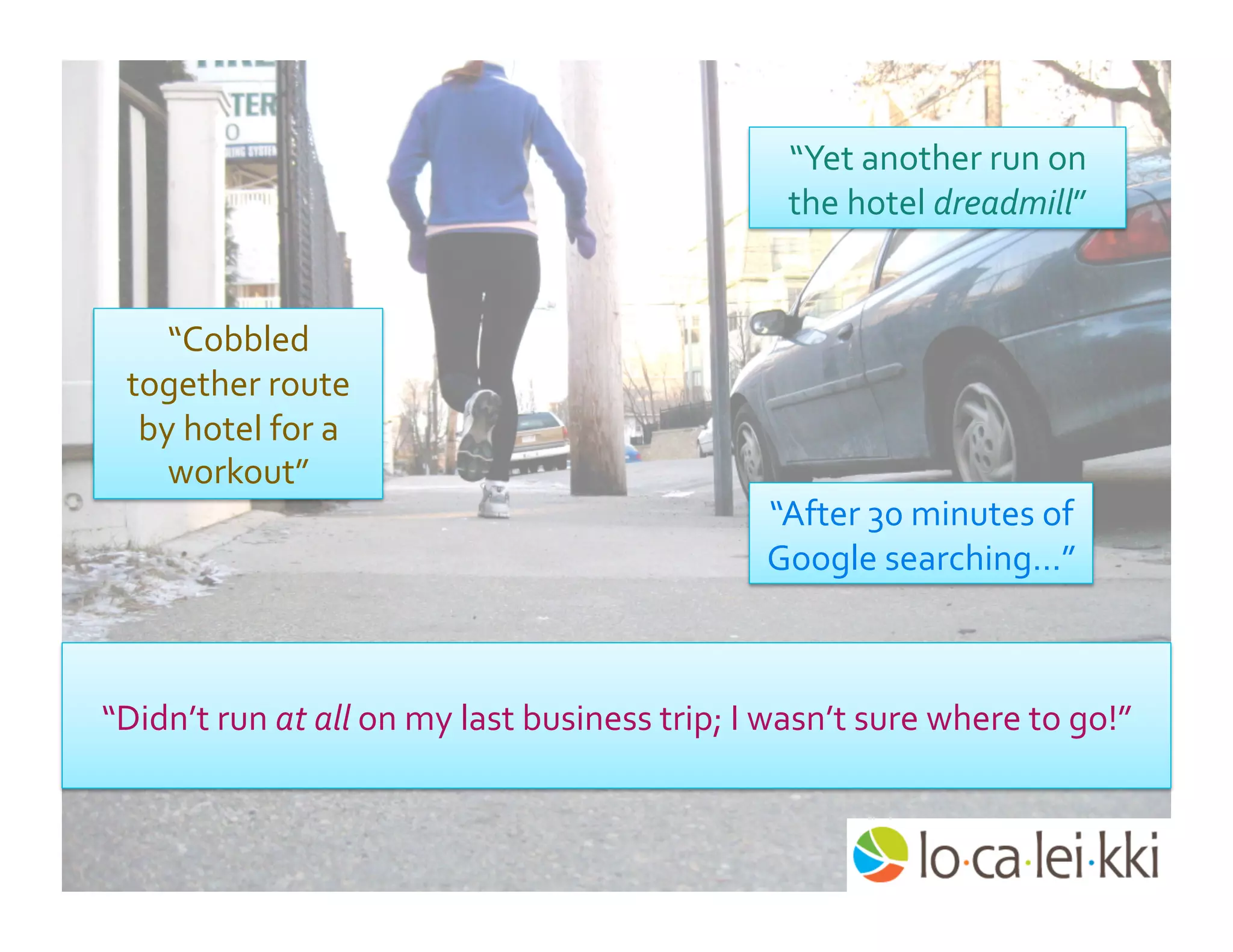
- The problem is framed through user pain points like 'Yet another run on the hotel treadmill' and '30 minutes of Google searching' (Slide 1).
- The market opportunity is defined by 53.2 million Americans who run and a $244 billion business travel industry (Slide 3).
- Localeikki notes a significant exit in the space: MapMyRun was acquired by Under Armour for $150 million (Slide 4).
- Early traction includes content in 49 out of 50 US states across 802 metro areas (Slide 5).
- User engagement is high, with 60% of users contributing content and 24% returning within 7 days (Slide 5).
- The team includes a Board member from Netflix and advisors from Deloitte and Competitor Group (Slide 6).
- Future milestones include a goal of 50% user retention and integration with the Concur Travel Itinerary API (Slide 7).
- The financial ask is $300,000, following a previous raise of $135,000 (Slide 9).
Slide-by-Slide Analysis
Slide 1: The Problem
The deck opens with a visual montage of a runner on a city street, overlaid with quotes that define the user's frustration. The quotes— "Yet another run on the hotel treadmill" and "After 30 minutes of Google searching..." —effectively highlight the friction in the current traveler experience. By stating "Didn't run at all on my last business trip; I wasn't sure where to go!" , the slide identifies a clear gap in the market: the lack of reliable, easily accessible local fitness information for people on the move.
Slide 2: The Solution
Slide 2 introduces "The Active Traveler's Solution" with a map of the United States showing a flight from the East Coast to San Diego. A callout box simulates a user notification: "Welcome to San Diego, Jen! Ready to play local? Check out the 3 running trails closest to your hotel." The bottom caption summarizes the product as a way to "Coordinate your fitness & travel plans through local recreation recommendations from people like you." This establishes the peer-to-peer nature of the platform.
Slide 3: Market Intersection
This slide quantifies the opportunity at the "Intersection of recreation & travel industries." It lists several key metrics: 53.2 million (19%) Americans run , accounting for 4.6 billion total outings . It notes a $12 billion annual spend on trail sport gear . On the travel side, it cites 460 million person-trips for business and a $244 billion business travel market . The slide concludes that trends are moving toward "social, local, mobile experiences."
Slide 4: Industry Landscape
Localeikki positions itself among major tech and fitness players. The slide features logos for Yelp , Google , and runWESTIN . Crucially, it highlights a successful exit in the sector: MapMyRun , which was "Acquired by UnderArmour For $150 million." This serves as a valuation benchmark and proof of interest from major athletic brands in digital fitness communities.
Slide 5: The MVP and Traction
This is the most data-dense slide in the deck. Under "Early stage product," it claims 4,200 downloads in the last 60 days and 16% user growth month-over-month for the past 6 months . The platform already has content in 49/50 states across 802 metro areas . Engagement metrics are also strong: 24% of app traffic returns within 7 days , and 60% of users have contributed content . They also mention having 75 Brand Ambassadors nationwide .
Slide 6: The Team
The "starting line-up" features Tracy McMillan (running, health behavior, planning) and Taylor Thomas (cycling, sales & community). The slide also lists a high-profile Board member, Mike Kail (VP of IT-Ops, Netflix) , and advisors from Deloitte Corporate Travel , McMillan Running , and Competitor Group . This suggests a balance of technical, travel-industry, and athletic expertise.
Slide 7: The Future
Localeikki outlines its "Near-term milestones," which include achieving density in key business travel cities and a UX/UI redesign . A major strategic goal is the "Integration of Concur Travel Itinerary API," which would allow the app to automatically suggest routes based on a user's booked travel. They also set a target of 50% users returning within 7 days .
Slide 8: The Value in Data
This slide consists of a large photo of a running group with the title "The value in data." While it lacks text, it implies that the aggregate data of where, when, and how people run while traveling is a proprietary asset that could be monetized or used to improve the product's intelligence.
Slide 9: The Ask
The financial slide is minimalist, stating a goal of "Raising $300,000." It also notes that "$135,000 [was] previously raised," indicating some level of prior investor validation or founder commitment.
Slide 10: Contact Information
The final slide provides the company logo, the tagline "The Active Traveler's Solution," and contact details for Tracy, including an email, Twitter handle, and the website URL.
What Localeikki Does Well
The deck excels at problem identification . By using relatable quotes on Slide 1, they immediately connect with anyone who has ever traveled for work and struggled to maintain a fitness routine. This emotional hook is backed up by strong engagement metrics on Slide 5. A 60% content contribution rate is exceptionally high for a social platform, suggesting that their early users are highly motivated and see significant value in the community.
The strategic focus on the Concur API (Slide 7) is a sophisticated move for an early-stage startup. It shows the founders understand that the biggest hurdle for a travel app is discovery. By integrating with the tools business travelers already use, they solve the distribution problem without a massive marketing spend.
What is Missing from the Deck
The most glaring omission is a clear revenue model . While Slide 8 hints at the value of data, there is no explanation of how the company will actually make money. Will it be a premium subscription, lead generation for hotels/gear, or data licensing? Investors typically want to see a path to profitability or at least a defined monetization strategy.
Additionally, the deck lacks unit economics . There is no mention of Customer Acquisition Cost (CAC) or Lifetime Value (LTV). While the 16% growth rate is positive, it is difficult to evaluate without knowing how much it costs to acquire those 4,200 users. Finally, the use of funds is not detailed. The deck asks for $300,000 but doesn't specify how that capital will be allocated between hiring, marketing, and product development.
What Other Founders Should Copy
Founders should emulate the "Intersection" market slide (Slide 3). Instead of just showing one massive, vague Total Addressable Market (TAM), Localeikki shows how two different industries overlap to create their specific niche. This makes the market opportunity feel more tangible and attainable.
The Industry Landscape slide (Slide 4) is also a good model. By including a specific acquisition figure ($150M for MapMyRun), they give investors an immediate sense of the potential exit scale. It moves the conversation from "is this a good idea?" to "how big can this get?" based on historical precedents.
Frequently asked questions
- What is Localeikki's primary value proposition?
- Localeikki provides local recreation recommendations specifically for travelers. It aims to replace the 'hotel treadmill' experience with peer-to-peer, local knowledge of running and cycling trails. The app coordinates fitness plans with travel itineraries, leveraging a community of 75 brand ambassadors to ensure content quality across 802 metro areas.
- How does the company plan to grow its user base?
- The deck outlines a 'near-term milestone' of integrating with the Concur Travel Itinerary API. By plugging into existing business travel workflows, Localeikki can reach its target demographic—business travelers—at the moment they are planning their trips, rather than relying solely on organic search or social discovery.
- What evidence of product-market fit is presented?
- Slide 5 shows 4,200 downloads within a 60-day window and a 16% month-over-month growth rate. More importantly, it highlights that 60% of their users contribute content, suggesting a highly engaged community rather than passive consumers. They have already mapped content in 49 states.
- Who are the key people behind the startup?
- The founders are Tracy McMillan (focused on health behavior and planning) and Taylor Thomas (focused on cycling, sales, and community). They are supported by a strong advisory board including Mike Kail (VP of IT-Ops at Netflix) and Brian Nichols (Deloitte Corporate Travel), providing both technical and industry-specific expertise.
- What is the business model for Localeikki?
- The deck does not explicitly detail a revenue model, such as subscriptions or advertising. However, Slide 8, titled 'The value in data,' and Slide 7's mention of 'user & place intelligence' suggest a data-monetization or B2B partnership strategy, potentially selling insights to travel providers or gear manufacturers.