Local Space presented a 10-slide deck in 2019 focused on a mobile-first approach to hyper-local social networking and security. Unlike competitors like Nextdoor, which anchor users to a specific home address, Local Space proposes a 'moving community' where the network follows the user within a 1km visibility radius. The product aims to solve three core issues: personal security, navigation to undocumented locations, and immediate assistance in emergencies. While the deck identifies a clear gap in the market for transient local communication, it lacks critical financial data, including a speci…
Key takeaways
- The core value proposition is a 1km radius mobile community that moves with the user, rather than being tied to a fixed neighborhood (Slide 4).
- The team consists of four individuals: a Legal Adviser/Strategy lead, an A.I. Engineer, a Front-End Developer, and a Back-End Developer/Team Lead (Slide 2).
- The problem slide identifies personal security as a task that cannot be delegated to a few personnel, requiring a community-based approach (Slide 3).
- Market size is framed globally using 2019 data, citing 4.27 billion internet users and 789 million smartphones sold that year (Slide 5).
- The product features a password-less login and a user-defined 'Visibility Radius' (V.R) for privacy control (Slide 6).
- The business model is currently focused on adoption, with future plans to monetize through local business offers and job seeker connections (Slide 7).
- Nextdoor is identified as the primary competitor, with the distinction that Nextdoor requires a fixed neighborhood of at least 50 households (Slide 8).
- The deck completely omits a financial ask, use of funds, or any historical traction metrics (Slides 1-10).
Slide-by-Slide Analysis
Slide 1: Title Slide
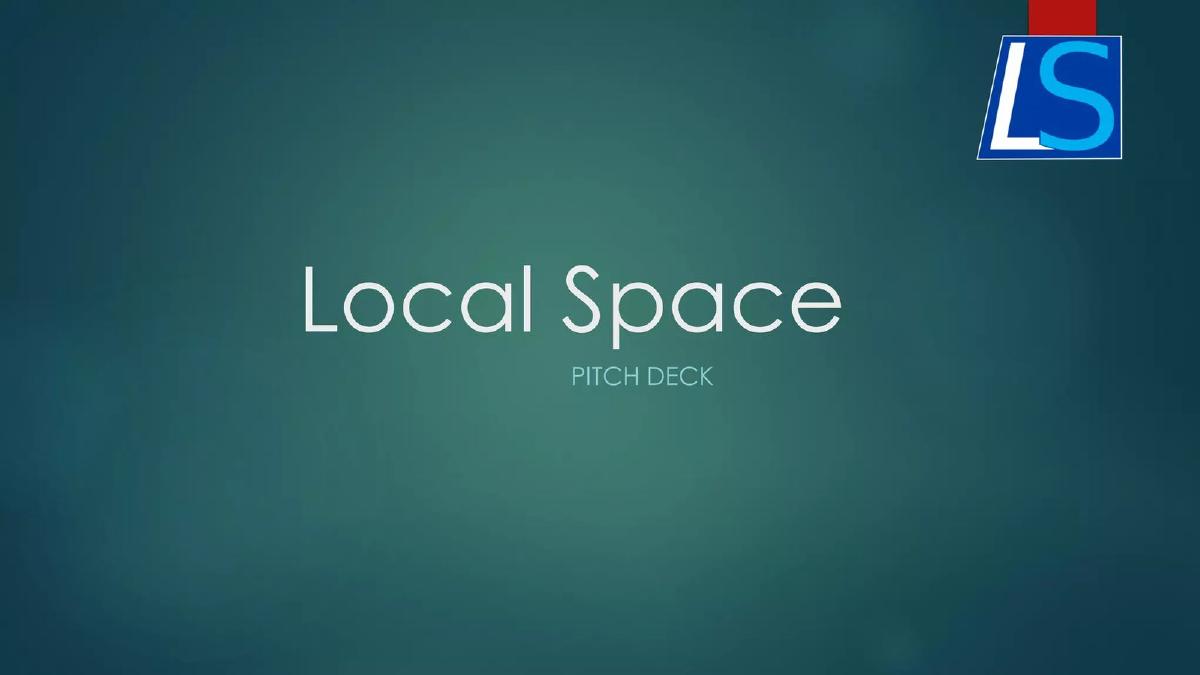
The cover slide features the company name, 'Local Space,' and the 'LS' logo. The design is minimalist with a dark teal gradient background. It establishes the brand but lacks a tagline or a one-sentence summary of what the company does, which is a missed opportunity to immediately hook the reader.
Slide 2: Our Team
This slide introduces four team members: Boluwatife Majoyeogbe (Legal Adviser/Strategy), Ilemobayo Justus (A.I. Engineer), Kosiso Ikezogwo (Front-End Developer), and Haastrup Elijah (Back-End Developer/Team Lead). While the roles cover the necessary technical and legal bases for a social/security app, there is a total absence of professional history. Investors look for 'why this team,' and without mentions of previous startups, relevant corporate experience, or specific technical achievements, the slide fails to build credibility.
Slide 3: Problem
The problem is broken down into three pillars: Security, Accessibility, and Getting Help. The text argues that security is a job that cannot be delegated to a few personnel, suggesting a need for a crowdsourced approach. It also touches on the fear of getting lost in new places and the irony of being 'helpless' despite being surrounded by people. This slide successfully identifies emotional pain points but lacks data or statistics regarding crime rates or navigation failures to quantify the scale of these problems.
Slide 4: Solution
Local Space defines its solution as a mobile app using GPS, map data, and AI to connect people within a 1km range. It highlights three specific use cases: getting directions to undocumented places, 'watching each other's back' for security, and 'yelling out for help' to alert nearby users. The 1km radius is a specific technical constraint that differentiates it from broader social networks.
Slide 5: Market Size
This slide uses 2019 data from internetlivestats.com. It cites 4,274,448,114 internet users, 789,712,677 smartphones sold 'this year,' and 82,465,463 tablets sold 'this year.' While these numbers are large, they represent the Total Addressable Market (TAM) in the broadest possible sense. The deck fails to narrow this down to a Serviceable Addressable Market (SAM) or a specific geographic launch market, making the opportunity feel unfocused.
Slide 6: Product
The product slide focuses on the user experience of onboarding. It notes a 'no password login' and registration via a 'verifiable phone number.' A key feature mentioned is the 'Visibility Radius (V.R),' which allows users to control their privacy. The note at the bottom clarifies that GPS must be enabled, which is a standard requirement for location-based services.
Slide 7: Business Model
The business model is presented as a future goal rather than a current reality. The founders state their primary focus is currently on adoption and user experience. They explicitly mention a desire to avoid 'annoying ads.' Future monetization plans include local business offers, job seeker connections, and professional awareness tools. This is a 'community first, revenue later' approach, which often requires significant venture backing to survive the pre-revenue stage.
Slide 8: Competition
The deck identifies Nextdoor as the primary competitor. It describes Nextdoor as a platform for 'fixed geographical neighborhoods' requiring at least 50 households. By highlighting these limitations, Local Space sets the stage for its own competitive advantage, though it fails to mention other proximity-based apps like Citizen or Life360.
Slide 9: Competitive Advantage
This slide reinforces the 'moving community' concept. It states that Local Space creates a community around users 'wherever they are at any particular instance in time.' This is the strongest point in the deck, as it clearly defines the unique value proposition: mobility. It moves the social network from a 'home-based' utility to a 'travel-based' utility.
Slide 10: Thank You
The final slide is a simple 'Thank You' on the same teal background. It lacks contact information, a website URL, or a call to action, which is a significant oversight for a pitch deck intended to generate investor interest.
What Local Space Does Well
The deck is highly focused on a single, clear differentiator: the transition from fixed-location social networking to dynamic, proximity-based networking. By defining the 'Visibility Radius' and the 1km limit, the founders show they have thought through the technical boundaries of their 'moving community' concept. The problem slide effectively uses relatable human fears—getting lost or being in danger in a crowd—to justify the existence of the app. The design is consistent and clean, avoiding the cluttered look of many early-stage decks.
What Is Missing from the Deck
The most glaring omission is the Ask . There is no mention of how much money the company needs, what the valuation is, or what the milestones for the next 18 months look like. Furthermore, the deck lacks any Traction metrics. Even if the app is in beta, data on user engagement, sign-ups, or results from a pilot program would significantly strengthen the case. The Team slide is also under-developed; without knowing the founders' backgrounds, it is impossible to judge if they have the capability to build the AI and GPS infrastructure they describe. Finally, the Financials are non-existent; there are no projections for burn rate, customer acquisition cost (CAC), or long-term revenue targets.
What Other Founders Can Copy
Founders should look at Slide 9 as a good example of how to distill a competitive advantage into a single, understandable sentence: 'Local space will create community/neighbor around its users wherever they are at any particular instance in time.' This clearly explains why the product is different from the market leader (Nextdoor). Additionally, the use of specific use cases on the Solution slide (Slide 4) helps investors visualize exactly how a customer would use the app in their daily life. The 'problem' framing on Slide 3 is also effective because it categorizes the issues into three distinct buckets, making a complex social problem easier to digest.
Final Thoughts
The Local Space deck is a conceptual pitch that succeeds in defining a niche but fails to provide the business rigor required for a successful fundraise. It identifies a genuine gap in the hyper-local market—the need for community connectivity while on the move—but leaves too many questions unanswered regarding execution, monetization, and team expertise. For this to be a viable investment prospect, the founders would need to add a slide on their specific go-to-market strategy, a detailed financial plan, and a clear request for capital.
Frequently asked questions
- What is the primary differentiator between Local Space and Nextdoor?
- According to Slide 8 and Slide 9, Nextdoor is built for fixed geographical neighborhoods requiring at least 50 households to form a private website. Local Space, by contrast, creates a 'moving community.' The user's 'neighbors' are whoever is within their specific visibility radius at any given moment, allowing for hyper-local interaction while traveling or in transit, rather than just at home.
- How does Local Space plan to make money?
- Slide 7 outlines a future business model focused on three areas: providing special offers from local businesses to users, connecting job seekers with potential employers in their immediate vicinity, and helping professional users build awareness within their visibility radius. The deck explicitly states they want to avoid 'annoying ads and pop-ups' to protect the user experience.
- What technical features are highlighted in the deck?
- Slide 4 and Slide 6 mention the use of GPS, map data, and Artificial Intelligence. Key features include 'password-less login,' a 'verifiable phone number' for registration, and a 'Visibility Radius (V.R)' that users can update to control who sees their public profile. The app also facilitates navigation to places not documented on standard maps through peer-to-peer information sharing.
- Who are the founders and what is their background?
- Slide 2 lists four team members: Boluwatife Majoyeogbe (Legal Adviser/Strategy), Ilemobayo Justus (A.I. Engineer), Kosiso Ikezogwo (Front-End Developer), and Haastrup Elijah (Back-End Developer/Team Lead). However, the deck does not provide any biographical information, past employment history, or educational credentials for these individuals, making it difficult to assess team-market fit.
- Is there any evidence of traction or a funding request?
- No. The 10-slide deck contains no mention of current user numbers, downloads, or pilot programs. Furthermore, there is no 'Ask' slide detailing how much capital the company is seeking to raise or how that capital would be allocated. This suggests the deck may be an early-stage concept pitch rather than a formal series-round fundraising document.