Auki Labs secured a $13M Seed round in 2024 to address the 'spatial computing' bottleneck in the AR industry. The company argues that current GPS, WiFi, and Bluetooth technologies lack the millimeter-level precision required for a persistent, shared metaverse. Their solution involves a decentralized, peer-to-peer positioning system that avoids the privacy pitfalls of crowdsourced 3D scanning. The deck is heavily vision-oriented, utilizing high-concept imagery to illustrate a future where physical displays are obsolete and 'rendering rights' for physical spaces are a trillion-dollar market. Wh…
Key takeaways
- Auki Labs aims to replace GPS with a peer-to-peer positioning system to enable a persistent AR metaverse (Slide 1).
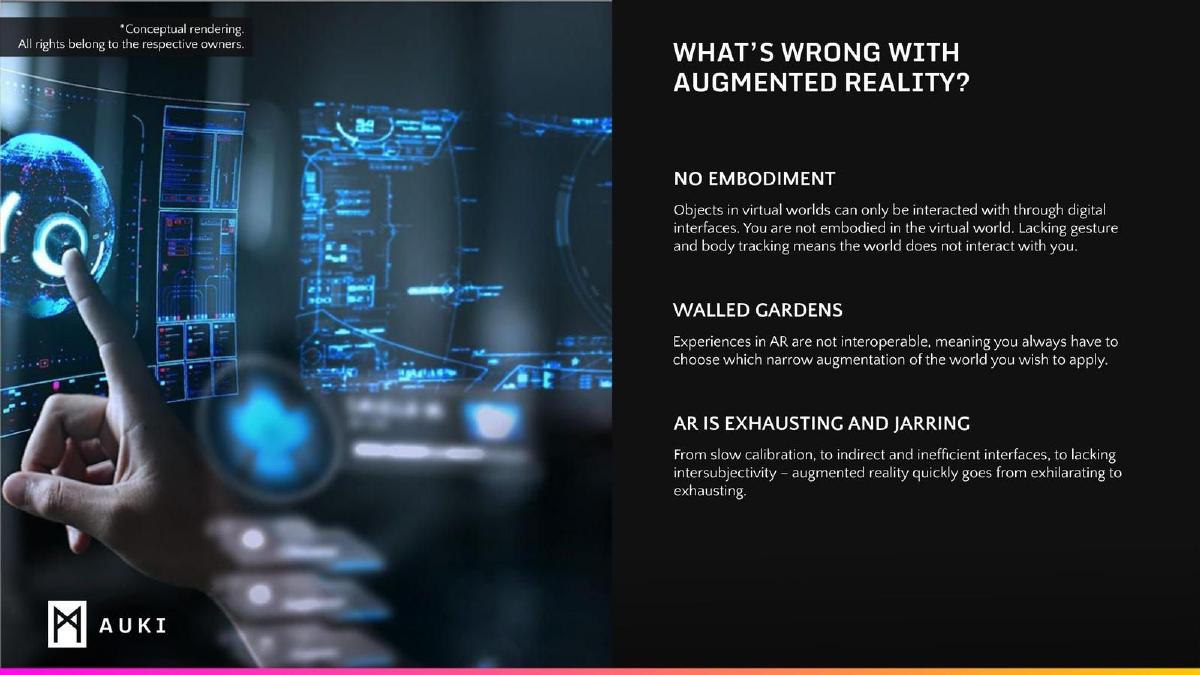
- The company identifies 'No Embodiment' and 'Walled Gardens' as the primary failures of current AR technology (Slide 2).
- Auki envisions a 'trillion dollar market' for rendering rights in physical spaces, effectively reinventing advertising (Slide 3).
- The deck claims GPS will never suffice for AR because it requires line-of-sight and fails in dense urban or indoor environments (Slide 4).
- Auki critiques current spatial computing efforts as 'Serfdom as a Service,' where users aren't compensated for crowdsourcing digital twins (Slide 5).
- The technical solution includes 'Manna' for instant calibration and 'Hagall' for distributed networking (Slide 6).
- The company raised $13M in 2024 to bring this peer-to-peer AR positioning technology to market (Publisher Fact).
- The deck relies heavily on conceptual renderings and philosophical arguments rather than traction data or revenue models.
The Visionary Bet on Spatial Consensus
Auki Labs entered the 2024 fundraising market with a bold proposition: the current infrastructure of the internet is incapable of supporting the next generation of augmented reality. As reported by Business Insider, the company successfully raised a $13M Seed round to build a decentralized positioning system. The deck is a masterclass in 'vision-led' pitching, focusing on the philosophical and technical shortcomings of giants like Google and Apple, while positioning Auki as the ethical and technical alternative.
Slide 1: The Mission Statement
The deck opens with a high-level summary of the company's purpose. Auki Labs states they make products that allow people to 'create, own, inhabit and interact with virtual worlds and objects anchored in reality.' The most provocative claim on this slide is the intention to 'replace the GPS system' by giving every cubic millimeter an address. This sets a massive scope for the project, signaling to investors that this is not just an app, but a foundational infrastructure play.
Slide 2: The AR Problem Set
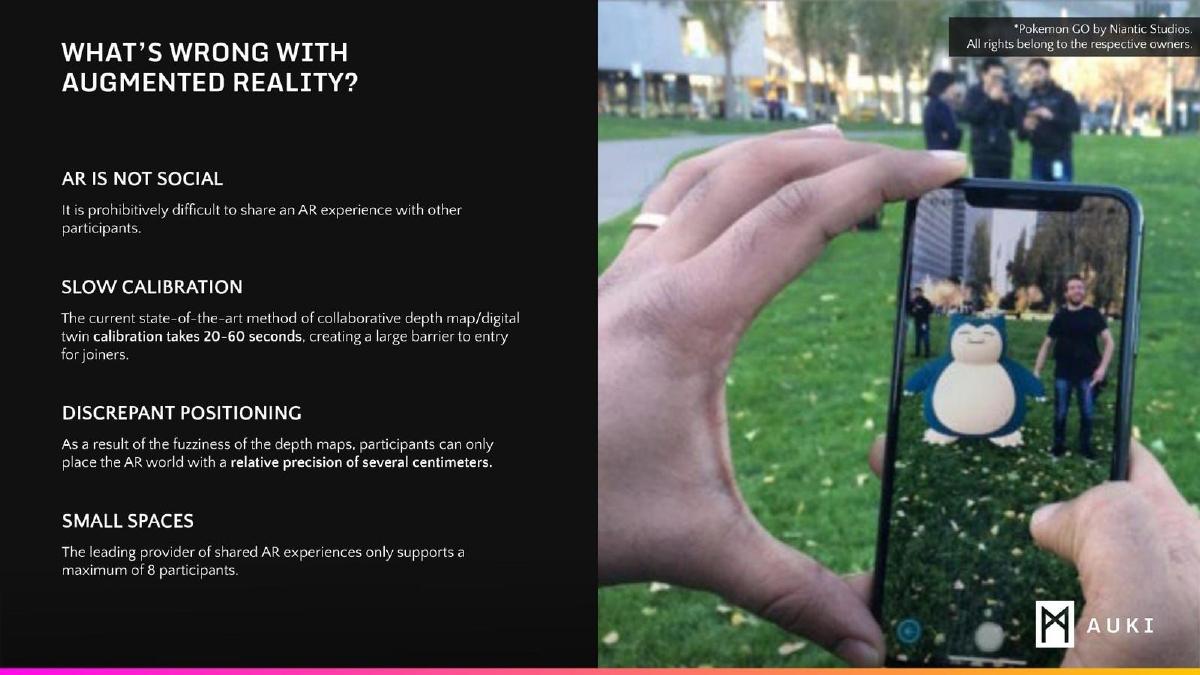
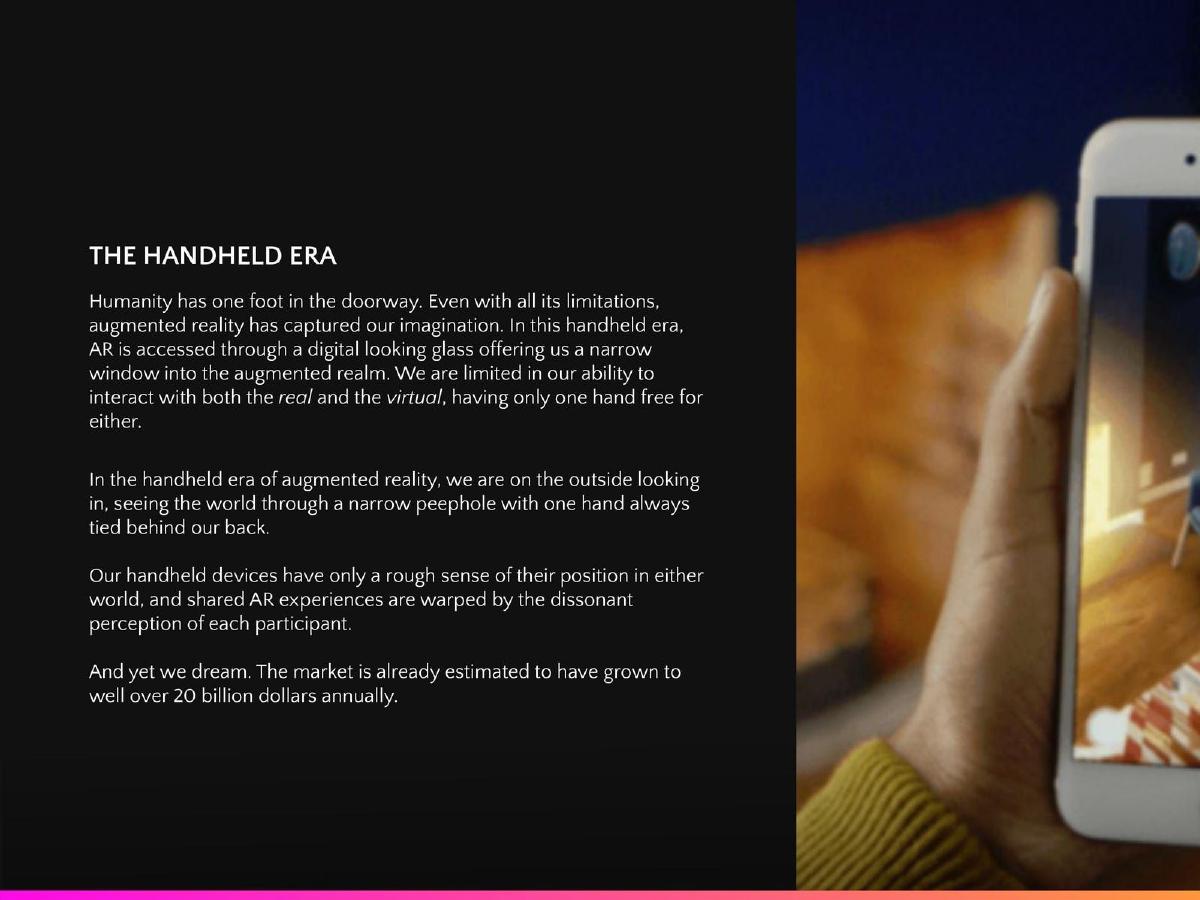
Slide 2, titled 'What's Wrong With Augmented Reality?', breaks down the current friction points. It cites 'No Embodiment,' 'Walled Gardens,' and the fact that AR is 'Exhausting and Jarring.' By highlighting that current AR experiences are not interoperable and lack 'intersubjectivity' (the ability for multiple people to see the same thing in the same place), Auki establishes the necessity for a new protocol. The use of a conceptual rendering on the left side of the slide reinforces the 'futuristic' tone of the deck.
Slide 3: The Trillion-Dollar Opportunity
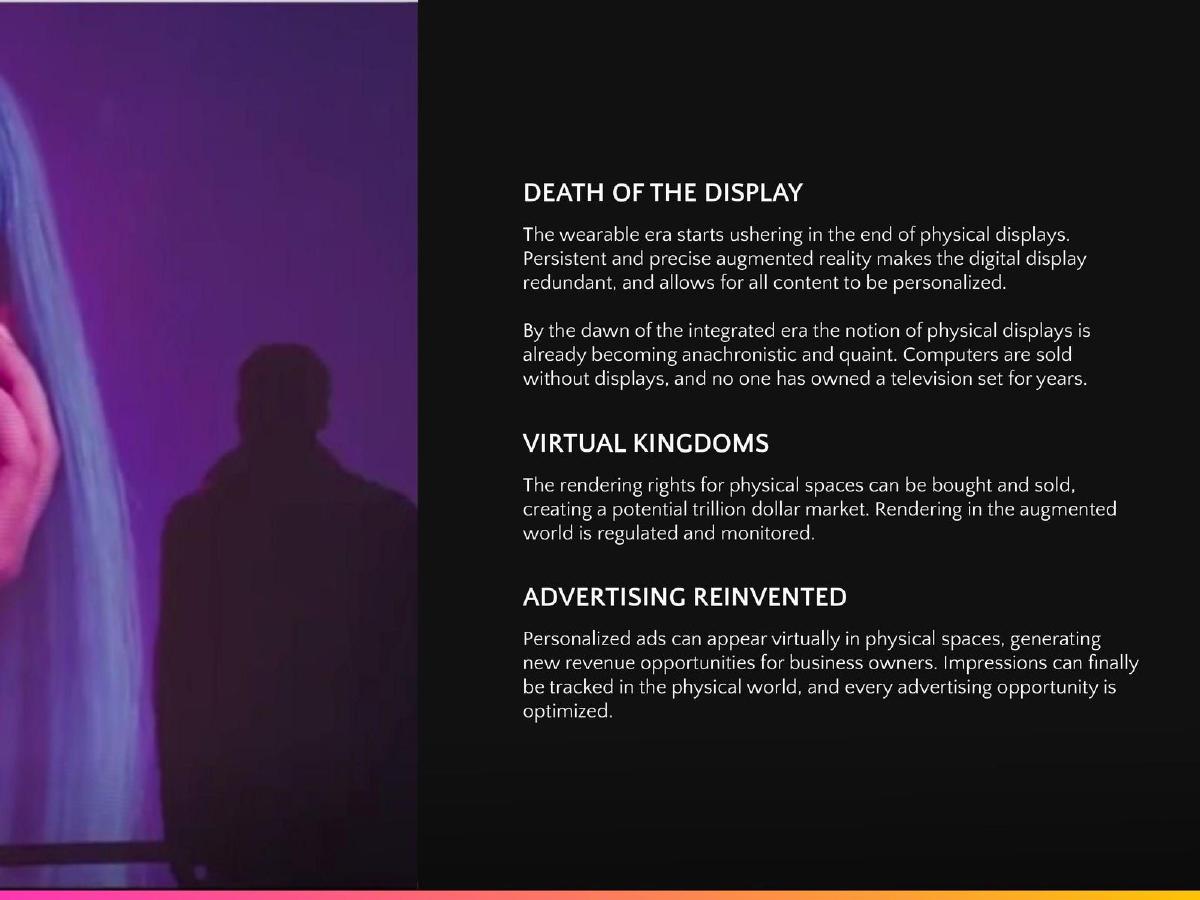
This slide shifts from the 'what' to the 'so what.' Auki introduces the concept of the 'Death of the Display,' suggesting that wearable AR will make physical screens redundant. The business case is built on 'Virtual Kingdoms'—the idea that rendering rights for physical spaces can be commoditized. They explicitly mention a 'potential trillion dollar market' where personalized ads are tracked in the physical world. This is a classic venture capital hook: identifying a massive legacy industry (advertising) and explaining how a new technology will capture its value.
Slide 4: Solving for [X, Y, Z]
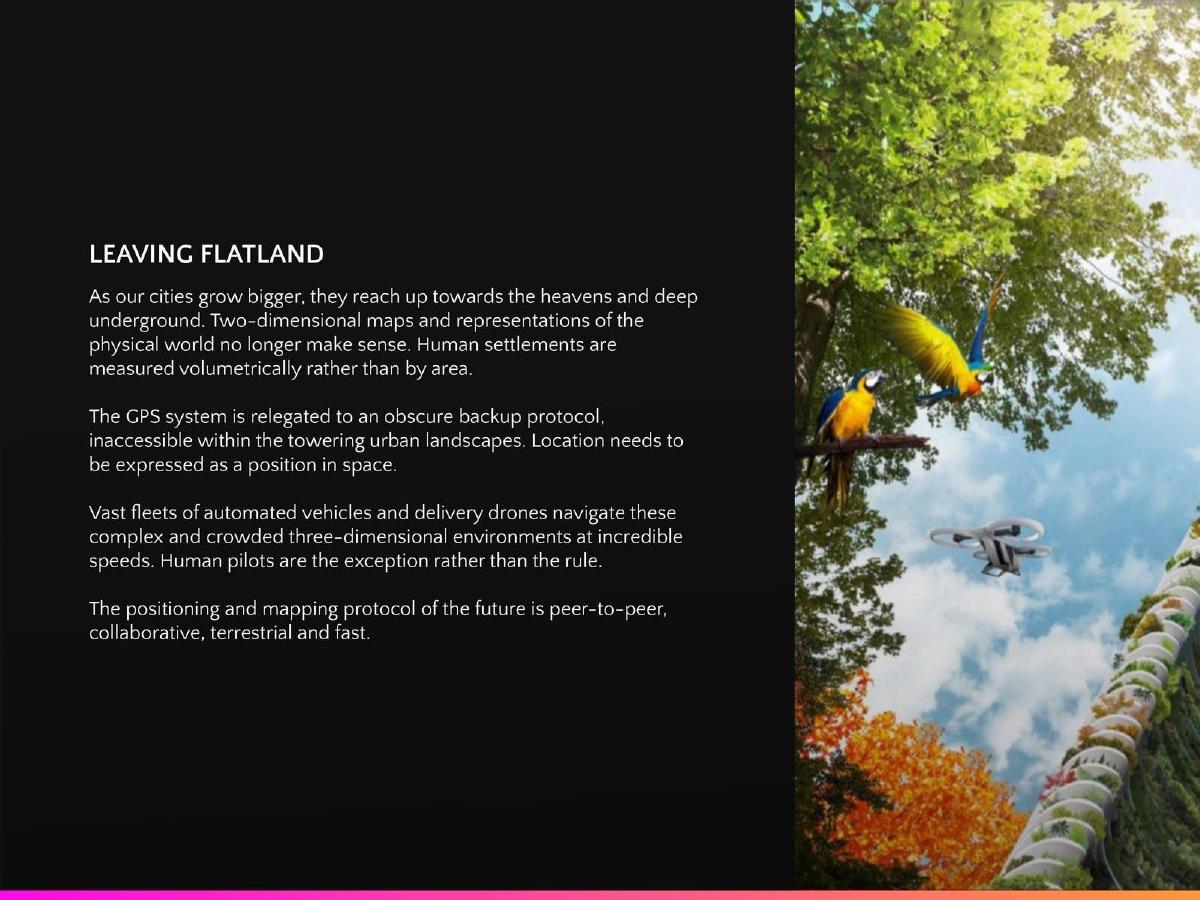
Slide 4 dives into the technical bottleneck. It argues that electronic devices only have a 'vague sense of their literal place in the world.' Auki dismisses GPS, WiFi, and Bluetooth as insufficient for the precision required for the metaverse. The slide emphasizes that devices need exact 3D coordinates, not just longitude and latitude. This slide serves to justify why Auki’s specific technical approach (peer-to-peer positioning) is the only viable path forward for spatial computing.
Slide 5: The Ethical Critique of Spatial Computing
In a unique move, Auki uses Slide 5 to attack the current industry standard of 'crowdsourced digital twins.' They label this 'Serfdom as a Service,' arguing that large corporations are violating privacy by 3D scanning homes and offices without compensating users. They also point out a technical 'chicken and egg' problem: you can't create a precise map without precise positioning. By framing their decentralized approach as a solution to 'surveillance capitalism,' Auki appeals to the growing investor interest in ethical tech and data sovereignty.
Slide 6: The SDK Components
The final slide in the provided set introduces the product: the Aukiverse SDK. It highlights two main components: Manna and Hagall . Manna is described as a patent-pending instant calibration method for social AR experiences. Hagall is a distributed networking engine where participants are routed to providers who 'earn tokens' for hosting. This introduces a Web3/decentralized element to the business model, suggesting a network effect where the infrastructure grows as more participants join.
What Works in This Deck
Strong Narrative Arc: The deck follows a logical progression from a massive vision to a specific technical problem, then to a market opportunity, and finally to a product solution. It builds a sense of inevitability around the transition from physical displays to spatial computing.
High-Quality Visuals: The use of dark backgrounds with vibrant, cyberpunk-style imagery (Slides 3 and 4) helps sell the 'future' that Auki is building. It makes the abstract concept of a 'persistent AR layer' feel tangible to the reader.
Clear Differentiation: By explicitly stating why GPS and current 'digital twin' methods fail, Auki carves out a unique competitive position. They aren't just building 'better AR'; they are building the 'only AR that works' according to their technical definitions.
What Is Missing from the Auki Labs Deck
The Team: In a Seed round, the team is often the most important factor. This deck (in the 12 slides described) does not include a team slide. For a project aiming to 'replace GPS,' investors would need to see deep expertise in computer vision, spatial mapping, and distributed systems.
Traction and Validation: While Slide 6 shows a 'live demo' of a virtual pet app (Matterless), there is no data on developer adoption, pilot programs, or user engagement. A $13M round usually requires some evidence that the SDK is being used by third parties.
Business Model Specifics: The deck mentions 'tokens' and 'rendering rights,' but it doesn't explain the actual revenue flow for Auki Labs. Is it a SaaS model for the SDK? A transaction fee on the token network? A percentage of the 'Virtual Kingdom' advertising? The mechanics are left to the imagination.
The Ask: There is no slide detailing how much capital is being raised or how it will be deployed. While we know from publisher facts that they raised $13M, a standard pitch deck should outline the milestones that this capital will enable.
Founder Takeaways
Sell the 'Why' Before the 'How': Auki spends four slides establishing the problem and the future state before mentioning their SDK. This is effective for deep-tech or infrastructure plays where the problem isn't yet obvious to the general public.
Use Provocative Language: Terms like 'Serfdom as a Service' and 'Death of the Display' are memorable. They give investors 'hooks' to remember the company by and help frame the competition in a negative light.
Address Privacy Early: For any technology involving cameras and 3D mapping, privacy is a major hurdle. Auki turns this into a competitive advantage by building their positioning system to be peer-to-peer and decentralized from the start.
Infrastructure vs. Application: If you are building a platform, show an application. The inclusion of the 'Matterless' app demo on Slide 6 is crucial because it proves the SDK actually does something, even if the broader vision of 'Virtual Kingdoms' is years away.
Frequently asked questions
- What is the core problem Auki Labs is trying to solve?
- Auki Labs identifies the 'positioning problem' as the primary barrier to the metaverse. They argue that GPS, WiFi, and Bluetooth lack the precision for devices to reach a consensus on their exact 3D coordinates. Without this, persistent AR layers cannot be anchored to the physical world accurately, leading to 'exhausting and jarring' user experiences.
- How does Auki Labs plan to monetize its technology?
- Slide 3 suggests a future where 'rendering rights' for physical spaces are bought and sold. They envision a new advertising paradigm where personalized ads appear virtually in physical spaces, allowing business owners to track impressions in the real world. Additionally, Slide 6 mentions a token-based system for hosting networking services.
- What are the 'Manna' and 'Hagall' components?
- These are the two primary SDK components shown on Slide 6. Manna is a patent-pending instant calibration method for peer-to-peer positioning. Hagall is a distributed networking engine that routes participants to cost-efficient providers, who earn tokens for their service, facilitating spatial multiplayer experiences.
- Why does the deck criticize 'Digital Twins'?
- Slide 5 argues that current crowdsourced digital twins (3D maps of interiors) are privacy violations and 'Serfdom as a Service.' Auki Labs claims these systems monetize intimate spaces without compensating the users who provide the data, and that the 'complex stitching' of these maps leads to inherent positioning imprecision.
- What is missing from the Auki Labs pitch deck?
- The deck is missing several standard venture components: a team slide showcasing founder expertise, a competition slide, a clear business model with pricing, financial projections, and a specific 'Ask' slide detailing how the $13M will be spent.