Audience Town’s 10-slide Seed deck is a masterclass in vertical specialization. By focusing exclusively on the 'home mover journey,' the company positions itself as a necessary alternative to fragmented horizontal platforms like Meta and Google. The deck effectively uses a 'before and after' narrative, showing how they consolidate 14 different marketing functions—from DSPs to attribution—into a single interface. With a clear TAM of $1T and a SAM of $95B, the deck leverages impressive 200%+ year-over-year growth and a roster of national clients like Lennar and Bear Mattress to justify a $6 mil…
Key takeaways
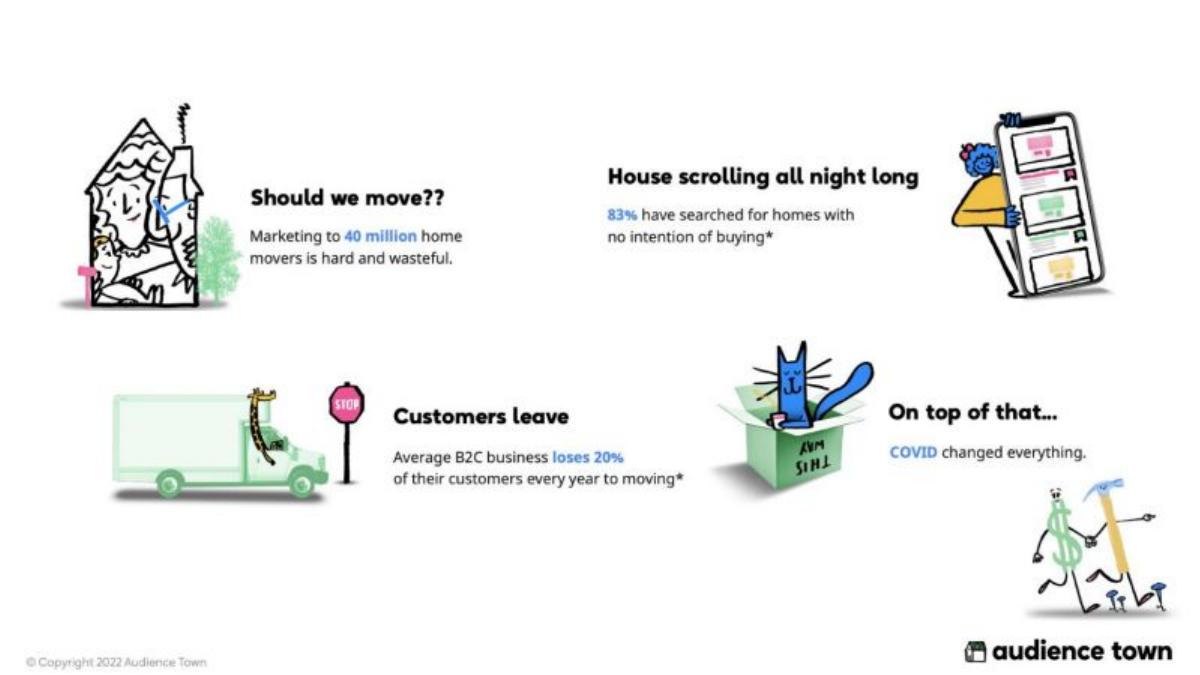
- The company identifies a specific audience of 40 million home movers as the primary target for their vertical data platform (Slide 2).
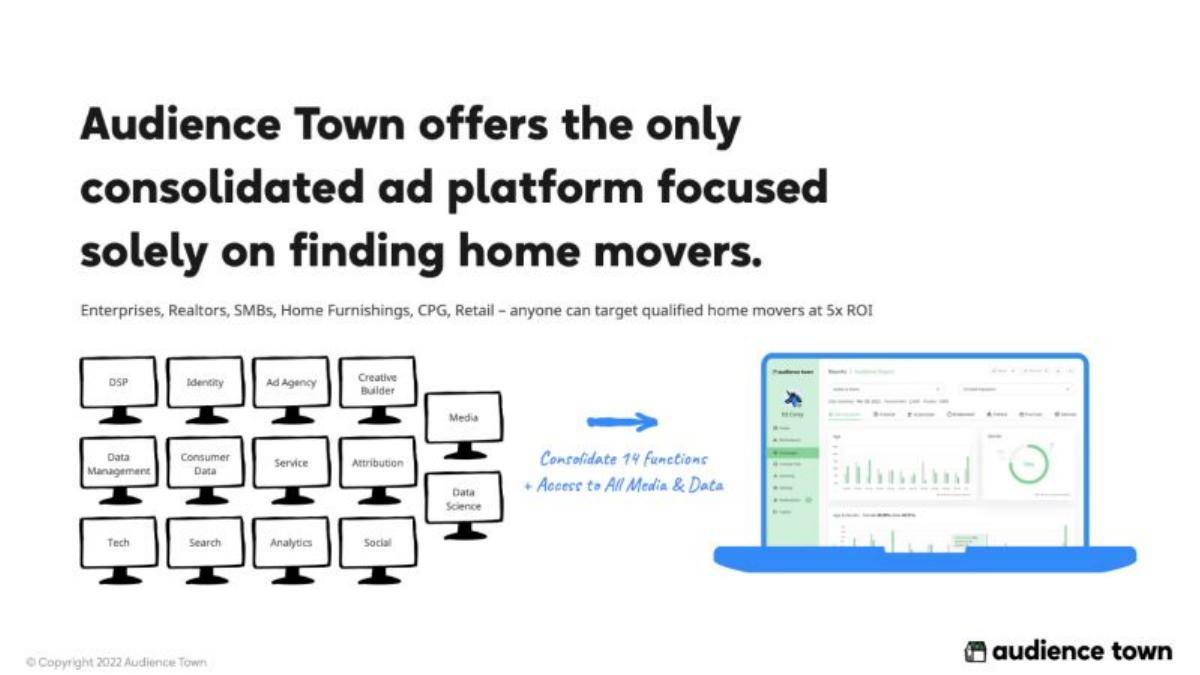
- Audience Town claims to consolidate 14 distinct marketing functions, including DSP, Identity, and Attribution, into one platform (Slide 5).
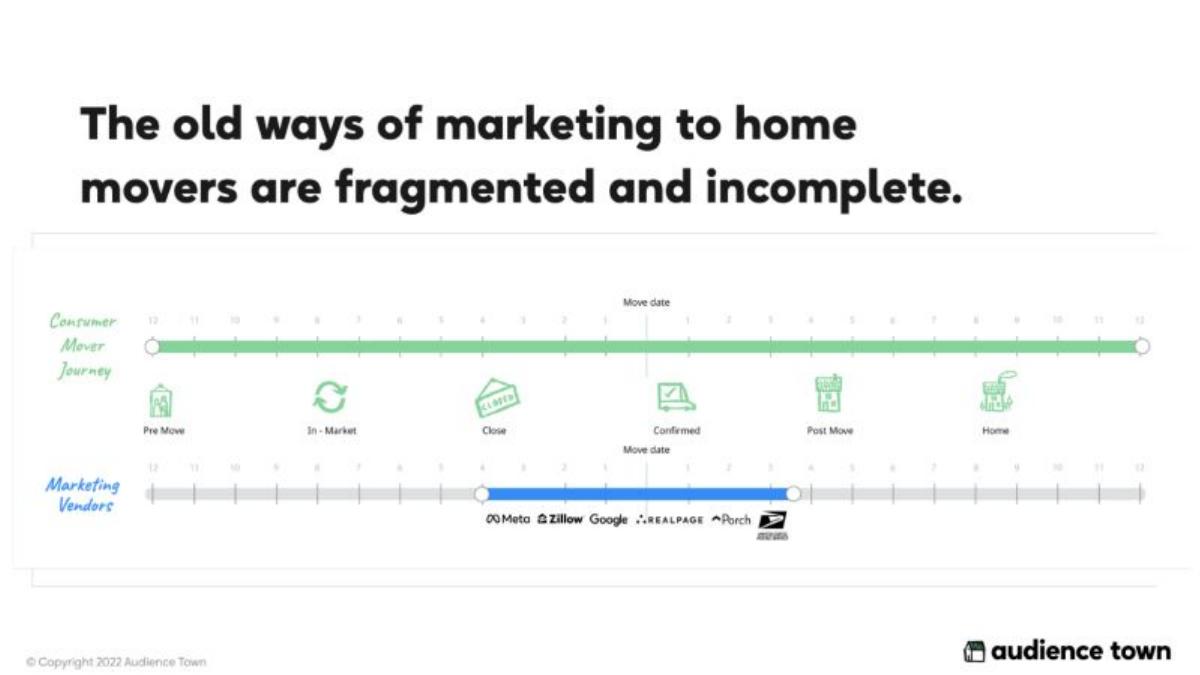
- Marketing to home movers is currently fragmented, with traditional vendors only covering a small window around the move date (Slide 3).
- The deck defines a massive Total Addressable Market (TAM) of $1 trillion for online advertising (Slide 7).
- The startup demonstrated consistent growth, citing 200% YoY growth in 2020 and 212% YoY growth in 2021 (Slide 8).
- The $6 million funding ask is explicitly tied to three goals: hiring leadership, accelerating product UI, and acquiring unique data (Slide 9).
- The platform utilizes a subscription/MRR payment model and includes an ML engine for data management (Slide 6).
- The deck completely omits a team slide, relying instead on traction and market size to establish credibility.
Introduction: The Vertical AdTech Play
Audience Town’s pitch deck is a concise, 10-slide presentation that focuses on the intersection of AdTech and PropTech. The primary thesis is that horizontal advertising platforms are inefficient for the specialized needs of the real estate industry. By building a vertical-specific data and advertising platform, Audience Town aims to capture the high-value 'home mover' demographic more effectively than generalist platforms.
Slide 1: The Vision Statement
The cover slide establishes the company as the 'first vertical data and advertising platform' for the home journey. It uses a clean aesthetic with a whimsical illustration style that carries through the deck. The value proposition is clearly stated: reaching customers from the 'dreaming' phase through 'moving day and beyond.' This immediately signals to investors that the company is looking at a long-term customer lifecycle rather than a one-off transaction.
Slide 2: Defining the Problem and the Audience
Slide 2 quantifies the target: 40 million home movers. It highlights the inefficiency of current marketing, noting that 83% of people search for homes with no intention of buying, which creates 'noise' for traditional advertisers. Crucially, it mentions that the average B2C business loses 20% of their customers every year due to moving, framing Audience Town not just as an acquisition tool, but as a retention solution. The mention of COVID changing everything serves as a 'why now' catalyst, though it remains a brief bullet point.
Slide 3: The Gap in the Market
This slide is one of the most effective in the deck. It uses a timeline of the 'Consumer Mover Journey' (from 12 months pre-move to 12 months post-move). It plots major incumbents like Meta, Zillow, Google, and the USPS, showing that they only cluster around the 'Move date.' This visualizes the 'fragmented and incomplete' nature of the current market, leaving a wide-open space for a platform that covers the full 24-month cycle.
Slide 4: The Solution Architecture
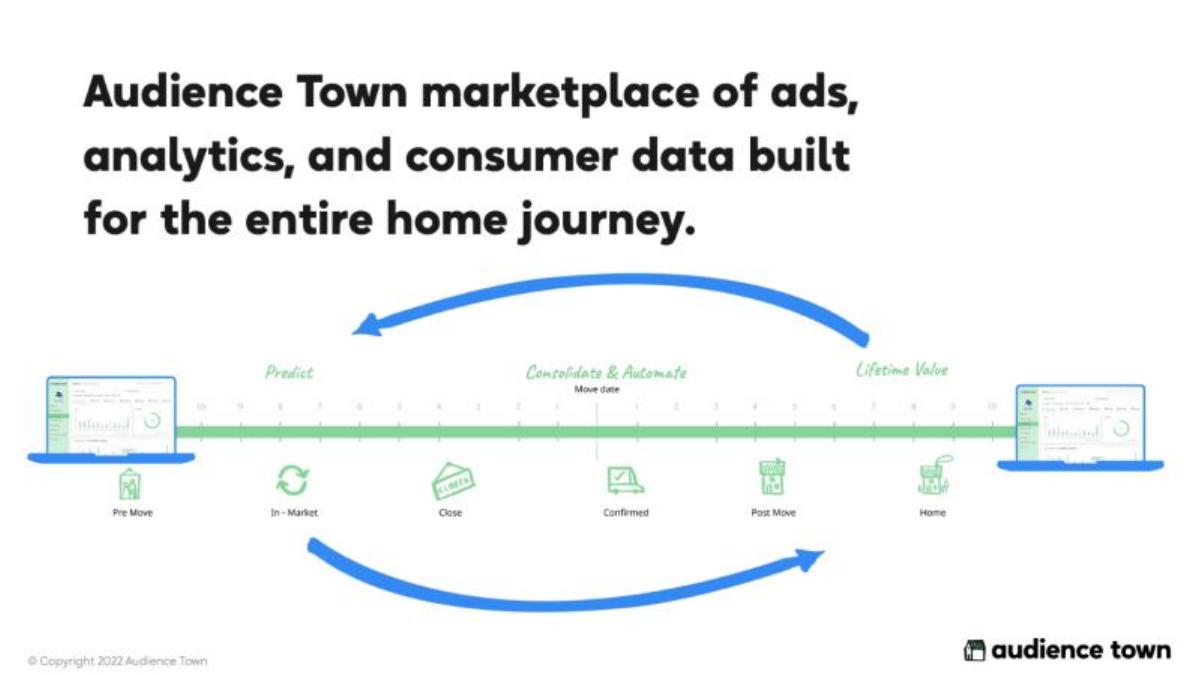
Slide 4 introduces the Audience Town marketplace. It mirrors the timeline from the previous slide but shows Audience Town covering the entire span. It highlights three core capabilities: Predict, Consolidate & Automate, and Lifetime Value. This slide transitions the narrative from 'there is a gap' to 'we fill the entire gap.'
Slide 5: The Consolidation Value Prop
This slide addresses the 'How.' It lists 14 different functions that marketers currently have to manage separately—including DSP, Identity, Ad Agency, Data Management, and Attribution. The slide uses a simple 'before and after' graphic to show these 14 functions being consolidated into the Audience Town platform. The claim of a '5x ROI' for anyone targeting home movers is a bold performance metric intended to hook growth-oriented investors.
Slide 6: Product Features and Business Model
Slide 6 provides a look at the platform's UI and lists its 'End-To-End Platform Features.' Key items include an ML engine for data management, attribution tools, and a 'subscription / MRR' payment model. This is critical for investors as it confirms the company is building a scalable SaaS/PaaS business rather than acting as a traditional service-based ad agency.
Slide 7: Market Size and Comparables
The 'Market' slide is dense with data. It claims the online advertising market is hitting $1 trillion. It breaks down the opportunity into TAM ($1T), SAM ($95B), and SOM ($1B). To provide context, it lists successful exits and market caps in both AdTech (The Trade Desk at $27B) and PropTech (Porch at $1.7B). By doing this, Audience Town argues that it belongs to two high-value categories simultaneously, potentially commanding a higher valuation multiple.
Slide 8: Traction and Growth
The traction slide uses a staircase graphic to show the company’s journey from 'Idea' in 2016 to 'Self-Service Platform launch' in 2021. The key metrics are '200% growth YoY' in 2020 and '212% growth YoY' in 2021. At the bottom of the slide, a 'logo wall' features prominent clients like Lennar, Toll Brothers, and Bear Mattress. This slide proves that the vertical approach is already resonating with major enterprise players.
Slide 9: The Ask and Use of Funds
The final content slide states the ask: 'up to $6 million.' The use of funds is transparently allocated to three pillars: leadership hiring, product/infrastructure acceleration, and data acquisition. This is a standard but necessary slide that tells investors exactly how their capital will be converted into further growth.
Slide 10: Conclusion
The final slide is a promotional graphic for the source of the deck and does not contain company-specific information.
What Audience Town Does Well
Vertical Focus: The deck successfully argues that 'Home Movers' are a distinct and underserved vertical. By focusing on this specific niche, they make a compelling case for why a specialized tool is better than a general one.
Visualizing the Gap: Slide 3 is a standout. Visualizing the 'incumbent cluster' versus the 'full journey' makes the market opportunity intuitive without requiring deep industry knowledge.
Consolidation Narrative: The '14 functions into 1' argument on Slide 5 is a classic SaaS value proposition. It promises efficiency and cost savings, which is always attractive to enterprise customers and investors alike.
What is Missing from the Deck
The Team Slide: The most glaring omission is the lack of a team slide. In a Seed round, the pedigree of the founders and their specific experience in AdTech or Real Estate is usually a primary decision factor for investors. The deck relies entirely on product and traction, leaving the 'who' a mystery.
Unit Economics: While the deck mentions 200%+ growth and a 5x ROI for customers, it does not provide internal unit economics like Customer Acquisition Cost (CAC), Lifetime Value (LTV), or churn rates. For a platform claiming to manage 'Lifetime Value,' seeing their own LTV metrics would have been powerful.
Competitive Landscape: While they show how they differ from Google and Meta, they don't address other vertical-specific competitors. Investors would likely want to know who else is trying to own the 'home mover' data space.
Founder Takeaways
Own a Timeline: If your business operates in a lifecycle (like moving, pregnancy, or career changes), use a timeline to show where competitors fail. Audience Town’s use of the 24-month journey is their strongest intellectual property in this deck.
Define Your Intersection: If you sit between two industries (like AdTech and PropTech), show the 'comps' for both. It helps investors understand which buckets of capital you might eventually tap into for an exit.
Consolidate the Mess: If your industry requires customers to use 10+ different tools, your primary slide should be the 'Unbundling vs. Re-bundling' graphic. Showing that you replace 14 functions with one UI is a very high-signal way to demonstrate value.
Frequently asked questions
- What is the core problem Audience Town is solving?
- According to Slide 2 and 3, the problem is twofold: marketing to 40 million home movers is currently 'hard and wasteful,' and existing marketing vendors are 'fragmented and incomplete.' Most vendors only target a narrow window around the move date, whereas Audience Town aims to cover the entire journey from 'dreaming' to 'post-move.'
- How does Audience Town differentiate itself from giants like Google or Meta?
- Slide 3 illustrates that while Meta, Zillow, and Google are 'Marketing Vendors,' they only capture a small slice of the consumer mover journey. Audience Town positions itself as a 'consolidated ad platform' (Slide 5) that offers end-to-end features specifically for this vertical, rather than being a general-purpose horizontal tool.
- What are the specific financial metrics shared in the deck?
- The deck is light on absolute dollar amounts but heavy on growth percentages. Slide 8 highlights 200% YoY growth in 2020 and 212% YoY growth in 2021. The catalogue facts supplement this by stating the company tripled its revenue and doubled its headcount leading up to this $6M round.
- What is the intended use of the $6 million investment?
- Slide 9 breaks the 'Use of Funds' into three categories: hiring engineering and marketing leadership, accelerating the self-serve ads UI and marketplace architecture, and acquiring unique data to enhance their vertical offering.
- Who are the competitors and comparable companies mentioned?
- Slide 7 lists 'AdTech comps' like The Trade Desk ($27B Market Cap) and PubMatic ($1.7B Market Cap), alongside 'PropTech comps' like Porch ($1.7B Market Cap) and various exits to News Corp and CoStar. This positions Audience Town at the lucrative intersection of these two sectors.