Northspyre raised $25 million in a 2023 Series B round led by CRV, with participation from Craft Ventures and Tamarisc Ventures. The 14-slide deck is notable for its restraint and focus on high-level financial outcomes rather than granular feature lists. By identifying that 3/4 of real estate projects finish over budget and that data is siloed across 15,000 companies, Northspyre positions itself as the 'operating system' for a $2T US market. The deck excels in demonstrating capital efficiency, boasting a $1.61 ARR for every $1 of investor capital deployed. While it lacks a traditional competi…
Key takeaways
- More than 3/4 of real estate projects finish over-budget, creating a massive opening for financial-focused software (Slide 2).
- The US real estate development market involves $2T of annual capital, yet data is siloed across 15,000 different companies (Slide 3).
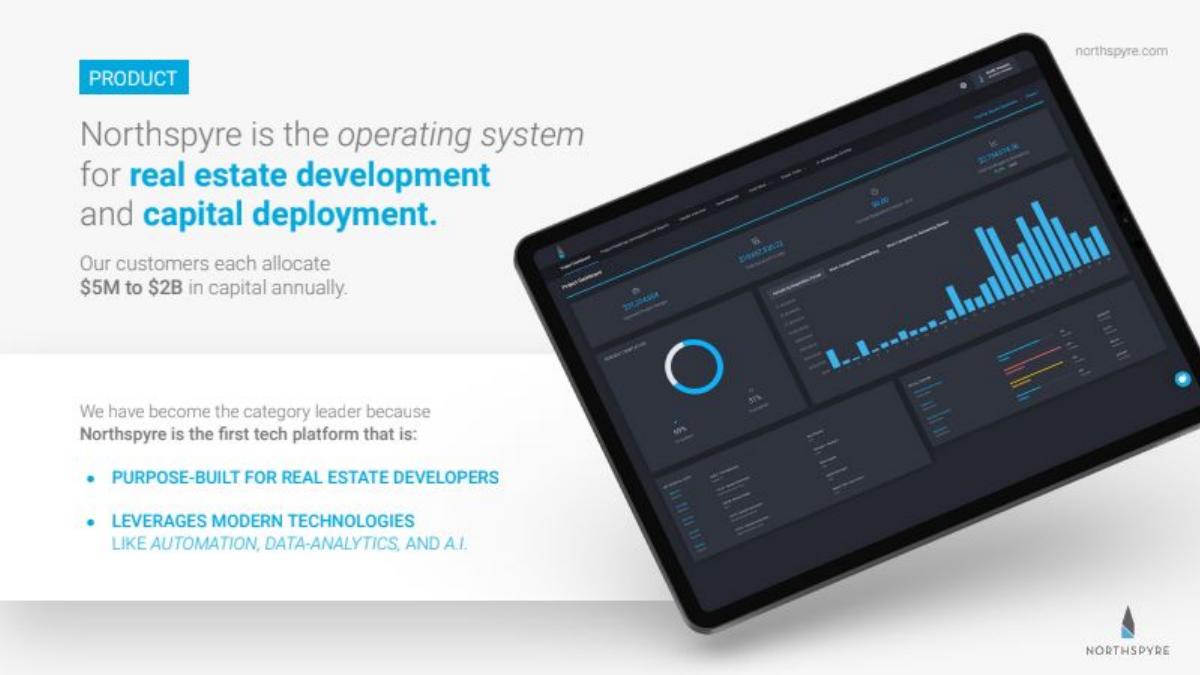
- Northspyre positions itself as an 'operating system' rather than just a tool, targeting customers who allocate between $5M and $2B annually (Slide 4).
- The platform claims to reduce cost overruns by 21-66%, translating to $2-6M in savings on a typical $100M project (Slide 7).
- Financial efficiency is a core highlight, with a 'Cash Conversion Score' of $1.61 in ARR for every $1 of investor capital deployed (Slide 8).
- The company maintains strong SaaS fundamentals including 91% gross margins and 130% net revenue retention (Slide 8).
- The leadership team combines deep real estate experience (Jones Lang LaSalle) with technical pedigree from companies like Ripple and Sailthru (Slide 10).
- The financing history shows a clear trajectory from a $57K F&F round to the $25M Series B, involving prominent angels like Des Traynor (Slide 12).
The Strategy of the Series B Narrative
Northspyre’s Series B pitch deck is a masterclass in narrative efficiency. At the Series B stage, investors are no longer looking for just a 'good idea' or early traction; they are looking for a scalable machine that converts capital into revenue with predictable efficiency. Northspyre leans heavily into this, using only 14 slides to tell a story of a fragmented, trillion-dollar industry being disrupted by a highly efficient SaaS engine. The deck avoids the clutter of deep technical explainers, choosing instead to focus on the 'Operating System' metaphor and hard financial outcomes.
Slide 1: Title and Intent
The deck opens with a high-resolution image of a bridge and city skyline, immediately grounding the company in the physical world of real estate and infrastructure. The text is direct: 'OUR INVESTMENT PLAN | from our $25M investment raise.' This slide sets a professional, institutional tone, signaling that this is a plan for growth rather than a desperate plea for funds.
Slide 2: Problem No. 1 - The Financial Gap
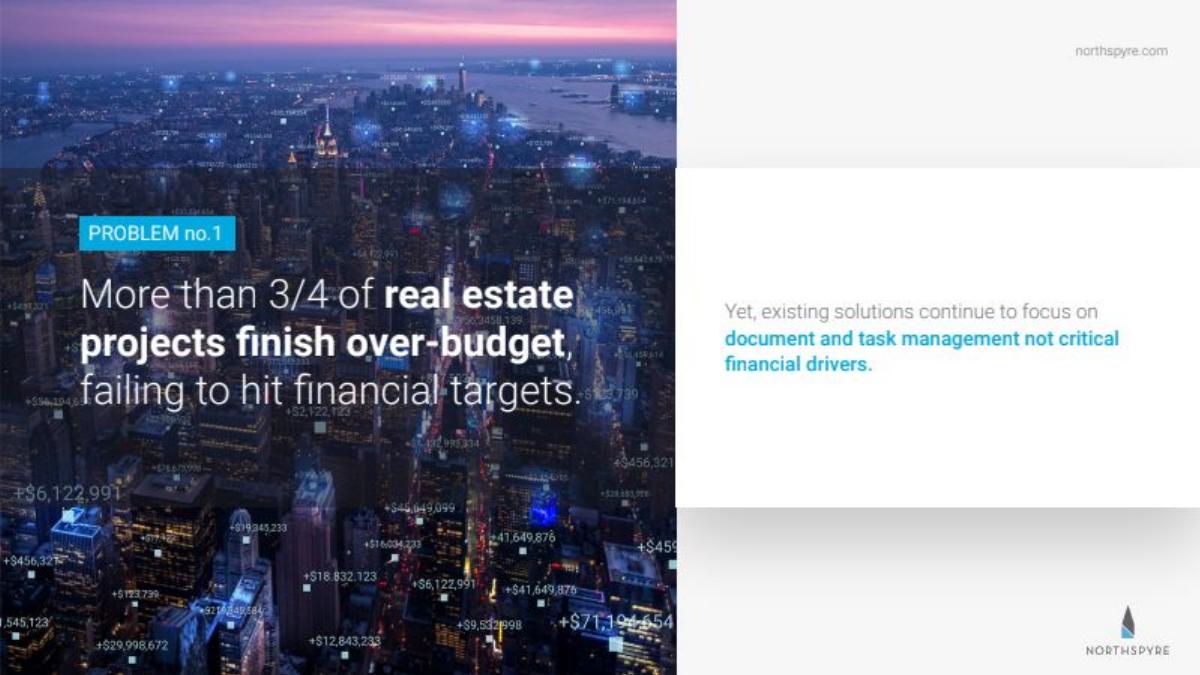
Northspyre identifies a specific, painful problem: 'More than 3/4 of real estate projects finish over-budget.' They contrast this with 'existing solutions' that focus on tasks and documents. By framing the problem as a failure to hit 'financial targets,' they position their software as a CFO-level necessity rather than a project manager’s convenience tool. This is a crucial distinction for B2B SaaS aiming for high contract values.
Slide 3: Problem No. 2 - Market Fragmentation
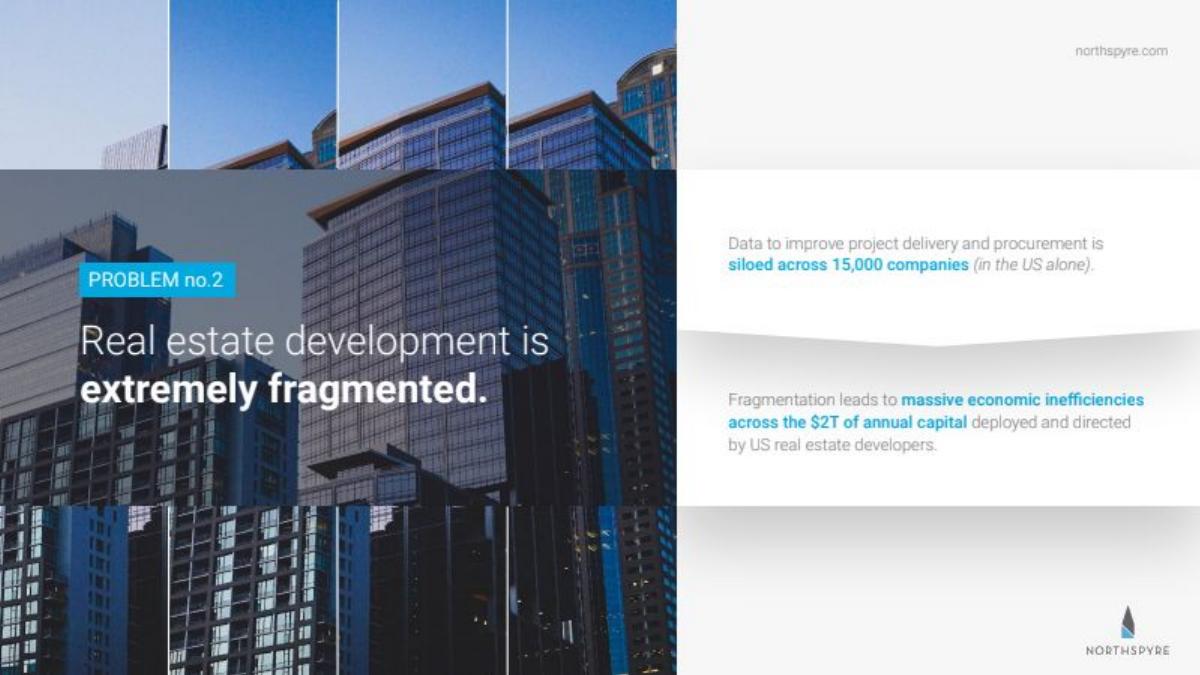
The second problem slide focuses on the macro environment. It states that real estate development is 'extremely fragmented,' with data siloed across 15,000 companies in the US. They tie this fragmentation to 'massive economic inefficiencies across the $2T of annual capital' deployed by developers. By citing the $2T figure, they establish the massive Total Addressable Market (TAM) without needing a separate, complex TAM slide.
Slide 4: The Product as an Operating System
Slide 4 introduces the solution. Northspyre is described as the 'operating system for real estate development and capital deployment.' The use of 'Operating System' (OS) is a common but effective trope in SaaS pitching, suggesting that the software is the central hub through which all work flows. They define their target customer clearly: those who allocate '$5M to $2B in capital annually.' The slide includes a clean dashboard mockup on a tablet, emphasizing a modern, mobile-accessible UI.
Slide 5: Global Market Size
This slide provides the hard numbers for the opportunity. It lists a '$2T' annual spend in the United States and a '$10T' spend globally. The visual is a simple dotted globe, keeping the focus on the scale of the numbers. It justifies why a $25M raise is appropriate for a company chasing a market of this magnitude.
Slide 6: The Three Pillars of the Solution
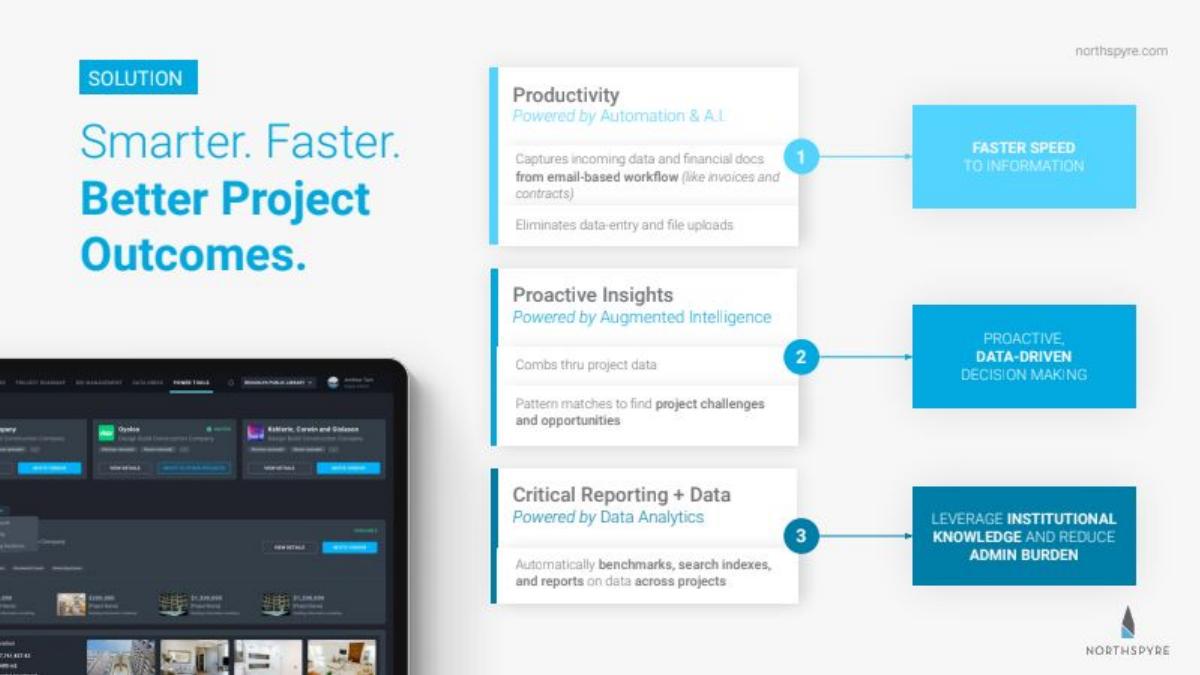
Northspyre breaks its value into three categories: Productivity (Automation & A.I.), Proactive Insights (Augmented Intelligence), and Critical Reporting (Data Analytics). Each pillar is tied to a business outcome: 'Faster speed to information,' 'Data-driven decision making,' and 'Reduce admin burden.' This slide bridges the gap between 'what the software does' and 'why the customer cares.'
Slide 7: The Value Proposition and ROI
This is arguably the most important slide for a Series B deck. It answers 'Why do our customers buy Northspyre?' with a staggering statistic: 'They can reduce cost overruns 21-66%.' They provide a concrete example: saving $2-6M on a $100M project. Including a link to an ROI calculator is a sophisticated touch that shows they have a repeatable sales process based on logic and math.
Slide 8: Financials and SaaS Metrics
Slide 8 is a 'wall of proof.' It lists 6x growth since the 2020 Series A, 91% gross margins, 130% net revenue retention (NRR), and 130+ customers. The standout metric is the 'Cash Conversion Score' of $1.61 in ARR for every $1 of investor capital. This metric is a favorite of firms like Craft Ventures (who invested in this round) because it proves the founders are excellent stewards of capital.
Slide 9: The Ask
The 'Ask' slide is simple: $25M. The use of funds is categorized into new products, GTM scaling (US and International), and the core product roadmap. The background image of the New York City skyline reinforces their current stronghold in major development hubs.
Slide 10: Leadership Team
The team slide highlights a mix of domain expertise and technical background. CEO William Sankey’s experience at Jones Lang LaSalle (JLL) provides the necessary 'street cred' in the real estate world, while the rest of the team brings experience from high-growth tech companies like Ripple and Sailthru. The inclusion of their educational backgrounds (Harvard, Yale, UPenn, Oxford) adds a layer of institutional trust.
Slide 11: User Testimonials
Social proof is provided by three distinct entities: MoMA (Museum of Modern Art), Denham Wolf, and ASH Development. The quotes focus on moving away from 'Excel' and 'redundant data entry.' The MoMA testimonial is particularly powerful, as it represents a high-profile, complex institutional client.
Slide 12: Financing History
This slide uses a timeline visual to show the company’s journey from a $57K F&F round to the current $25M Series B. It lists notable investors like David Sacks (Craft Ventures) and Des Traynor (Intercom). Showing the progression of round sizes ($275K to $1.45M to $7.5M to $25M) demonstrates a healthy, upward trajectory that de-risks the investment for new VCs.
Slide 13: Contact Information
The deck concludes with a standard 'Thank you' slide featuring William Sankey’s direct contact information. The background returns to the NYC skyline, maintaining the visual theme of urban development.
What Northspyre Does Well
Capital Efficiency Focus: The inclusion of the 'Cash Conversion Score' on Slide 8 is a brilliant move. It speaks directly to the concerns of Series B investors who want to ensure their money won't be wasted on inefficient customer acquisition. By showing that they generate more than a dollar of ARR for every dollar spent, they prove their business model is sustainable.
Tangible ROI: Many SaaS decks stay in the realm of 'better, faster, stronger.' Northspyre puts a dollar amount on their value: $2-6M in savings per $100M project. This makes the purchase a 'no-brainer' for a developer, which in turn makes the investment a 'no-brainer' for a VC.
Market Context: By framing the problem as 'fragmentation' and 'siloed data,' they move the conversation away from 'features' and toward 'infrastructure.' They aren't just selling a tool; they are selling the solution to a systemic industry failure.
What Is Missing from the Deck
Competition Slide: There is no mention of Procore, Autodesk, or other legacy construction management players. While Northspyre differentiates by focusing on the 'financial drivers' rather than 'task management,' investors will inevitably ask how they win against the incumbents. A slide addressing this head-on would have been beneficial.
Unit Economics: While they show Gross Margins and NRR, they omit Customer Acquisition Cost (CAC) and Lifetime Value (LTV). At Series B, investors usually want to see the 'magic number' or LTV/CAC ratio to understand the payback period of their marketing spend.
Product Depth: The deck is very high-level. While this works for a narrative, it doesn't show how the 'A.I.' and 'Automation' actually function. A few more screenshots or a 'How it Works' slide could have helped demystify the technology for less industry-savvy investors.
Founder Takeaways: What to Copy
Use the 'Operating System' Hook: If your software is meant to be the primary workspace for a user, call it an Operating System. It carries more weight than 'platform' or 'app.'
Quantify the Pain: Don't just say your customers save money. Say they save 21-66% and show what that looks like for a typical project. Use the customer's own language (e.g., 'cost overruns').
Show the Funding Journey: A financing history slide (like Slide 12) is an excellent way to show momentum. It proves that other smart people have already done the due diligence and decided to back you, which creates a 'fear of missing out' (FOMO) for new investors.
Lead with Efficiency: In a tighter venture market, growth at all costs is out; efficient growth is in. Highlighting your Cash Conversion Score or your ARR-to-Burn ratio is the fastest way to a VC's heart in the current environment.
Frequently asked questions
- What is the primary problem Northspyre is solving?
- According to Slide 2, the primary problem is that over 75% of real estate projects exceed their budgets because existing solutions focus on document management rather than critical financial drivers. Slide 3 further identifies market fragmentation as a secondary issue, noting that data is siloed across 15,000 US companies, leading to massive economic inefficiencies in a $2T annual market.
- How does Northspyre quantify its value proposition to developers?
- Northspyre uses very specific financial metrics to prove its worth. Slide 7 states that customers can reduce cost overruns by 21% to 66%. To make this tangible, the deck notes that on a typical $100M project, a development team can save between $2M and $6M. They even include a link to an ROI calculator for further validation.
- What are the key financial metrics mentioned in the Series B deck?
- Slide 8 provides a comprehensive look at their Series B health. Key metrics include a 6x growth rate since their 2020 Series A, 91% gross margins (excluding one-time implementation fees), 130% net revenue retention, and a customer base of over 130 companies. Most notably, they highlight a 'Cash Conversion Score' of $1.61 ARR per $1 of capital deployed.
- Who is on the Northspyre leadership team?
- The team, shown on Slide 10, is led by CEO and Head of Product William Sankey, a Harvard and Yale graduate who worked at Jones Lang LaSalle. He is supported by CTO Andrew Tam (formerly of Sailthru), Chief Architect Matthew Phinney (formerly of Ripple), and Head of Sales Neil Griffin, who has a background in construction finance consulting.
- How does Northspyre plan to use the $25M raised in this round?
- As stated on Slide 9, the 'Ask' slide, the $25M is earmarked for three primary objectives: launching new products, scaling their Go-To-Market (GTM) strategy both within the US and internationally, and advancing their core product roadmap. This indicates a shift from product-market fit validation to aggressive market expansion.