Nostos Genomics raised $5.6M in 2021 with a deck that masterfully identifies a 'bottleneck' in the genetic testing value chain. While sequencing costs have plummeted, the interpretation of data remains manual and inefficient. The deck uses a clean, five-step process diagram to explain their AION platform, which automates variant interpretation. By framing the problem as a 70% failure rate in current genetic testing diagnoses, the company creates a compelling 'why now' narrative. The team slide is particularly strong, showcasing a mix of deep scientific expertise (150+ papers) and commercial e…
Key takeaways
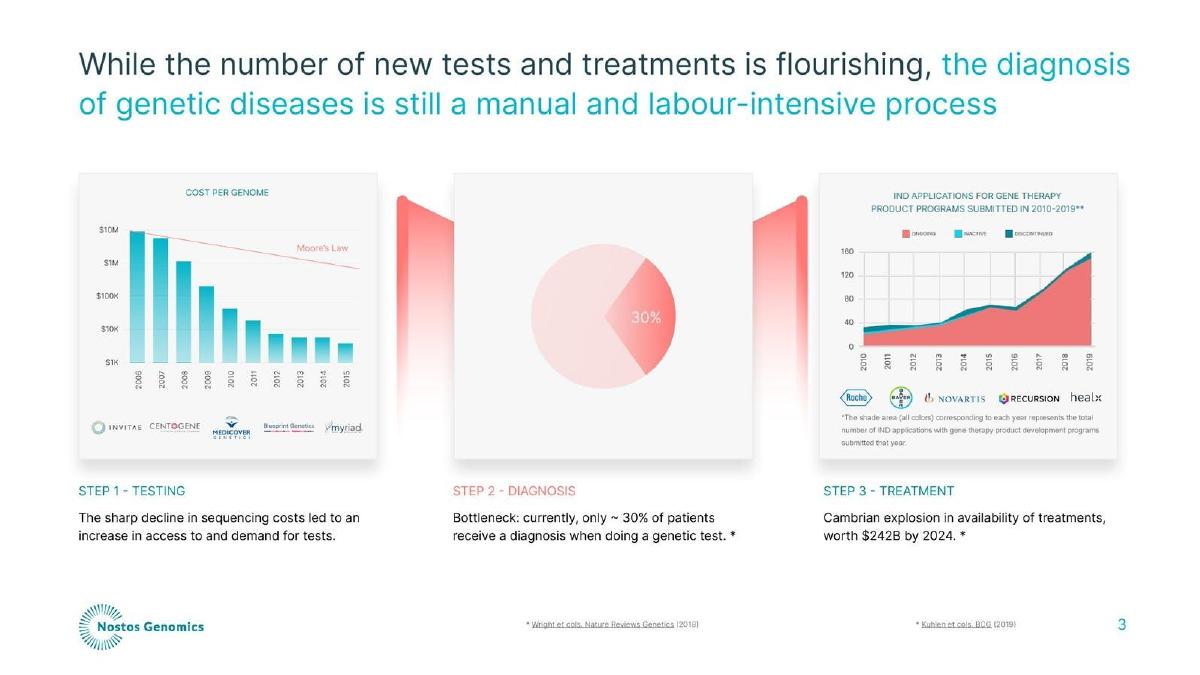
- The deck identifies a critical bottleneck on Slide 3: while sequencing costs have dropped, only ~30% of patients currently receive a diagnosis when doing a genetic test.
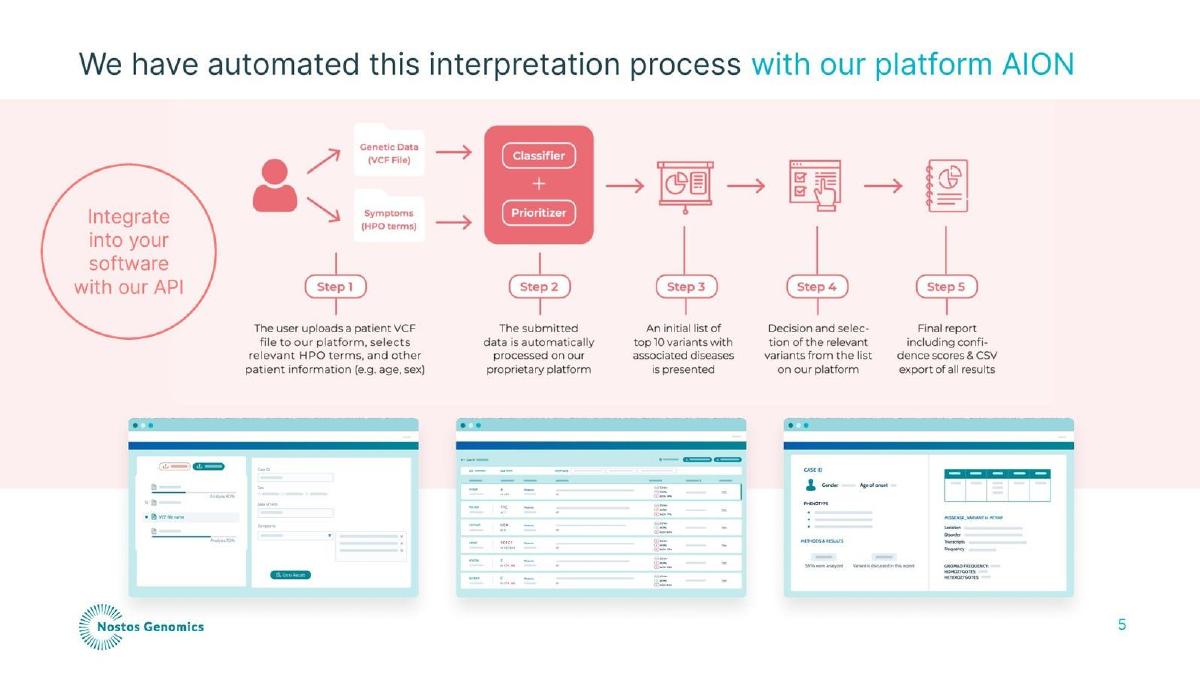
- Slide 5 provides a clear five-step visualization of the AION platform, showing how it moves from a VCF file to a final report with confidence scores.
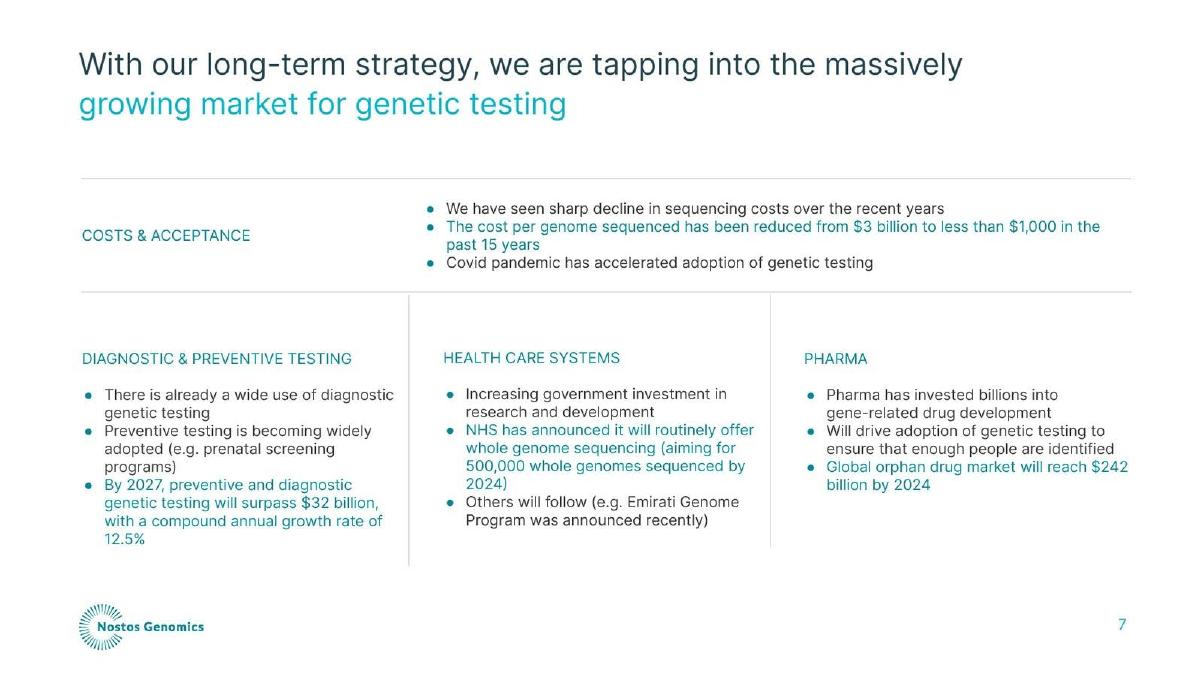
- Market size is framed through three distinct verticals on Slide 7: Diagnostic & Preventive Testing ($32B by 2027), Health Care Systems (e.g., NHS sequencing 500k genomes), and Pharma ($242B orphan drug market).
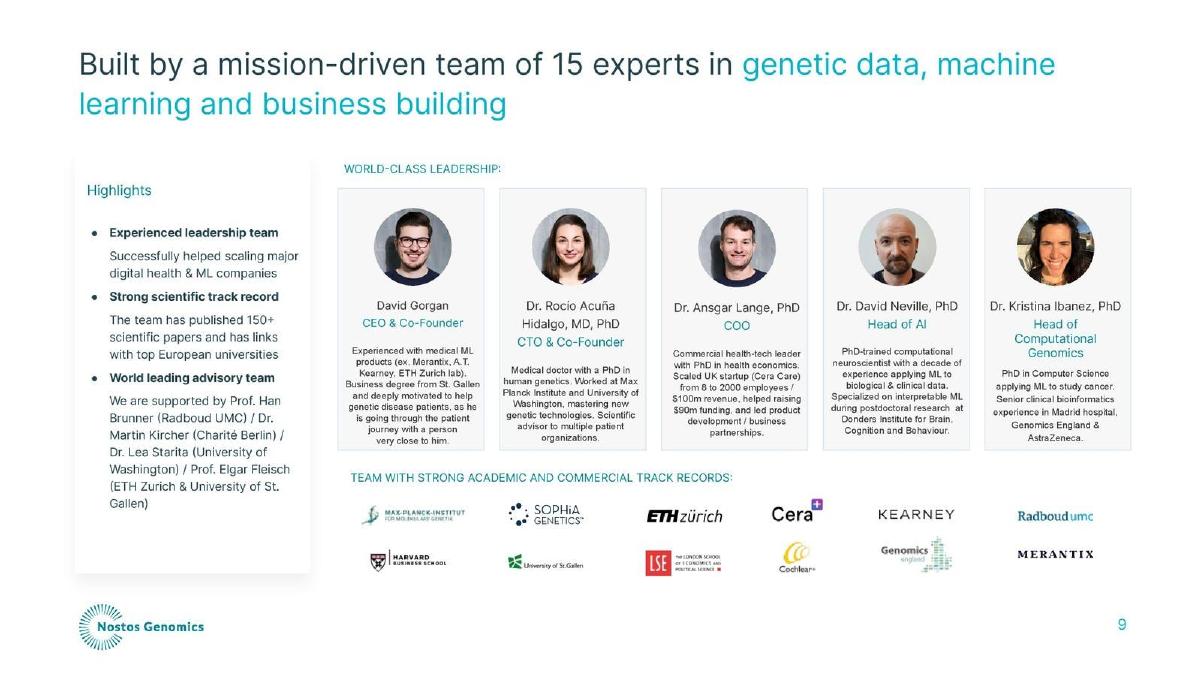
- The team slide (Slide 9) emphasizes a 'strong scientific track record' with over 150 published papers and links to top European universities.
- The leadership team includes a mix of MD/PhDs and commercial leaders who helped scale startups like Cera Care from 8 to 2,000 employees (Slide 9).
- The deck highlights a massive cost reduction in sequencing from $3 billion to less than $1,000 in the past 15 years as a primary market driver (Slide 7).
- Slide 11 explicitly states the value proposition: doubling the number of diagnoses to help the 70% of patients who currently remain undiagnosed.
- The deck omits a specific 'Ask' slide detailing the exact use of the $5.6M raised, focusing instead on the long-term mission.
The Narrative: Bridging the Gap Between Data and Diagnosis
Nostos Genomics operates in the highly technical field of bioinformatics and clinical genetics. For a Seed stage company, the primary challenge is translating complex biological processes into a venture-backable business case. This deck, which helped secure $5.6M in 2021, succeeds by focusing on a single, massive inefficiency: the 'diagnostic odyssey' faced by patients with rare genetic diseases. By quantifying the failure rate of current testing (70% undiagnosed), they transform a scientific tool into a high-value clinical necessity.
Slide 1-2: The Vision and Branding
The opening slides are minimalist, featuring the company logo and a stylized DNA helix. The tagline on Slide 1, "Enabling faster, more efficient Genomic Healthcare," sets a clear tone. It avoids overly technical jargon in favor of two universal business virtues: speed and efficiency. This is a strategic choice for a Seed round where investors may not all be PhDs in genetics but do understand the value of process optimization in healthcare.
Slide 3: The Bottleneck Narrative
This is arguably the most important slide in the deck. It breaks the industry into three steps: Testing, Diagnosis, and Treatment. Step 1 (Testing) shows a bar chart of the 'Cost Per Genome' plummeting from $10M in 2006 to under $1K by 2015, citing companies like Invitae and Centogene. Step 3 (Treatment) highlights a 'Cambrian explosion' in gene therapy, with a chart showing IND applications rising toward a $242B market by 2024. Between these two flourishing bookends lies Step 2 (Diagnosis) , which the slide labels a 'Bottleneck.' It cites a 2018 Nature Reviews Genetics paper stating that "currently, only ~30% of patients receive a diagnosis when doing a genetic test." This creates an immediate, logical gap for the company to fill.
Slide 4: Transition to Solution
Slide 4 serves as a bridge, reiterating the company name and preparing the viewer for the technical reveal of their platform. In a 12-slide deck, using a slide purely for transition can be risky, but here it serves to reset the focus from the industry-wide problem to the specific Nostos solution.
Slide 5: The AION Platform Workflow
Slide 5 introduces AION , the company's automated interpretation platform. It uses a clean, linear flow diagram to demystify the product. The process is broken down into five steps: uploading a VCF file and HPO terms (symptoms), automated processing via a "Classifier + Prioritizer," the presentation of a 'top 10' list, user selection, and the generation of a final report with "confidence scores." Crucially, a callout bubble on the left states, "Integrate into your software with our API," signaling that this is a scalable software-as-a-service (SaaS) play rather than a manual consultancy service. The inclusion of three UI screenshots at the bottom provides tangible proof that the product exists and is functional.
Slide 6: Deepening the Product Value
Slide 6 continues the product deep-dive, though the text provided is minimal. In the context of the full deck, this section likely expands on the specific AI methodologies used to outperform manual interpretation, reinforcing the 'proprietary' nature of the platform mentioned in the previous slide.
Slide 7: Market Opportunity and Strategy
This slide segments the market into three pillars to demonstrate the breadth of the opportunity. Under Costs & Acceptance , they note the reduction of sequencing costs from $3 billion to less than $1,000. Under Diagnostic & Preventive Testing , they project the market will surpass $32 billion by 2027 with a 12.5% CAGR. The Health Care Systems section highlights the UK's NHS aiming for 500,000 whole genomes by 2024. Finally, the Pharma section connects the platform to the $242B orphan drug market. This slide effectively argues that Nostos is not just a tool for small labs, but a critical infrastructure component for national health systems and global pharmaceutical giants.
Slide 8: Strategic Positioning
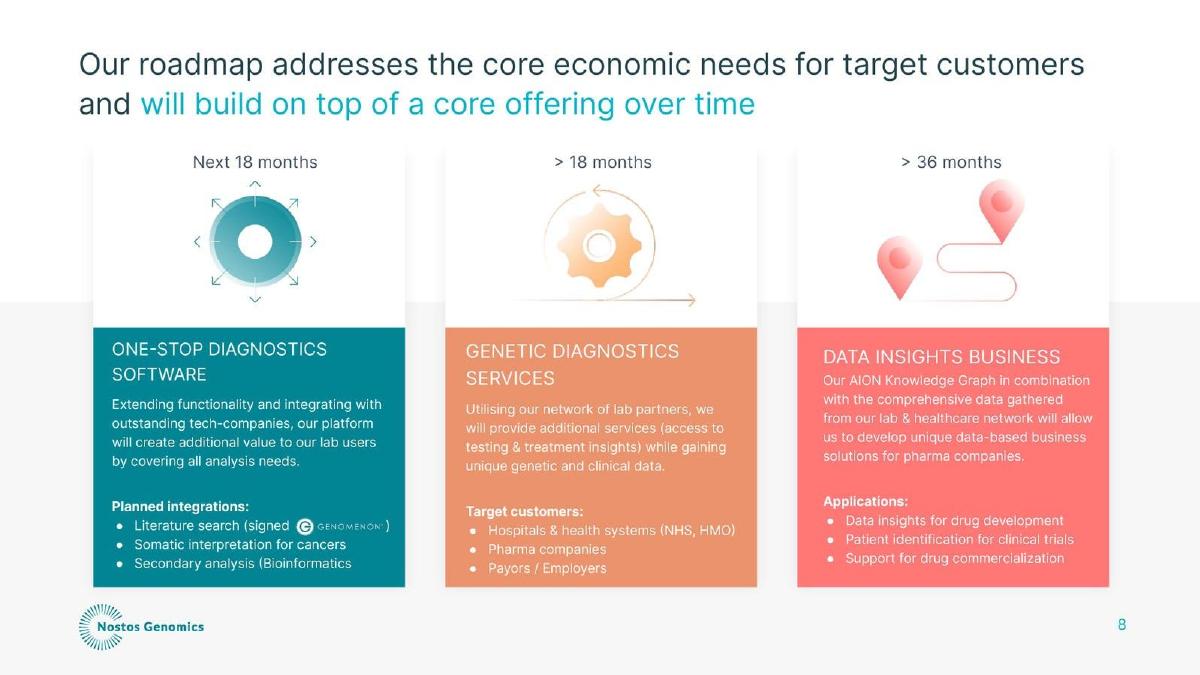
Slide 8 likely addresses the competitive landscape or the specific go-to-market strategy. By this point in the deck, the investor understands the 'what' and 'why'; this slide would logically address the 'how'—how Nostos wins against incumbents or manual workflows in a clinical setting.
Slide 9: The Team Slide
For a deep-tech startup, the team slide is a deal-maker. Nostos presents a "mission-driven team of 15 experts." The leadership bios are impressive: CEO David Gorgan (ex-Merantix, A.T. Kearney), CTO Dr. Rocío Acuña Hidalgo (MD, PhD in human genetics), and COO Dr. Ansgar Lange (who helped scale Cera Care to 2,000 employees and $100M revenue). The slide also highlights a "strong scientific track record" with 150+ published papers. A logo wall at the bottom includes prestigious institutions like Harvard Business School, ETH Zürich, Max-Planck-Institut, and AstraZeneca, providing significant social proof and academic validation.
Slide 10: Momentum and Milestones
Slide 10 typically covers traction. For a Seed round, this would include pilot programs, partnerships with hospitals, or validation studies comparing AION's diagnostic accuracy against human geneticists. The text provided indicates this slide continues the narrative of growth and validation.
Slide 11: The Mission and Impact
Slide 11 shifts to the human impact of the technology. It lists three key pillars: Clear & Fast Diagnosis (doubling the number of diagnoses), Genomic Prevention (allowing parents to provide better care), and Accessible and Affordable healthcare. The use of high-quality photography of individuals humanizes the technical data presented earlier, reminding investors that the '70% undiagnosed' figure represents real people and families.
Slide 12: Closing
The final slide provides the closing contact information. While the provided text is minimal, the standard practice is to leave the company logo and contact details visible during the Q&A session.
What Nostos Genomics Does Well
The deck is exceptionally strong at identifying a specific, quantifiable pain point . Many genomics startups fail by being too broad; Nostos focuses specifically on the 'interpretation bottleneck.' By citing that only 30% of tests result in a diagnosis, they create a clear metric for success: increasing that percentage. The visual representation of the AION platform on Slide 5 is also a highlight, as it makes a complex bioinformatic process feel like a standard, easy-to-use SaaS workflow. Finally, the team slide is a masterclass in balancing academic prestige (PhDs and 150+ papers) with commercial scaling experience (Cera Care, A.T. Kearney).
What is Missing from the Deck
The most glaring omission is a detailed 'Ask' slide . While we know from publisher reports that they raised $5.6M, the deck itself does not explicitly state the amount sought or the specific milestones that capital will unlock (e.g., 'Hire 5 bioinformaticians,' 'Secure 3 hospital pilots'). Additionally, there is a lack of unit economics . While the market size is well-documented, the deck doesn't explain the pricing model—is it per-report, a monthly subscription, or a percentage of the value created for pharma? Finally, a competitor matrix is missing. The genomics space is crowded with players like Fabric Genomics and Sophia Genetics; a slide explaining Nostos's unique technical advantage (moat) over these incumbents would have strengthened the case for a $5.6M Seed round.
Instructions for Founders
Founders in the healthcare or AI space should study how Nostos uses external validation to build their case. Slide 3 and Slide 7 are built almost entirely on third-party data from Nature Reviews Genetics, BCG, and the NHS. This shifts the burden of proof from the founders to established authorities, making the market opportunity feel inevitable rather than speculative. Furthermore, if you are building a technical product, copy the five-step workflow visualization used on Slide 5. It manages to show the 'inputs' (VCF files) and 'outputs' (Reports) clearly while keeping the 'black box' of the AI (Step 2) simple and non-intimidating for non-technical investors.
Frequently asked questions
- What is the core problem Nostos Genomics is solving?
- According to Slide 3, the core problem is that the diagnosis of genetic diseases is still a manual and labor-intensive process. Despite the 'Cambrian explosion' in treatments and the sharp decline in sequencing costs, approximately 70% of patients who undergo genetic testing still fail to receive a definitive diagnosis.
- How does the AION platform work according to the deck?
- Slide 5 outlines a five-step automated process: 1) User uploads a VCF file and symptoms, 2) Data is processed by a proprietary Classifier and Prioritizer, 3) A list of top 10 variants is presented, 4) The user selects relevant variants, and 5) A final report with confidence scores and CSV export is generated.
- What are the primary market drivers identified by the founders?
- Slide 7 identifies three drivers: the decline in sequencing costs (now under $1,000), increased government investment (such as the NHS aiming for 500,000 whole genomes sequenced by 2024), and the massive investment by Pharma into gene-related drug development for the $242B orphan drug market.
- What is the background of the Nostos Genomics leadership team?
- The team (Slide 9) features a blend of academic and commercial expertise. It includes Dr. Rocío Acuña Hidalgo (CTO), an MD/PhD in human genetics; Dr. Ansgar Lange (COO), who helped scale Cera Care to 2,000 employees; and specialists in AI and computational genomics with experience at AstraZeneca and Genomics England.
- Does the deck include financial projections or a specific funding ask?
- No. The 12-slide deck focuses on the problem, solution, market opportunity, and team. It lacks a detailed financial model, specific revenue projections, or a slide detailing how the $5.6M Seed round will be allocated across hiring, R&D, or sales.