Sparrow’s 2013 pitch deck introduces a social enterprise model for the telecommunications industry, specifically a 'Buy-One-Give-One' mobile service. The deck is heavily visual, relying on large-scale photography and high-level social impact statistics to build an emotional narrative. While it successfully demonstrates traction through $750,000 in revenue, donations, and grants (Slide 4), it lacks the granular financial data typical of a seed-stage venture deck. There is no mention of churn, customer acquisition cost (CAC), or specific pricing tiers. Instead, the deck focuses on the 'digital…
Key takeaways
- The company utilizes a 'Buy-One-Give-One' business model applied to mobile subscriptions (Slide 3).
- Sparrow reported 20% month-over-month revenue growth and a total of $750,000 across revenue, donations, and grants (Slide 4).
- The startup has secured financial support or partnerships with major entities including Google, Sprint, Citi, and Twitter (Slide 4).
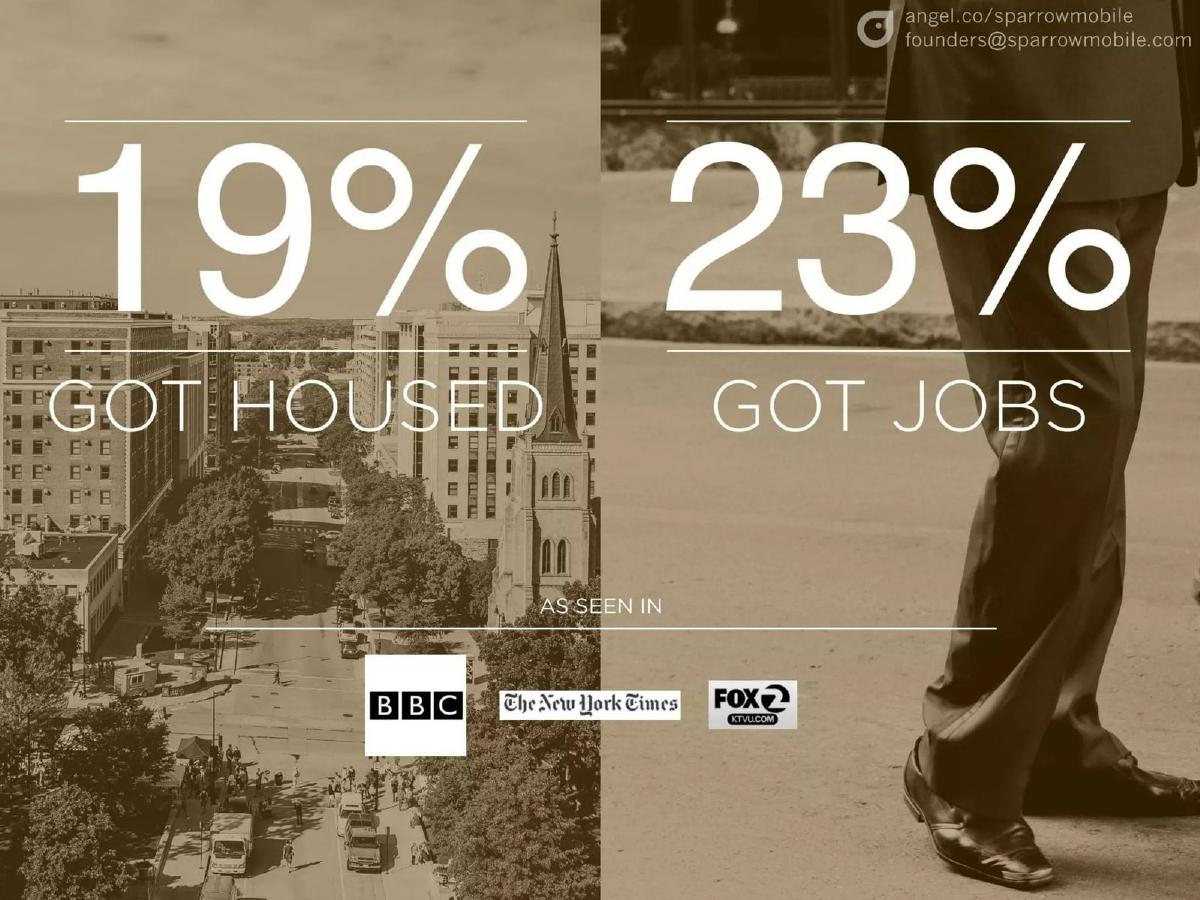
- Social impact is the primary value proposition, with 19% of beneficiaries finding housing and 23% finding employment (Slide 5).
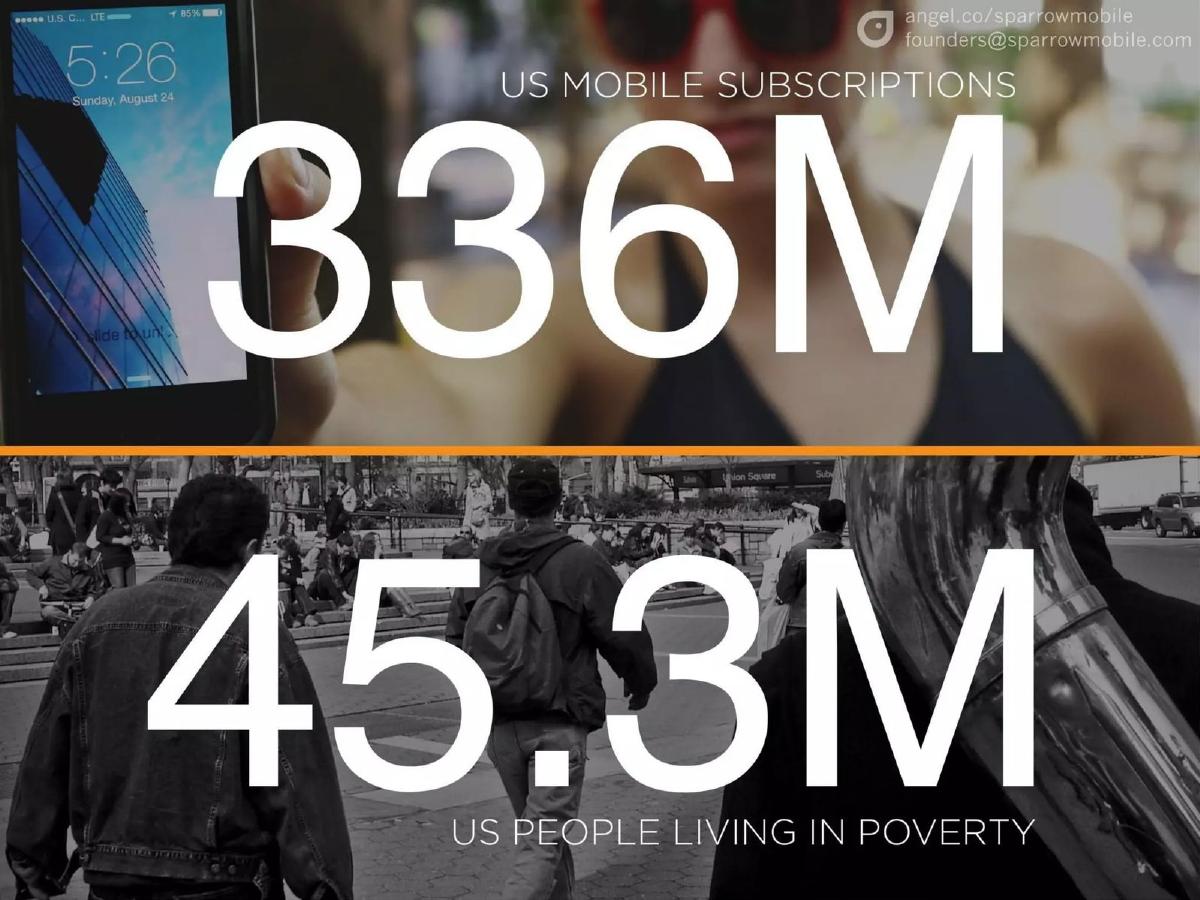
- The total addressable market is framed by 336 million U.S. mobile subscriptions against 45.3 million people in poverty (Slide 6).
- The deck includes a 'Mobile Access + Cloud Platform' consisting of impact apps, reporting, and a user portal called 'My Sparrow' (Slide 9).
- The presentation lacks a formal 'Ask' slide detailing the specific amount of capital being raised or the valuation (Slide 12).
- The team slide, titled 'Our Flock,' features a group photo but omits names, titles, and professional backgrounds (Slide 10).
Introduction: The Social Impact Mobile Carrier
Sparrow’s pitch deck is a study in mission-driven storytelling. Founded in 2013, the company attempts to disrupt the traditional telecommunications model by injecting a social conscience into mobile service. The deck, consisting of 12 slides, leans heavily on the 'Toms Shoes' model of Buy-One-Give-One, applying it to the digital divide. While the aesthetics are modern and the impact metrics are compelling, the deck leaves significant questions regarding the underlying economics of a mobile virtual network operator (MVNO) with a high-cost social mission.
The Hook and the Mission (Slides 1-3)
Slide 1 serves as the title card, featuring the logo and the tagline 'Mobile For All.' It includes an AngelList URL and a general founders' email address. The imagery is a street-level view of a crosswalk, grounding the brand in an urban, accessible environment.
Slide 2 is a full-bleed photograph of an elderly man leaning out of a vehicle. There is no text on this slide. In the context of the deck, this serves as a 'humanizing' element, likely intended to represent the demographic Sparrow aims to help. It sets an emotional tone before any data is presented.
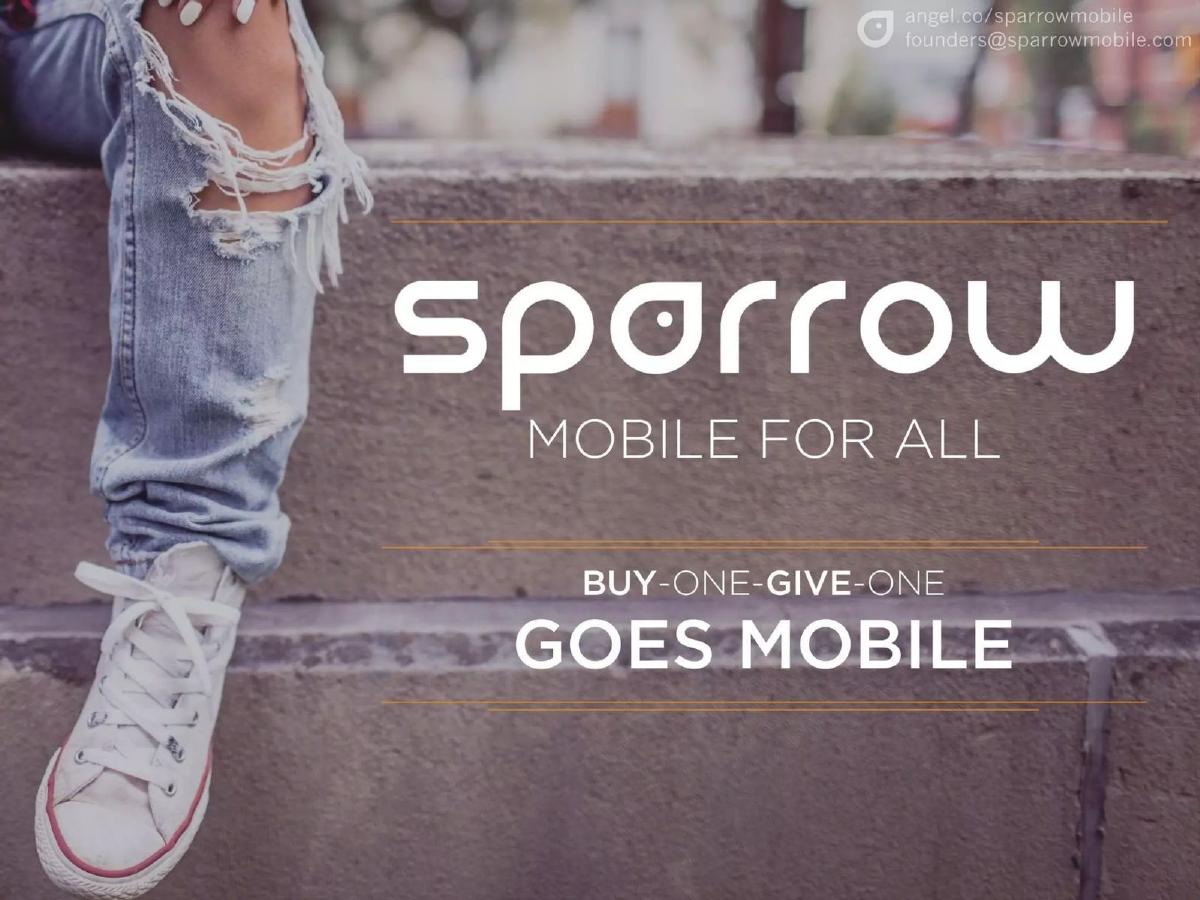
Slide 3 introduces the core value proposition: 'Buy-One-Give-One Goes Mobile.' This is the most critical slide for understanding the business model. It positions Sparrow not just as a utility, but as a social movement. By using the phrase 'Goes Mobile,' they are leveraging a consumer-familiar concept (BOGO) and applying it to a new vertical.
Traction and Validation (Slides 4-5)
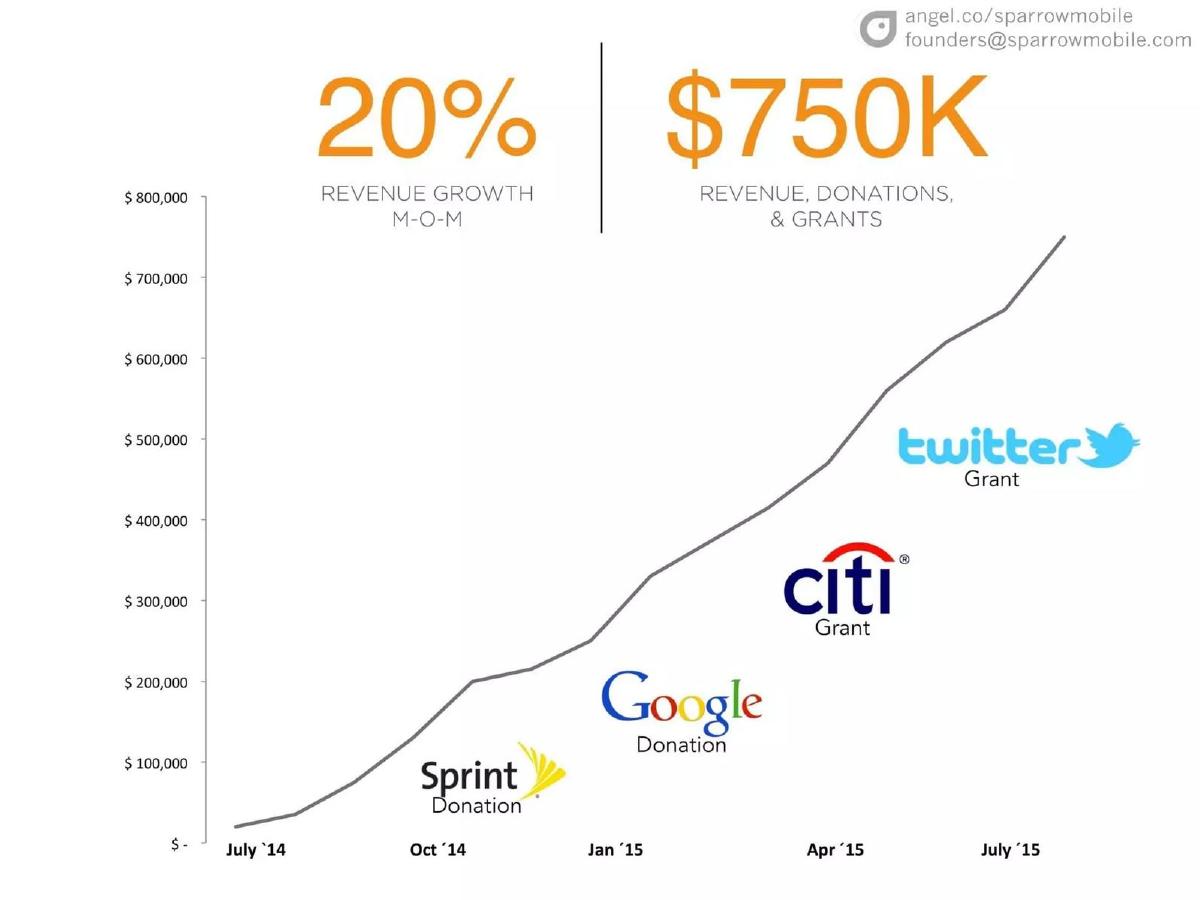
Slide 4 provides the first hard data points. The company claims 20% month-over-month revenue growth. Below a line graph that starts in July '14 and ends in July '15, they list a total of $750,000. This figure is a composite of 'Revenue, Donations, & Grants.' The slide also features logos for Sprint, Google, Citi, and Twitter, specifying which were donations and which were grants. This is a strong validation slide, showing that major tech and financial institutions have vetted and funded the concept.
Slide 5 shifts from financial traction to impact traction. It features two large statistics: '19% Got Housed' and '23% Got Jobs.' These are powerful 'so-what' metrics that justify the company's existence. The slide also includes 'As Seen In' logos for the BBC, The New York Times, and Fox 2, providing third-party media credibility.
The Problem and the Market (Slides 6-8)
Slide 6 defines the market gap. It contrasts 336 million U.S. mobile subscriptions with 45.3 million people living in poverty. The implication is that while the market is saturated, a significant portion of the population is underserved or excluded from the benefits of mobile connectivity due to economic barriers.
Slide 7 is a visual metaphor: a dilapidated, abandoned payphone on a brick wall. This slide represents the 'old way' or the lack of access. It serves as a transition from the problem of poverty to the modern solution of mobile technology.
Slide 8 shows a clean, high-resolution image of a smartphone (a Nexus 5) running the Android operating system. This represents the 'Product.' It signals that Sparrow provides modern, high-quality hardware and software, rather than outdated or 'budget' technology often associated with social programs.
The Solution and Platform (Slide 9)
Slide 9 outlines the 'Mobile Access + Cloud Platform.' This is the only slide that hints at the technical infrastructure. It lists four components: Impact Apps, My Sparrow (likely the customer portal), Thank You (likely a feedback loop for donors/buyers), and Reporting. This suggests that Sparrow is more than just a SIM card provider; they are building a software layer to manage the relationship between the 'buyer' and the 'beneficiary.'
The Team and Culture (Slides 10-11)
Slide 10 , titled 'Our Flock,' shows a group photo of seven people in an office setting. While it puts faces to the company, it is a weak team slide by venture standards. It lacks names, titles, and past achievements. An investor cannot tell if the team has experience in telecom, logistics, or software engineering from this slide alone.
Slide 11 shows a group of young people in 'Hack for the Homeless' t-shirts speaking with an older man (who appeared on Slide 2). This slide emphasizes the company's roots in community engagement and grassroots activism. It reinforces the brand's authenticity but does not provide new business information.
The Conclusion and Call to Action (Slide 12)
Slide 12 ends with the slogan 'A mobile company you can love' and an invitation to 'Come talk to us at our table!' This indicates the deck was likely used at a conference, demo day, or a specific event where the founders had a physical presence. It provides the AngelList link and email again but lacks a specific financial ask.
What Works in This Deck
Strong Emotional Narrative: The deck uses high-quality photography and a clear 'hero/victim/guide' narrative structure. It makes the investor feel like they are part of a solution to a systemic problem (poverty and the digital divide).
Validation Through Association: Listing Google, Twitter, Citi, and Sprint on a single slide (Slide 4) provides immense credibility. Even if the amounts were grants rather than equity investments, the fact that these organizations' CSR or venture arms approved the funding is a significant signal.
Outcome-Oriented Metrics: Most social impact decks stop at 'number of units given away.' Sparrow goes further by tracking life outcomes like housing and employment (Slide 5). This makes the business case for the 'Give-One' side of the model much stronger.
What Is Missing
Unit Economics: There is no information on the cost of a subscription, the margin on the 'Buy-One' side, or the cost of the device/service on the 'Give-One' side. For a BOGO model to be sustainable, the margins on the retail side must be high enough to subsidize the donated side, or the company must rely perpetually on grants.
Competitive Landscape: The deck does not mention other MVNOs or government-subsidized programs like 'Lifeline' (often called 'Obama phones'). Investors would want to know how Sparrow competes with free government programs or low-cost carriers like MetroPCS.
The Ask: A standard pitch deck should clearly state how much money is being raised and what that money will achieve (e.g., 'Raising $2M to reach 50k subscribers'). This deck is purely informational and lacks a closing transaction.
Team Pedigree: Slide 10 is a missed opportunity. In 2013, the 'who' was as important as the 'what.' Omitting the founders' backgrounds makes it difficult to assess execution risk.
What a Founder Should Copy
The Traction Slide Layout: Slide 4 is an excellent example of how to show growth and validation simultaneously. Combining a growth chart with partner logos is an efficient use of space that builds immediate trust.
The Contrast Slide: Slide 6 effectively uses large typography to contrast two related but disparate numbers. This is a classic 'Gap' slide that clearly defines the size of the problem and the opportunity.
Visual Consistency: The deck has a consistent color palette (orange and white) and a clean, minimalist aesthetic. It feels like a modern consumer brand, which is essential for a company trying to sell a 'lovable' mobile service.
Final Analysis
Sparrow’s deck is a 'Mission Deck.' It is designed to recruit believers and secure grants rather than to pass a rigorous VC due diligence process focused on LTV/CAC ratios. It successfully proves that there is a demand for a socially conscious mobile carrier and that the model can produce real-world results. However, to raise a traditional Series A, the founders would need to supplement this deck with a robust financial appendix and a clear path to profitability that doesn't rely on the $750,000 in grants and donations highlighted on Slide 4.
Frequently asked questions
- What is the core business model of Sparrow?
- Sparrow operates on a 'Buy-One-Give-One' model for mobile services. According to Slide 3, for every mobile subscription purchased, the company provides mobile access to a person in need. The catalogue listing clarifies that after three months of service, a person in need receives a device loaded with content and tools designed to help break the cycle of poverty.
- How much revenue has Sparrow generated?
- Slide 4 indicates that Sparrow has reached $750,000 in cumulative 'Revenue, Donations, & Grants.' It is important to note that the deck aggregates earned revenue with non-dilutive grant funding and donations, making it difficult to discern the exact commercial performance of the mobile subscription product alone.
- Who are Sparrow's partners or donors?
- Based on the logos displayed on Slide 4, Sparrow has received support from Sprint (Donation), Google (Donation), Citi (Grant), and Twitter (Grant). These partnerships are used to validate the company's mission and provide early-stage capital to scale their social impact initiatives.
- What social impact metrics does the deck highlight?
- Slide 5 focuses on the outcomes for the 'Give-One' recipients. It claims that 19% of these individuals 'Got Housed' and 23% 'Got Jobs.' The deck attributes these successes to the mobile connectivity provided by Sparrow, though it does not detail the methodology used to track these long-term outcomes.
- Is there a clear investment ask in the deck?
- No. The deck concludes on Slide 12 with a call to action to 'Come talk to us at our table!' and provides contact information. It does not specify a funding goal, use of proceeds, or current valuation. This suggests the deck may have been used for a demo day or a social impact competition rather than a formal VC pitch.