Speedlancer’s 2015 pitch deck is a high-level overview of an on-demand freelance platform that prioritizes speed above all else. At just 9 slides, the deck is remarkably brief, focusing on the friction of traditional outsourcing—characterized as a cycle of bidding and failure—versus their '4 hour delivery' model. While it successfully identifies a massive market opportunity ($400B+ Global Staffing Market) and provides a strong engagement metric (1/3 repeat users within 14 days), it is critically lacking in operational depth. There is no mention of revenue, unit economics, a full team roster,…
Key takeaways
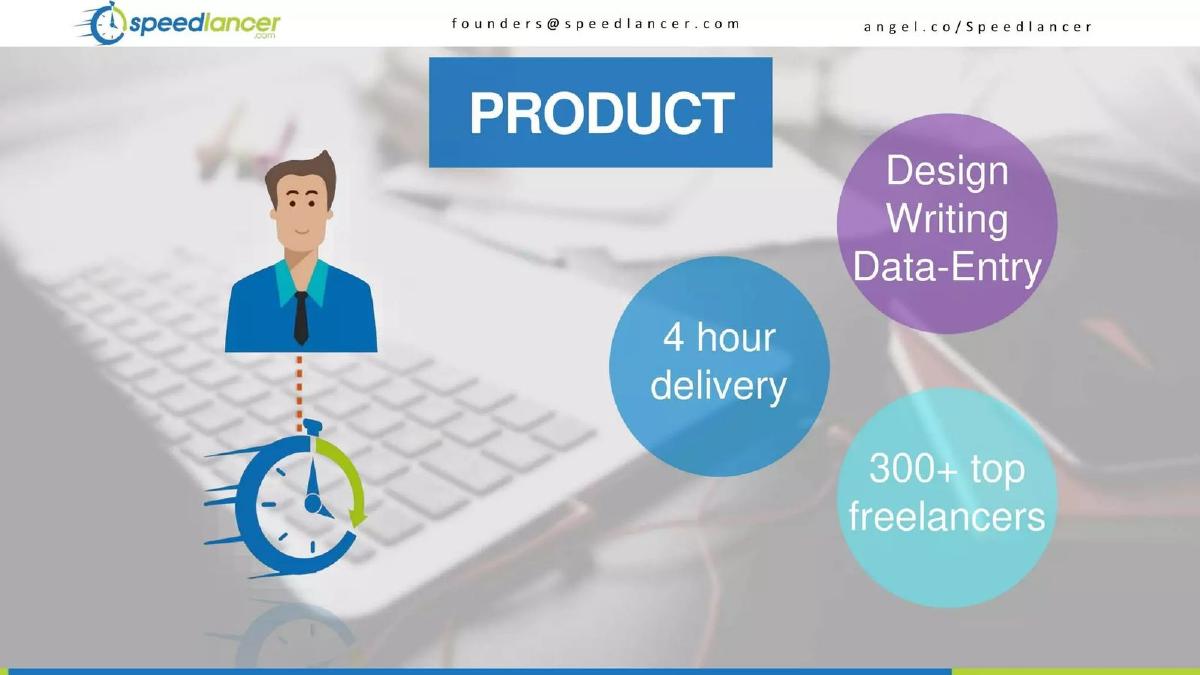
- The platform promises a 4-hour delivery window for design, writing, and data-entry tasks on slide 4.
- Speedlancer claims a curated network of 300+ top freelancers to ensure quality, as stated on slide 4.
- A significant engagement metric is highlighted on slide 7: 1/3 of users repeat their purchase within 14 days.
- The deck identifies a $400B+ Global Staffing Market and a $100B Global Outsourcing Market on slide 8.
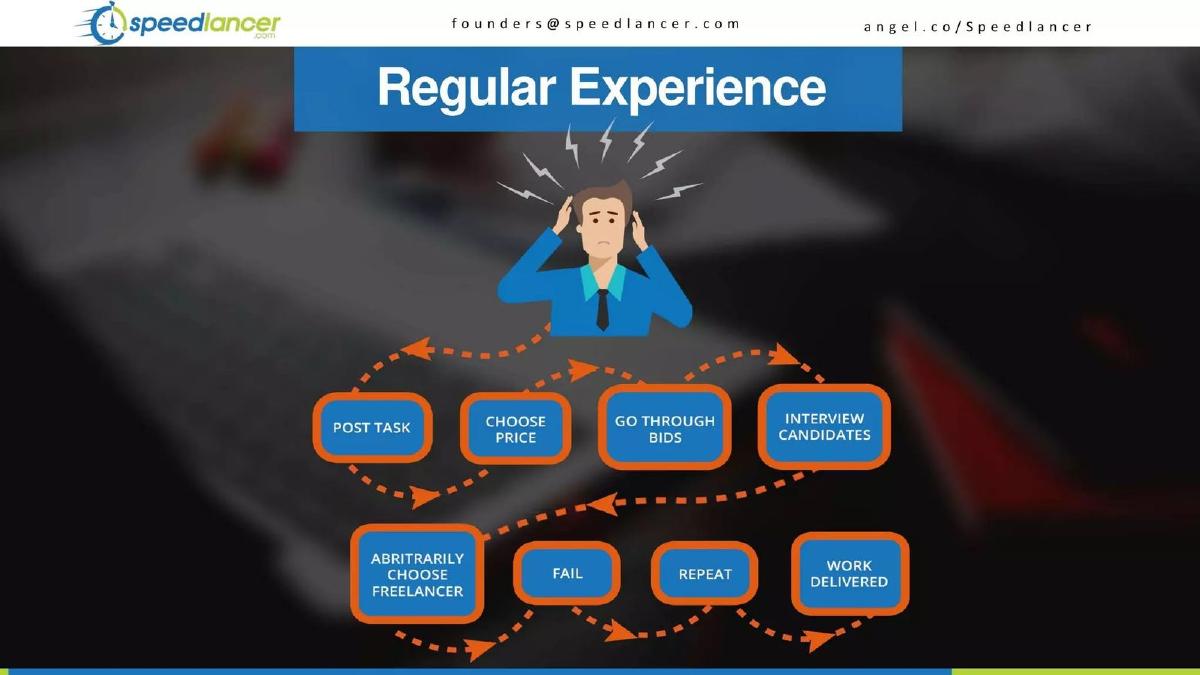
- The 'Regular Experience' of outsourcing is critiqued on slide 3 as a frustrating loop of bidding, interviewing, and failing.
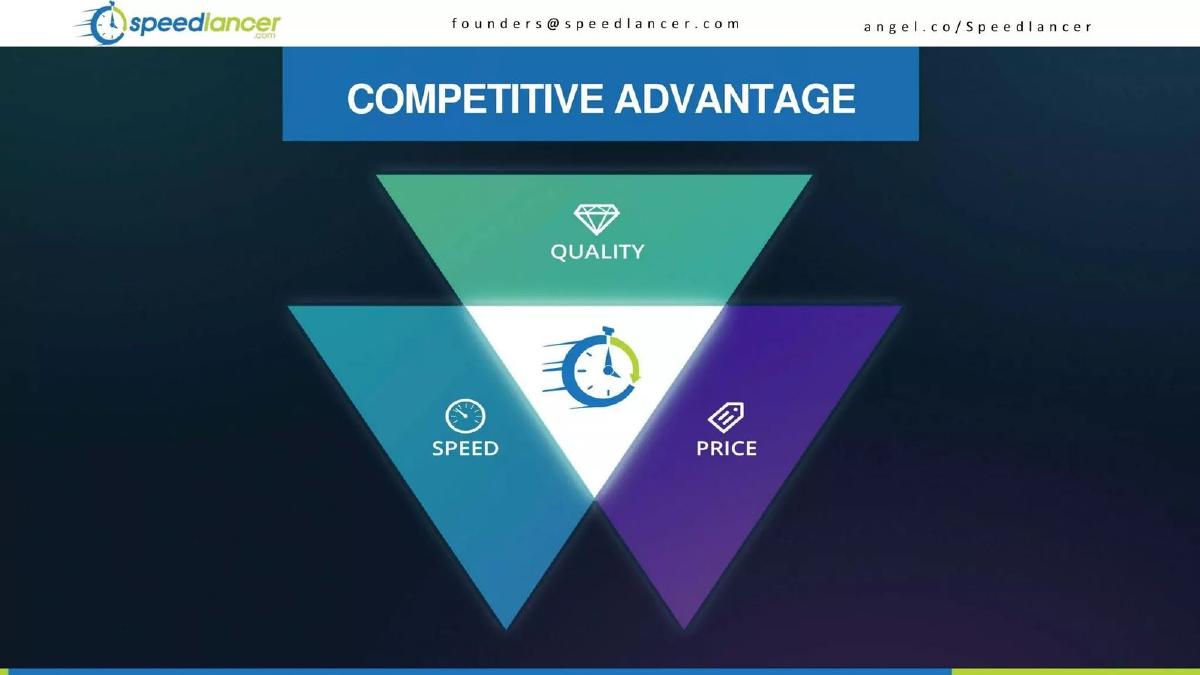
- The competitive advantage is visualized as a balance between Quality, Speed, and Price on slide 5.
- The deck completely omits a financial slide, revenue figures, or an explicit funding request.
- The team slide (slide 9) only lists one individual, Adam Stone, without providing a professional background or bio.
The Speedlancer Teardown: Minimalism vs. Information
The 2015 Speedlancer deck is a product of its era—a time when 'Uber for X' was the dominant pitch narrative. In this case, Speedlancer is 'Uber for Freelancing.' The deck is incredibly lean at only 9 slides. While brevity is often a virtue in fundraising, this deck borders on the cryptic. It relies heavily on the founder's ability to fill in the gaps during a live presentation, which makes it a risky document for asynchronous viewing by a venture capitalist.
The Opening: Branding and the 'Why'
Slide 1: Title Slide The deck opens with the Speedlancer logo. The logo itself incorporates a stopwatch, immediately signaling that time/speed is the core value proposition. There is no tagline or mission statement here, just the brand.
Slide 2: The Hook Slide 2 uses a variation of the 'Keep Calm and Carry On' meme, replaced with 'KEEP CALM AND OUTSOURCE.' This is a weak slide. It attempts to use a then-current cultural reference to establish a theme, but it provides no data, no insight, and no specific problem statement. It is essentially a filler slide that consumes 11% of the total deck real estate.
The Problem and Product Solution
Slide 3: The Regular Experience This is the first substantive slide. It uses a flowchart to describe the 'Regular Experience' of outsourcing. The steps include: Post Task, Choose Price, Go Through Bids, Interview Candidates, Arbitrarily Choose Freelancer, Fail, Repeat. The central graphic is a frustrated man with lightning bolts coming out of his head. This slide effectively communicates the 'pain' of existing platforms like Upwork or Freelancer.com, where the burden of HR and vetting falls on the customer.
Slide 4: Product Speedlancer presents its solution here. The man from the previous slide is now smiling. The key features are listed in circles: '4 hour delivery,' 'Design Writing Data-Entry,' and '300+ top freelancers.' This is a strong slide because it offers a concrete, measurable promise (4 hours) and defines the scope of the service. By pre-vetting the freelancers, Speedlancer removes the 'Interview' and 'Bidding' steps shown in the previous slide.
Competitive Positioning and Mystery
Slide 5: Competitive Advantage The company uses an inverted triangle graphic to show the intersection of Quality, Speed, and Price. The Speedlancer logo sits in the center. This is a standard 'pick two' trope in project management (Quality, Speed, or Cheap), and Speedlancer is claiming they have solved for all three. However, the slide lacks evidence. There are no comparative price points or quality metrics to back up this claim.
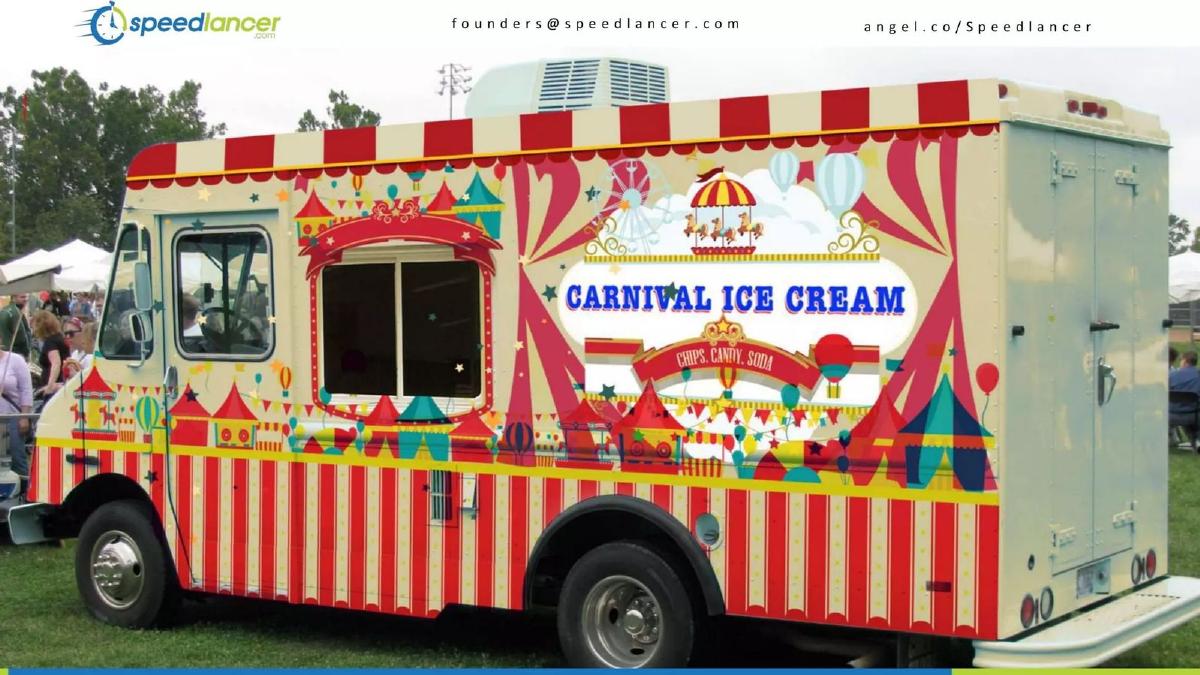
Slide 6: The Ice Cream Truck This slide is a full-page photo of a 'Carnival Ice Cream' truck. There is no text. In the context of a 9-slide deck, this is a baffling inclusion for a reader. It was almost certainly a placeholder for a story about a specific customer or a metaphor for the 'treat' of fast delivery, but as a standalone slide, it fails to convey information.
Traction and Market Size
Slide 7: Engagement This is the most important slide for an investor. It states: '1/3 REPEAT within 14 days.' High retention and high frequency are the lifeblood of a marketplace. If a third of the customers are coming back within two weeks, it suggests that the 4-hour delivery promise is not just a gimmick but a utility that users integrate into their workflows. This is the 'aha' moment of the deck.
Slide 8: Market The deck moves to the macro view. It shows two overlapping circles: a $400B+ Global Staffing Market and a $100B Global Outsourcing Market. While these numbers are large enough to justify venture scale, they are very broad. The deck does not specify what portion of this market is addressable by a 4-hour micro-task platform.
The Conclusion (or Lack Thereof)
Slide 9: Contact The final slide lists 'ADAM STONE' and an email address. It also includes the website URL. Notably, there is no 'Ask' slide. We do not know how much money the company is raising, what the valuation expectations are, or what the milestones for the next 18 months look like. There is also no mention of other team members, advisors, or existing investors.
What Works in the Speedlancer Deck
The 4-Hour Promise: In a world of 'as soon as possible,' giving a hard number (4 hours) is a powerful marketing tool. It sets a clear expectation and differentiates the product from the 'days or weeks' timeline of traditional bidding sites.
The Retention Metric: The 1/3 repeat rate within 14 days is a stellar metric for an early-stage company. It proves product-market fit more effectively than a thousand words of prose could. It tells the investor that the service is addictive and useful.
Clarity of Scope: By limiting the product to 'Design, Writing, and Data-Entry' on slide 4, the company avoids the trap of trying to be everything to everyone. It suggests a focused operational approach.
What is Missing from the Speedlancer Deck
Financials and Unit Economics: This is the most glaring omission. There is no mention of revenue, average order value (AOV), or the margin Speedlancer takes on each task. Without knowing the 'take rate,' an investor cannot calculate the potential of the business.
The Team: A startup is often a bet on the founders. This deck only names Adam Stone. It provides no biography, no past successes, and no indication that there is a technical or operational team behind him. For a marketplace that requires complex matching algorithms and supply-side management, this is a significant red flag.
The Ask: Every pitch deck should end with a clear request. Speedlancer leaves the investor guessing. Are they looking for $50k or $5M? What will the funds be used for? Hiring? Marketing? Geographic expansion?
Go-To-Market Strategy: How does Speedlancer acquire customers? Is it through SEO, paid ads, or B2B partnerships? The deck explains the product but ignores the engine that will drive growth.
What a Founder Should Copy
The Problem Visualization: Slide 3 is an excellent example of how to visualize a 'messy' status quo. The contrast between the chaotic flowchart of the competitor and the streamlined promise of the product is a classic, effective pitch technique.
The Single-Metric Traction Slide: Founders often clutter their traction slides with dozens of meaningless charts. Speedlancer’s decision to highlight one powerful retention metric (Slide 7) is a bold move that forces the investor to focus on the company's strongest data point.
Minimalist Design: While the content is lacking, the visual design is clean. The use of a consistent color palette (blue and green) and simple iconography makes the deck easy to digest quickly. It respects the investor's time, even if it leaves them with too many unanswered questions.
Final Thoughts
The Speedlancer deck is less of a 'pitch' and more of a 'teaser.' It successfully identifies a massive market and a specific, painful friction point in that market. It provides one very compelling piece of data regarding user retention. However, it fails to provide the structural business information required for a professional investment decision. It is a deck designed to get a meeting, not to close a round. For a founder today, the takeaway is clear: be as bold as Speedlancer with your value proposition, but be far more transparent with your numbers and your team.
Frequently asked questions
- What problem is Speedlancer trying to solve?
- Speedlancer targets the friction and time-waste inherent in traditional freelance platforms. Slide 3 illustrates the 'Regular Experience' as a convoluted process of posting tasks, choosing prices, interviewing candidates, and often failing. They aim to replace this 'arbitrary' selection process with a curated, high-speed alternative that removes the need for bidding and interviewing.
- How does Speedlancer differentiate itself from Upwork or Fiverr?
- According to slide 4 and slide 5, the primary differentiators are speed and curation. While other platforms require users to vet candidates, Speedlancer claims to have 300+ pre-vetted 'top freelancers' and guarantees delivery within 4 hours. Their competitive advantage is presented as a 'triple threat' of quality, speed, and price, though price specifics are not provided.
- What are the biggest red flags in this deck?
- The lack of financial data and team depth are major omissions. There is no mention of Gross Merchandise Volume (GMV), revenue, or take rates. Furthermore, slide 9 only lists Adam Stone. For a marketplace business, investors typically want to see a team with experience in operations, engineering, and supply-side growth, none of which are detailed here.
- Is the market size data credible?
- Slide 8 cites a $400B+ Global Staffing Market and a $100B Global Outsourcing Market. While these are standard industry figures for 2015, the deck does not explain Speedlancer's Serviceable Addressable Market (SAM) or how they intend to capture a specific niche within these massive, broad categories.
- What is the 'Carnival Ice Cream' truck slide about?
- Slide 6 features a full-page image of a 'Carnival Ice Cream' truck with no text. In a pitch setting, this was likely a visual aid for a verbal anecdote—perhaps regarding a specific client use case or a metaphor for 'on-demand' service. However, in a standalone deck, it provides zero information and creates confusion for the reader.