Spill’s 14-slide pre-seed deck is a masterclass in timing and founder-market fit. Raised in 2022 following the acquisition of Twitter, the deck identifies a vacuum in the 'real-time conversation' market. The founders, Alphonzo Terrell and DeVaris Brown, leverage their deep institutional knowledge of Twitter to highlight specific technical and social failures, such as poor advertising ROI and the lack of creator rewards. The deck is visually minimalist, relying on cultural memes and clear, punchy text to establish a brand identity that feels native to the community it aims to serve. By request…
Key takeaways
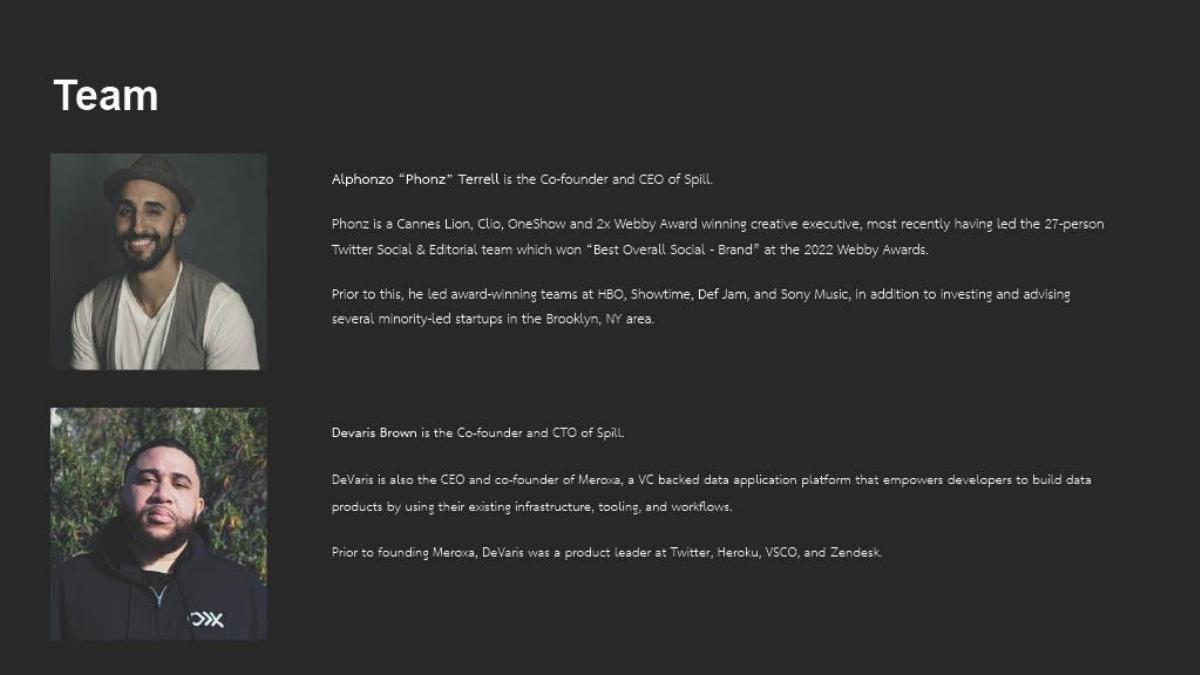
- The deck leans heavily on the founders' pedigree, citing Alphonzo Terrell’s leadership of a 27-person team at Twitter that won a 2022 Webby Award (Slide 2).
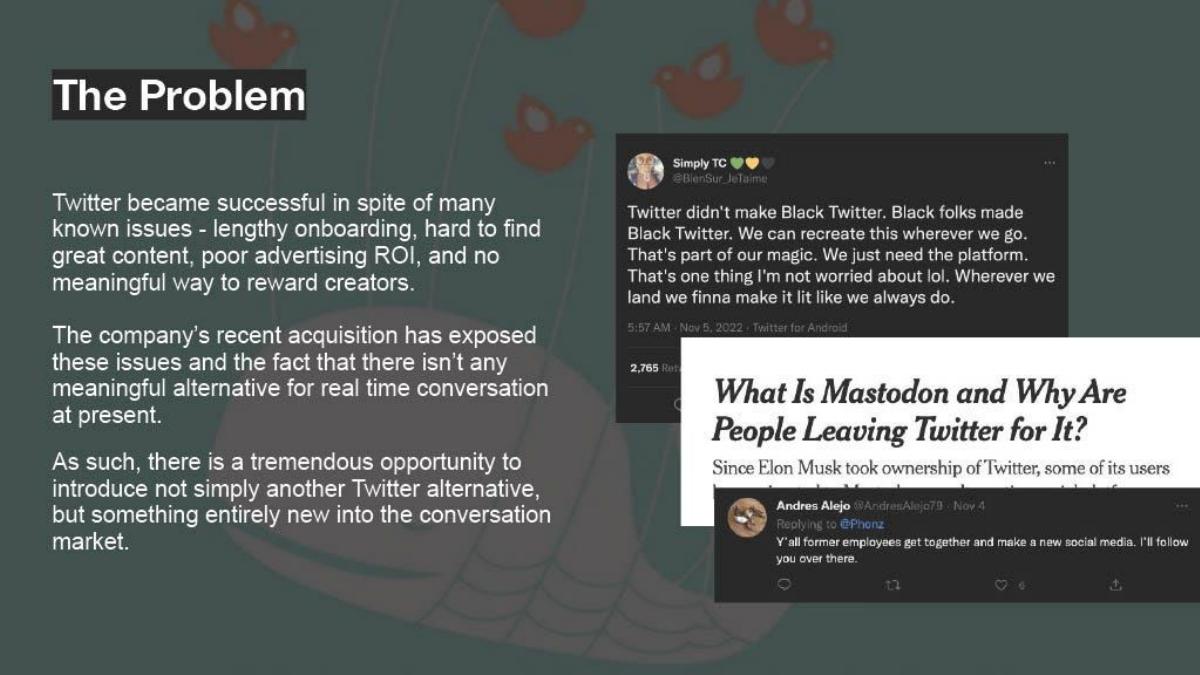
- Spill identifies a specific market opening created by Twitter's 'recent acquisition,' arguing there is no meaningful alternative for real-time conversation (Slide 3).
- The product vision includes a unique monetization hook: users 'automatically get paid if a Spill of yours goes viral' (Slide 4).
- The competitive analysis acknowledges global giants like LINE (700m downloads) and WeChat (1 billion MAU) but notes their lack of significant user bases outside native regions (Slide 6).
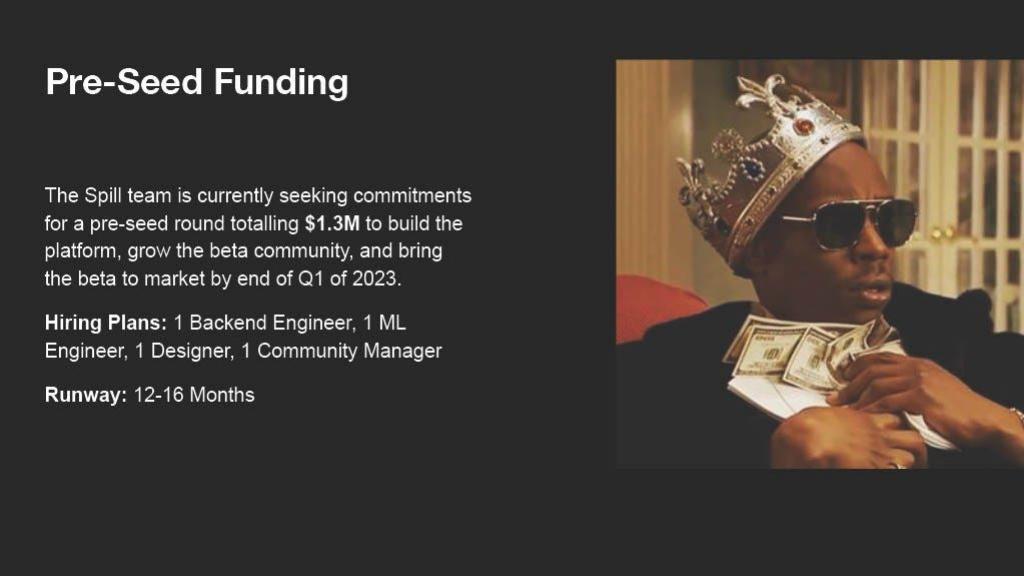
- The 'Ask' is highly specific, requesting $1.3M for a 12-16 month runway with a defined hiring plan for four specific roles (Slide 7).
- Cultural relevance is used as a design language, featuring memes like Kermit the Frog drinking tea to signal the brand's voice (Slide 5).
- The deck omits traditional financial projections or detailed unit economics, focusing instead on the 'Initial Product Offering' and community growth (Slide 4).
- The problem slide uses social proof, featuring actual tweets from users expressing a desire to follow former employees to a new platform (Slide 3).
The Power of Timing and Pedigree
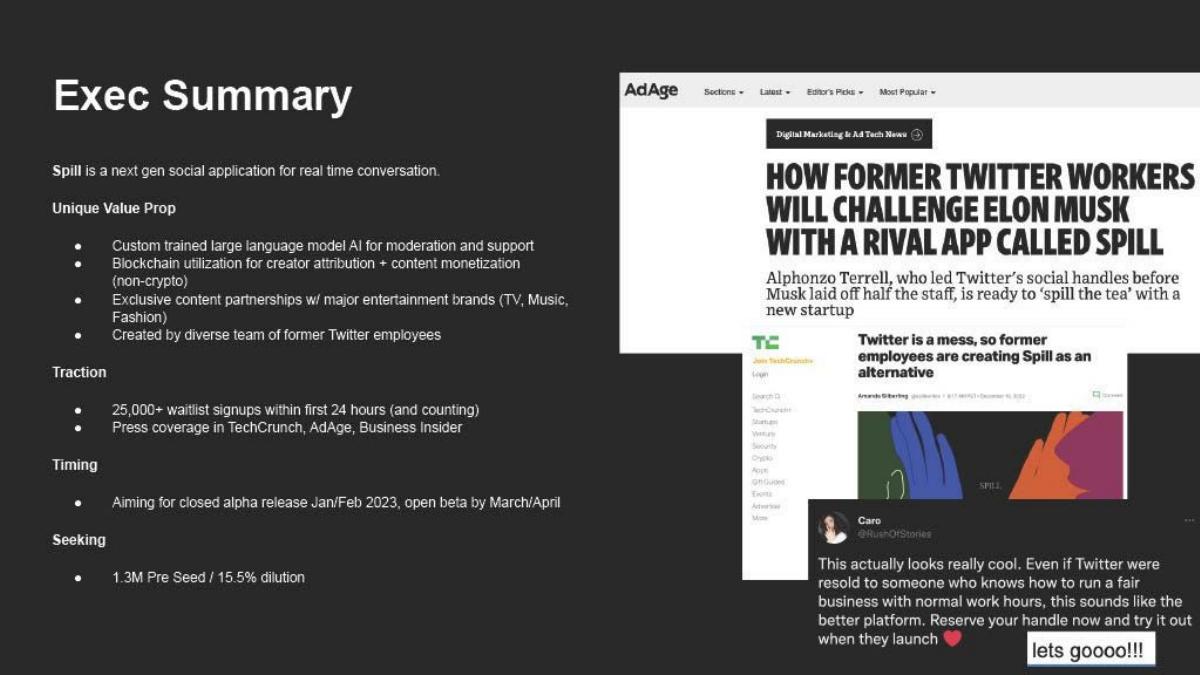
Spill’s pitch deck arrived at a unique moment in social media history. Following the high-profile acquisition of Twitter, the market for real-time conversation was perceived as vulnerable. This deck, created by former Twitter insiders, doesn't just pitch a product; it pitches a correction to the status quo. The 14-slide presentation is remarkably lean, focusing on the founders' ability to execute where their former employer failed. According to publisher reports from Business Insider, this deck successfully secured $1.3M in pre-seed funding in 2022.
Slide 1: Branding and Identity
The deck opens with a minimalist title slide. The logo—the word 'SPILL' surrounded by concentric, broken circles—suggests ripples or a broadcast signal. It is clean, professional, and sets a tone of modern tech without the 'bubbly' aesthetic common in early-stage consumer apps. There is no tagline on this slide, allowing the brand name to stand alone.
Slide 2: The Team
This is arguably the most important slide in the deck. It establishes Alphonzo "Phonz" Terrell and DeVaris Brown as the ideal founders for this venture. Terrell is described as a 'Cannes Lion, Clio, OneShow and 2x Webby Award winning creative executive,' specifically noting his leadership of the 27-person Twitter Social & Editorial team. Brown is introduced as the CTO, with a background as a product leader at Twitter, Heroku, VSCO, and Zendesk, and as the co-founder of Meroxa. By highlighting their 'Twitter veteran' status, they immediately bypass the question of whether they understand the complexities of social media at scale.
Slide 3: The Problem
Slide 3 identifies the 'known issues' of Twitter: lengthy onboarding, difficulty finding content, poor advertising ROI, and the lack of creator rewards. However, the slide goes further by referencing the 'recent acquisition' as a catalyst that exposed these issues. The inclusion of social media screenshots—specifically a tweet stating, 'Twitter didn't make Black Twitter. Black folks made Black Twitter'—serves as a powerful piece of social proof. It identifies a specific, highly active subculture that feels underserved and ready to migrate.
Slide 4: Initial Product Offering
Spill defines its product as a 'easier, safer, and more rewarding social experience.' The slide lists four key features: creating 'Spills' (posts), hosting in-app chat events (both virtual and IRL), following cultural commentary, and a blockchain-adjacent promise: 'you automatically get paid if a Spill of yours goes viral.' This last point is a significant differentiator, moving Spill from a simple communication tool to a platform for the creator economy. The use of the money-mouth face emoji adds a casual, community-focused tone to the technical promise.
Slide 5: The Vision
Using the famous 'Kermit drinking tea' meme, this slide states the ultimate goal: 'to make Spill the de facto platform to discover and discuss culture worldwide.' The meme is a clever nod to the brand name (spilling the tea) and demonstrates that the founders are culturally fluent. It bridges the gap between a high-level corporate mission and the actual behavior of social media users.
Slide 6: Competition
The competition slide is refreshingly honest. It acknowledges Twitter's 240m DAU but points out the lack of global alternatives. It lists LINE (700m downloads), Koo (50m MAU), and WeChat (1 billion MAU), but dismisses them as regional players. By framing the competition this way, Spill positions itself as the only player capable of capturing the Western 'real-time conversation' market that is currently in flux. The slide also includes a news headline about 'Google and Twitter veterans' mapping out an alternative, reinforcing their own narrative.
Slide 7: Pre-Seed Funding and The Ask
The final slide in the provided sequence details the financial request. The team sought $1.3M to build the platform and bring the beta to market by the end of Q1 2023. The slide is highly transparent about where the money goes: hiring one Backend Engineer, one ML Engineer, one Designer, and one Community Manager. They project a runway of 12-16 months. The image of Dave Chappelle as 'Prince' holding cash is a bold, culturally specific choice that reinforces the brand's identity even in the 'boring' financial section.
What Works in the Spill Deck
Founder-Market Fit: The deck does an exceptional job of selling the founders. In a pre-seed round, investors are betting on the team. By showing that they didn't just work at Twitter, but led award-winning teams there, Terrell and Brown make a compelling case for their ability to build a superior alternative.
Market Timing: The deck leans into the chaos of the Twitter acquisition. It frames the venture not just as a 'good idea,' but as a necessary solution to a sudden market vacuum. This creates a sense of urgency for investors.
Brand Voice: Most pitch decks are dry. Spill uses memes and cultural references that reflect the actual product they are building. This shows investors that the founders understand their target demographic's communication style.
What is Missing from the Spill Deck
Monetization Detail: While the deck mentions 'poor advertising ROI' as a problem and 'getting paid for virality' as a feature, it does not explain the underlying business model. How does Spill generate the revenue to pay those creators? Is it through ads, subscriptions, or transaction fees?
Content Moderation Strategy: One of the biggest challenges for social media startups is moderation. While the publisher summary mentions 'advanced content moderation,' the slides themselves are light on how they will handle the safety issues that plague their competitors.
User Acquisition Plan: The deck mentions 'growing the beta community,' but it lacks a specific strategy for how they will lure millions of users away from established platforms. Social media relies on network effects, and the deck doesn't detail the 'hook' that will trigger mass migration.
Lessons for Founders
Leverage Your 'Unfair Advantage': If you have worked at a market leader, use that experience to highlight specific, insider-level problems that outsiders wouldn't see. Spill’s founders didn't just say Twitter was bad; they pointed to 'lengthy onboarding' and 'poor advertising ROI'—specific pain points they likely saw firsthand.
Be Specific with the Ask: Don't just ask for a dollar amount. Tell investors exactly who you are going to hire and how long that money will last. Spill’s breakdown of four specific roles shows a disciplined approach to growth.
Social Proof Matters: Even if you don't have users yet, you can show that there is a demand for your solution. Spill used screenshots of potential users literally asking for the founders to build a new platform. This is a powerful way to validate a market before a single line of code is written.
Frequently asked questions
- How did Spill justify a $1.3M pre-seed round without a live product?
- Spill relied on extreme founder-market fit. Both founders are former Twitter leaders with deep domain expertise. By highlighting their specific achievements—like winning a Webby Award for Twitter's social team—they convinced investors that they were the most qualified team to build a 'Twitter-killer' during a period of platform instability.
- What is the unique selling proposition (USP) of Spill compared to other Twitter clones?
- Unlike Mastodon or other decentralized alternatives, Spill focuses on two specific pillars: cultural commentary and creator compensation. The deck explicitly states that creators will 'automatically get paid' for viral content, addressing a major pain point in the creator economy that legacy platforms have struggled to solve.
- Why does the deck use memes like Kermit the Frog?
- This is a strategic choice to demonstrate brand-market fit. Spill aims to be the home for 'culture,' and by using memes that are synonymous with 'spilling tea' (gossip/news), they show investors they understand the digital vernacular of the audience they are targeting.
- What are the specific hiring plans mentioned in the deck?
- The deck outlines a very lean and technical initial team. With the $1.3M raise, they planned to hire one Backend Engineer, one ML Engineer, one Designer, and one Community Manager. This suggests a focus on building a robust, moderated platform rather than a massive sales force.
- How does Spill view its competition?
- Spill takes a global view of competition, mentioning LINE, Koo, and WeChat. However, they dismiss these as threats by noting their lack of success outside their native regions. They position Spill as the only viable 'globally accessible' alternative for real-time conversation currently in development.