Global Crossing Airlines (GlobalX) positions itself as a 'new breed' of hybrid charter airline, leveraging a low fixed-cost, asset-light model to serve both passenger charter and cargo sectors. The December 2021 deck emphasizes the company's regulatory readiness, including US 121 domestic flag authority and international permits for Canada, Mexico, and Brazil. By utilizing pass-through economics—where customers cover fuel and other variable costs—GlobalX claims to be insulated from economic cycles and fuel price volatility. The presentation highlights a diverse client base ranging from NCAA s…
Key takeaways
- The company operates as a US 121 domestic flag and supplemental carrier with full DOT international authority (Slide 3).
- The business model utilizes pass-through economics, meaning fuel and other costs are paid by the customer, removing fuel risk from the airline (Slide 5).
- GlobalX targets recession-resilient sectors including the U.S. military, NCAA sports teams, and casino/VIP tour flying under multi-year contracts (Slide 5).
- The airline maintains three strategic bases in Miami (MIA), Atlantic City (ACY), and Las Vegas (LAS) to provide 3-hour range coverage across North America (Slide 9).
- Current government and high-profile clients include NASA, the U.S. Department of Homeland Security, and various collegiate athletic programs like Alabama and Penn State (Slide 11).
- The cargo division is expanding from an original plan of 5 aircraft to 9 A321 converted freighters currently under lease or firm LOIs (Slide 13).
- FAA certification for the cargo operations was scheduled to begin in January 2022 (Slide 13).
- The company states it has been 100% equity financed to date and acquired its assets at 'Post Covid Prices' (Slide 15).
Executive Summary: The Hybrid Aviation Play
Global Crossing Airlines, operating under the brand GlobalX, presents an investor update from December 2021 that outlines a transition from a startup carrier to an established hybrid operator. The deck focuses on two primary revenue streams: passenger charter and narrow-body cargo. By positioning themselves as an 'asset-light' player in a traditionally capital-intensive industry, GlobalX attempts to convince investors that they have bypassed the traditional risks of airline management, such as fuel price fluctuations and cyclical demand drops.
Slide 1: Title and Visual Branding
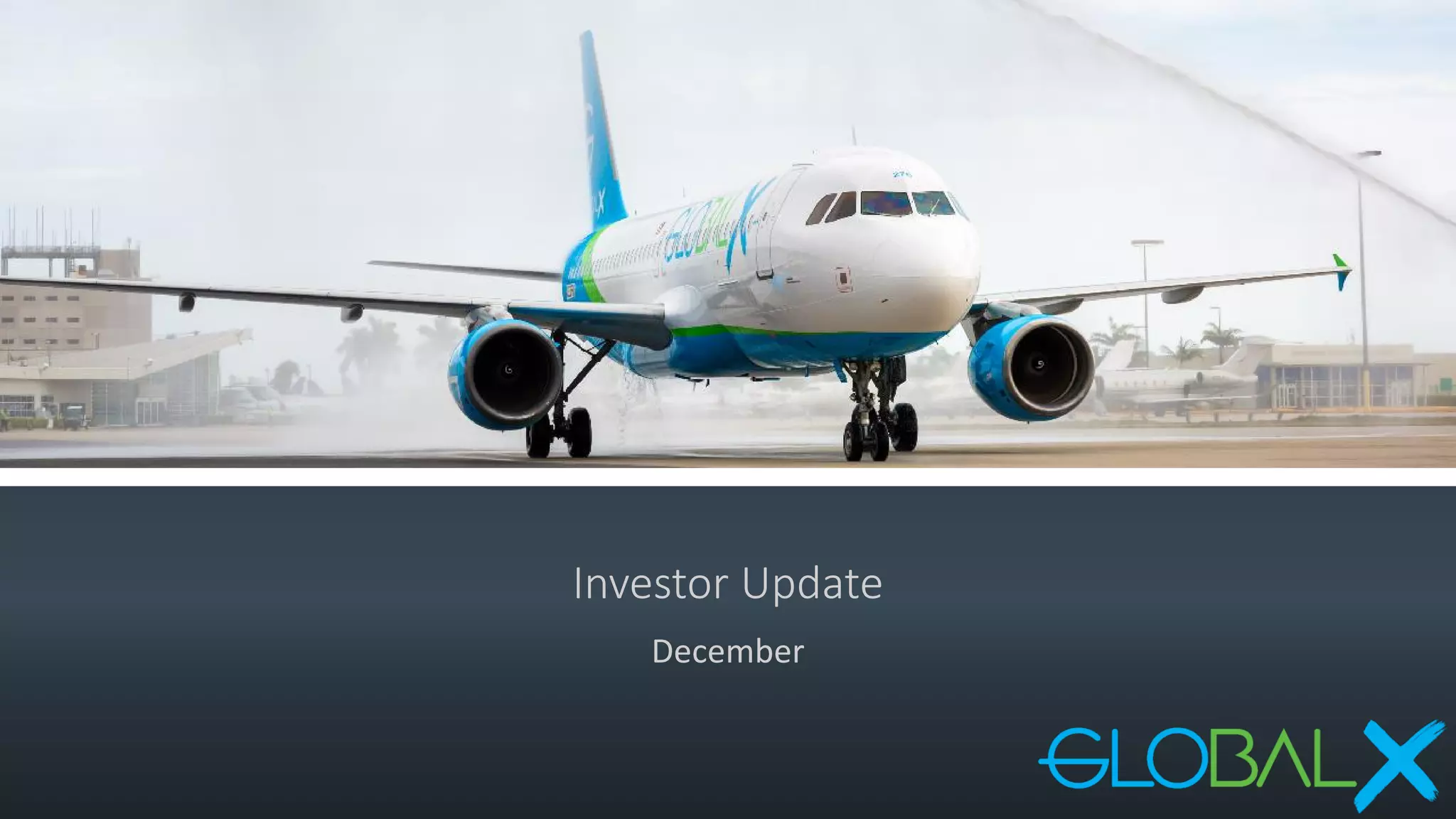
The cover slide features a high-resolution image of a GlobalX Airbus A320 receiving a traditional water salute, a ceremony typically reserved for inaugural flights or new aircraft deliveries. This visual immediately establishes the company as an active operator with physical assets. The title is simple: "Investor Update - December," accompanied by the GlobalX logo. There is no specific mention of a funding round amount or valuation on this slide, identifying it as a general corporate update rather than a specific 'ask' deck.
Slide 3: The Hybrid Charter Overview
This slide defines the company's identity as a "New Breed of Hybrid Charter Airlines." It lists their regulatory credentials, which are critical in the aviation sector. Specifically, it notes they are a "US 121 domestic flag and supplemental carrier" with "Full DOT international authority." The slide also mentions operating permits for Canada, Mexico, and Brazil. The core value proposition stated here is a "differentiated low fixed cost, asset light business model" designed to flex capacity. The green highlight at the bottom emphasizes the "Ability to quickly adapt to any demand environment," which was a significant talking point in late 2021 as the industry recovered from pandemic-related disruptions.
Slide 5: Business Model and Economics
Slide 5, titled "Leading Charter Business," dives into the financial mechanics of their operations. The most important bullet point here is "Pass-through economics – Fuel and other costs paid by customer (i.e., no fuel risk)." This is a major differentiator from scheduled airlines (like Delta or United) that must hedge fuel or absorb price spikes. The slide claims the business is "largely insulated from economic cycles" because it serves niche groups that fly regardless of the economy: the U.S. military, NCAA sports teams, and VIP tour groups under multi-year contracts. This slide attempts to de-risk the investment by showing recurring revenue and cost protection.
Slide 7: Fleet Visuals
This slide is a simple gallery of four aircraft in the GlobalX livery, identified by their registration numbers: N276GX, N277GX, N278GX, and N279GX. While it lacks technical specifications (like seat count or engine type), it serves as proof of existence for their fleet. For an airline, showing the actual tail numbers of aircraft under their control is a standard way to demonstrate operational scale to investors.
Slide 9: Geographic Reach and Bases
The "Bases Expansion" slide uses a map of North America with three overlapping red circles representing a "3 Hour Range" from their primary hubs: Miami (MIA), Atlantic City (ACY), and Las Vegas (LAS). The text explains that these three bases allow for "short ferry/repositioning of aircraft," which keeps costs down when quoting charters. By showing coverage that spans from the Caribbean to the Canadian border and across the continental U.S., the company demonstrates its ability to service the entire North American market efficiently.
Slide 11: The Client Roster
This is a high-impact logo slide titled "Current Clients." It is divided into four quadrants:
Collegiate Sports: Includes logos for Alabama Crimson Tide, Penn State, Xavier, VCU, and several others. · Tour and Travel: Lists Havana Air, Turpial Airlines, and Agua Caliente Casinos. · GOV: Features the logos for NASA and the U.S. Department of Homeland Security. · Brokers: Lists major industry intermediaries like Air Charter Service, Chapman Freeborn, and PJS (Private Jet Services).
This slide provides social proof and validates the claim that their revenue is diversified across government, sports, and commercial sectors.
Slide 13: Cargo Expansion Strategy
Titled "Projected Stable Cargo Business," this slide highlights a pivot or expansion into the freight market. The company states they have "9 A321 converted freighter aircraft currently under lease/firm LOI’s," noting this is an increase from an original plan of five. The A321 freighter is a modern, fuel-efficient narrow-body cargo jet. The slide also sets a timeline, stating that "Certification with the FAA will start January 2022." This indicates that at the time of the deck, the cargo side of the business was in the pre-operational/certification phase rather than actively flying freight.
Slide 15: Summary and Financial Position
The final slide in this selection summarizes the investment case. It reiterates the "Resilient and Diverse Business Model" and the fact that assets were "Acquired at Post Covid Prices." A significant financial disclosure is made here: the company is "100% Equity Financed to Date." This suggests a clean balance sheet without heavy debt loads, which is rare for an airline. The final bullet point positions them for "High Growth in Rebound," leaning into the macro-economic recovery narrative of late 2021.
What Global Crossing Airlines Does Well
The deck is exceptionally clear about its economic moat . By emphasizing "pass-through economics" on slide 5, they address the number one concern for airline investors: fuel price volatility. Most startup airlines fail because they cannot manage the spread between ticket prices and fuel costs; GlobalX circumvents this by making the customer responsible for the variable costs of the flight.
The regulatory transparency is also a strength. In aviation, the "US 121" certification mentioned on slide 3 is a high bar to clear. Listing this, along with specific international permits, tells sophisticated investors that the company has already passed the most difficult bureaucratic hurdles of the industry.
Finally, the client diversification shown on slide 11 is impressive. By showing they work with both the Department of Homeland Security and NCAA football teams, they demonstrate that their revenue isn't dependent on a single industry or contract type.
What is Missing from the Deck
Despite the operational details, there are several critical omissions that a professional investor would require for a full evaluation:
Management Team: The provided slides do not include a team slide. In a highly regulated industry like aviation, the experience of the CEO, Director of Operations, and Chief Pilot is paramount. · Financial Performance: While the deck mentions "high growth and high margin," it provides zero actual numbers. There are no revenue figures, EBITDA projections, or burn rate statistics. · Unit Economics: There is no breakdown of the hourly cost to operate an A320 versus the hourly charter rate. Without this, the "high margin" claim is unsubstantiated. · Competition: The deck does not mention other charter operators like Sun Country or Atlas Air. A competitive landscape slide is missing. · The Ask: There is no slide detailing how much capital they are looking to raise or how those funds would be allocated (e.g., how much for the A321 conversions vs. working capital).
Founder Lessons: Copy This, Avoid That
Copy the "Pass-Through" Clarity: If your business model has a unique way of offloading risk (like fuel costs or inventory holding costs), make it a standalone bullet point. GlobalX does a great job of explaining why their margins are more stable than their competitors' by highlighting this single contractual detail.
Copy the Geographic Range Map: For any logistics or service business, a map showing "time-to-customer" or "serviceable range" is much more effective than a list of cities. Slide 9 effectively communicates their operational efficiency at a glance.
Avoid Vague Financial Claims: GlobalX claims "high growth and high margin" on slide 5 without a single dollar sign or percentage. Founders should avoid using qualitative adjectives for quantitative metrics. If you say margins are high, you must provide the percentage; otherwise, it looks like you are hiding poor performance behind marketing speak.
Avoid the Missing Team Slide: Never send a deck to an external party without a team slide. In the early stages of a company—especially one as complex as an airline—investors are betting on the people who can navigate the FAA and DOT regulations more than the planes themselves.
Frequently asked questions
- What is Global Crossing Airlines' primary business model?
- GlobalX operates as a hybrid charter airline focusing on both passenger and cargo sectors. According to slide 3, they use an asset-light, low fixed-cost model designed to flex capacity based on market demand. A key component of their financial strategy is pass-through economics, where the chartering client pays for fuel and other operational costs directly, shielding the airline from commodity price volatility.
- Which geographic markets does GlobalX serve?
- Slide 3 notes that the airline holds operating permits for the United States, Canada, Mexico, and Brazil. Slide 9 illustrates their operational footprint with three main bases: Miami (MIA), Atlantic City (ACY), and Las Vegas (LAS). These bases are positioned to allow for short ferry and repositioning flights, covering all potential North American clients within a 3-hour flight range.
- Who are the airline's major customers?
- The company serves four main categories as shown on slide 11: Collegiate Sports (e.g., University of Alabama, Xavier, VCU), Tour and Travel (e.g., Havana Air, Turpial Airlines), Government (NASA, Department of Homeland Security), and various aviation brokers such as Air Charter Service and Chapman Freeborn. They also cite the U.S. military as a key customer group on slide 5.
- What are the company's plans for the cargo market?
- GlobalX is significantly increasing its commitment to the cargo sector. Slide 13 reveals they have 9 A321 converted freighter aircraft under lease or firm Letters of Intent (LOIs), which is an increase from their original plan of 5 aircraft. They were slated to begin FAA certification for these cargo operations in January 2022.
- How has the company financed its growth so far?
- According to the summary on slide 15, Global Crossing Airlines has been 100% equity financed to date. The deck also emphasizes that their current fleet of aircraft was acquired at 'Post Covid Prices,' suggesting they took advantage of the market downturn to secure assets at a lower cost basis than traditional market rates.