The GlamST pitch deck is a 12-slide presentation from 2014 that successfully navigated the Series A stage by focusing on high-impact visuals and enterprise-grade traction. Eschewing dense text, the company relies on a 'show, don't tell' philosophy, utilizing high-resolution product simulations and a clear revenue growth chart. With a reported $400k run rate and 60% margins at the time of the deck, GlamST demonstrated a viable business model in the $50B US beauty industry. The deck is particularly strong in its use of social proof, listing six major global beauty brands as current customers. W…
Key takeaways
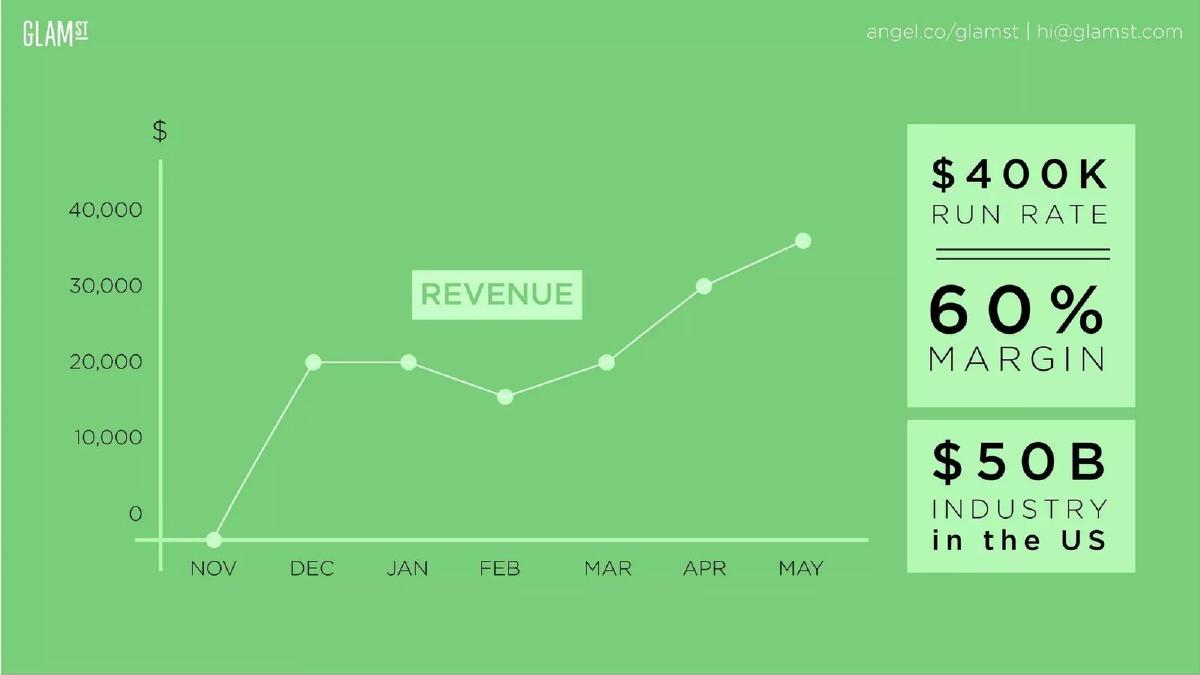
- The company reports a $400k run rate with 60% margins on slide 5.
- GlamST identifies a $50B beauty industry in the US as its primary market opportunity on slide 5.
- The deck highlights a 52% increase in engagement for partners like Maybelline on slide 9.
- Over 100,000 virtual makeovers had been performed at the time of the presentation, according to slide 9.
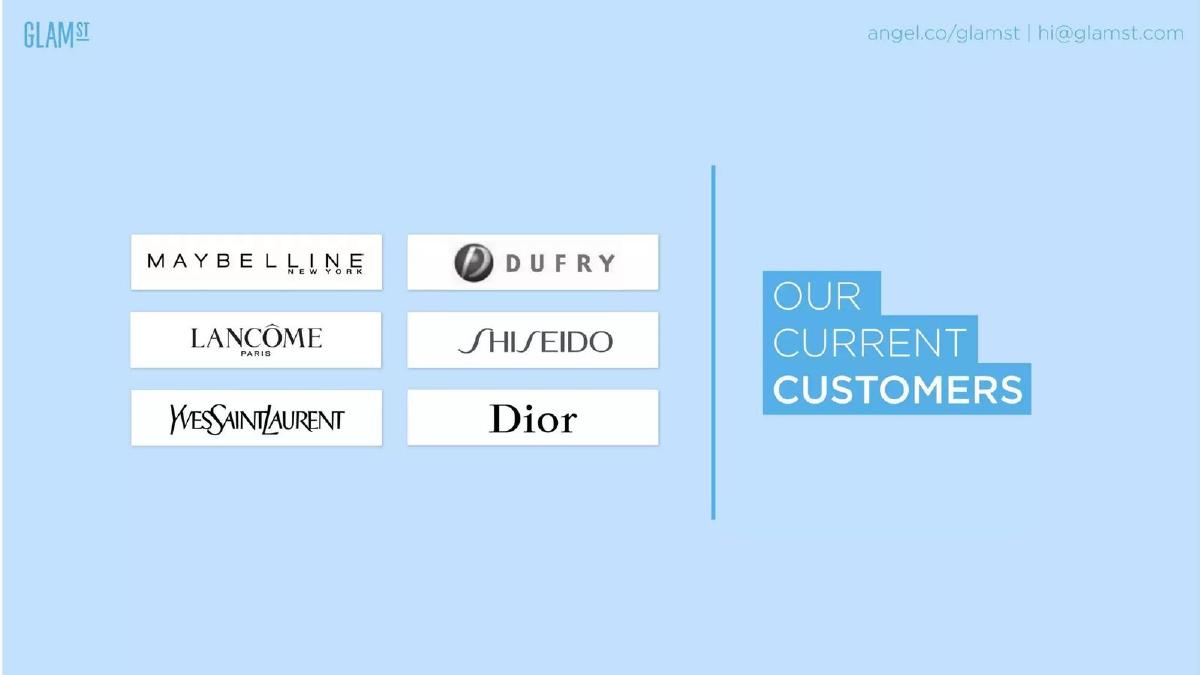
- The customer list includes major global brands such as Maybelline, Lancôme, YSL, Shiseido, Dior, and Dufry on slide 6.
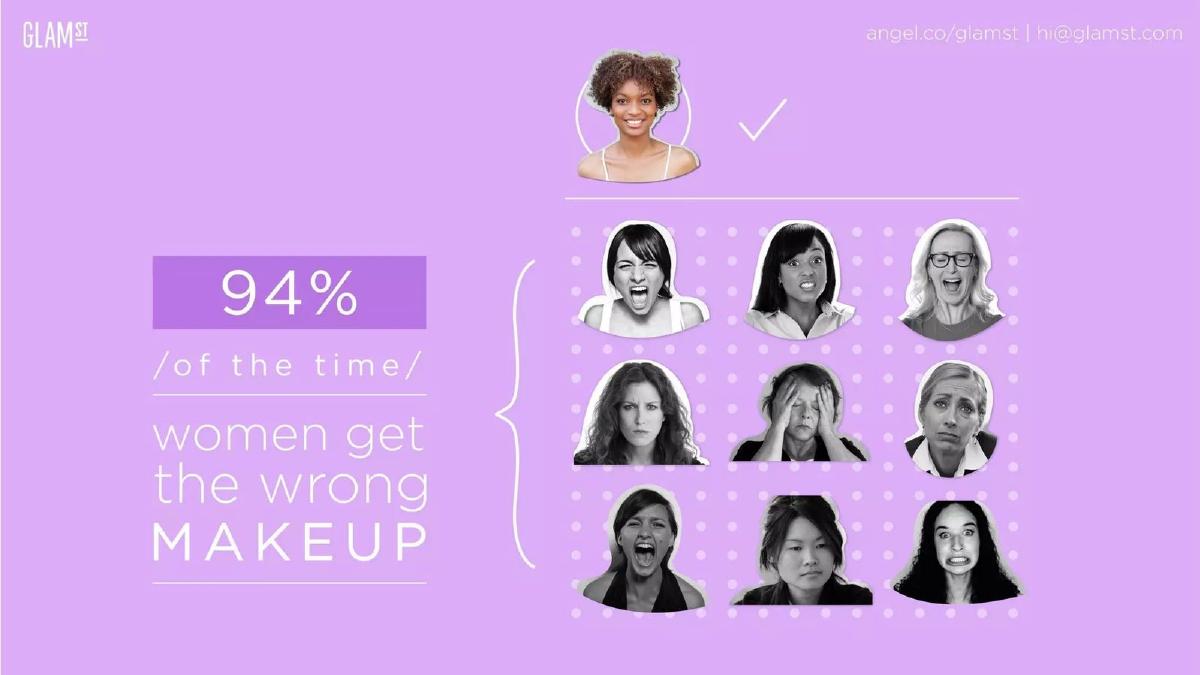
- The problem is quantified by the claim that 94% of the time women get the wrong makeup on slide 3.
- The team slide (slide 10) emphasizes specific domain expertise: retail for the COO, startups for the CEO, and mobile for the CTO.
- The deck uses a visual revenue growth chart showing a steady climb from November to May on slide 5.
Introduction: The Power of Visual Proof
The GlamST pitch deck is a 12-slide masterclass in brevity and visual storytelling. Produced in 2014 for a Series A round, the deck focuses heavily on the 'magic' of the product—augmented reality makeup try-ons—and the high-tier enterprise validation the company had already secured. By 2014, AR was still a nascent technology for many investors, making the 'show, don't tell' approach of this deck essential for building credibility.
Slides 1-4: Defining the Friction in Beauty Retail
Slide 1 is a minimalist title slide featuring only the GlamST logo against a black background. This sets a high-fashion, premium tone consistent with the beauty industry.
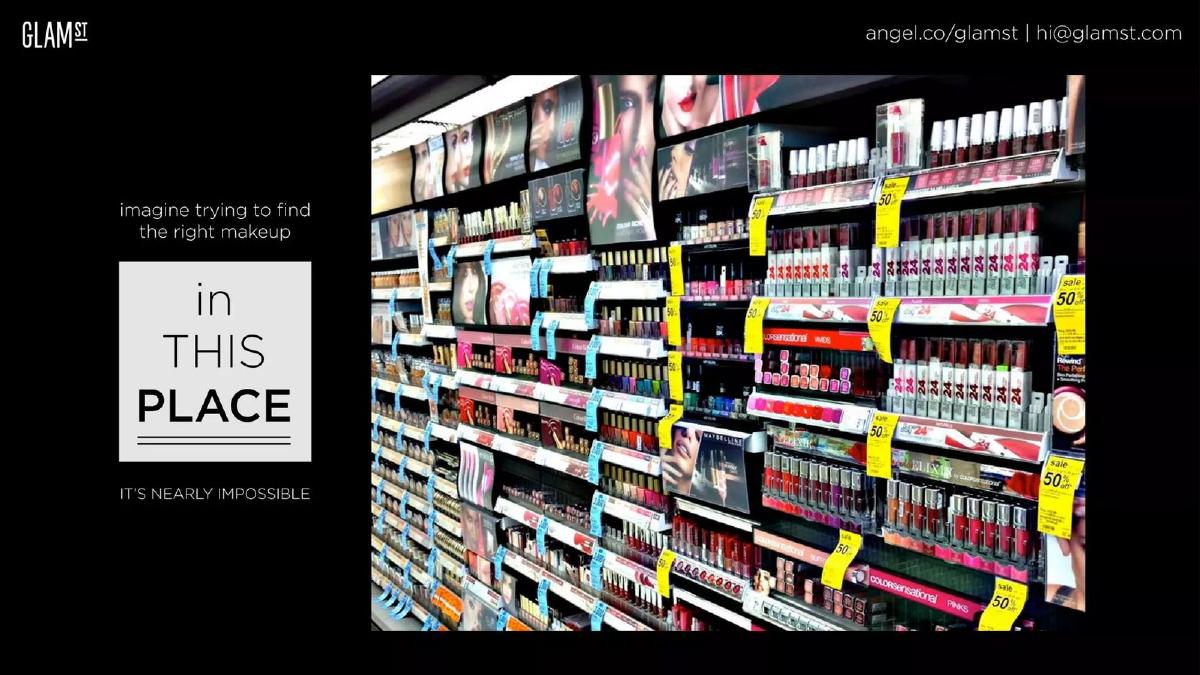
Slide 2 immediately dives into the problem. It uses a high-density image of a makeup aisle with the text 'imagine trying to find the right makeup in THIS PLACE. IT’S NEARLY IMPOSSIBLE.' This creates immediate empathy for the consumer's struggle with choice paralysis in retail environments.
Slide 3 quantifies the frustration. It claims that '94% /of the time/ women get the wrong MAKEUP.' The slide uses a grid of nine frustrated or upset faces contrasted with one satisfied face at the top. This is a bold statistic designed to highlight a massive inefficiency in the $50B market mentioned later.
Slide 4 provides the transition to the solution with a simple, orange-themed slide stating: 'we make SHOPPING for makeup EASY.' The use of a shopping cart icon reinforces the commercial intent of the technology.
Slides 5-6: Financial Traction and Blue-Chip Validation
Slide 5 is one of the most important slides in the deck, combining market size, revenue growth, and margins. It features a line graph showing revenue growth from November to May. While the Y-axis uses increments of 10,000, it doesn't explicitly state if this is dollars or users, though the sidebar clarifies a $400K RUN RATE . The slide also boasts a 60% MARGIN and identifies a $50B INDUSTRY in the US . This slide effectively communicates that the business is not just a cool tech demo, but a growing, profitable enterprise.
Slide 6 provides the 'Social Proof' that many Series A investors look for. It lists six 'CURRENT CUSTOMERS': Maybelline New York, Dufry, Lancôme Paris, Shiseido, Yves Saint Laurent, and Dior . For a startup at this stage, having a roster of LVMH and L'Oréal-owned brands is a massive signal of product-market fit and technical reliability.
Slides 7-9: The Product Experience and Case Study
Slide 7 returns to the user experience, showing a woman wiping off lipstick with the text 'women try 10 SHADES OF LIPSTICK just to find the right one. IT’S UNCOMFORTABLE UNSANITARY & PAINFUL.' This slide justifies why a digital solution is superior to the status quo.
Slide 8 showcases the 'Virtual Makeup Simulation.' It features an iPad displaying a 'photo realistic application' of lipstick. The zoom-in bubble on the lips is intended to show the quality of the AR—specifically the texture and edge detection, which were significant technical hurdles in 2014.
Slide 9 acts as a mini-case study for Maybelline. It shows the interface on an iMac and lists two key metrics: INCREASED engagement 52% and +100.000 MAKEOVERS . This proves that the technology isn't just a novelty; it drives measurable consumer behavior for the brands paying for it.
Slides 10-12: The Team and the 'Dave' Factor
Slide 10 introduces the leadership. Carolina (COO) is tagged with 'retail' and logos for Endeavor and SAP. Agustina (CEO) is tagged with 'startups' and logos for Endeavor, AIESEC, and Fortune. Javier (CTO) is the 'mobile expert' with logos for Orbitz and eBay. The inclusion of the 'Endeavor Entrepreneur' logo for all three founders suggests a high level of vetting by the global entrepreneurship network.
Slide 11 serves as a summary slide, repeating the $400K RUN RATE and 60% MARGIN alongside the customer logos. It reinforces the core message: GlamST is a proven, high-margin business working with the biggest names in beauty.
Slide 12 ends the deck on a lighthearted note. It shows a man ('Dave') with virtual makeup applied, with the caption 'Making hundreds of thousands of people beautiful every year... EVEN DAVE.' This serves as a final demonstration of the technology's versatility and the team's personality.
What Works in This Deck
Extreme Brevity: With only 12 slides and very little text, the deck is designed to be flipped through in under two minutes. This is ideal for a first-look deck. · High-Quality Visuals: In a beauty-tech pitch, the 'look' of the product is everything. The simulations shown on slides 8 and 9 look professional and realistic, which builds trust in the underlying tech. · Logo Density: The customer slide (slide 6) is incredibly strong. For a Series A company, having that many household names as active customers is a significant barrier to entry for competitors. · Clear Unit Economics: Stating a 60% margin on slide 5 and slide 11 tells investors exactly what kind of business this is—likely a SaaS or licensing model with high scalability.
What Is Missing
The Ask: There is no slide indicating how much money GlamST is raising or what they plan to do with the capital. While this information is often shared in person, its absence makes the deck feel incomplete as a standalone fundraising document. · Competition: The deck does not mention other AR beauty players (like YouCam or Modiface). Investors in 2014 would have been keenly interested in how GlamST's '100 custom filters' (mentioned in the company description) compared to rivals. · Product Roadmap: The deck shows what they have done (lipstick and base), but it doesn't explain where the tech is going. Are they moving into hair color? Skincare analysis? Wearables? · Detailed Financials: While the run rate and margin are great, a Series A deck usually includes a more detailed breakdown of CAC (Customer Acquisition Cost) and LTV (Lifetime Value), especially for an enterprise-facing business.
What a Founder Should Copy
The Problem/Solution Loop: Slides 7 and 8 are a perfect example of identifying a specific physical pain point (unsanitary lipstick testing) and immediately showing the digital cure. · Case Study Integration: Don't just say your product works; show it working for a recognizable brand. Slide 9's Maybelline data is more persuasive than any internal projection. · Consistent Branding: The deck uses a consistent color palette and clean typography that reflects the industry it serves. It feels like it belongs in the world of high-end retail. · The 'Personality' Slide: Ending with a joke or a humanizing image (like 'Dave' on slide 12) can make a founder more memorable in a sea of dry presentations.
Frequently asked questions
- What is GlamST's primary value proposition?
- GlamST provides an augmented reality (AR) virtual makeup simulation that allows users to try on products via mobile, web, and in-store interfaces. According to slide 8, the technology focuses on 'photo realistic application' to solve the 'uncomfortable, unsanitary, and painful' process of trying on physical makeup samples in stores.
- How does GlamST demonstrate market traction?
- Traction is demonstrated through both financial metrics and enterprise partnerships. Slide 5 shows a revenue growth chart peaking in May with a $400k run rate. Slide 9 provides a specific case study of their work with Maybelline, noting a 52% increase in engagement and over 100,000 makeovers completed.
- Who are the key members of the GlamST leadership team?
- The team consists of Carolina (COO, retail background with SAP experience), Agustina (CEO, startup background with Fortune experience), and Javier (CTO, mobile expert with Orbitz and eBay experience). All three founders are also noted as Endeavor Entrepreneurs on slide 10.
- What specific problem in the beauty industry is the company solving?
- The deck identifies two main problems: the difficulty of finding the right product in crowded retail environments (slide 2) and the inefficiency of physical testing. Slide 7 notes that women often try 10 shades of lipstick to find the right one, a process they describe as 'uncomfortable, unsanitary & painful.'
- Is there a specific funding request in this deck?
- No, the 12-slide deck does not include a specific 'Ask' slide detailing the amount of capital being raised or the intended use of funds. It functions more as a high-level business overview and traction report rather than a closing document.