Otovo's 17-slide deck for their 2022 equity private placement is a masterclass in demonstrating geographic scalability. The company positions itself as a pure-play marketplace platform that avoids the heavy capital expenditure of traditional solar installers by matching homeowners with a network of 500+ third-party contractors. The narrative is driven by strong macro tailwinds, including soaring energy prices and favorable EU regulations. Key to their pitch is the 'speed to market' metric, showing they can now launch a new country and reach 50 sales in just three months. While the deck lacks…
Key takeaways
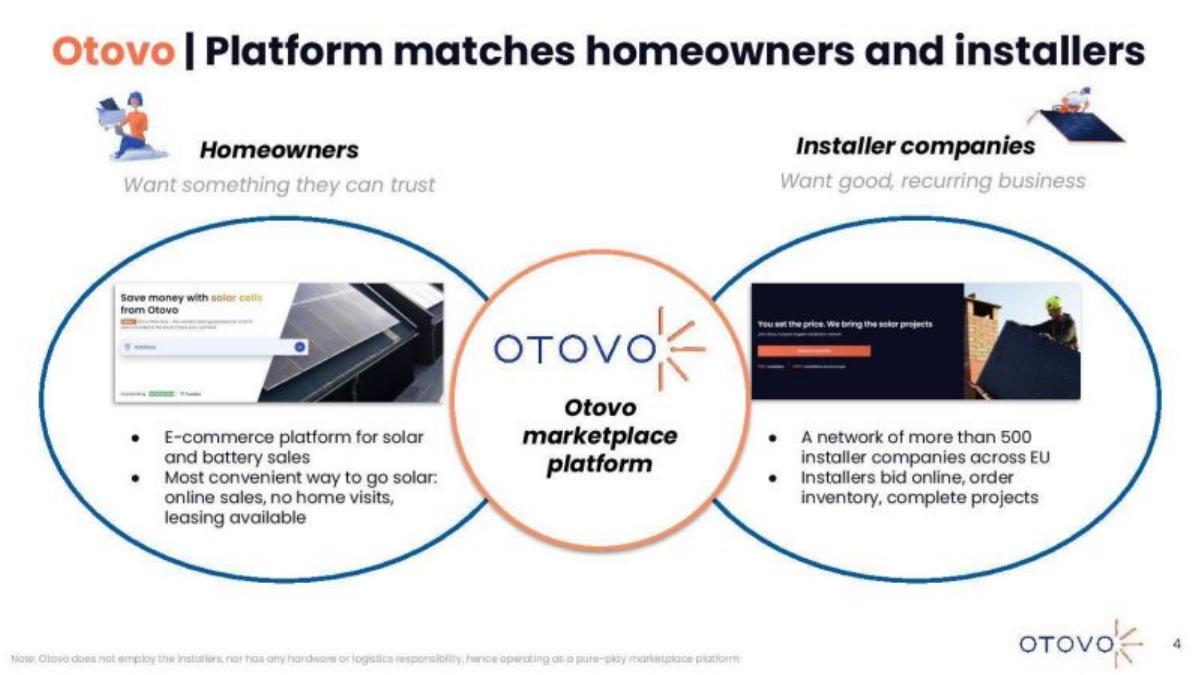
- The platform acts as a pure-play marketplace, connecting homeowners with over 500 installer companies across the EU (Slide 4).
- Otovo has a proven geographic playbook, having expanded from Norway in 2016 to 7 countries by 2021 (Slide 8).
- Expansion efficiency is a core metric, with the Germany launch reaching 50 projects in just 3 months compared to 8 months for earlier markets (Slide 9).
- The business model shifts from one-time solar sales to a 'Virtual Power Plant' (VPP) and subscription-based ecosystem (Slide 10).
- Market opportunity is quantified at ~600k unaddressed residential installations in high-potential European markets (Slide 11).
- The company aims to double its footprint from 7 to 15+ countries by 2023 (Slide 12).
- Funding is explicitly tied to incremental growth, projecting a jump from ~10,000 sales in 2022 to 80-90k by 2025 (Slide 13).
- Subscription models are projected to increase gross profit per customer by 3-4x compared to direct sales (Slide 15).
The Marketplace Playbook for Renewable Energy
Otovo’s 2022 pitch deck is a highly structured argument for geographic dominance. Operating in the residential solar sector, Otovo distinguishes itself not through proprietary hardware, but through a superior software-enabled marketplace. This teardown examines how they used data-driven expansion metrics and macro-economic tailwinds to secure $30M in venture funding.
Slides 1-3: The Formalities
The deck opens with a direct title slide (Slide 1) stating the purpose: "Equity Private Placement" with the ambitious goal to "Build #1 solar player in Europe." This is immediately followed by two dense slides of legal disclaimers (Slides 2 and 3). While standard for private placements in European markets, these slides signal that the company is operating with a high degree of institutional maturity, likely targeting professional and venture investors rather than early-stage angels.
Slide 4: Defining the Marketplace
Slide 4 is the foundational "How it Works" slide. It uses a simple Venn diagram to position Otovo as the "Marketplace platform" between homeowners and installer companies. Key details include:
Homeowners: Offered an e-commerce platform for solar and battery sales with no home visits required. · Installers: A network of over 500 companies that bid online for projects. · The Asset-Light Model: A footer note explicitly states that Otovo does not employ installers or have hardware/logistics responsibility, defining them as a "pure-play marketplace platform."
Slide 5: The Four Pillars of the Pitch
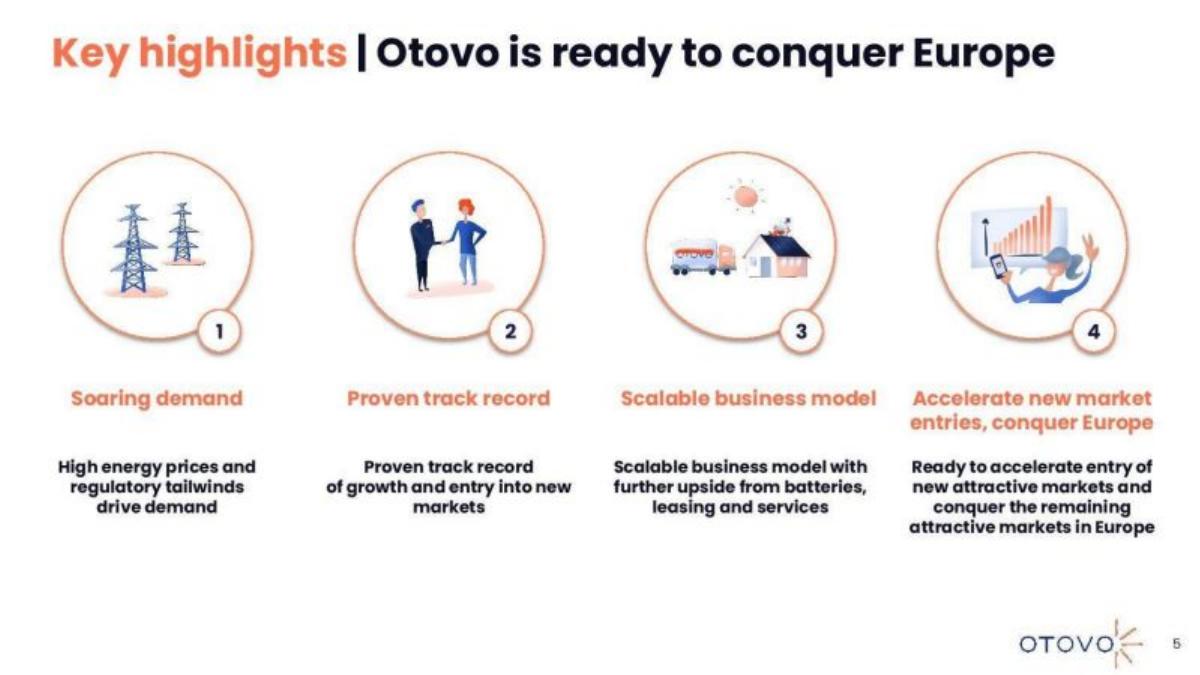
This slide serves as an executive summary, highlighting four key themes: Soaring demand, a proven track record, a scalable business model, and the plan to accelerate new market entries. It sets the stage for the deep dives that follow, ensuring the investor knows exactly which boxes the company intends to tick.
Slides 6-7: Macro Tailwinds and Demand
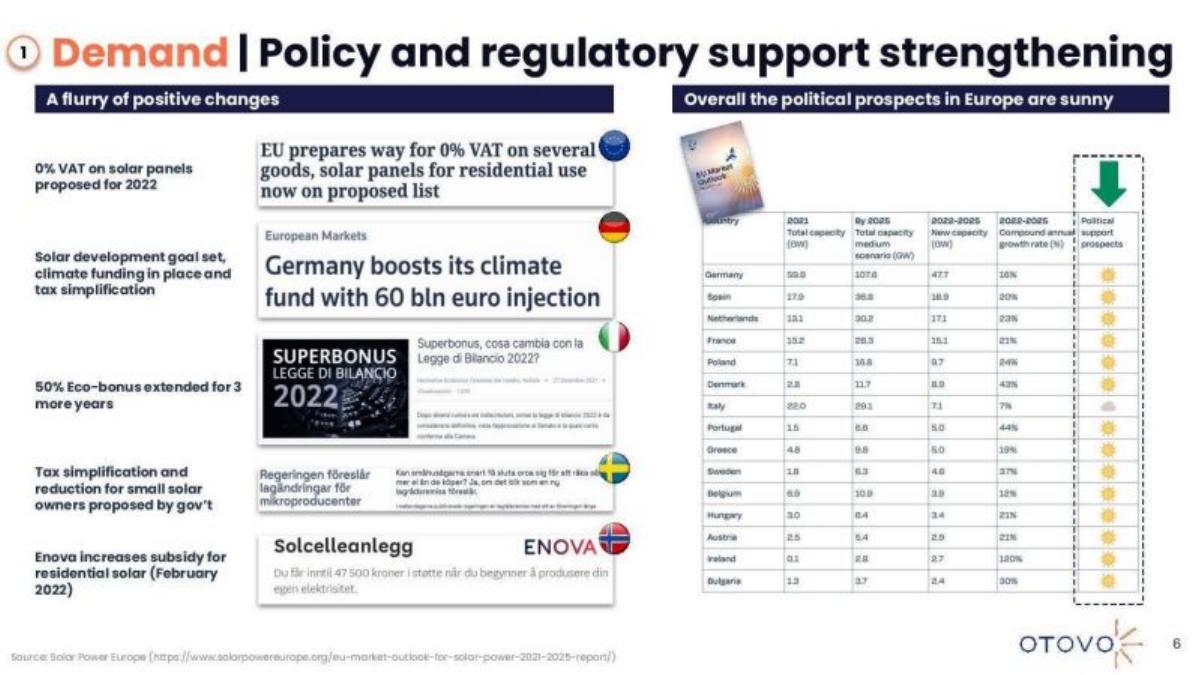
Otovo leans heavily into the external environment. Slide 6 lists "A flurry of positive changes" across Europe, such as 0% VAT in several countries, Germany's 60 billion euro climate fund, and Italy's "Superbonus." It includes a table from Solar Power Europe showing double-digit compound annual growth rates (CAGR) for solar capacity across 15+ countries. Slide 7 connects these policies to consumer reality, showing historically high power prices (e.g., 290 EUR/MWh in Sweden) and claiming that this has led to "3x consumer interest" and "Record low CAC" (Customer Acquisition Cost).
Slides 8-9: The Expansion Playbook
These are arguably the most important slides in the deck. Slide 8 shows a chronological timeline of launches: Norway ('16), Sweden ('18), France ('19), Spain ('19), Poland ('20), Italy ('21), and Germany ('21). Slide 9 then quantifies their learning curve. It shows a bar chart of the "Months from GM started until 50 projects sold." For their 6th market, it took 8 months; for Germany (their 7th), it took only 3 months. This data point is used to prove that Otovo has a repeatable, accelerating "launch playbook." It also introduces Christian Rahn as the GM for Germany, noting his background at BlaBlaCar and Lastminute.com.
Slide 10: Product Evolution and LTV
Slide 10 illustrates the "Platform advantage." It shows a staircase of value: starting with Solar, adding Batteries, moving to Subscriptions, and eventually forming a "Virtual Power Plant" (VPP). This visualizes how Otovo plans to increase the lifetime value (LTV) of a customer far beyond the initial installation.
Slides 11-12: The Road to 15+ Countries
Slide 11 quantifies the remaining opportunity, stating that ~40% of the European market remains unaddressed. They identify ~600k potential installations in "high potential" markets like the UK, Netherlands, and Belgium. Slide 12 maps out the transition from 7 countries in 2021 to 15+ countries by 2023. They list their competitive advantages as "Volume-driven hardware advantages" and "Lower cost of capital."
Slide 13: The Growth Forecast
This slide provides a clear bar chart of projected sales volume. It distinguishes between growth without additional funding and "Incremental growth facilitated by added funding." The projections are aggressive: jumping from ~5,000 sales in 2021 to a target of 80-90k sales by 2025. This is the slide that justifies the $30M raise by showing the massive delta in scale that the capital will unlock.
Slide 14-15: Profitability and Unit Economics
Slide 15 (labeled as part of section 4) breaks down the financial model. It claims that adding batteries doubles the gross profit per customer. More importantly, it highlights the "Subscription" model, which it claims increases gross profit per customer by 3-4x compared to direct sales. The slide also notes that they expect to reach "Operational break-even 2-3 years after entering new markets."
Slides 16-17: Conclusion and Contact
Slide 16 summarizes the "Outlook," reiterating the proven track record and the unique opportunity created by energy prices. Slide 17 provides contact information for CEO Andreas Thorsheim and CFO Lars Ekeland, set against a background of an actual Otovo installation. Notably, there is no dedicated team slide featuring the broader leadership or board, which is unusual for a venture round of this size.
What Works in This Deck
The Velocity Metric: Showing that the time to reach 50 sales dropped from 8 months to 3 months is a powerful way to prove operational maturity. · Clear Market Segmentation: Slide 11 does an excellent job of categorizing European markets by potential, showing that Otovo isn't just expanding blindly but targeting high-volume regions. · The "Funding Gap": Slide 13 clearly visualizes what the investor's money buys—the orange bars represent the specific growth that will not happen without this capital.
What is Missing
Team Slide: While the GM of Germany and the CEO/CFO are mentioned, there is no slide detailing the experience of the broader engineering, operations, or marketing leadership. · Competitive Landscape: The deck mentions "relative to peers" on Slide 12 but never names a single competitor or provides a feature-by-feature comparison. · Detailed Financials: While gross profit multipliers are shown, there are no absolute figures for revenue, EBITDA, or burn rate.
What Founders Should Copy
The "Playbook" Slide: If you are a geographic expansion play, you must prove that each subsequent launch is faster and cheaper than the last. Slide 9 is the gold standard for this. · Macro-to-Micro Connection: Otovo doesn't just say "energy prices are high." They show the specific EUR/MWh per country and then link it directly to their CAC and conversion rates. · Visualizing the Upsell: The staircase diagram on Slide 10 is an effective way to show how a simple product (solar) evolves into a complex, high-margin ecosystem (VPP/Subscriptions).
Frequently asked questions
- What is Otovo's core business model?
- Otovo operates as a marketplace platform for residential solar and battery installations. They do not employ installers or own hardware. Instead, they provide an e-commerce interface for homeowners to get quotes and a bidding platform for a network of over 500 local installer companies to secure projects.
- How does Otovo justify its rapid European expansion?
- The deck highlights a 'proven track record' of entering 7 countries since 2016. Crucially, it shows that their launch process is accelerating; their most recent launch in Germany reached the 50-project milestone in 3 months, significantly faster than their 6th market, which took 8 months.
- What are the primary growth drivers mentioned in the deck?
- Growth is driven by three factors: soaring energy prices across Europe (reaching up to 290 EUR/MWh in Sweden), regulatory support such as 0% VAT on solar panels, and a product expansion strategy that includes batteries and subscription-based leasing.
- What are the projected unit economics for Otovo?
- Otovo claims that adding batteries can double the gross profit per combined customer. Furthermore, moving from direct sales to a subscription model is expected to increase gross profit per customer by 3 to 4 times, helping the company reach operational break-even in new markets within 2-3 years.
- Is there a specific 'ask' or valuation in the deck?
- The deck is titled 'Equity Private Placement' and mentions that the funding will facilitate accelerated growth. While the catalogue listing notes a $30M raise, the slides themselves do not specify the exact dollar amount sought or the company's valuation.