The Our Future pitch deck is a masterclass in using platform-specific metrics to prove product-market fit in the creator economy. Spanning just 10 slides, the presentation focuses heavily on 'Our Traction' and 'Our Engagement,' using direct screenshots from YouTube and TikTok analytics to validate its claims. The company identified a specific void—the lack of business news for Gen Z—and filled it with short-form video content that outperformed legacy giants like Forbes and Bloomberg on social platforms. With 500 million views in a six-month window and a 40.4% returning viewer rate, the deck m…
Key takeaways
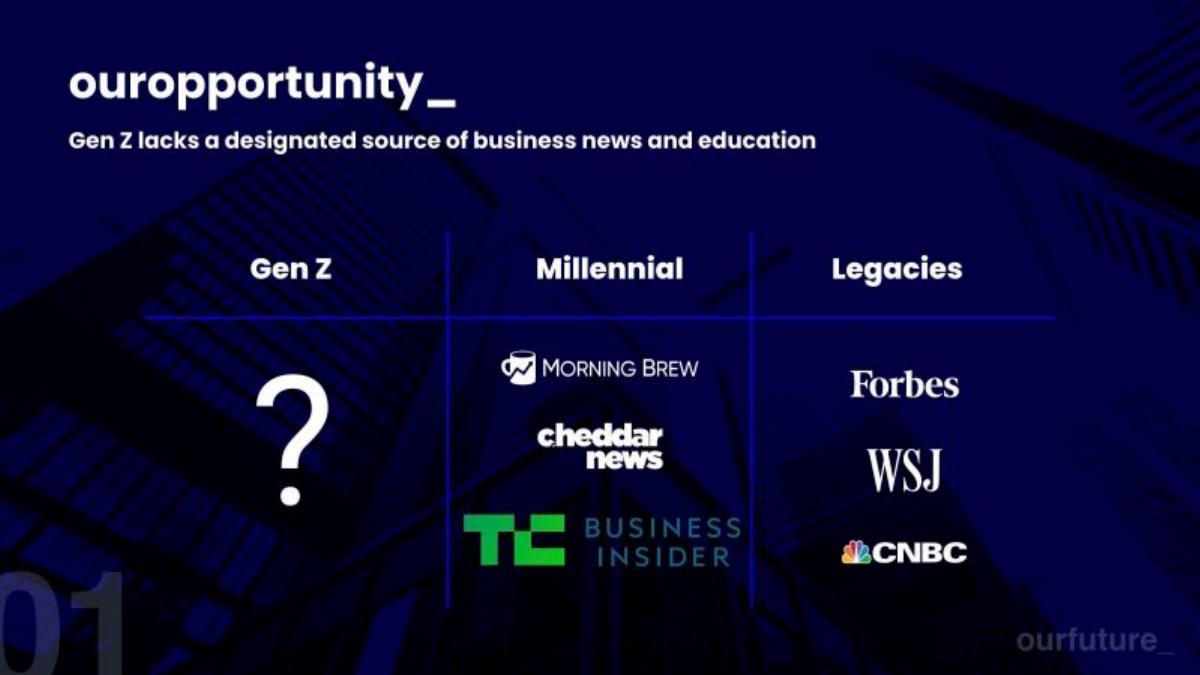
- The deck identifies a market gap where Gen Z lacks a designated source for business news compared to Millennials (Slide 1).
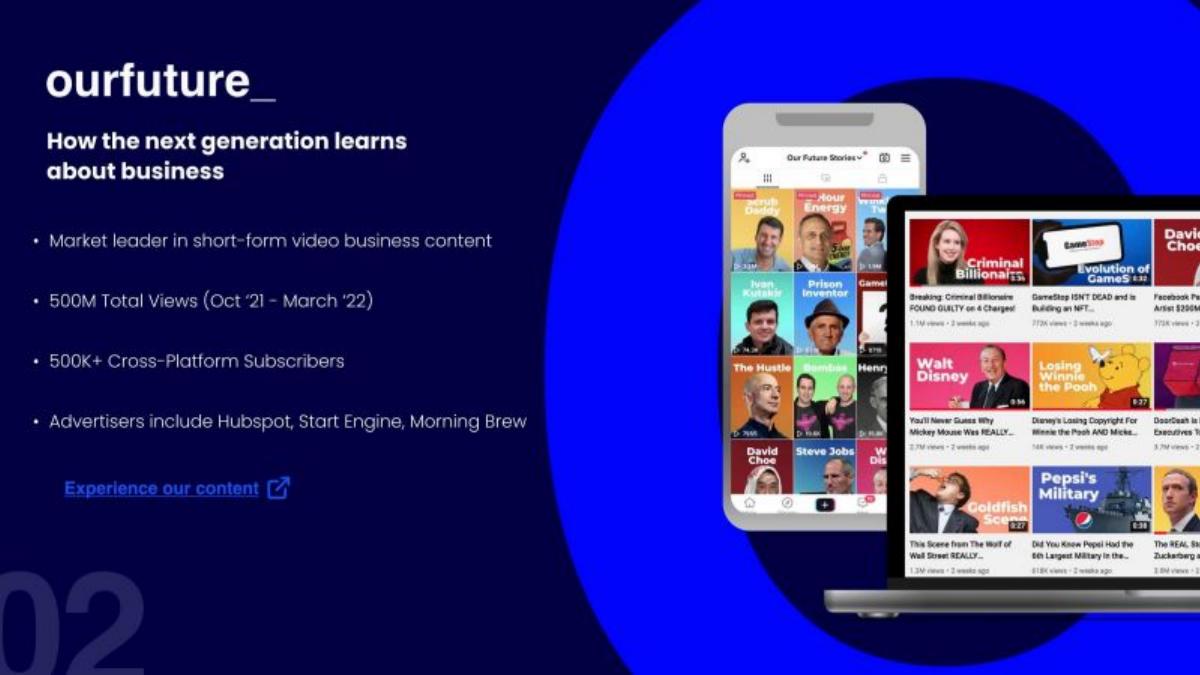
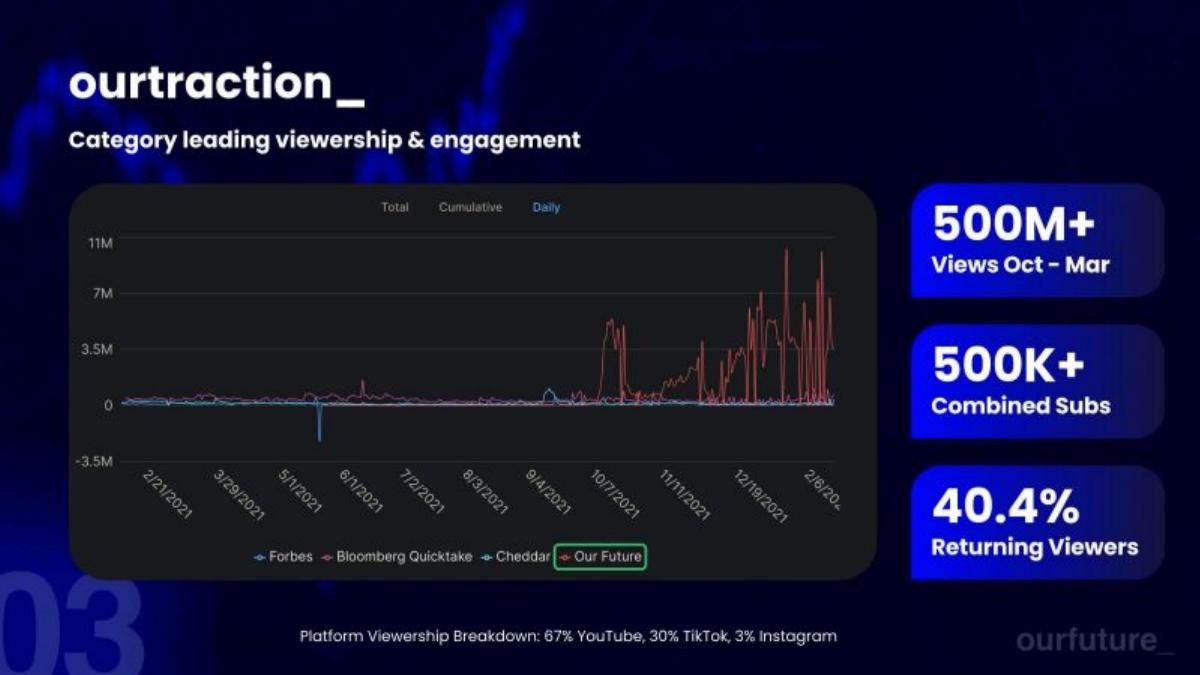
- Our Future achieved 500M+ total views between October 2021 and March 2022 (Slide 2).
- The platform viewership breakdown is heavily weighted toward YouTube at 67%, followed by TikTok at 30% (Slide 3).
- A high retention rate is a core metric, with 40.4% of viewers returning to the content (Slide 3).
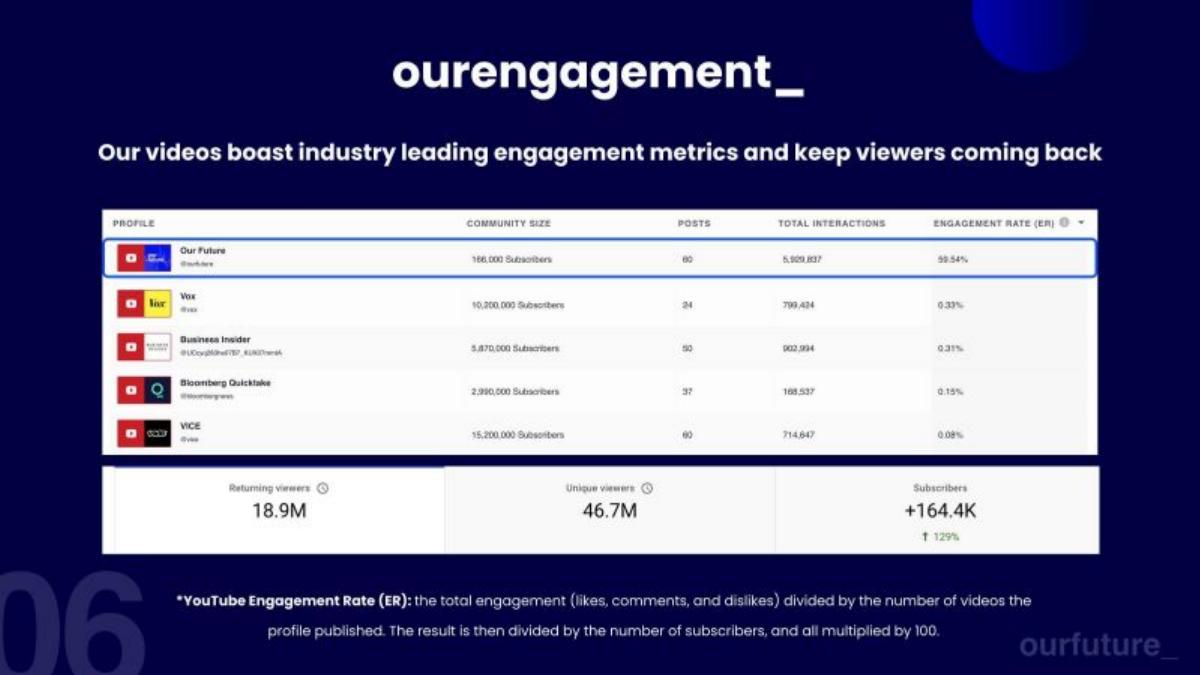
- The brand claims a 59.54% engagement rate on YouTube, significantly higher than Vox, Business Insider, or Vice (Slide 6).
- The audience is 87% male and 40% within the 18-25 age range (Slide 7).
- The business model is diversified, with 70% of revenue projected from advertising and brand sponsorships (Slide 9).
- The vision includes expanding into niche verticals like 'Our Future Crypto' and 'Our Future Real Estate' (Slide 8).
Slide-by-Slide Teardown
Slide 1: Our Opportunity
The deck opens with a classic 'gap in the market' slide. It categorizes the media landscape into three columns: Gen Z, Millennial, and Legacies. Under 'Legacies,' it lists Forbes, WSJ, and CNBC. Under 'Millennial,' it lists Morning Brew, Cheddar News, TechCrunch, and Business Insider. The 'Gen Z' column is occupied only by a large question mark. The header states: 'Gen Z lacks a designated source of business news and education.' This is a highly effective way to frame the problem for investors or acquirers who are already aware of the 'Morning Brew for X' success story.
Slide 2: Our Future
Slide 2 introduces the solution and the brand. It defines the company as 'How the next generation learns about business.' Key highlights include being a 'Market leader in short-form video business content,' 500M total views from Oct '21 to March '22, and 500K+ cross-platform subscribers. It also lists high-profile advertisers: Hubspot, Start Engine, and Morning Brew. The visual includes a smartphone and laptop mockup showing their content feed, emphasizing the 'short-form' nature of the product.
Slide 3: Our Traction
This slide provides a deep dive into viewership. A line chart compares 'Our Future' against Forbes, Bloomberg Quicktake, and Cheddar. The chart shows a massive spike in daily views for Our Future starting around October 2021, while the competitors remain relatively flat. Three call-out boxes on the right highlight 500M+ views, 500K+ combined subs, and a 40.4% returning viewer rate. At the bottom, a platform breakdown is provided: 67% YouTube, 30% TikTok, and 3% Instagram.
Slide 4: Our Traction (YouTube)
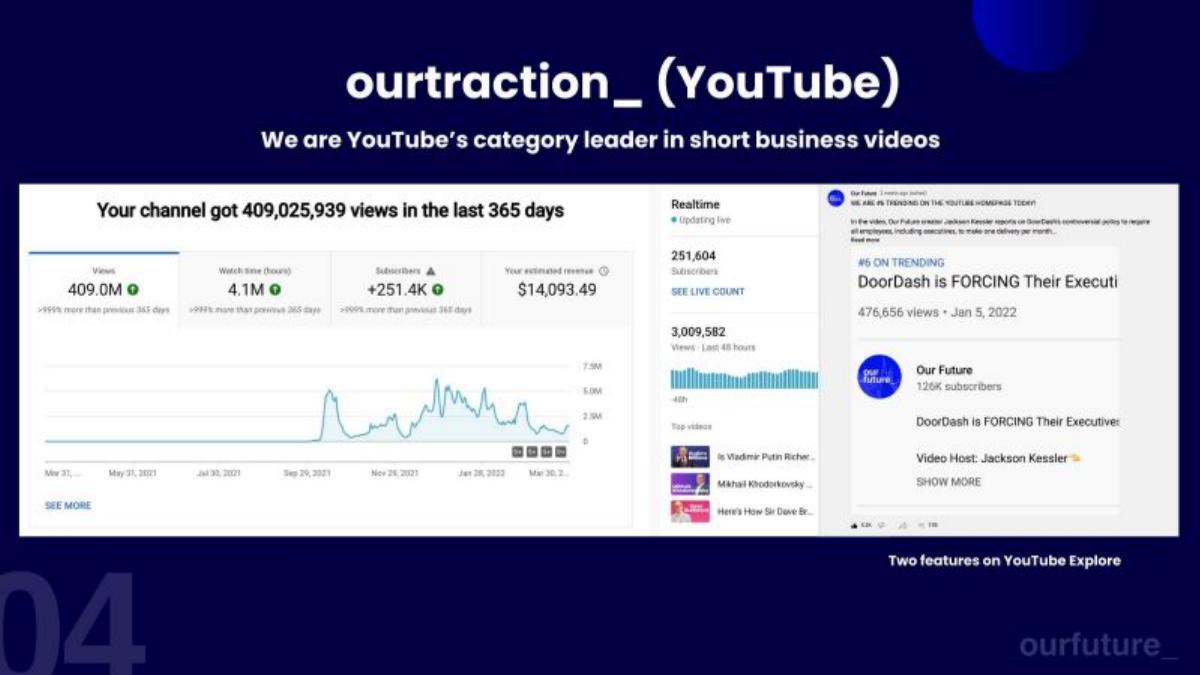
Slide 4 is a 'proof' slide, using a direct screenshot from YouTube Creator Studio. It shows 409,025,939 views in the last 365 days and an 'estimated revenue' of $14,093.49. While the revenue figure is low for the view count, it clarifies that the business is not reliant on YouTube AdSense, but rather on the reach itself. The slide also notes two features on 'YouTube Explore' and shows a video trending at #6 on the homepage.
Slide 5: Our Traction (TikTok)
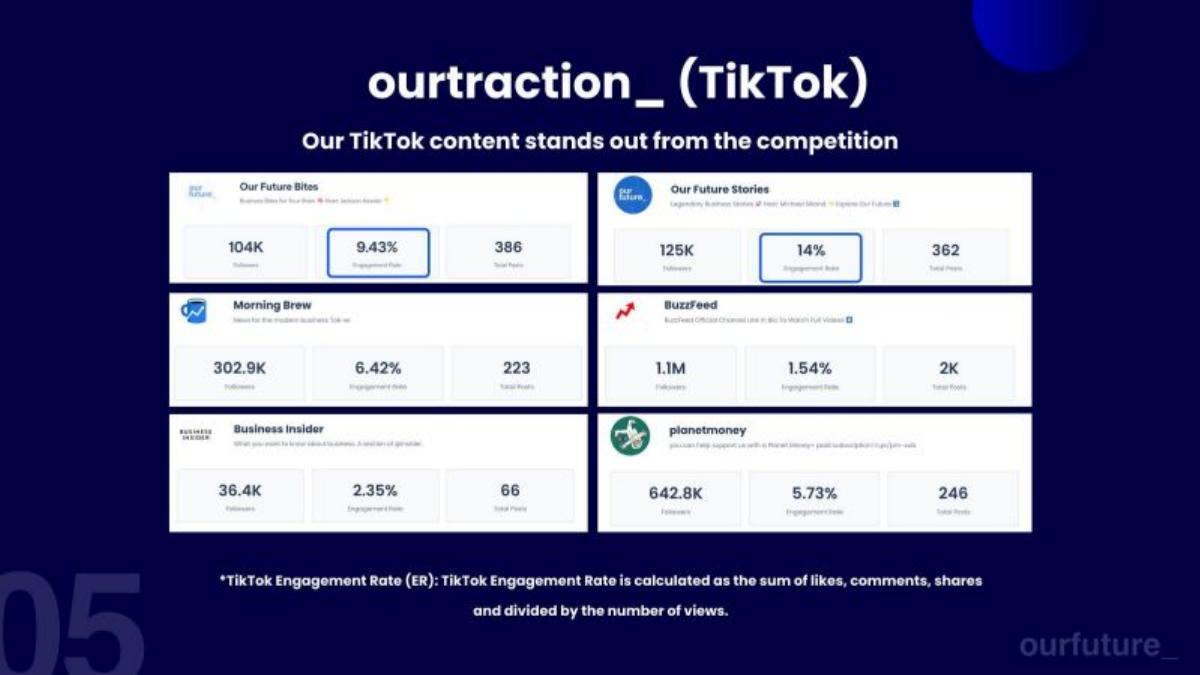
Continuing the traction theme, this slide focuses on TikTok. It compares two Our Future accounts ('Bites' and 'Stories') against Morning Brew, BuzzFeed, Business Insider, and Planet Money. The key metric here is 'Engagement Rate.' Our Future Stories is shown with a 14% engagement rate, dwarfing BuzzFeed (1.54%) and Business Insider (2.35%). A footnote explains that the rate is calculated as the sum of likes, comments, and shares divided by views.
Slide 6: Our Engagement
This slide doubles down on YouTube engagement. It presents a table comparing Our Future to Vox, Business Insider, Bloomberg Quicktake, and Vice. Despite having the smallest community size (166,000 subscribers at the time of the screenshot), Our Future claims a 59.54% engagement rate. The next closest is Vox at 0.33%. This slide is intended to show that while they are smaller in total numbers, their audience is significantly more 'locked in.'
Slide 7: Our Audience
Demographics are the focus here. The audience is 51% U.S. based, 87% male, 40% aged 18-25 (Gen Z), and 31% aged 25-34 (Millennials). This confirms the brand's ability to capture the target demographic mentioned in Slide 1, while also showing 'spillover' appeal into the Millennial market.
Slide 8: Our Vision
This slide outlines the expansion strategy. The goal is to 'replicate our success across every category to dominate business media.' It lists eight potential verticals: Stories, Bites, Crypto, Markets, Marketing, Startups, Real Estate, and Entertainment. Each is given a 'Gen Z's [Legacy Brand]' equivalent (e.g., 'Gen Z's TechCrunch'). It also identifies the current hosts, Michael Sikand and Jackson Kessler, for the first two verticals.
Slide 9: Our Business
The final content slide explains the revenue model. A pie chart shows 70% Advertising & Brand Sponsorships, 20% Licensing Deals, and 10% Subscription/Events. A logo cloud at the bottom features brands like HubSpot, Morning Brew, The Hustle, Index Ventures, and Public.com, suggesting a strong existing base of B2B partners.
Slide 10: Closing Slide
The final slide is a standard promotional slide for the platform hosting the deck, with no additional company information.
What Our Future Does Well
Platform-Native Proof: The use of raw screenshots from YouTube and TikTok analytics is incredibly effective. It removes the 'trust me' factor that often plagues media decks. By showing the actual 'Trending' status and the 'Creator Studio' dashboard, they provide undeniable proof of their reach.
Comparative Dominance: The deck consistently benchmarks Our Future against legacy giants. By showing a 59% engagement rate next to Vice's 0.08%, they make a compelling argument that the old guard is failing to connect with the new generation, creating a massive opening for a nimble, video-first brand.
Clear Market Positioning: Slide 1 is a textbook example of how to define a 'white space.' By showing that every other generation has a 'Morning Brew' equivalent except for Gen Z, they create a sense of inevitability for their business.
What is Missing
A Dedicated Team Slide: While the hosts are mentioned on Slide 8, there is no slide detailing the professional backgrounds of the founders or the production team. In a media business, the ability to produce high-quality content consistently is a 'key person' risk that investors usually want to see addressed.
Financial Depth: Slide 4 shows a very low AdSense revenue figure ($14k for 400M views). While Slide 9 explains that 70% of revenue comes from sponsorships, the deck does not provide actual revenue totals, margins, or burn rates. This suggests the deck was likely used for a high-level partnership or a strategic acquisition conversation rather than a traditional VC round.
Unit Economics: There is no mention of the cost to produce a video versus the revenue generated per video. For a media company looking to scale into eight different verticals (as seen on Slide 8), understanding the 'cost of content' is vital.
What a Founder Should Copy
The 'Engagement Over Reach' Narrative: If you are a smaller player in a crowded market, copy Slide 6. Don't just talk about how many followers you have; talk about how much more those followers care compared to the followers of your larger competitors. High engagement is often a leading indicator of future growth.
The Vertical Expansion Map: Slide 8 is a great way to show 'Room to Grow.' By mapping out how the core competency (short-form business video) can be applied to niche topics like Real Estate or Crypto, the founders show that they aren't just a 'one-hit-wonder' channel, but a potential media conglomerate.
Visual Mockups: The use of phone and laptop frames to display content (Slide 2) helps the viewer immediately understand the 'vibe' and format of the product without having to watch a single video. It grounds the abstract concept of 'media' into a tangible user experience.
Frequently asked questions
- What is the primary value proposition of Our Future?
- Our Future positions itself as the premier short-form video media brand for Gen Z business news. According to Slide 1, while Millennials have Morning Brew and Cheddar, and older generations have WSJ and Forbes, Gen Z lacked a dedicated source. Our Future fills this gap by delivering business education through high-engagement social video platforms.
- How does Our Future compare to legacy media competitors?
- The deck uses comparative data to show that Our Future outperforms legacy brands in engagement. Slide 6 shows a YouTube engagement rate of 59.54%, while legacy competitors like Bloomberg Quicktake and Vice are listed at 0.15% and 0.08% respectively. This suggests that while legacy brands have larger total subscriber counts, Our Future has a more active and loyal audience.
- What are the key demographics of their audience?
- Based on Slide 7, the audience is predominantly male (87%) and based in the U.S. (51%). The age breakdown confirms their Gen Z focus, with 40% of viewers aged 18-25. Interestingly, they also have a significant 'tertiary' audience of Millennials, with 31% of viewers in the 25-34 age bracket.
- What is the revenue model for the company?
- The company utilizes a three-pronged revenue strategy as shown on Slide 9. The majority of revenue (70%) comes from advertising and brand sponsorships. Licensing deals for co-branded content account for 20%, and the remaining 10% is projected to come from subscriptions and events, including paywalled content.
- Who are the key people mentioned in the deck?
- While the deck lacks a dedicated team slide, Slide 8 identifies Michael Sikand as the host of 'Our Future Stories' and Jackson Kessler as the host of 'Our Future Bites.' These individuals appear to be the faces of the brand, which is consistent with a creator-led media business model.