BIGcontrols raised $125,000 in 2014 with a remarkably brief 8-slide presentation. The deck is a study in minimalism, eschewing dense financial tables for high-impact visual statements. It leads with a massive regulatory failure—Apple’s $14.5 billion loss in Ireland—to immediately establish the 'hair-on-fire' problem of tax compliance. While the deck lacks a formal business model slide, unit economics, or a specific funding ask, it leverages the founders' deep institutional pedigree at firms like KPMG and EY to bridge the trust gap. By positioning themselves at the intersection of blockchain t…
Key takeaways
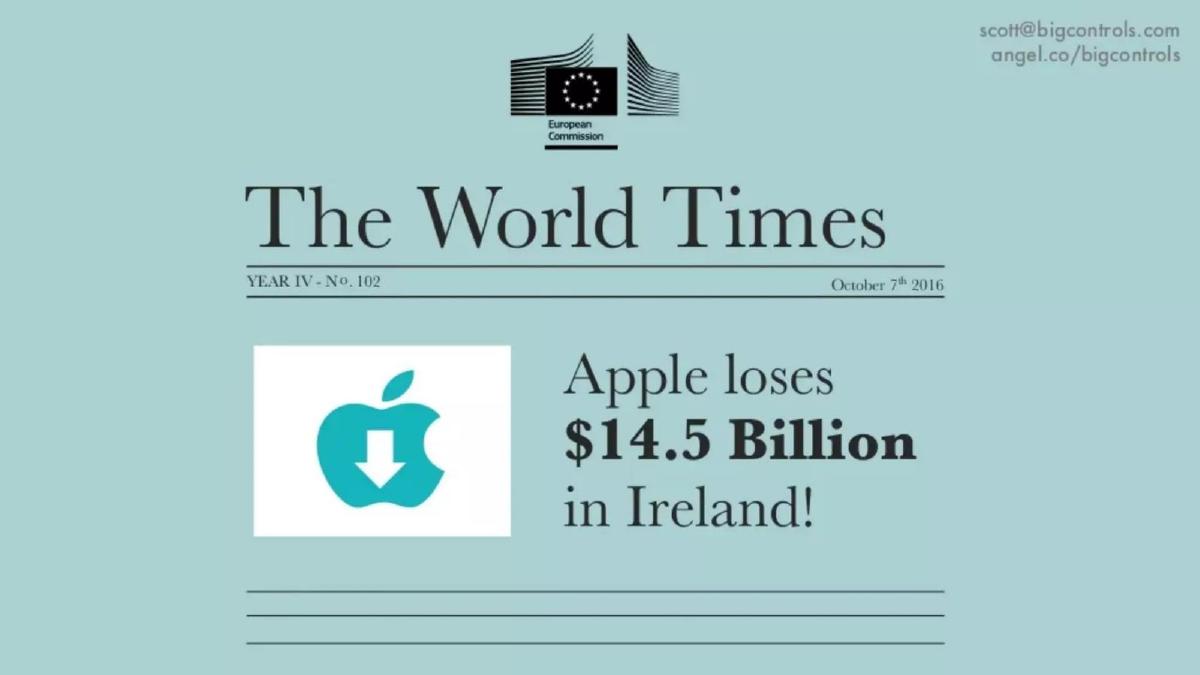
- The deck uses a high-profile news headline on slide 2 to quantify the cost of failure at $14.5 billion.
- Market size is visually represented on slide 3 as a $100 billion compliance risk exposure.
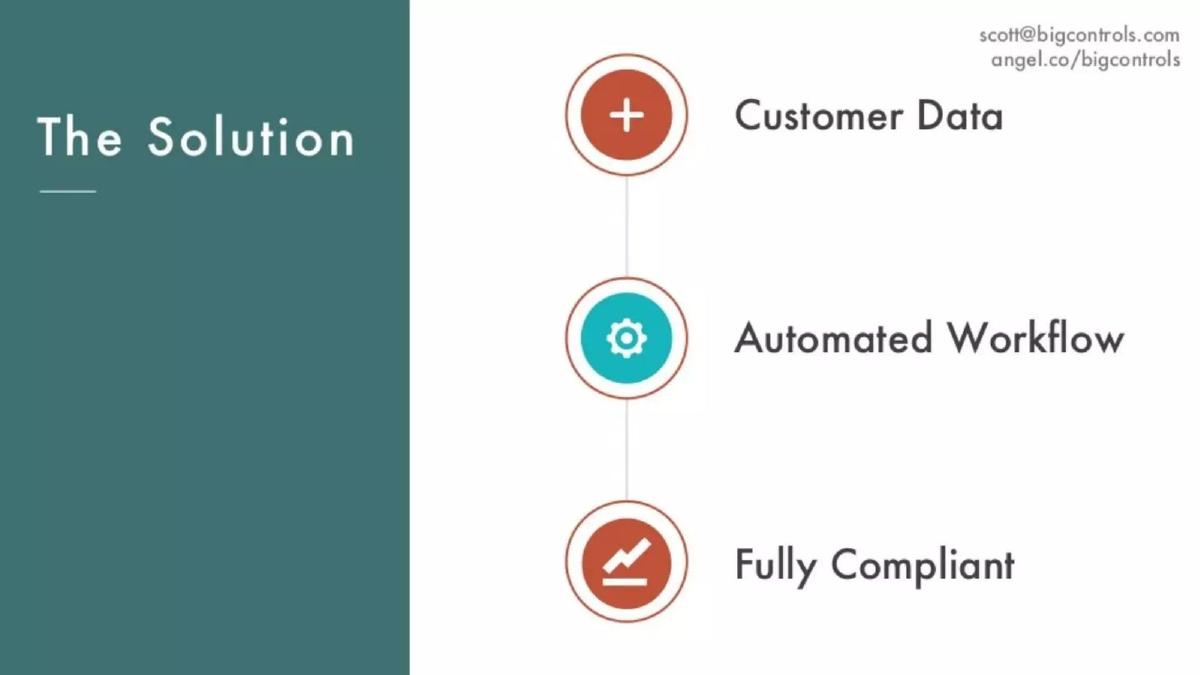
- The solution is reduced to a three-step vertical flow on slide 4: Customer Data, Automated Workflow, and Fully Compliant.
- Founder credibility is established on slide 5 through logos of Big Four accounting firms KPMG and EY.
- Slide 6 implies a strategic partnership or customer relationship with Accenture without providing specific contract details.
- Regulatory tailwinds are highlighted on slide 7 by featuring the Financial Accounting Standards Board (FASB) logo.
- The deck completely omits a business model, competition analysis, and a specific use-of-funds slide.
- Contact information, including an AngelList link, is present on every slide from 2 through 8 to facilitate immediate investor follow-up.
The 8-Slide Minimalist Approach to Enterprise Compliance
The BIGcontrols pitch deck is an exercise in extreme brevity. At only 8 slides, it bypasses the traditional 15-20 slide narrative in favor of a high-level visual summary. In 2014, when this deck was used to raise $125,000, the concept of blockchain for enterprise was still in its infancy. The founders chose to focus not on the 'how' of the technology, but on the 'how much' of the problem. By anchoring the presentation in massive figures—$14.5 billion and $100 billion—they attempt to make the need for their solution feel self-evident.
The Hook: High-Stakes Failure
Slide 1: Title Slide The deck opens with the company logo and the tagline: "Take ownership of your business incentives." It is clean and professional, using a teal and white color palette that persists throughout the deck.
Slide 2: The World Times Instead of a standard problem slide, BIGcontrols uses a mock newspaper headline: "Apple loses $14.5 Billion in Ireland!" dated October 7th, 2016. This is a powerful use of social proof and fear. By highlighting a failure by one of the world's most sophisticated companies, it implies that no corporation is safe from tax incentive compliance risks. Note: The date on this slide (2016) suggests the deck was updated after the initial 2014 seed raise mentioned in the catalogue facts, or used for subsequent bridge funding.
Quantifying the Waste
Slide 3: Compliance Risk Exposure This slide uses a graphic of a globe with a faucet leaking money into a trash can labeled "WASTE." It cites two key figures: a "$100 Billion" banner and a "50%" funnel. The visual argument is that half of the available incentives are being lost to poor management. This slide serves as the TAM (Total Addressable Market) and Problem slide combined, though it focuses more on the 'pain' than the specific market size calculation.
Slide 4: The Solution The solution is presented as a simple linear process: Customer Data + Automated Workflow = Fully Compliant. It is a high-level abstraction. There are no screenshots of the software, no dashboard previews, and no mention of blockchain on this specific slide. It sells the outcome (compliance) rather than the tool.
Credibility and Momentum
Slide 5: The Team This is arguably the strongest slide in the deck. Scott Nelson (CEO) lists logos for KPMG and EY, two of the Big Four accounting firms. For a startup selling tax compliance software, this domain expertise is critical. Martin Frid-Nielsen (CTO) lists NetObjects and Borland, providing the necessary technical balance. In a seed round, investors are betting on the team's ability to navigate a complex industry, and these logos do the heavy lifting.
Slide 6: Revenue Growth This slide is confusing. It is titled "Revenue Growth" but contains only the Accenture logo. It does not show a growth chart, ARR figures, or customer counts. It implies a relationship with Accenture—perhaps as a channel partner or a major client—but the lack of data makes the title "Revenue Growth" feel like a placeholder for a conversation rather than a factual report.
Slide 7: Regulatory Change The deck highlights the "FASB" (Financial Accounting Standards Board) logo. This points to a 'Why Now?' factor. Regulatory changes often create forced buying cycles for enterprise software. By including this, BIGcontrols signals that the market is shifting in a way that makes their automated compliance tool a necessity rather than a luxury.
Slide 8: Thank You The final slide provides the CEO's phone number and repeats the company logo. Like the rest of the deck, it is minimalist and direct.
What Works in the BIGcontrols Deck
The primary strength of this deck is its clarity of purpose . It doesn't get bogged down in the technical minutiae of smart contracts or blockchain architecture. Instead, it stays focused on the executive-level problem: losing billions of dollars due to compliance errors. The use of the Apple headline on slide 2 is a masterclass in establishing urgency. If Apple can't get it right, every CFO reading this deck will wonder if their own company is at risk.
The founder-market fit is also exceptionally well-communicated on slide 5. In the world of tax and finance, pedigree matters. By showcasing Big Four experience, the founders immediately differentiate themselves from generalist tech entrepreneurs trying to enter a highly regulated space.
What is Missing from the BIGcontrols Deck
While the minimalism is a choice, several critical components are absent that would typically be required for a larger raise:
Business Model: There is no mention of how the company makes money. Is it a SaaS subscription? A percentage of the tax incentives recovered? A per-transaction fee on the blockchain? · Competition: The deck operates in a vacuum. It does not acknowledge existing legacy systems or other startups in the space. · Product Depth: There are no UI/UX visuals. For a platform promising "actionable intelligence," seeing the interface is usually a requirement for investors to understand the value proposition. · The Ask: The deck never specifies how much money is being raised or what the milestones are for the next 18 months. · Unit Economics: There is no mention of Customer Acquisition Cost (CAC) or Lifetime Value (LTV), which are standard for Seed and Series A decks.
What a Founder Should Copy
Founders should emulate the visual hierarchy used here. Each slide has one clear message. Slide 3 is about waste; Slide 5 is about expertise; Slide 7 is about regulation. This prevents 'cognitive overload' for the investor.
Another smart move is the persistent contact info . By placing the email address and AngelList link in the top right corner of every slide (starting from slide 2), the founders make it incredibly easy for a deck that has been forwarded or shared to lead back to a direct conversation. Finally, the use of regulatory tailwinds (Slide 7) is a highly effective way to create a sense of 'Why Now?' without needing a complex timeline.
Final Summary
The BIGcontrols deck is a 'teaser' deck rather than a comprehensive investment memorandum. It is designed to provoke a meeting rather than close a deal on its own. By focusing on massive risk ($14.5B) and deep expertise (KPMG/EY), it successfully builds a narrative of a high-stakes problem being solved by the only people qualified to handle it. While it leaves many questions unanswered regarding the business model and product, its brevity ensures that the core message—compliance is broken and we can fix it—is never lost.
Frequently asked questions
- How much did BIGcontrols raise with this deck?
- According to the catalogue listing, BIGcontrols raised $125,000 in a Seed round in 2014. The deck itself does not state the amount raised or the valuation, which is common for decks intended for broad distribution or platform listings like AngelList.
- What is the core technology behind the platform?
- While the slides are visually sparse, the company description identifies it as a blockchain platform using smart contracts. The deck focuses more on the outcome—automated workflow and compliance—than the technical architecture of the permissioned blockchain.
- Who are the founders and what is their background?
- Slide 5 introduces Scott Nelson (Founder & CEO) and Martin Frid-Nielsen (CTO). Nelson brings experience from Big Four firms KPMG and EY, while Frid-Nielsen has a background with NetObjects and Borland, suggesting a mix of domain expertise and technical leadership.
- What market problem does the deck address?
- The deck addresses the 'Compliance Risk Exposure' in the tax credit and incentive space. Slide 3 claims a $100 billion exposure with a 50% waste factor, suggesting that corporations are losing significant value due to inefficient tracking and regulatory errors.
- Is there a clear call to action in the deck?
- The deck concludes on slide 8 with a 'Thank You' and direct contact information for the CEO. It lacks a specific 'Ask' slide detailing how much capital is being sought or the milestones that capital will achieve, relying instead on the AngelList link provided on every slide.