How crypto and web3 startups show a team investors can identify and trust: real names, blockchain work shipped, compliance experience and results.
Web3 Team Slide: Show Real People Who Have Shipped on the Blockchain
Crypto has had many anonymous teams and failed projects, so investors read a web3 team slide first for who the people are, then for what they have built and whether anyone understands regulation. This guide compares seven real team slides from decks tagged web3 in our library, from Sorare's two founders with a named past employer and a result each to Yuga Labs' founders shown only as ape avatars and handles.
TL;DR
Use real names, and give each person blockchain work they shipped and one result. Sorare's CEO "signed 6-figure deals" and its CTO "built and managed a 10+ blockchain engineering team", both at a named company. Glow Labs' co-CEO says she "launched a NFT project that made 1.1M+ in revenue". iReekt lists years at a crypto exchange, Transferwise, Barclays and IBM, including a compliance lead. GoGoCoin and BigControls list past employers only, Kryptomon gives first names and titles, and Yuga Labs shows pseudonymous handles and cartoon apes.
Web3 team slides from real pitch decks
Each example shows the exact stored slide above its analysis and links to the full teardown. The clearest slides come first; weaker ones follow for contrast. Claims are as shown on the slides; comments are ours.
Sorare team slide — slide 2
Fantasy football game with blockchain-based cards. Slide titled "Founding Team".
Sorare deck, slide 2. Exact stored slide matched to this analysis.
Our analysis: Short and checkable: both founders have a senior role at the same blockchain company and a specific result. The slide says nothing about football, games or collectibles, which the product also needs.
Evidence and limitation: A named past employer, a role, and one result for each founder.
What a founder can adapt: Add one line on the game or sports side, or a hire who covers it.
Supporting analysis
What the deck claims: Nicolas Julia, "CEO": "Prev. VP Operations @Stratumn", "Signed 6-figure deals, scaled operations after the $8M round". Adrien Montfort, "CTO": "Prev. VP Engineering @Stratumn", "Built and managed a 10+ blockchain engineering team".
Presentation choice: Investors in a blockchain game want founders who have built on a blockchain and grown a company.
When it does not fit: Nothing major; a very short slide works when every line counts.
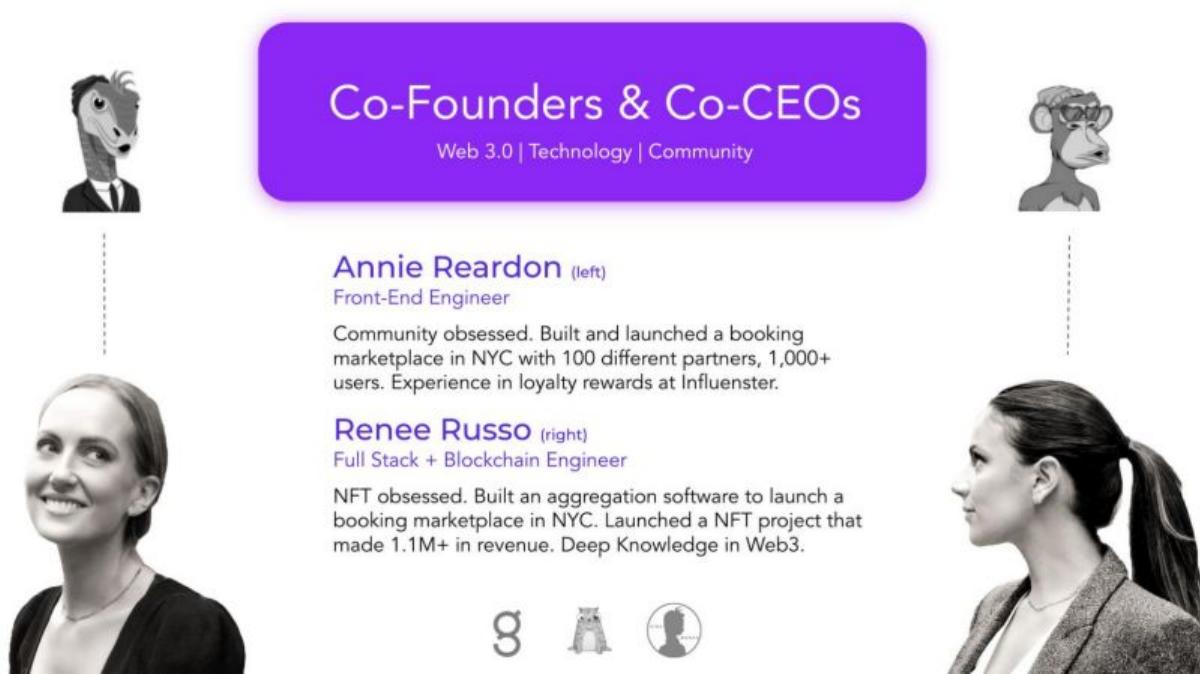
Web3 community and loyalty product. Slide titled "Co-Founders & Co-CEOs" with the subtitle "Web 3.0 | Technology | Community".
Glow Labs deck, slide 2. Exact stored slide matched to this analysis.
Our analysis: Both founders have something they built with a number attached. The NFT project isn't named, so an investor can't look up the $1.1M figure.
Evidence and limitation: Numbers for a marketplace they built and an NFT project's revenue, plus photos next to NFT avatars.
What a founder can adapt: Name the NFT project so investors can check it on the blockchain.
Supporting analysis
What the deck claims: Annie Reardon, "Front-End Engineer": "Community obsessed. Built and launched a booking marketplace in NYC with 100 different partners, 1,000+ users. Experience in loyalty rewards at Influenster." Renee Russo, "Full Stack + Blockchain Engineer": "NFT obsessed. Built an aggregation software to launch a booking marketplace in NYC. Launched a NFT project that made 1.1M+ in revenue. Deep Knowledge in Web3."
Presentation choice: In web3, a founder who has already launched a project that sold is strong proof.
When it does not fit: Words like "obsessed" taking space a fact could use.
Crypto trading platform in Spain. Slide titled "Our Team".
iReekt deck, slide 3. Exact stored slide matched to this analysis.
Our analysis: One of the few slides here with a named compliance lead, which matters for a crypto trading platform. The lines give years and job titles but no results.
Evidence and limitation: Named employers and years for each founder, including a compliance lead.
What a founder can adapt: Add one result per founder, such as what Carlos did at AvatarBTC.
Supporting analysis
What the deck claims: Carlos Vicioso, "Founder & Product Lead": "+9 Years as a cryptocurrency consultant & Bitcoin daytrader. Former employee of the first cryptoexchange in Spain (AvatarBTC)." Diego Rubio, "Founder & Compliance Lead": "+25 Years as Counselor of Law. +10 Years in Compliance department. +2 Years Transferwise." Juan V. Maillo, "Founder & CTO": "1 Year Barclays – Unix Administrator. +4 Years IBM – Systems administrator & Data center operator." Juan Pablo Chullo, "Founder & Frontend Lead": web developer roles at named companies.
Presentation choice: Crypto trading is regulated in most places, so investors look for someone who knows compliance.
When it does not fit: Years and titles with no outcome.
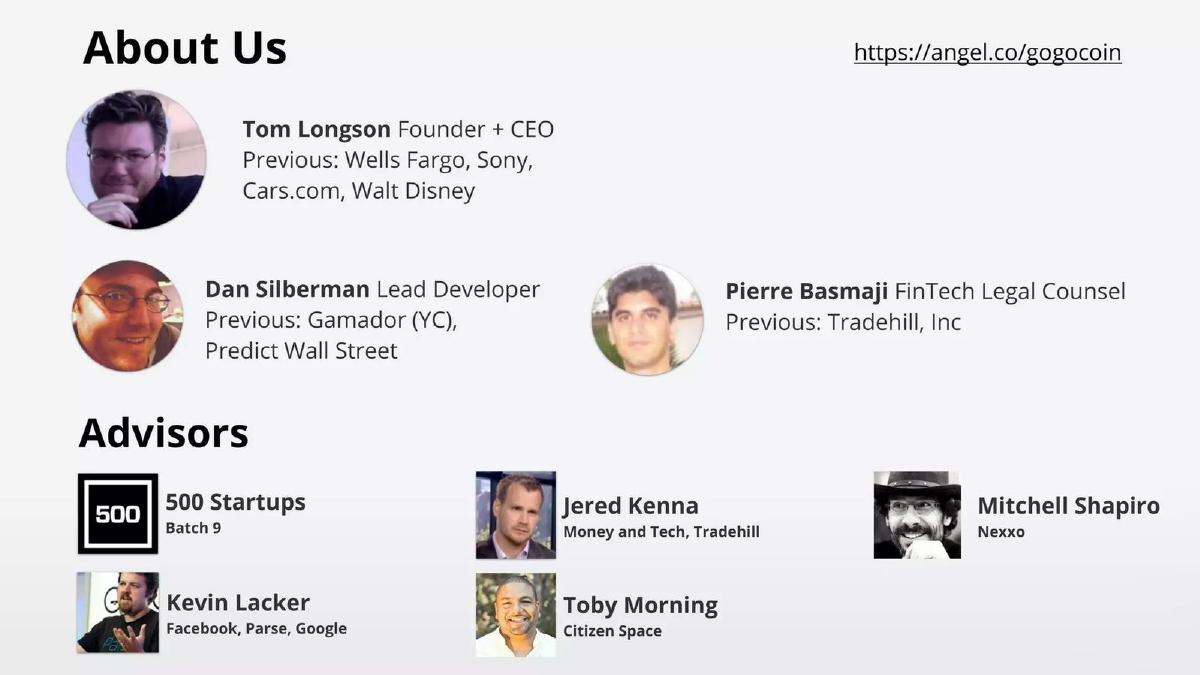
GoGoCoin deck, slide 2. Exact stored slide matched to this analysis.
Our analysis: It covers payments, engineering and legal. The lines are employer lists without roles or results, so an investor can't tell what anyone did at Wells Fargo or Tradehill.
Evidence and limitation: Named past employers, a legal counsel from a named Bitcoin exchange, and named advisers.
What a founder can adapt: Add each person's role and one result at their most relevant employer.
Supporting analysis
What the deck claims: Tom Longson, "Founder + CEO": "Previous: Wells Fargo, Sony, Cars.com, Walt Disney". Dan Silberman, "Lead Developer": "Previous: Gamador (YC), Predict Wall Street". Pierre Basmaji, "FinTech Legal Counsel": "Previous: Tradehill, Inc". Advisors: "500 Startups Batch 9", Jered Kenna ("Money and Tech, Tradehill"), Mitchell Shapiro ("Nexxo"), Kevin Lacker ("Facebook, Parse, Google"), Toby Morning ("Citizen Space").
Presentation choice: Payments investors look for someone who has handled money movement and regulation.
When it does not fit: Lists of well-known employers with no role.
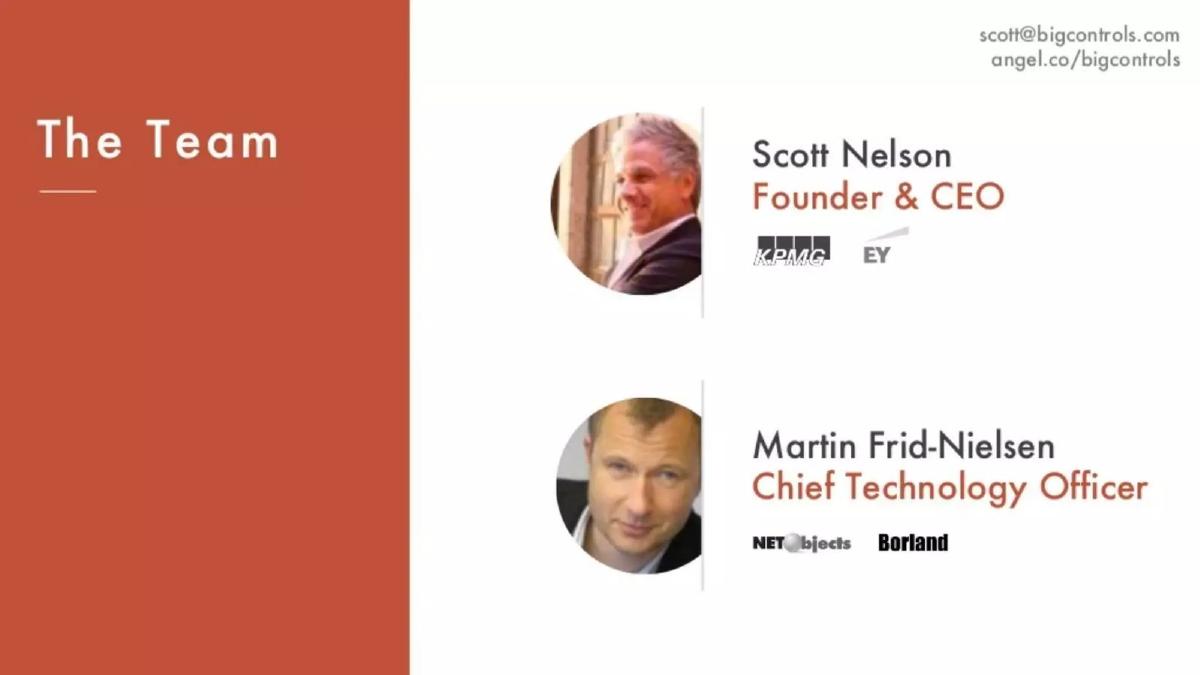
BigControls deck, slide 5. Exact stored slide matched to this analysis.
Our analysis: Clean and readable, but the logos carry all the claims. An investor can't tell what either person did at those companies or what they have built.
Evidence and limitation: Names, titles and past employer logos.
What a founder can adapt: Add a line under each logo saying the role and one result.
Supporting analysis
What the deck claims: Scott Nelson, "Founder & CEO", with KPMG and EY logos. Martin Frid-Nielsen, "Chief Technology Officer", with NetObjects and Borland logos.
Presentation choice: Logos alone don't show what someone can build.
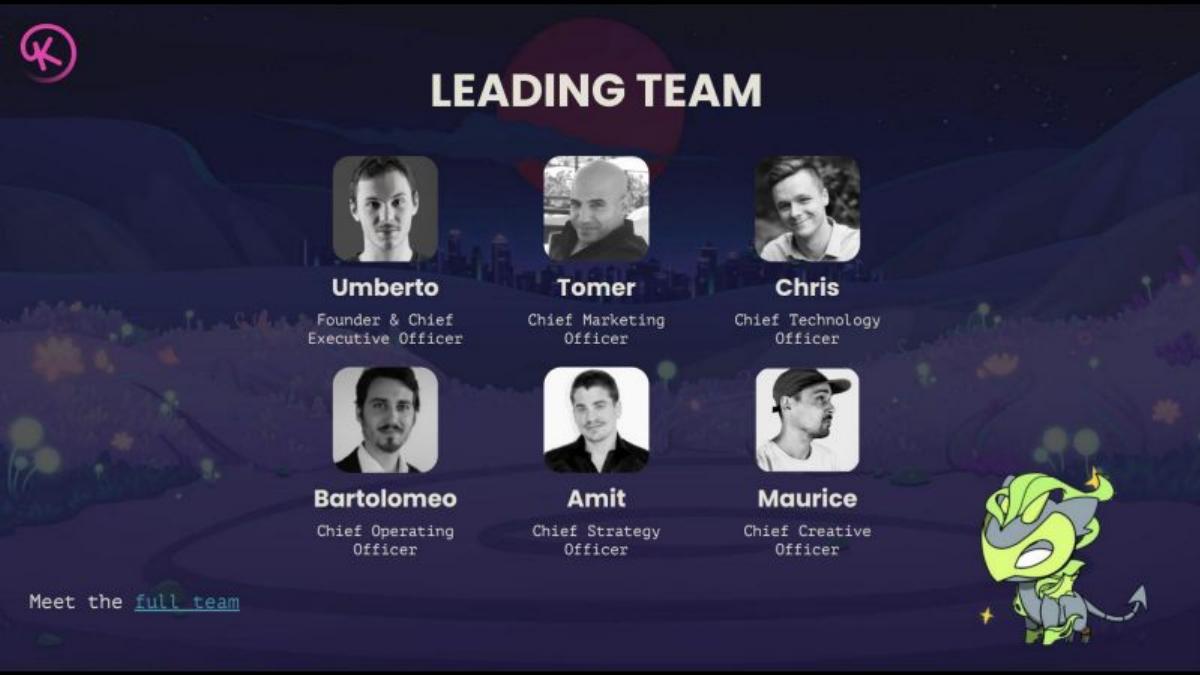
Kryptomon deck, slide 6. Exact stored slide matched to this analysis.
Our analysis: The roles cover a game company, and faces are shown. With no surnames or past work, an investor can't check anyone.
Evidence and limitation: First names and titles only.
What a founder can adapt: Add surnames and one past game or blockchain project each.
Supporting analysis
What the deck claims: Six photos with first names and titles: Umberto, "Founder & Chief Executive Officer"; Tomer, "Chief Marketing Officer"; Chris, "Chief Technology Officer"; Bartolomeo, "Chief Operating Officer"; Amit, "Chief Strategy Officer"; Maurice, "Chief Creative Officer". A link: "Meet the full team".
Presentation choice: Six chiefs with no background raises questions rather than answering them.
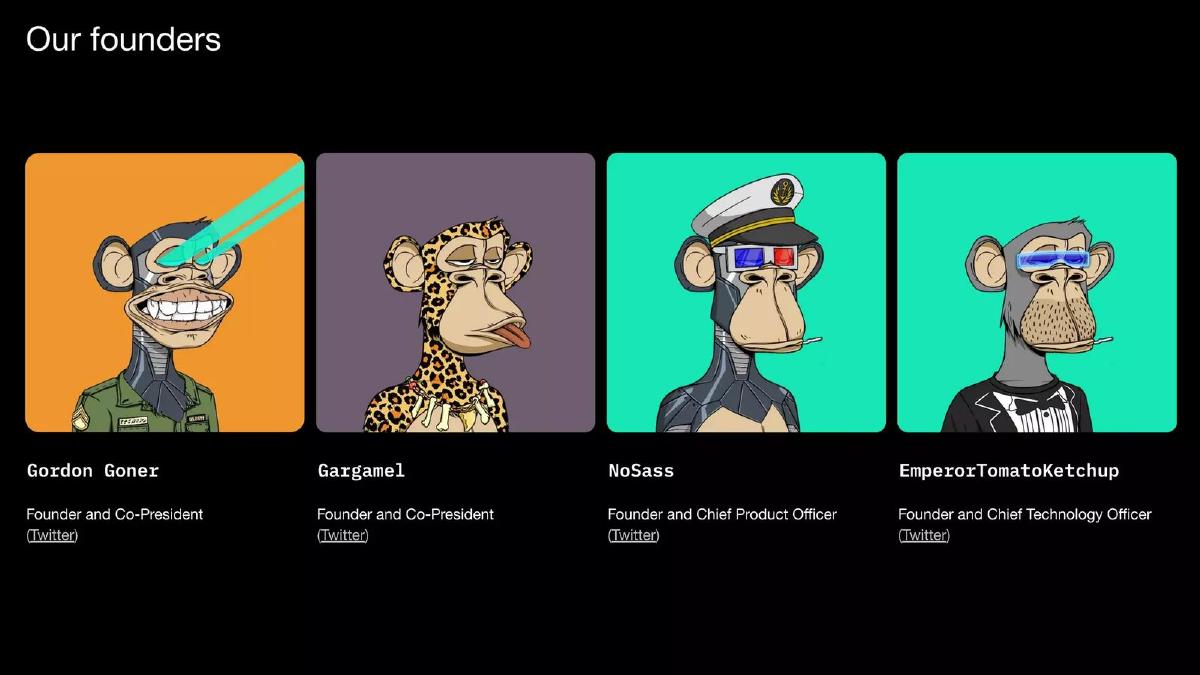
Yuga Labs deck, slide 6. Exact stored slide matched to this analysis.
Our analysis: Handles fit the brand, and the same deck's next slide names its operating executives. On this slide alone, an investor can't tell who the founders are or what they have done.
Evidence and limitation: Pseudonymous handles, titles and social media links.
What a founder can adapt: If founders use handles publicly, still give investors real names and backgrounds.
Supporting analysis
What the deck claims: Four ape avatars with handles and titles: Gordon Goner, "Founder and Co-President"; Gargamel, "Founder and Co-President"; NoSass, "Founder and Chief Product Officer"; EmperorTomatoKetchup, "Founder and Chief Technology Officer". Each has a "(Twitter)" link.
Presentation choice: Pseudonymous founders can raise money when the product is already famous; most teams can't rely on that.
When it does not fit: Avatars and handles as the only information.
Whether an investor can identify the people, see blockchain or compliance experience, and check a result.
Example
Business
Real names
Blockchain or compliance
Result
Sorare
Blockchain football game
Yes
Blockchain company roles
6-figure deals, 10+ engineers
Glow Labs
Web3 community
Yes
NFT project
$1.1M+ NFT revenue (unnamed)
iReekt
Crypto trading
Yes
Crypto exchange, compliance lead
Not stated
GoGoCoin
Bitcoin payments
Yes
Bitcoin exchange legal counsel
Not stated
BigControls
Web3
Yes
Not stated
Not stated
Kryptomon
NFT game
First names
Not stated
Not stated
Yuga Labs
NFT collections
Handles only
Not stated
Not stated
Key Takeaways
Show full, real names; investors will check who is behind the project.
Give each person blockchain work they shipped, with a result.
Name who handles compliance or legal.
Say what each person did at each past employer.
Keep avatars and handles as extras, not instead of names.
Build your web3 team slide
Show who the people are, what they have built on a blockchain, and who handles regulation.
Names. Does every person have a full, real name?
Built. What blockchain product, token or contract has each person shipped?
Result. What users, revenue, volume or team size can each person point to?
Compliance. Who handles legal and regulation, and where did they do it before?
Checkable. Can an investor look up each project or contract you mention?
Copyable framework: Headline: [what the team has built on a blockchain]. [Name], CEO: [company or project], [result]. [Name], CTO: [contracts or chain work], [scale]. [Name], Compliance: [past role], [licences or regions].
Illustrative example 1 — written by us
Before: Launched a NFT project that made 1.1M+ in revenue.
After: Launched [project name] on [chain] in [year]: $1.1M+ in primary sales.
What improved: Our illustrative rewrite; the bracketed details are placeholders, not Glow Labs' facts. Naming the project lets investors check it.
What this guide adds
The general team slide guide covers any company. Web3 adds token launches, smart contract security and regulation, and a history of anonymous founders, so investors look first for identifiable people and then for blockchain or compliance experience.
Our library's web3 tag covers NFT games, exchanges, crypto payments, NFT collections and token projects. We note each company's business in the examples.
How we read each slide
We quote the text on the stored slide images. We have not checked any employer, revenue, team size or experience claim.
Common mistakes
Handles instead of names. Give investors real names, even if you use handles publicly.
First names only. Add surnames so people can be checked.
No compliance lead. Show who knows the rules for tokens, trading or payments.
Unnamed projects. Name the project behind a revenue figure.
Logos without roles. Say what each person did at each company.
Diagnostic checklist
Full, real names.
Blockchain work each person shipped.
One result per person.
A named compliance or legal lead.
Projects and past roles investors can look up.
Frequently asked questions
What should a web3 startup's team slide show?
Real names, blockchain work each person has shipped, and who handles compliance. Sorare gives each founder a named past employer and a result.
Can founders stay pseudonymous?
Publicly, some do, but investors will still ask who they are. Yuga Labs' founders slide shows only handles and avatars.
Do we need a compliance person on the team slide?
For trading, payments or tokens it helps. iReekt names a founder with 10+ years in compliance and time at Transferwise.
How we chose these examples
Corpus: published pitch deck teardowns on StartupFundraising.com. Founder-uploaded private decks are excluded.
Selection (2026-09-27): we searched extracted slide text in decks tagged web3 for team, founders, leadership or management together with CEO, CTO, chief, former, previously or years. About 30 slides matched; we reviewed those with stored images and not used elsewhere.
Kept seven. Left out: Binance p4 (already used in the fintech team guide), Twilight Coin p2 and Etherisc p7 (decks already used in the web3 product guide), Good Gaming p5 (names and titles only, like Kryptomon), and slides whose text matched but showed products, problems, funds or company overviews (Binance, FTX p2, GTX, Lithium, MetaProps, MoneyBridge, TBD, Circle). FTX p10, Lithium p12, Yuga Labs p7 and Carbon Block p7 team slides have no stored image. No uploads were requested.
Review: stored slide text and images were checked on 2026-09-27 and matched to company, deck and slide number (editorial model review). No person has yet completed an editorial review of this page.
Claims are as shown on the slides; we have not verified them. We make no claim that any slide caused a fundraising outcome.