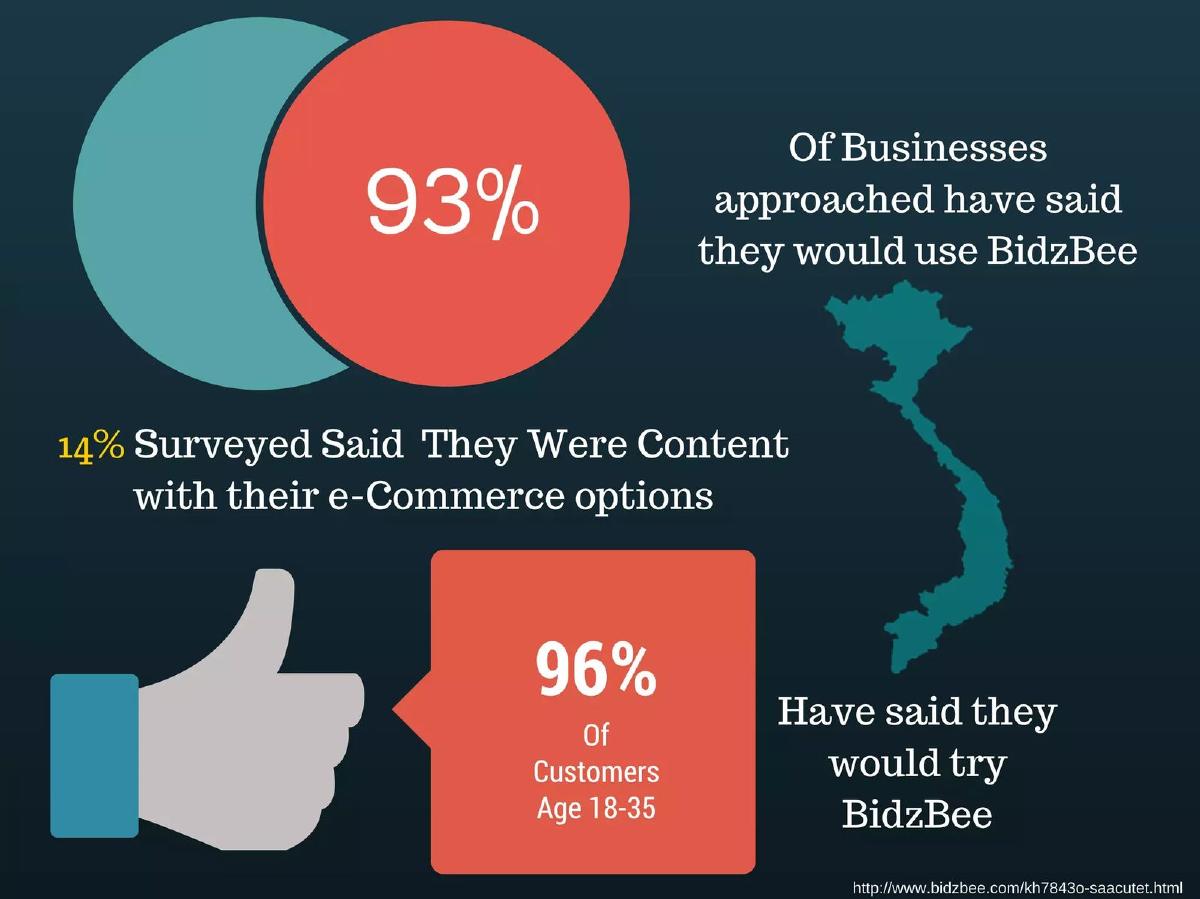
BidzBee is a mobile-first auction platform designed for the Vietnamese market, aiming to professionalize the informal commerce currently happening in large Facebook groups. The deck highlights a significant opportunity, citing over 150,000 active members in specific Facebook auction groups who lack a proper platform. With a revenue model based on a 10% commission and a $0.14 fee per item, the company projects a $205,000 revenue opportunity from just a 0.1% capture of the $205 million niche market. The deck emphasizes early validation, including surveys where 99% of participants approved their…
Key takeaways
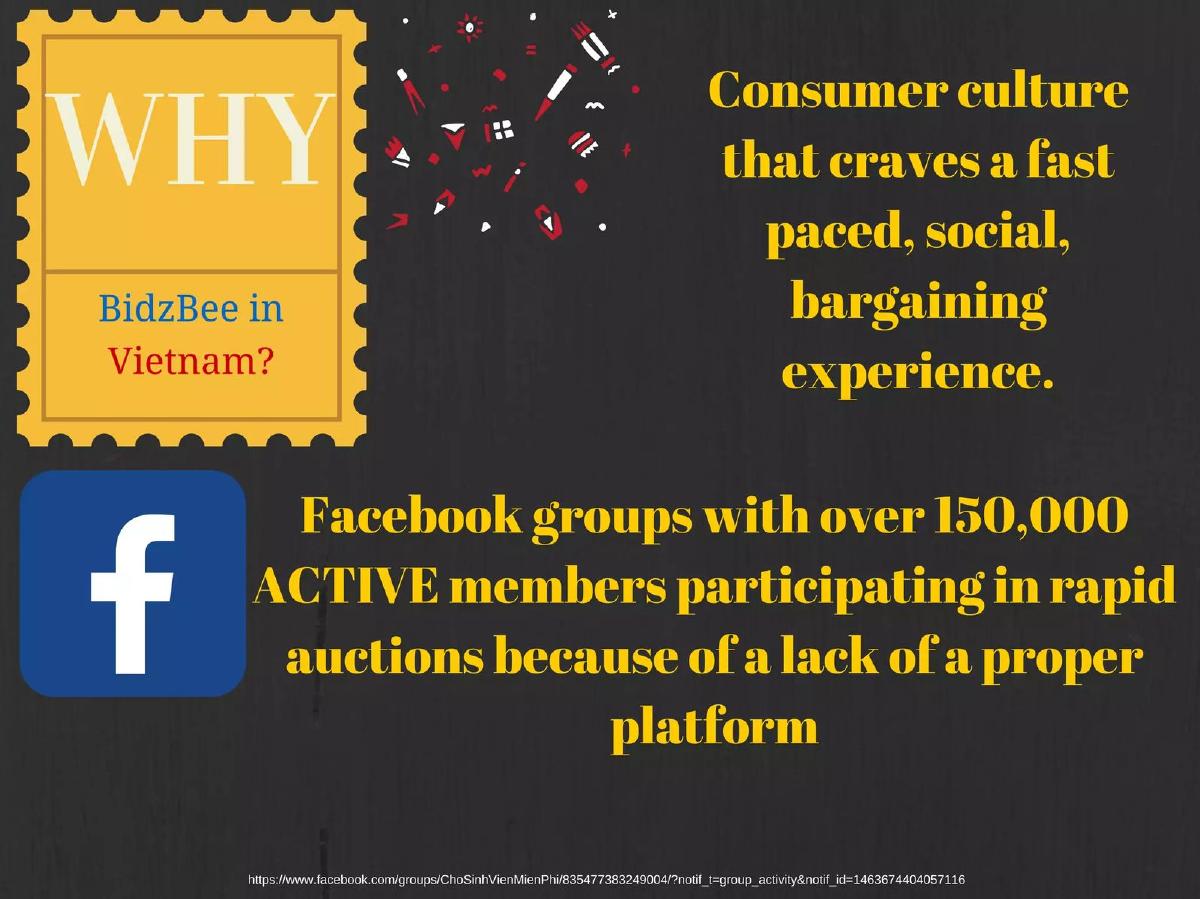
- The platform targets a specific cultural craving in Vietnam for fast-paced, social bargaining experiences (Slide 3).
- Validation is drawn from existing Facebook groups with over 150,000 active members participating in rapid auctions without a dedicated tool (Slide 3).
- Market sizing estimates the BidzBee niche at $3.5 billion for all of Vietnam and $1.3 billion for Saigon alone, based on 2014 government data (Slide 5).
- The revenue model utilizes a two-pronged approach: a 10% commission plus a $0.14 fee per item (Slide 5).
- User acquisition strategy involves 'piggybacking' on existing networks and aggressively targeting Facebook group admins (Slide 6).
- The founders have invested a total of $500 USD to date, covering market research, web mock-ups, and tech builds (Slide 7).
- The team includes a local market expert, a sales/management lead with AT&T experience, and a full-stack developer (Slide 8).
- The deck omits a specific funding ask, though it outlines a timeline for an Alpha launch and first revenue in Q3 2016 (Slide 7).
BidzBee Pitch Deck Analysis
BidzBee presents a classic 'unbundling' play, attempting to take a high-volume activity occurring on a general social network (Facebook) and move it to a purpose-built vertical platform. The deck focuses heavily on the unique cultural dynamics of the Vietnamese market, specifically the appetite for social bargaining and the rapid growth of mobile commerce.
Slide 1: Title Slide
The cover slide establishes the geographic focus and the core value proposition immediately: 'Vietnam's Explosive Mobile Market Meets BidzBee.' The subtitle, 'Modern Auctions in a Mobile World,' positions the company as a contemporary solution to an existing market need. The branding is high-contrast yellow and black, which is consistent throughout the deck.
Slide 2: The Problem
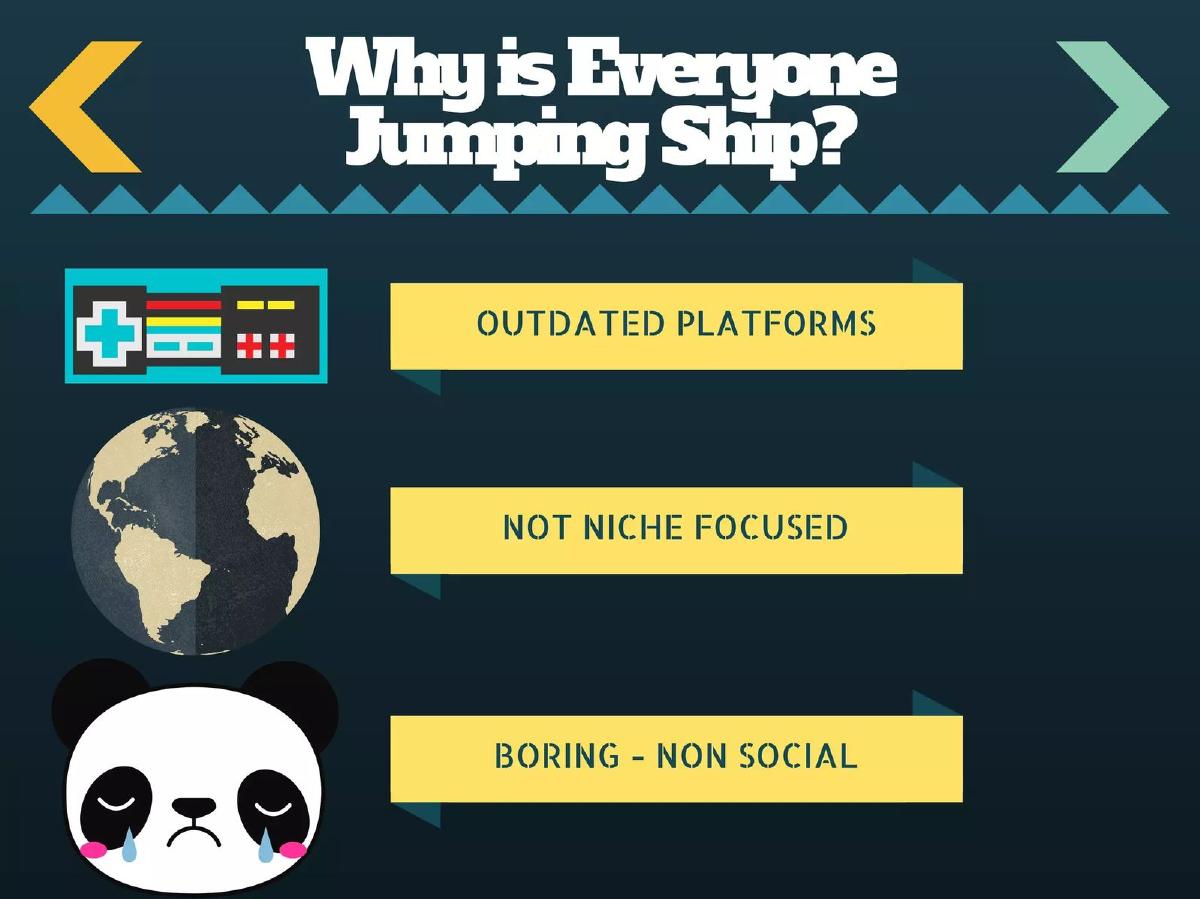
Slide 2 uses a 'Why is Everyone Jumping Ship?' headline to identify three pain points: 'Outdated Platforms,' 'Not Niche Focused,' and 'Boring - Non Social.' The use of a crying panda and a retro game controller suggests that current solutions are either emotionally unappealing or technologically obsolete. This slide sets the stage for a solution that is modern, targeted, and engaging.
Slide 3: The Opportunity and 'Why Vietnam?'
This slide provides the most compelling evidence for the startup's existence. It cites a 'Consumer culture that craves a fast paced, social, bargaining experience.' More importantly, it points to a specific, measurable behavior: 'Facebook groups with over 150,000 ACTIVE members participating in rapid auctions because of a lack of a proper platform.' This is a strong signal of product-market fit before the product even fully exists, as it proves that the behavior is already happening at scale.
Slide 4: The Product Mock-up
Under the heading 'Why not give them this?', Slide 4 shows a grid-based web or mobile interface. The UI displays various consumer goods—handbags, cosmetics, electronics—with clear 'BID' buttons, current bid prices in Vietnamese Đồng (₫), and percentage discounts (e.g., '90% OFF'). The interface includes social elements like 'Reminders' and a user profile, mimicking a standard e-commerce experience but optimized for bidding.
Slide 5: Market Sizing and Revenue Model
Slide 5 breaks down the TAM (Total Addressable Market) and the revenue model. Citing 'moit.gov.vn 2014,' the deck claims a $3.5 billion market for the 'BidzBee Niche' in Vietnam and $1.3 billion in Saigon. The revenue math is presented clearly: a 10% commission plus a $0.14 fee per item. They project that a 0.1% capture of this niche market would yield $205,000. A key validation point mentioned here is that the 'Commission and Fee Rate' was 'Approved by 99% of people Surveyed.'
Slide 6: Acquisition Strategy
The 'Stage 1 Acquisition' slide outlines three pillars for growth: 1) 'Aggressively target current groups and their admins' (referring to the Facebook groups mentioned earlier), 2) 'Direct marketing at every major and minor event,' and 3) 'Piggy Back awareness through our massive Network.' While 'massive Network' is not defined, the focus on converting existing Facebook group users is a logical and low-cost starting point.
Slide 7: Traction and Roadmap
This slide provides a chronological look at the company's progress from March 2016 through Q3 2016. It shows a lean operation, with a 'Total Investment to Date: $500 USD.' Key milestones include attending the '1337 pre-accelerator in Saigon,' contacting 150+ vendors, and polling 100+ customers. The roadmap culminates in an 'Alpha Launch in June' and 'First revenue to come in' during Q3 2016. The slide ends with a question mark next to 'Traction?', acknowledging that they are in the very early stages of proving the model.
Slide 8: The Team
The team slide features three individuals. Phuong Nguyen Braccia is listed as the 'Local Market Expert' with a TripAdvisor logo. Christopher Braccia is responsible for 'Execution, Sales, Management' and displays logos for AT&T and U-verse. Hieu Tran is the 'Full Stack Developer' with logos for Apple, Android, and Windows. This suggests a balance of local market knowledge, corporate sales experience, and technical ability.
Slide 9: Contact and Sources
The final slide provides contact information and a list of sources for their market data, including Saigoneer, Statista, and various Vietnamese government portals (vecita.gov.vn, moit.gov.vn). This adds a layer of credibility to the figures presented in Slide 5.
What BidzBee Does Well
Identifying Existing Behavior: The strongest part of this deck is Slide 3. By identifying 150,000 people already performing the core activity (auctions) on a suboptimal platform (Facebook), the founders prove there is a 'hair on fire' problem. · Lean Validation: The traction slide shows that the founders did a significant amount of legwork—surveys, vendor outreach, and accelerator participation—on a very small budget ($500). This demonstrates capital efficiency and a commitment to market research. · Clear Revenue Model: Many early-stage decks are vague about how they will make money. BidzBee is explicit about their commission and per-item fee, and they even claim to have validated these prices with potential users.
What is Missing from the Deck
The Ask: The deck never explicitly states how much money the company is looking to raise or what the specific terms of the round are. · Competitive Landscape: While they mention 'outdated platforms,' they don't name specific competitors or explain how they will defend against Facebook simply adding better auction tools to their own Groups feature. · Unit Economics: There is no mention of the cost to acquire a customer (CAC) or the lifetime value (LTV). While it may be early for these metrics, some estimates based on their 'Stage 1 Acquisition' plan would be helpful. · Financial Projections: The deck calculates a revenue potential based on a 0.1% market share but does not provide a multi-year forecast showing expenses, burn rate, or profitability timelines.
Founder Takeaways
Focus on 'Shadow Markets' Founders should look for 'shadow markets'—large groups of people using general tools (like Facebook, WhatsApp, or Excel) to perform specific commercial tasks. If you can show that 150,000 people are struggling to do something on a platform not built for it, you have a compelling case for a vertical solution.
Validate Pricing Early BidzBee's claim that 99% of surveyed users approved their fee structure is a powerful data point. Even if the survey sample was small (100 people), it shows a willingness to pay that reduces a major risk for investors.
Show the Work The traction slide (Slide 7) is a great example of how to show progress when you don't have significant revenue or user numbers yet. Listing the number of vendors contacted, customers polled, and specific accelerator milestones shows momentum and a disciplined approach to building a business.
Frequently asked questions
- What is the primary problem BidzBee is solving?
- BidzBee addresses the lack of a dedicated, social, and mobile-optimized auction platform in Vietnam. Currently, users rely on 'outdated platforms' or informal Facebook groups that lack proper auction tools, despite having hundreds of thousands of active members. The company aims to provide a fast-paced, niche-focused, and social bargaining experience that aligns with local consumer culture.
- How does BidzBee plan to generate revenue?
- The revenue model is based on two streams: a 10% commission on sales and a flat $0.14 fee per item listed or sold. According to the deck, this fee structure was 'approved by 99% of people surveyed.' They calculate that capturing just 0.1% of their identified niche market would result in $205,000 in revenue.
- What traction has the company achieved so far?
- As of the deck's creation, the company had completed the 1337 pre-accelerator in Saigon, contacted over 150 vendors, and polled over 100 customers. They invested $500 of their own capital into market research and a prototype build. The roadmap indicated an Alpha launch scheduled for June 2016, with revenue expected to follow in Q3 2016.
- Who are the key members of the founding team?
- The team consists of Phuong Nguyen Braccia, designated as the Local Market Expert with ties to TripAdvisor; Christopher Braccia, who handles execution, sales, and management with a background at AT&T U-verse; and Hieu Tran, a Full Stack Developer with experience across Apple, Android, and Windows platforms.
- What is missing from this pitch deck?
- The most notable omissions are a specific investment 'ask' (how much money they are raising) and a detailed breakdown of how that capital will be used. Additionally, while they provide a revenue formula, the deck lacks multi-year financial projections, a detailed competitive analysis beyond 'outdated platforms,' and specific unit economics like Customer Acquisition Cost (CAC).