Bigblue’s Series A deck is a lean, 14-slide presentation that successfully rebrands the traditionally low-margin logistics business as a high-growth software play. By positioning fulfillment as the final piece of the modern e-commerce 'backbone' alongside giants like Shopify and Stripe, Bigblue justifies its tech-first valuation. The deck relies heavily on social proof, showcasing over 350 D2C brands and a team with pedigree from Amazon and Apple. While the traction slide is heavily redacted in this public version, the narrative flow—from the 'Amazon standard' problem to a three-pillar value…
Key takeaways
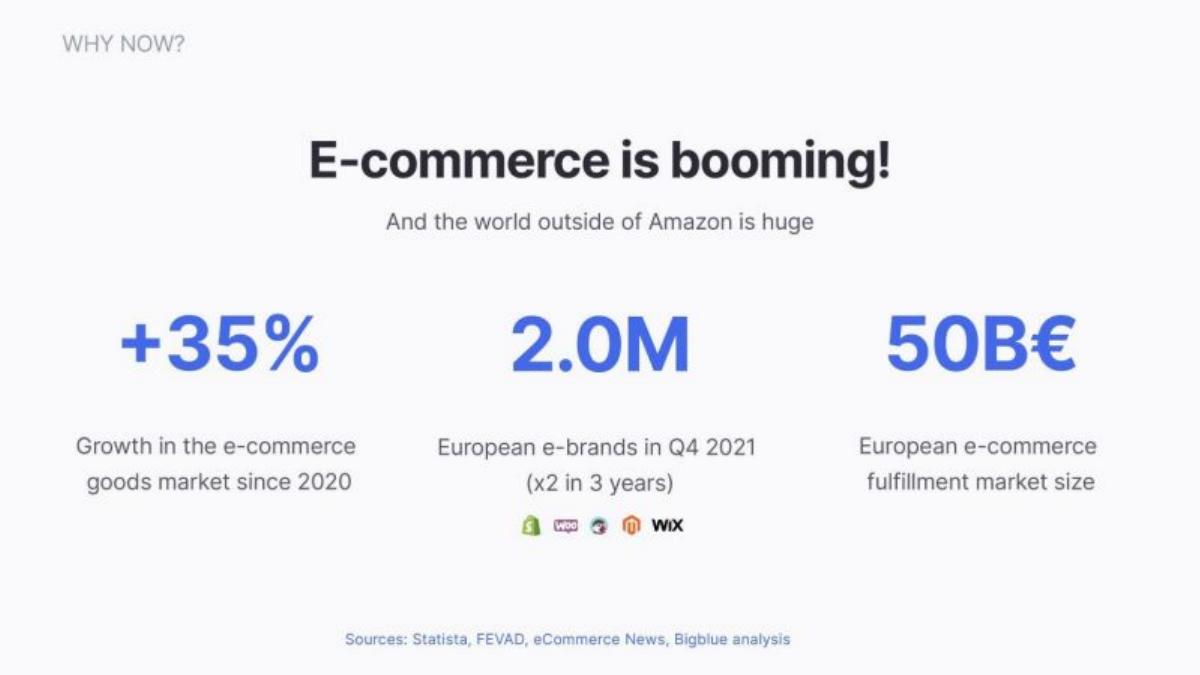
- The 'Why Now' slide identifies a 50B€ European e-commerce fulfillment market and 2.0M e-brands as of Q4 2021 (Slide 2).
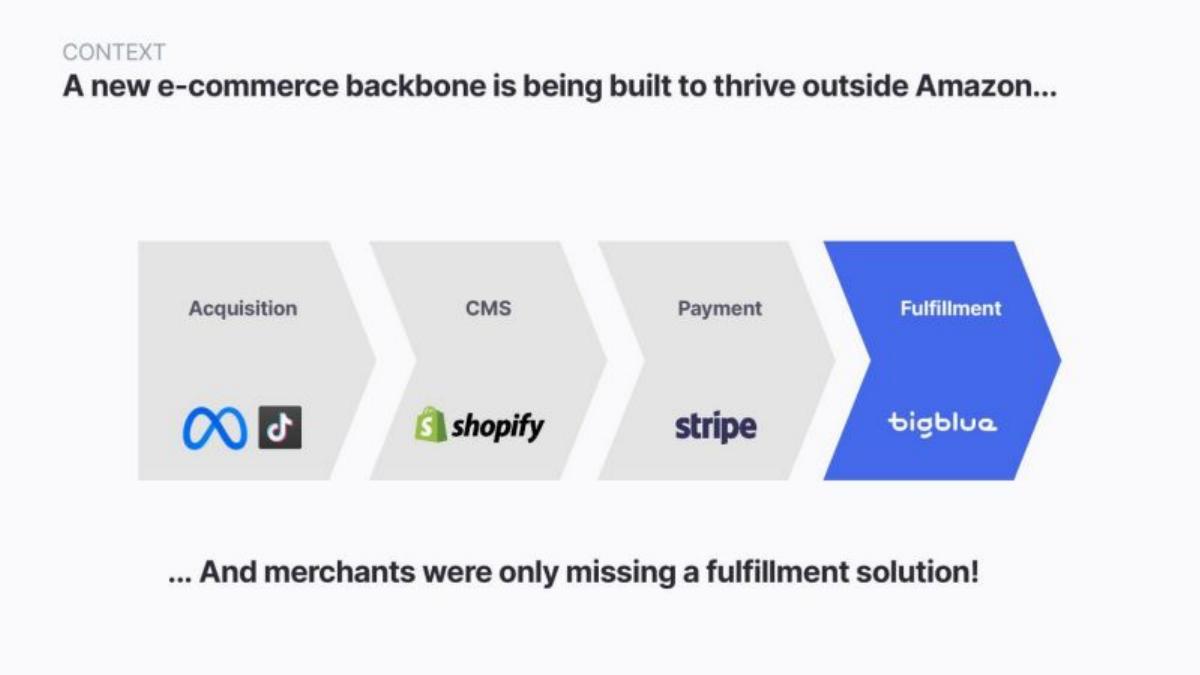
- Bigblue positions itself as the final link in the e-commerce stack following Acquisition (Meta/TikTok), CMS (Shopify), and Payment (Stripe) (Slide 4).
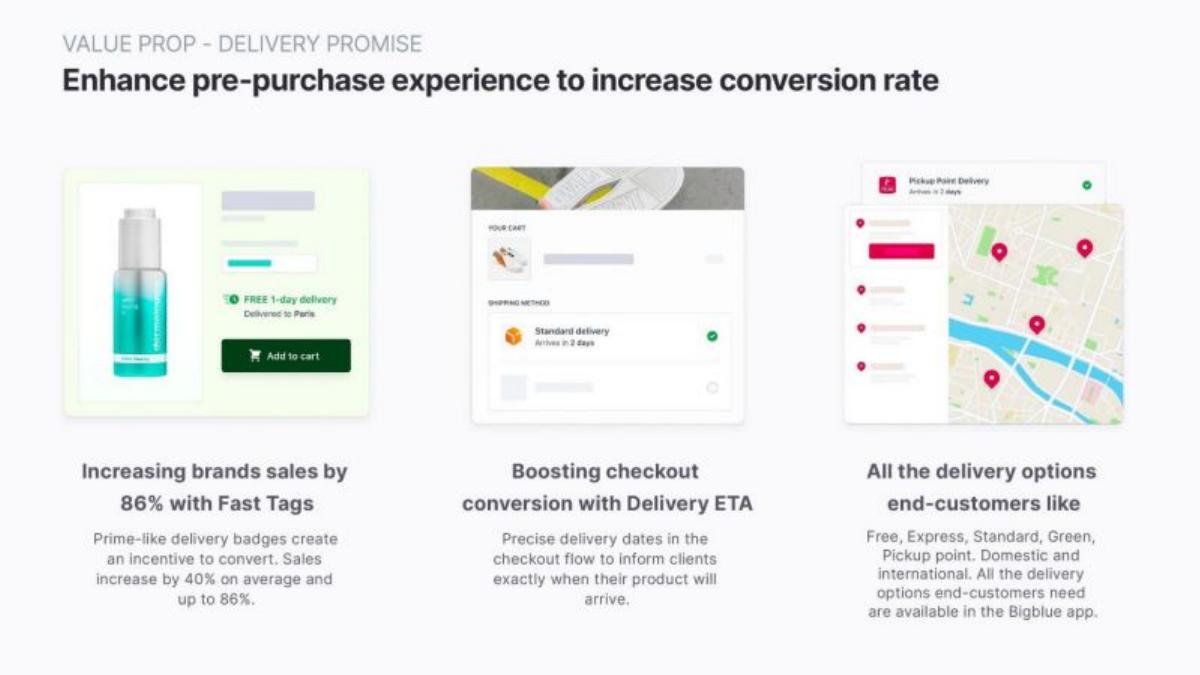
- The platform claims to increase brand sales by up to 86% through 'Fast Tags' that mimic Amazon Prime badges (Slide 6).
- Logistics infrastructure is highlighted with automated warehouses located in France, Spain, and the UK (Slide 7).
- The company reports a high engagement rate for its post-purchase experience, citing a 74% average open rate for tracking emails (Slide 8).
- The business model is described as 'SaaS-ified delivery' featuring per-delivery fees and monthly per-item storage fees (Slide 9).
- Traction metrics include a growth rate of >3.5x year-on-year and a 2.4% churn rate (Slide 10).
- The team slide emphasizes industry pedigree with former experience at Amazon, Apple, Criteo, and Doctolib (Slide 12).
The Narrative: Fulfillment as a Growth Lever
Bigblue’s 2022 Series A deck is a masterclass in shifting the investor's perception of logistics from a 'cost center' to a 'revenue generator.' In a crowded market of third-party logistics (3PL) providers, Bigblue uses its 14 slides to argue that delivery is the most critical part of the customer journey. By the time an investor reaches the final slide, the company has positioned itself not just as a warehouse operator, but as a vital piece of software infrastructure. This teardown examines how they structured this $15M raise.
Slides 1-2: Setting the Stage and the 'Why Now'
The deck opens with a minimalist title slide (Slide 1) featuring the Bigblue logo and the simple subtitle 'FUNDRAISING DECK.' This leads immediately into the market opportunity on Slide 2. Titled 'WHY NOW?', this slide uses three heavy-hitting statistics to establish urgency. They cite a 35% growth in the e-commerce goods market since 2020 and identify 2.0 million European e-brands as of Q4 2021, a number that has doubled in three years. Most importantly, they peg the European e-commerce fulfillment market size at 50B€. By citing sources like Statista and FEVAD, they ground their ambitions in third-party data.
Slides 3-4: The Problem and the Modern Backbone
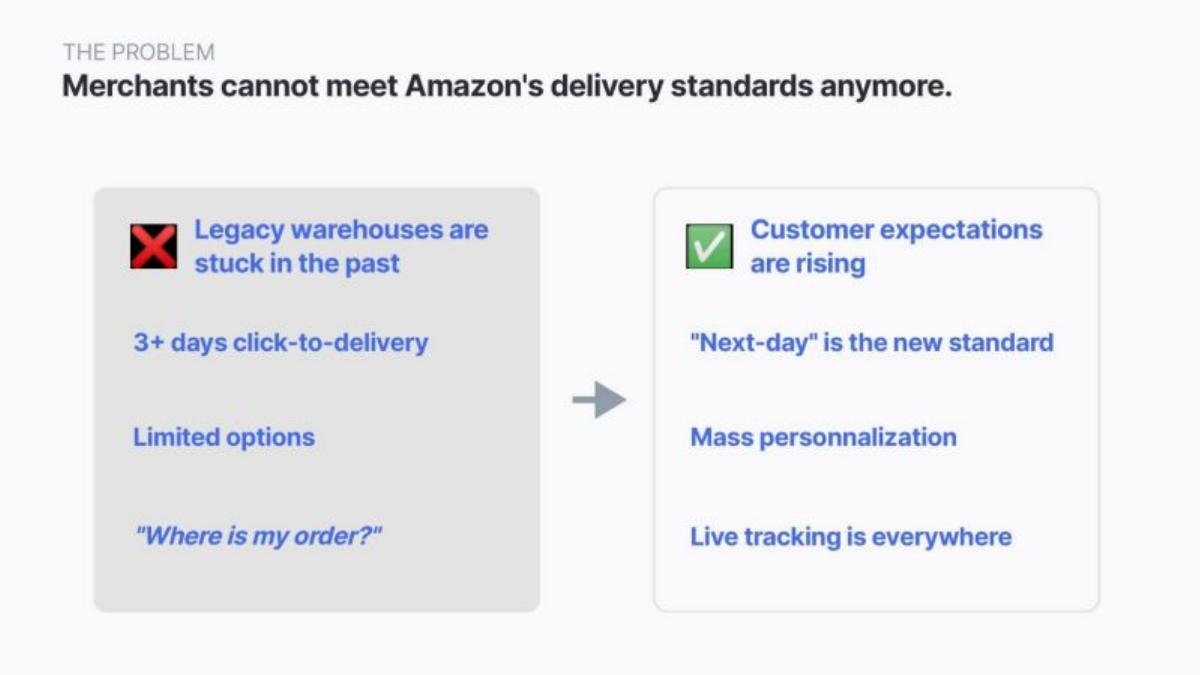
Slide 3 defines the conflict: 'Merchants cannot meet Amazon's delivery standards anymore.' This is a classic 'David vs. Goliath' framing. They contrast 'Legacy warehouses' (marked with a red X) against 'Customer expectations' (marked with a green check). The legacy side is characterized by '3+ days click-to-delivery' and the dreaded 'Where is my order?' customer support queries. The expectation side highlights 'Next-day' as the new standard and the need for 'Mass personalization.'
Slide 4 is perhaps the most strategic in the deck. It visualizes the 'new e-commerce backbone' as a four-step chevron process: Acquisition (Meta/TikTok), CMS (Shopify), Payment (Stripe), and finally, Fulfillment (Bigblue). By placing their logo alongside multi-billion dollar platforms like Shopify and Stripe, Bigblue is signaling that they are the missing piece of the modern tech stack. The caption, '...And merchants were only missing a fulfillment solution!', suggests that Bigblue is the inevitable conclusion of the e-commerce evolution.
Slides 5-8: The Three-Pillar Value Proposition
After a transition slide (Slide 5) stating their value prop as 'Fulfillment for customer centric brands,' the deck dives into three specific product areas. Slide 6 focuses on 'Delivery Promise.' It claims that their 'Fast Tags' (Prime-like badges) increase sales by an average of 40% and up to 86%. This is a crucial pivot; they are telling investors that their logistics software actually helps brands sell more products, not just ship them.
Slide 7, 'Delivery Success,' addresses the physical infrastructure. It mentions 'enterprise-grade logistics' and 'state-of-the-art automated warehouses' in France, Spain, and the UK. This slide reassures investors that while they are a software company, they have the operational 'moat' of physical locations to handle ultra-fast shipping.
Slide 8, 'Delivery Delight,' focuses on the post-purchase experience. This is where the 'SaaS' elements shine. They highlight branded tracking emails with a 74% open rate. They frame this as a marketing opportunity for brands to drive repeat sales, further distancing themselves from traditional, 'invisible' logistics companies.
Slides 9-10: Business Model and Traction
Slide 9 is titled 'We SaaS-ified delivery.' It outlines a simple, three-part pricing model: a per-delivery fee, a monthly per-item storage fee, and volume-based discounts. This 'pay-as-you-grow' model is highly attractive to D2C startups and suggests a predictable, scalable revenue stream for Bigblue.
Slide 10 presents the traction. Although the specific dollar amounts are redacted in this version (marked as 'xx'), the growth trends are clear. They claim to be growing >3.5x year-on-year. Key metrics include a 2.4% churn rate and a +60% expansion in revenue in 2021. The bar chart shows a steep upward trajectory from 2019 through a forecasted 2022. The mention of '€xxM current Net ARR + €xxM signed' indicates a strong sales pipeline.
Slides 11-12: Social Proof and Team Pedigree
Slide 11 is a 'logo wall' showcasing over 350 D2C brands. Including recognizable names like Dermalogica and From Future provides the necessary social proof to validate their market fit. Slide 12 introduces the leadership team. The founders (Tim Dumain, Mathias Griffe, and William Meunier) are supported by heads of Sales, Product, and Transportation. The bottom of the slide features logos of former employers, including Amazon, Apple, Criteo, and Vimeo. This 'pedigree' section is designed to prove that the team has the experience to scale a complex, global operation.
Slides 13-14: Conclusion
The deck concludes with a simple 'Thank you!' on Slide 13. Slide 14 is a promotional slide for the platform where the deck was hosted and is not part of the Bigblue presentation itself. Notably, the deck ends without a specific 'Ask' slide detailing the valuation or the exact use of the $15M. In many Series A rounds, these details are often reserved for the final stages of due diligence or a separate teaser document, though their absence here is a notable omission for a 'complete' fundraising deck.
What Bigblue Does Well
The Bigblue deck excels at category positioning . Instead of fighting for space in the 'logistics' category, they successfully move themselves into the 'e-commerce enablement' category. By aligning themselves with Shopify and Stripe, they change the valuation multiples that an investor might apply to the business. Software-enabled services often command much higher multiples than pure-play service businesses.
The use of metrics as a narrative tool is also impressive. They don't just say their software is good; they say it has a 74% open rate. They don't just say their shipping is fast; they say their 'Fast Tags' increase conversion by 40%. These are 'hard' numbers that appeal to the analytical nature of Series A investors.
What is Missing
The most glaring omission is a detailed 'Ask' and 'Use of Funds' slide . While we know from external sources that they raised $15M, a standard pitch deck usually outlines how that capital will be deployed (e.g., 40% to R&D, 30% to international expansion, etc.).
Additionally, there is no explicit competition slide . While they mention 'Legacy warehouses,' they do not address other modern competitors in the e-commerce fulfillment space (such as ShipBob or Huboo). Investors at the Series A stage typically want to see that a founder understands the competitive landscape and has a clear plan to win against other well-funded incumbents.
What Other Founders Should Copy
Founders building in 'unsexy' industries like logistics, construction, or manufacturing should copy Bigblue’s 'Backbone' visualization (Slide 4) . If you can show that your product is the final, missing piece of an already successful ecosystem, you make the investment feel like an inevitable win.
Another element to emulate is the three-pillar value proposition (Slides 6-8) . By breaking the product down into 'Promise,' 'Success,' and 'Delight,' Bigblue covers the entire customer lifecycle. This prevents the product from feeling like a 'point solution' and makes it feel like a comprehensive platform. Finally, the 'SaaS-ified' pricing slide is a great way to communicate a complex business model in a way that venture capitalists—who are often most comfortable with SaaS—can easily digest.
Frequently asked questions
- What is Bigblue's core value proposition?
- According to slide 5, Bigblue provides 'Fulfillment for customer centric brands.' This is further broken down into three pillars: Delivery Promise (pre-purchase conversion), Delivery Success (operational control and warehouse automation), and Delivery Delight (post-purchase branded tracking and marketing).
- How does Bigblue differentiate itself from traditional 3PL providers?
- Bigblue differentiates by 'SaaS-ifying' the experience. On slide 3, they contrast 'Legacy warehouses' (3+ days delivery, limited options) with their modern solution (next-day standards, mass personalization, and live tracking). They also highlight their software layer, such as 'Fast Tags' and branded tracking emails with 74% open rates.
- What geographical markets does Bigblue serve?
- Slide 7 explicitly mentions that Bigblue operates state-of-the-art automated warehouses in France, Spain, and the United Kingdom. This European focus is supported by the market data on slide 2, which values the European e-commerce fulfillment market at 50B€.
- What are the key financial metrics mentioned in the deck?
- The traction slide (Slide 10) lists a >3.5x year-on-year growth rate, a 2.4% churn rate, and a +60% expansion in revenue for 2021. While specific ARR and ARPA figures are redacted as 'xx' in the public version, the deck notes a 'healthy top-line' and a scalable LTV to CAC ratio.
- Who are Bigblue's customers?
- Slide 11 states that Bigblue is trusted by over 350 leading D2C brands. Featured logos include Dermalogica, From Future, Pete Sorensen, and Nutrivita. The deck focuses heavily on 'customer-centric' brands that prioritize the delivery experience as a marketing tool.