BigBit is an early-stage venture focused on leveraging big data and social insights to help businesses target the right customers with the right deals in real-time. The deck, originating from a team with strong ties to Polish technical universities, emphasizes the massive growth of the big data market—projected to reach $16.9 billion by 2015 according to their cited 2012 IDC research. While the deck successfully establishes the technical pedigree of its founders, Agnieszka and Mirosław Zdebiak, and identifies a clear market gap, it lacks specific product screenshots, a defined business model,…
Key takeaways
- The company positions itself in the real-time targeting space using social data (Slide 1).
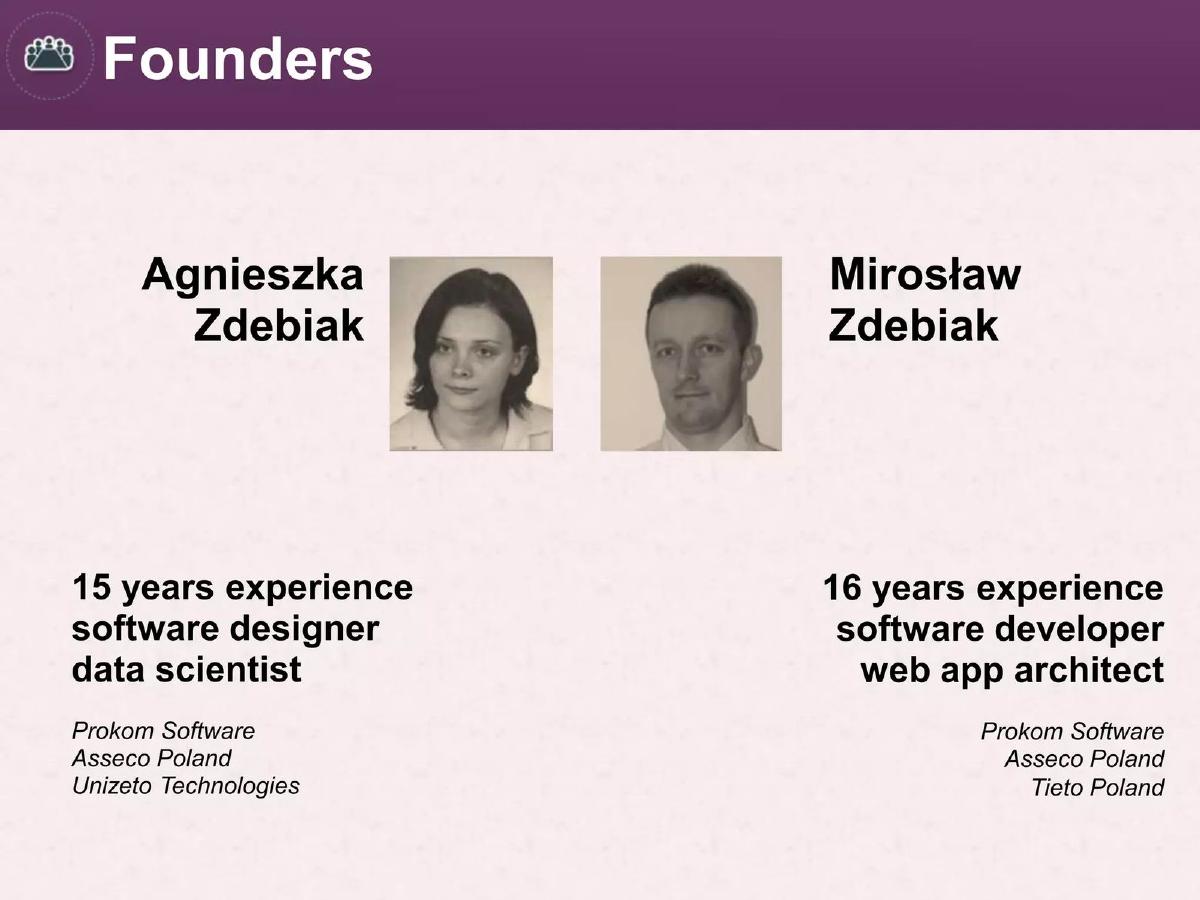
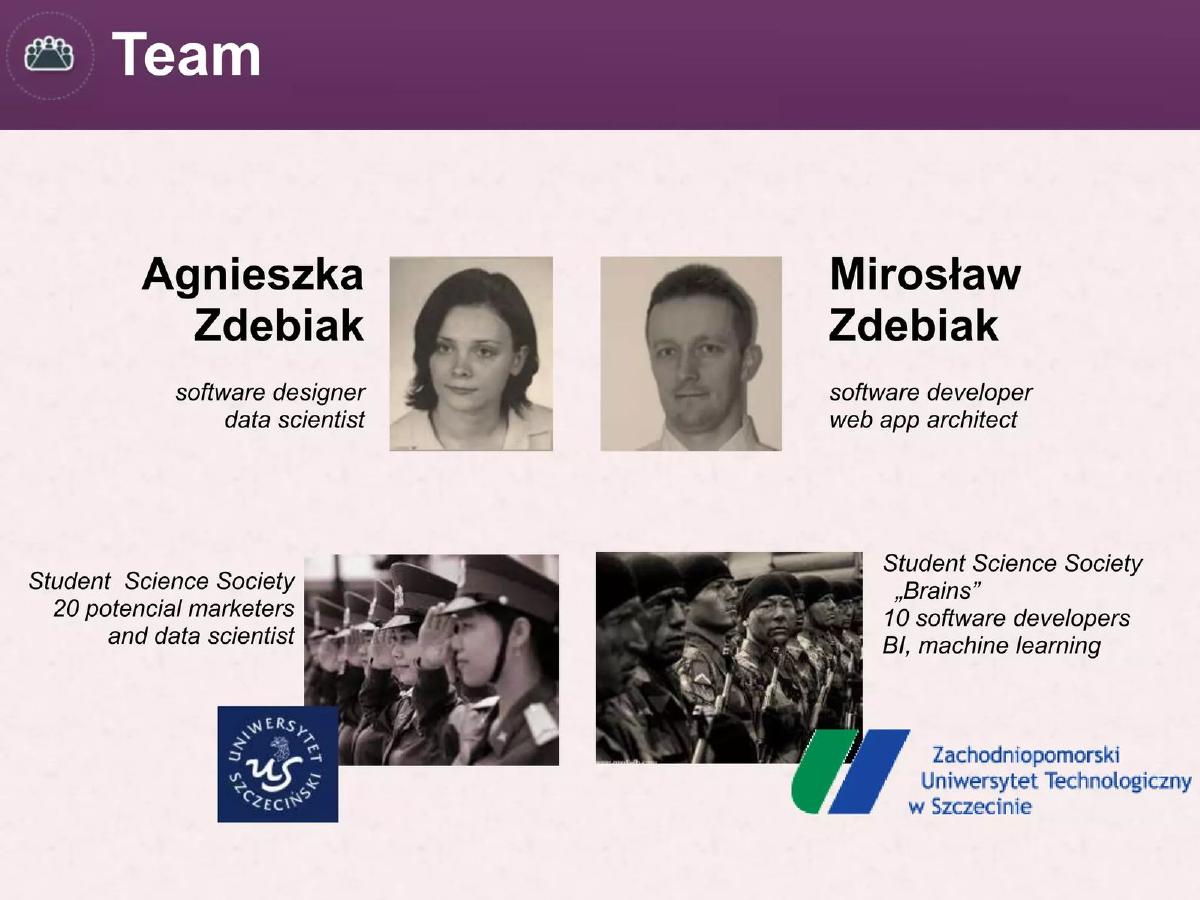
- The core team consists of Agnieszka Zdebiak (software designer/data scientist) and Mirosław Zdebiak (software developer/web app architect) (Slide 2).
- The startup leverages academic partnerships, citing support from the Student Science Society at the University of Szczecin and West Pomeranian University of Technology (Slide 2).
- The problem defined is the difficulty businesses face in picking up valuable clients and targeting them with the right deal at the right time (Slide 3).
- The solution promises to estimate profits from discounts and calculate ROI while analyzing customer loyalty (Slide 4).
- Market growth is a central theme, citing an IDC forecast that the big data market would grow from $3.2 billion in 2010 to $16.9 billion in 2015 (Slide 5).
- The company is currently pre-beta, with 'launch beta' listed as a milestone for the next three months (Slide 6).
- Financing to date has been provided by private founders' resources, and they are now actively seeking a seed investor (Slide 6).
BigBit Pitch Deck Analysis
BigBit enters the market at a time when 'Big Data' was transitioning from a buzzword to a critical business requirement. The deck is structured as a classic problem-solution narrative, leaning heavily on the technical expertise of its founding team and the projected growth of the data analytics industry. While the deck is visually clean, it operates at a high level of abstraction, focusing more on the 'why' and 'who' than the 'how.'
Slide 1: Title and Value Proposition
The cover slide introduces the brand BigBit and immediately defines its niche: "REAL-TIME TARGETING using social data." The imagery features three diverse individuals holding social profile icons, suggesting a focus on consumer-facing businesses. The inclusion of the Twitter handle @BigBit indicates an early effort to establish a social media presence, though no other contact information is present on this slide.
Slide 2: The Team and Academic Roots
Slide 2 introduces the human capital behind the project. Agnieszka Zdebiak is listed as the software designer and data scientist , while Mirosław Zdebiak is the software developer and web app architect . The slide is notable for its emphasis on academic collaboration. It mentions the Student Science Society at the Uniwersytet Szczeciński (University of Szczecin) providing "20 potencial marketers and data scientist" and the Student Science Society "Brains" at the Zachodniopomorski Uniwersytet Technologiczny w Szczecinie (West Pomeranian University of Technology) providing "10 software developers" focused on BI and machine learning . This suggests that BigBit is essentially a university spin-off or a project heavily supported by student talent, which provides a low-cost scaling model for R&D but may raise questions for investors regarding full-time commitment and intellectual property ownership.
Slide 3: The Problem Statement
The problem slide is concise, asking two primary questions: "How to pick up valuable clients?" and "How target right customers with the right deal at the right time using BigData?" The use of the term "valuable clients" suggests a focus on Customer Lifetime Value (CLV) rather than just raw acquisition. The phrasing "How target" contains a minor grammatical omission, but the intent is clear: businesses have data but lack the real-time execution capabilities to make it actionable.
Slide 4: The Solution
The solution slide mirrors the problem slide's language, stating the goal to "Target right deal at the right time!" It lists two primary functions of the BigBit platform: "Estimate profits from discounts and special offers" and "Calculte ROI and analyze customer loyalty." The visual includes a tablet displaying a 3D bar chart, implying a dashboard-driven user interface. However, there are no actual screenshots of the software, suggesting the product may still be in the conceptual or early development phase. The misspelling of "Calculte" is a minor detail that could affect professional perception during a high-stakes pitch.
Slide 5: A Gap in the Market
To justify the venture's existence, BigBit points to massive industry tailwinds. Citing an IDC Insights forecast from 2012 , the slide notes that "The big data market is expected to grow from $3.2 billion in 2010 to $16.9 billion in 2015." This slide serves to validate the "Big" in BigBit, showing that even a small share of this rapidly expanding market represents a significant opportunity. It effectively addresses the 'Why Now?' question by highlighting the explosion of data availability.
Slide 6: Next Steps and Financing
The final slide in this set outlines the immediate roadmap. Under "Milestons for next 3 months," the company lists "team advanced training," "launch beta," and "looking for first business clients." This confirms the company's pre-revenue, pre-product status. The "Financing" section notes that they have used "private founders resources" thus far and are now "looking for seed investor." Crucially, the slide does not state how much capital they are seeking or what the specific use of funds will be beyond the three-month milestones mentioned.
What Works in the BigBit Deck
The deck is highly focused. It does not try to solve every problem in marketing; it stays strictly within the realm of real-time targeting via social data. The technical pedigree of the founders, combined with the support of 30 specialized students and two universities, gives the project a level of technical credibility that many early-stage startups lack. The market slide uses a reputable source (IDC) to provide a macro-economic justification for the business, which is essential for convincing investors of the potential exit scale.
What Is Missing from the BigBit Deck
The most glaring omission is a Business Model slide. There is no mention of whether this is a SaaS platform, a commission-based tool, or a consultancy service. Without a pricing strategy, investors cannot model the potential return. Additionally, there is no Competition slide. The social data and real-time bidding/targeting space was already crowded by 2012, and failing to acknowledge competitors suggests a lack of market awareness. Finally, the Ask is too vague. Simply stating they are "looking for seed investor" without a dollar amount or a valuation range makes it difficult for an investor to know if the deal fits their portfolio requirements.
Founder's Guide: What to Copy and What to Avoid
Copy the academic leverage: If you are a technical founder, showing that you have a pipeline of talent from universities (as seen on Slide 2) is a great way to demonstrate how you will out-build competitors with less capital. It shows a 'moat' of human capital.
Avoid the lack of specifics: Do not go to a seed investor without a clear financial ask and a basic business model. Even if you are pre-beta, you should have a hypothesis on how you will charge customers. Also, ensure your deck is proofread; typos like "Calculte" and "Milestons" can distract from an otherwise professional presentation.
Frequently asked questions
- What is BigBit's primary product offering?
- Based on the slides, BigBit offers a real-time targeting platform that utilizes social data. The goal is to help businesses identify 'valuable clients' and deliver specific deals or discounts at the optimal moment to maximize ROI and customer loyalty. However, the deck does not show the actual software interface or specific API integrations.
- Who are the founders and what is their background?
- The founders are Agnieszka Zdebiak and Mirosław Zdebiak. Agnieszka is identified as a software designer and data scientist, while Mirosław is a software developer and web app architect. They appear to have a strong technical and academic foundation, supported by student science societies and technical universities in Szczecin, Poland.
- What stage of development is BigBit in?
- BigBit is in the pre-seed/seed stage. Slide 6 explicitly states that they are currently 'looking for first business clients' and planning to 'launch beta' within the next three months. Up to this point, the venture has been funded entirely by the founders' private resources.
- How does BigBit define the market opportunity?
- BigBit defines the opportunity through the rapid expansion of the Big Data sector. They cite a 2012 IDC Insights forecast showing the market growing from $3.2 billion to $16.9 billion over five years. They view the inability of companies to effectively use this data for real-time targeting as the 'gap in the market.'
- What is missing from the BigBit pitch deck?
- The deck lacks several critical components for a late-stage seed round, including a business model (how they make money), a competitive analysis (who else is in the social data space), and a specific funding request. It also lacks traction metrics, likely because the product has not yet entered the beta phase.