Bunch secured $4.4M in Seed funding, led by M13, to scale its AI-driven professional growth platform. The 2022 deck centers on the 'Great Resignation' as a catalyst for individual-led upskilling, positioning Bunch as the 'Duolingo for leadership.' The company showcases strong early traction with over 47,000 downloads and a highly engaged user base that opens the app twice daily. A critical component of their pitch is the 'B2C2B' go-to-market strategy: building a massive, habit-forming consumer base to eventually force enterprise adoption. While the deck is light on specific unit economics and…
Key takeaways
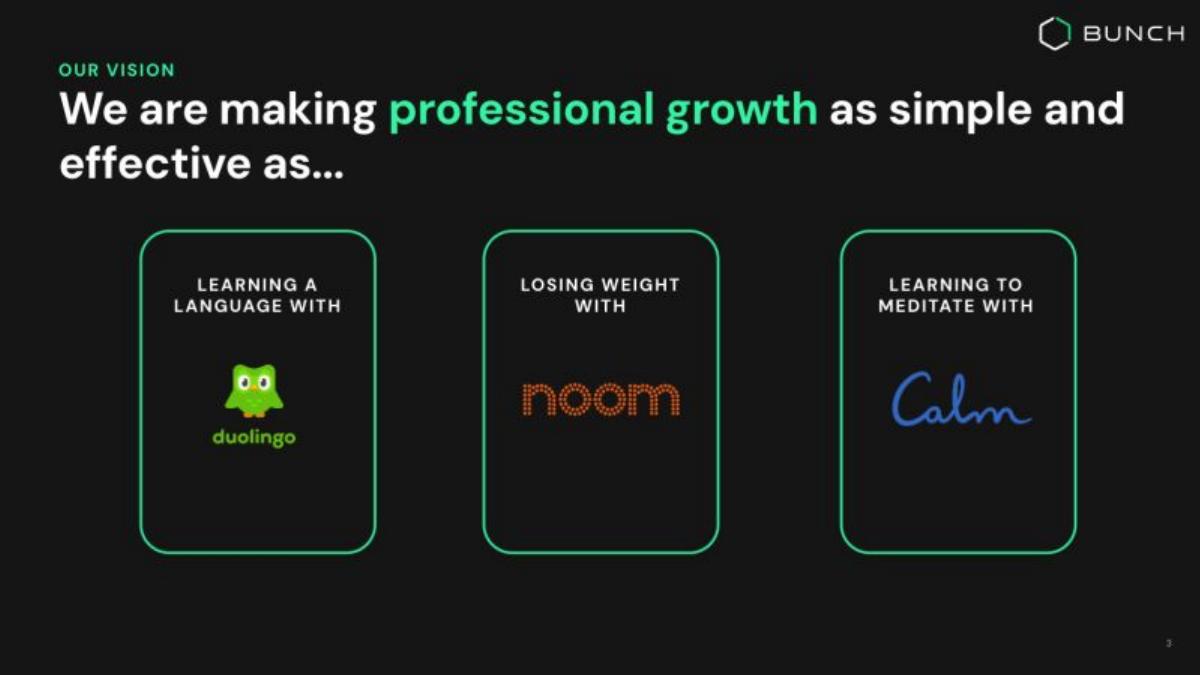
- Bunch positions itself as the professional growth equivalent to Duolingo, Noom, and Calm on slide 3.
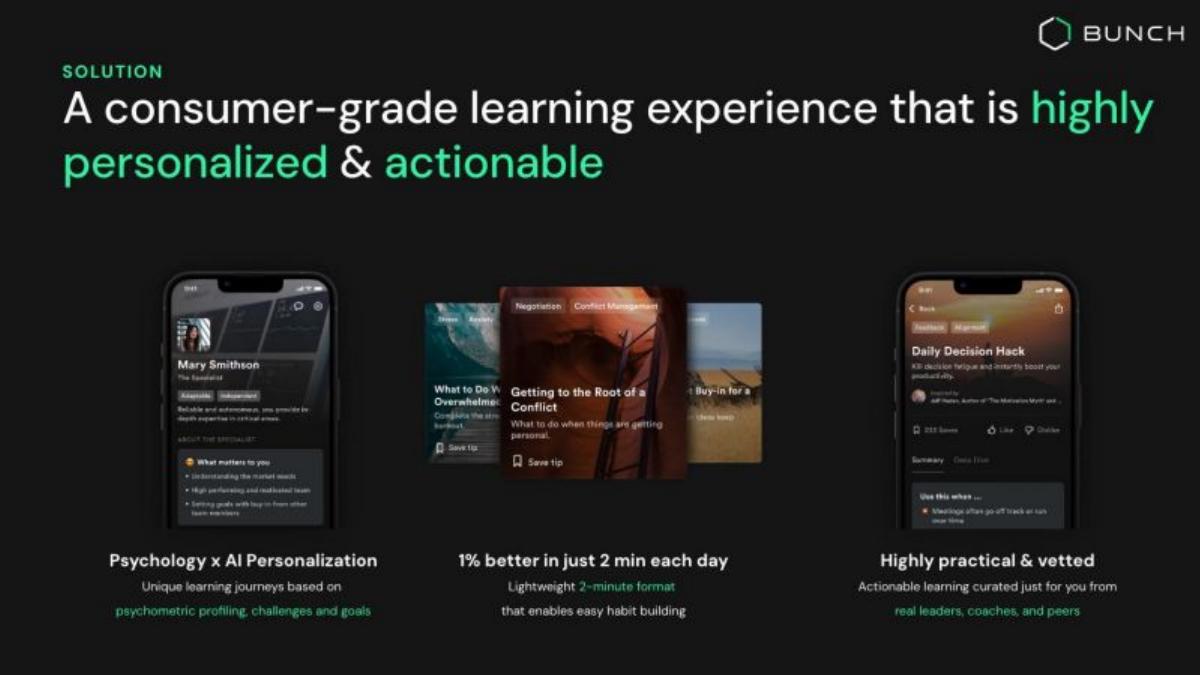
- The platform leverages psychometric profiling and AI to create personalized 2-minute daily learning journeys as shown on slide 5.
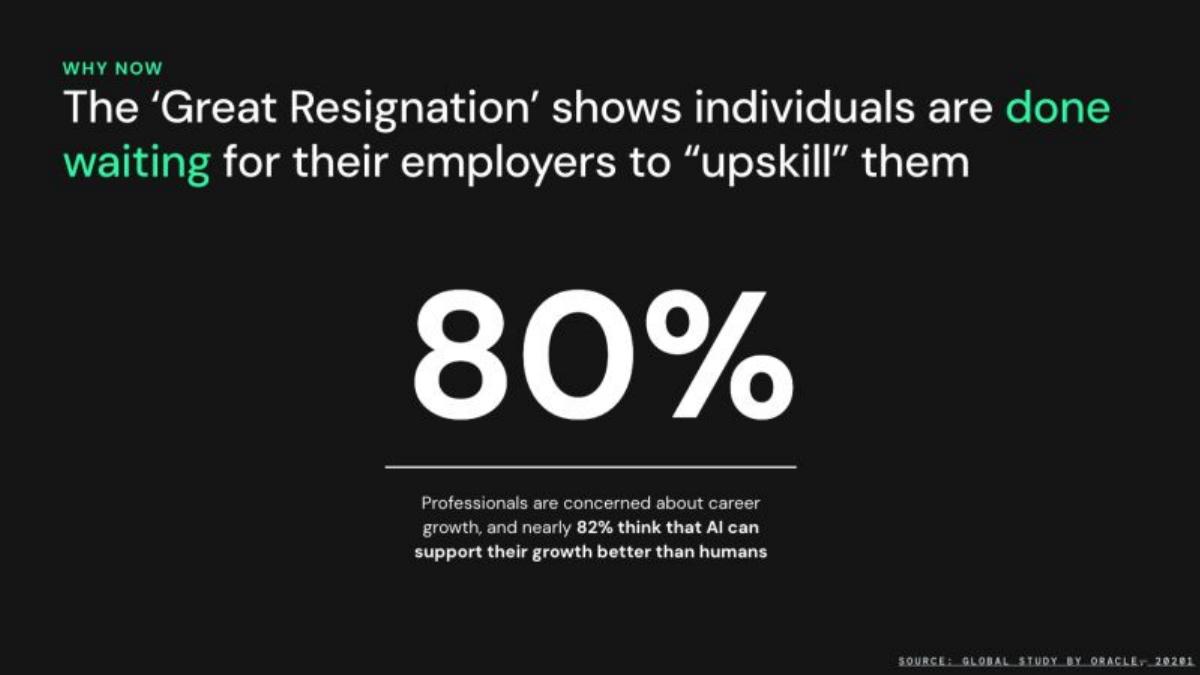
- Market timing is tied to the 'Great Resignation,' with slide 6 noting that 82% of professionals believe AI can support growth better than humans.
- Traction is demonstrated by a 10x growth since launch, reaching 47,726 total downloads by January 2022 on slide 10.
- Engagement metrics are high for the category, with habit-forming users spending 10 minutes per day and showing 52% month-3 retention on slide 12.
- The go-to-market strategy follows a B2C2B path, aiming for individual monetization in 2022 and company-level monetization by 2024 on slide 16.
- The Total Addressable Market is estimated at $335B, based on 2.6 billion professionals with smartphones and a $129 ARPU on slide 17.
- The deck lacks a specific 'Ask' slide detailing the exact funding amount sought or the planned allocation of capital.
Executive Summary: The Habit-Forming Coach
Bunch’s Seed deck is a masterclass in positioning a professional tool as a consumer lifestyle app. By explicitly comparing themselves to Duolingo and Calm, the founders shift the conversation away from boring HR tech and toward high-frequency consumer habits. The deck focuses heavily on the 'why now'—the Great Resignation—and uses impressive engagement data to prove that users actually want to learn leadership skills if the friction is low enough. While it lacks the financial rigor of a later-stage deck, it successfully sells a vision of a new category: the AI Leadership Coach.
Slides 1-3: Vision and Positioning
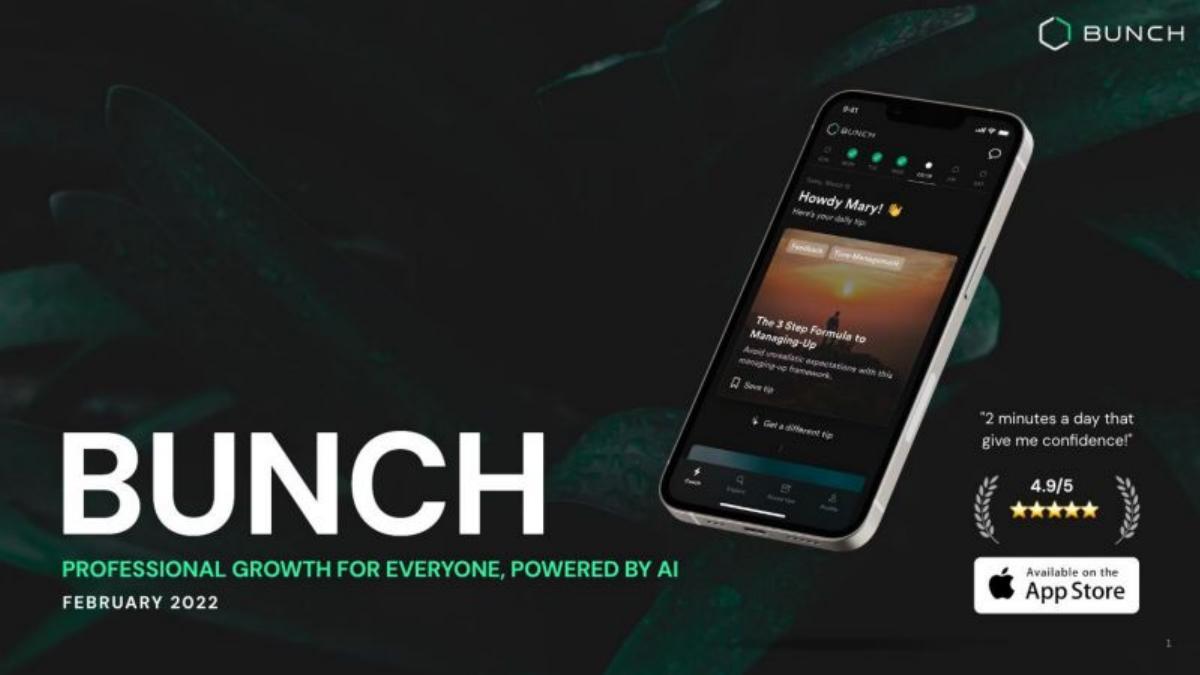
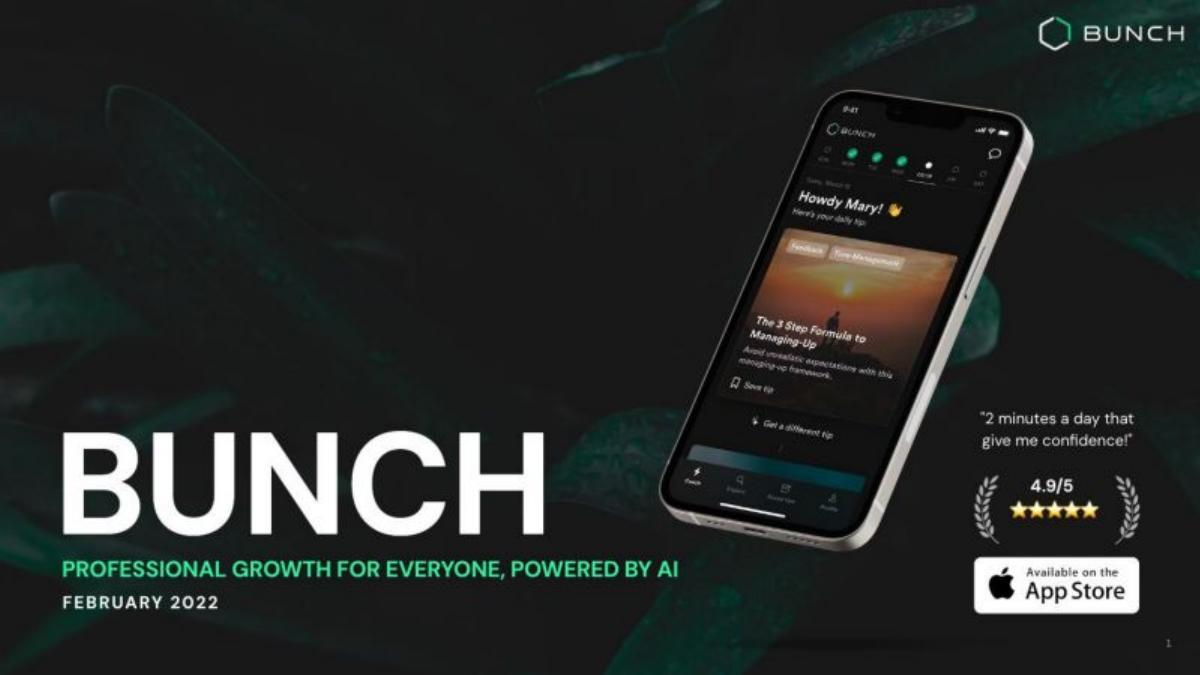
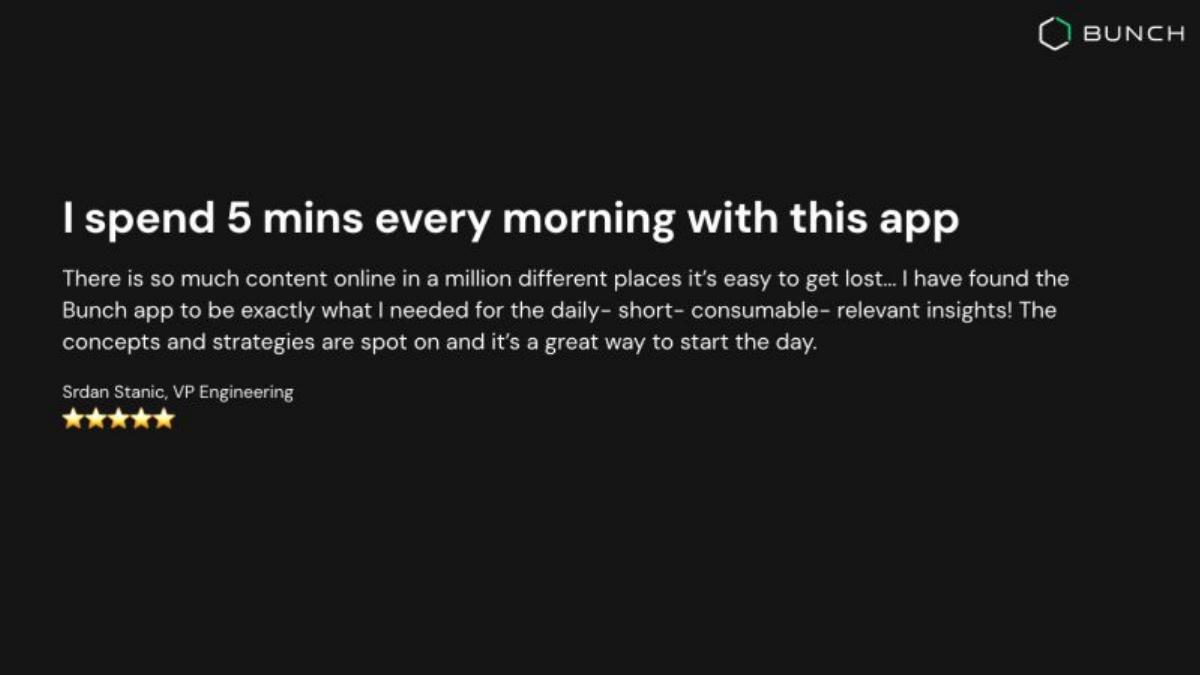
Slide 1 serves as a clean title card, establishing the brand identity: 'Professional growth for everyone, powered by AI.' It immediately anchors the product in the mobile ecosystem with an App Store badge and a 4.9/5 star rating. Slide 2 uses a powerful testimonial from a VP of Engineering to validate the '5 minutes every morning' habit, which is a recurring theme throughout the deck. Slide 3 is the most critical for positioning. It uses the 'X for Y' trope effectively, stating that Bunch is making professional growth as simple as learning a language with Duolingo, losing weight with Noom, or meditating with Calm. This immediately tells an investor that this is a high-engagement, B2C-style play, not a clunky enterprise LMS.
Slides 4-6: The Problem and The 'Why Now'
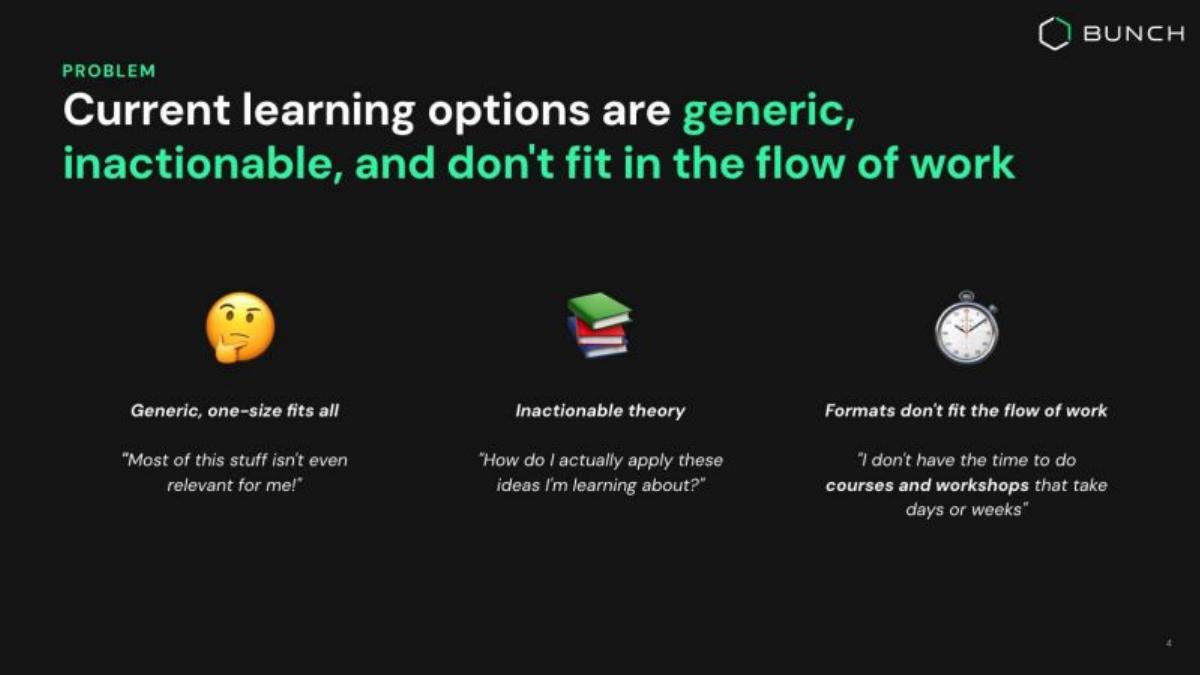
Slide 4 identifies the friction in current learning options: they are generic, inactionable, and don't fit the flow of work. It uses relatable quotes like 'I don't have time to do courses and workshops that take days or weeks.' Slide 5 introduces the solution: a consumer-grade experience that is 'highly personalized & actionable.' It breaks this down into three pillars: Psychology x AI Personalization, a 2-minute daily format, and vetted content from real leaders. Slide 6 provides the macro-economic justification. It cites the 'Great Resignation' and a study showing that 80% of professionals are concerned about career growth, with 82% believing AI can support them better than humans. This slide successfully creates a sense of urgency for the investment.
Slides 7-9: Product and Content Strategy
Slide 7 features another high-profile testimonial, this time from a Strategy & Operations leader at Twitter, emphasizing how the app provides confidence in real-work situations. Slide 8 showcases the 'Creators'—the source of the content. By listing names like Nir Eyal (author of Hooked) and Rand Fishkin (CEO of SparkToro), Bunch demonstrates that its content isn't just generic AI-generated text, but insights from recognized industry experts. Slide 9 goes under the hood of the 'Psychology x AI' engine. It details the inputs (psychometric profiles, calendar patterns, peer feedback) and the outputs (tips, quizzes, recommended peers). This technical slide is necessary to justify the 'AI' label in the title.
Slides 10-12: Traction and Engagement
Slide 10 is the primary traction slide. It shows a growth curve of total downloads, reaching 47,726 by January 2022. It also lists logos of companies where users work, including TikTok, Coca-Cola, Meta, and PayPal, suggesting organic bottom-up adoption. Slide 11 creates a user persona (Emeka, an Account Manager) to humanize the data, highlighting that 94% of Millennials and Gen-Z are stressed at work. Slide 12 provides the 'meat' for engagement-focused investors. It claims habit-forming users visit 2x daily, spend 10 minutes per day, and have a 52% month-3 retention rate. These are strong numbers for an educational app, though the asterisk clarifies these figures are specifically for users who have already 'built a habit.'
Slides 13-15: Growth and Roadmap
Slide 13 outlines the user acquisition strategy, which relies heavily on word-of-mouth (every 10 users bring 3 more), influencer marketing, and partnerships with platforms like Harvard Business Review and Perkbox. Slide 14 shows Monthly Active User (MAU) growth, which is steady at 11% per month, reaching 9.6K in January 2022. Slide 15 presents the 'Road to 100k Downloads,' mapping out future features like an Ambassador Program and a 'Premium plan (stealth)' to drive virality and revenue. This slide sets the stage for the Series A milestone.
Slides 16-18: Market and Competition
Slide 16 explains the B2C2B go-to-market strategy. It’s a clear roadmap: build a community (B2C), monetize individuals (B2C2B), and then sell to the enterprise (B2B) by 2024. Slide 17 tackles the market size. It calculates a $335B TAM based on 2.6 billion professionals and a $129 ARPU. The SOM (Serviceable Obtainable Market) is narrowed down to 65 million US Millennials and Gen-Z workers, valued at $8.3B. Slide 18 is a standard 2x2 competitive matrix, placing Bunch in the top-right quadrant for 'Habit-building' and 'Psychology x AI personalization,' distancing itself from 'Generic content' providers like LinkedIn Learning and Audible.
Slides 19-21: Team and Advisors
Slide 19 introduces the core team, highlighting Darja Gutnick’s background as an organizational psychologist and Anthony Reo’s expertise in conflict resolution. It also notes that the team conducted 300+ user interviews in 2021, showing a commitment to customer discovery. Slide 20 is a simple transition to the Appendix . Slide 21 is an impressive 'Bunch Angels' slide. It features 18 operators from companies like Trivago, Airbnb, Google, and Soundcloud. Having this many high-profile industry insiders as backers is a significant signal of credibility for a Seed-stage startup.
What Bunch Does Well
Strategic Benchmarking: By comparing itself to Duolingo and Calm, Bunch avoids the 'boring HR tool' trap and signals that it understands consumer behavior and retention. · Signal through Angels: The roster of 18 angel investors from top-tier tech companies is a massive de-risking factor for VCs. It suggests the product has already been vetted by the very people who would eventually buy or use it at scale. · Retention Focus: Highlighting the 52% month-3 retention rate is a smart move. In the crowded 'ed-tech' space, most apps suffer from high churn; Bunch proves its '2-minute' format actually works to keep users coming back. · Visual Clarity: The deck uses a consistent, dark-themed aesthetic that feels modern and premium, matching the 'consumer-grade' promise of the product.
What is Missing from the Bunch Deck
The Ask: There is no slide stating how much money the company is raising or what the specific milestones for the next 18 months are. While we know from external sources they raised $4.4M, the deck itself leaves this out. · Revenue and Unit Economics: The deck mentions a 'Premium plan' in stealth but provides no data on current revenue, conversion rates from free to paid, or Customer Acquisition Cost (CAC). For a Seed round, investors usually want to see at least a pilot of the monetization model. · B2B Proof of Concept: While the roadmap points toward B2B, there are no case studies or data points showing that companies are willing to pay for this at a corporate level yet.
Founder Takeaways: What to Copy
Use the 'X for Y' comparison wisely: Don't just pick a big company; pick companies that share your usage pattern. Bunch picked Duolingo because they both rely on short, daily sessions. · Humanize your data: Slide 11, which combines a user persona with a macro stat about stress, is much more memorable than a slide full of bar charts. · Show the 'Engine': If you claim to be 'AI-powered,' include a slide like Slide 9 that explains the inputs and outputs. It moves the claim from 'marketing fluff' to 'proprietary tech.' · Leverage your cap table: If you have notable angels, give them their own slide. It is one of the strongest forms of social proof you can offer before you have millions in revenue.
Frequently asked questions
- What is the core value proposition of Bunch?
- Bunch provides a 'consumer-grade' leadership coaching experience that is highly personalized via AI and psychometric profiling. Unlike traditional corporate workshops, it focuses on 2-minute daily 'micro-learning' sessions designed to fit into a professional's morning routine, aiming to make leadership growth as habit-forming as language learning or meditation.
- How does Bunch plan to transition from B2C to B2B?
- The deck outlines a three-stage 'B2C2B' strategy on slide 16. It starts by building a thriving community of individual users (B2C), moves to individual monetization (B2C2B), and finally leverages that bottom-up adoption to sell enterprise-wide licenses at the company level by 2024.
- What evidence of product-market fit does the deck provide?
- Bunch points to two primary signals: growth and engagement. Slide 10 shows 10x download growth to over 47k users, while slide 12 highlights that power users open the app twice daily and spend 10 minutes per session. A 52% month-3 retention rate is cited as evidence of the product's stickiness.
- Who are the key people behind Bunch?
- The team is led by CEO Darja Gutnick, an organizational psychologist and 3x founder, and COO Anthony Reo, a conflict resolution expert. The broader team includes a CTO with a prior exit and a massive group of 18 'Bunch Angels' from top-tier firms like Trivago, Google, and Salesforce.
- What major components are missing from this pitch deck?
- The deck notably omits a specific 'Ask' slide, meaning it doesn't state the dollar amount being raised or how the funds will be spent. It also lacks detailed financial projections, current revenue/MRR figures, and specific unit economics like Customer Acquisition Cost (CAC) or Lifetime Value (LTV).