Buffer’s seed deck is a 13-slide presentation that prioritizes hard metrics over stylistic flair. At the time of this deck, the company had already achieved a $150,000 annual revenue run rate with 800 paying users and a 97% margin. The narrative leans heavily on the 'Social Media Landscape,' citing 'Zuckerberg’s Law' to justify the need for a scheduling tool. While the deck lacks a formal 'Ask' slide or detailed financial projections beyond a single revenue milestone, it successfully uses third-party validation from ReadWriteWeb and high-profile advisors like Guy Kawasaki to build credibility…
Key takeaways
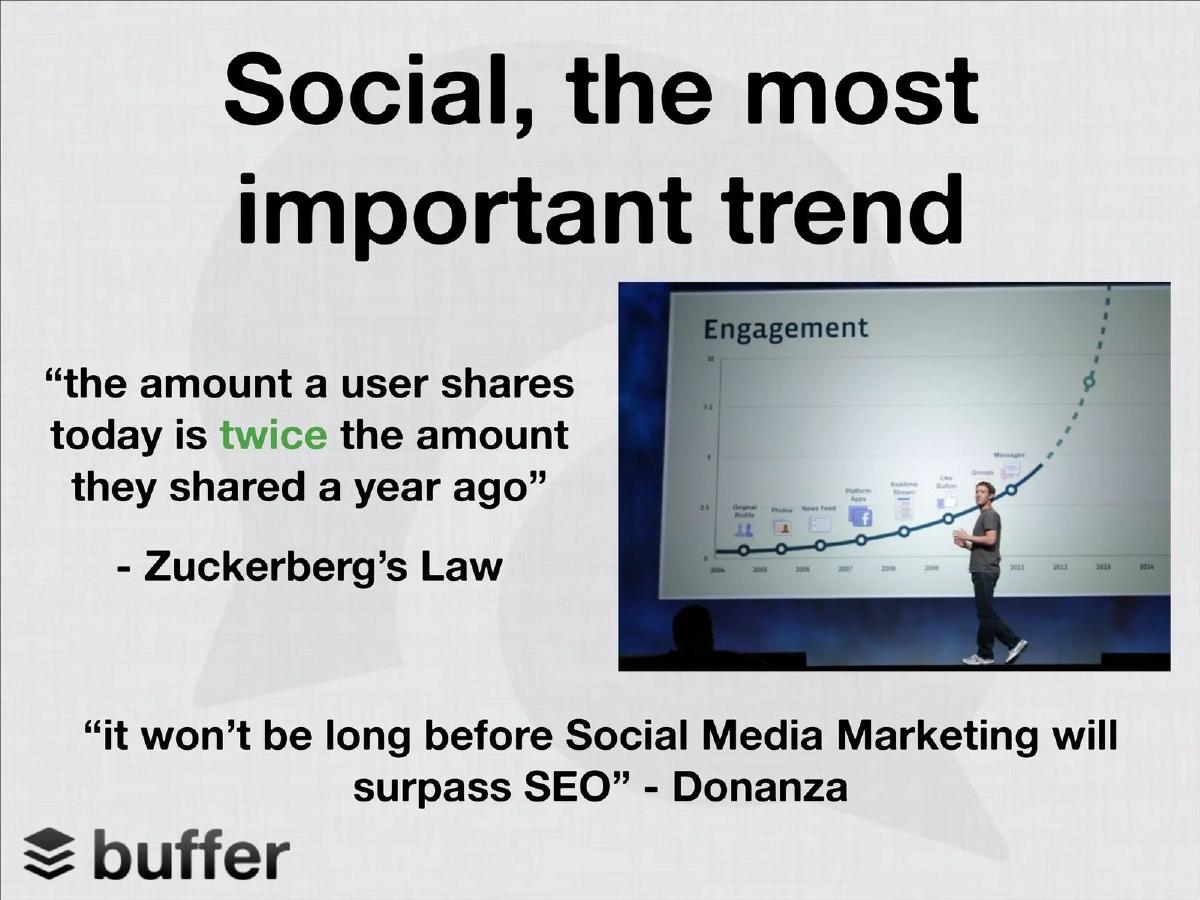
- The deck leads with market trends, citing that social media sharing is doubling annually (Slide 2).
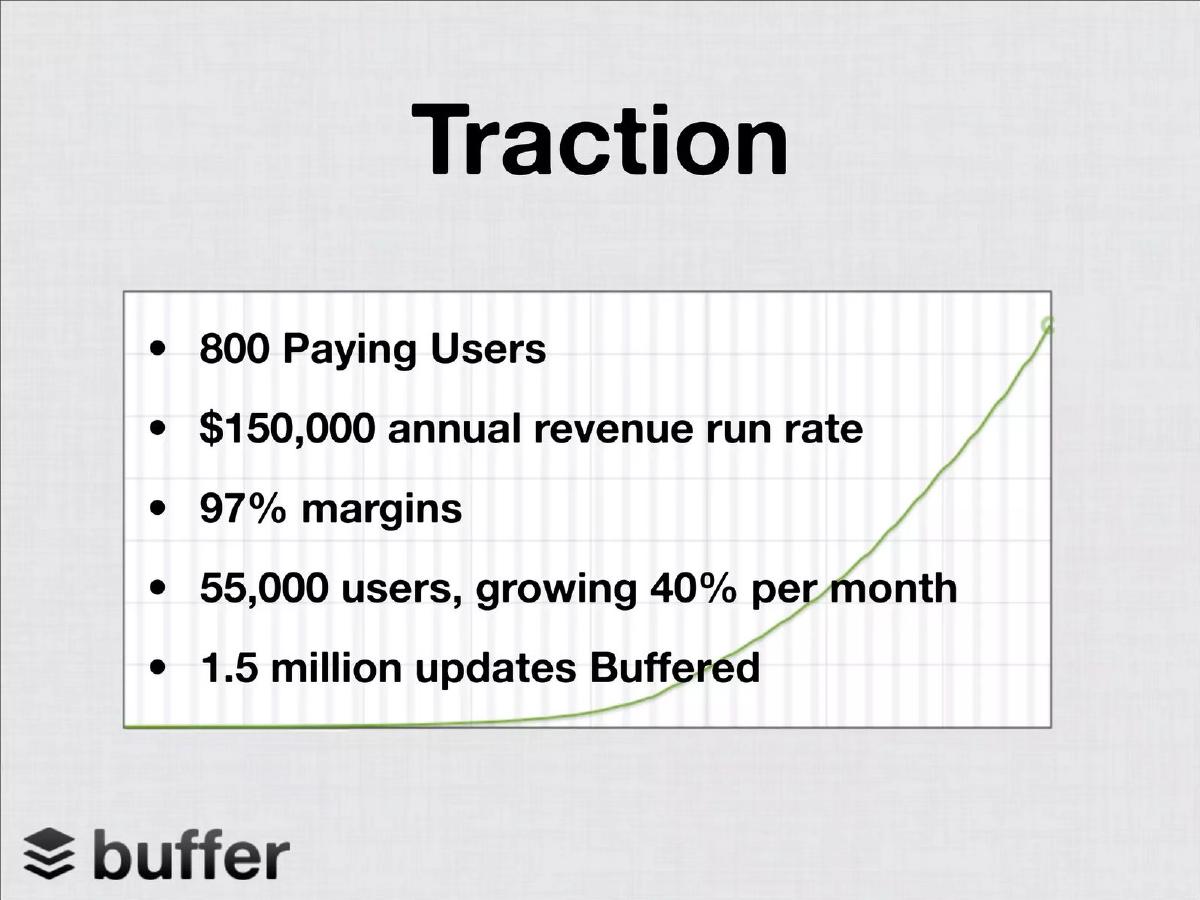
- Traction is the centerpiece, reporting 55,000 users and a $150,000 annual revenue run rate (Slide 5).
- The business operates at a 97% margin, a highly attractive figure for software investors (Slide 5).
- The business model relies on a 2% freemium conversion rate and a $240 Lifetime Value (Slide 7).
- Buffer positions itself as a 'sharing standard' rather than just a standalone app, citing 6 active integrations (Slide 10).
- The competitive landscape is mapped by function, separating Buffer from dashboards like HootSuite (Slide 11).
- The team slide highlights speed, noting the founder took the idea to revenue in just 7 weeks (Slide 12).
- High-profile advisors Guy Kawasaki and Hiten Shah are used to provide institutional credibility (Slide 12).
The Power of Traction-Led Storytelling
The Buffer seed deck is often cited as one of the most transparent and effective early-stage decks in SaaS history. It does not rely on complex graphics or futuristic visions. Instead, it relies on the cold, hard reality of growth. In an era where many startups were chasing 'eyeballs,' Buffer was chasing dollars, and this deck proves that revenue is the best possible signal for an investor.
Slide 1: Title Slide
The deck opens with a minimalist title slide featuring the Buffer logo. There is no tagline, no date, and no presenter name. While simple, it establishes the brand immediately. In a modern context, adding a one-sentence value proposition here would be advisable, but for Buffer, the simplicity reflects their product philosophy.
Slide 2: Market Trends
Buffer begins by establishing the 'Why Now?' factor. They quote 'Zuckerberg’s Law,' stating that the amount a user shares is doubling every year. By including a photo of Mark Zuckerberg in front of an engagement graph, they anchor their startup to the success of Facebook. They also include a quote from Donanza suggesting social media marketing will surpass SEO. This slide sets the stage: the volume of content is exploding, and marketers are shifting their budgets to social.
Slide 3: The Problem Statement
Slide 3 is a simple transition question: 'How do you use social to drive traffic?' It identifies the core pain point for their target customer—the marketer. It frames the product not as a 'cool tool,' but as a utility for traffic generation.
Slide 4: The Solution (Product)
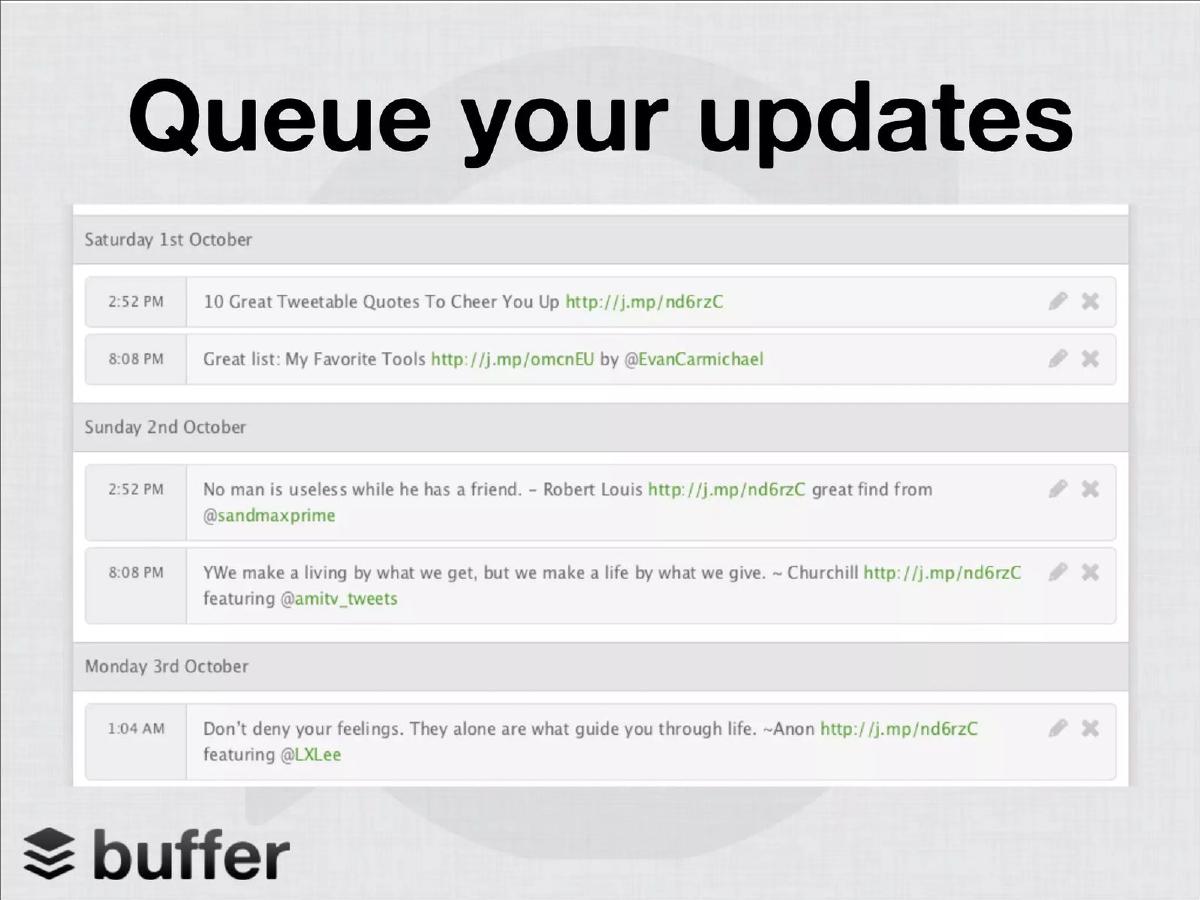
Instead of a list of features, Slide 4 shows a screenshot of the interface under the heading 'Queue your updates.' The screenshot is vital because it shows the product is real and functional. It demonstrates the core value proposition: scheduling content across multiple days to ensure a consistent social presence without manual effort.
Slide 5: Traction
This is the most important slide in the deck. Buffer lists five key metrics: 800 paying users, a $150,000 annual revenue run rate, 97% margins, 55,000 users growing at 40% per month, and 1.5 million updates 'Buffered.' The 97% margin figure is particularly powerful for SaaS investors, as it implies that almost every dollar of new revenue drops straight to the bottom line. The hand-drawn style growth curve on the right emphasizes the 40% monthly growth rate.
Slide 6: Milestones
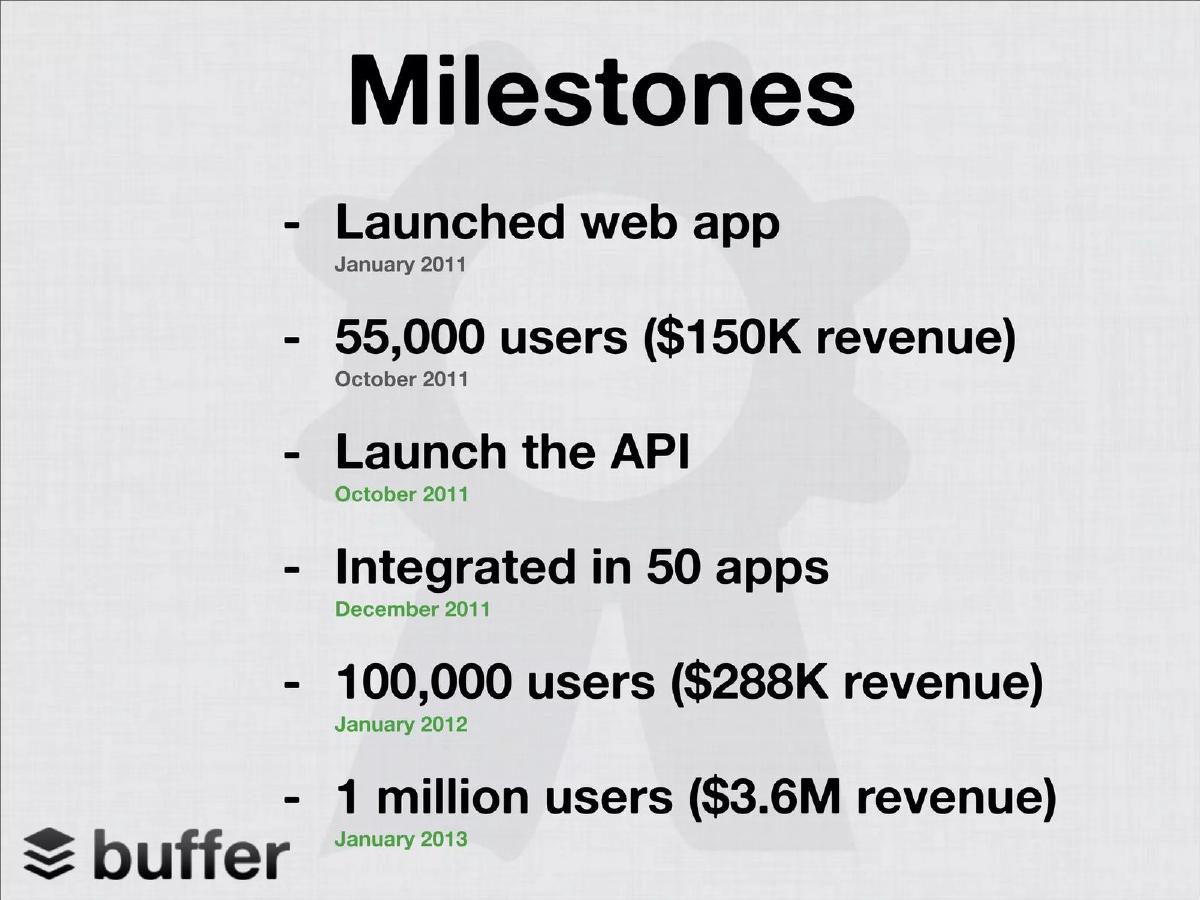
Slide 6 provides a timeline of achievements and future projections. It shows they launched the web app in January 2011 and reached 55,000 users by October 2011. The slide then projects forward to January 2013, aiming for 1 million users and $3.6M in revenue. This gives investors a sense of the founders' velocity and their ability to hit targets.
Slide 7: Business Model
Buffer explains their unit economics clearly here. They operate a freemium model with a 'consistent 2% conversion' rate. They disclose a 5% churn rate and a Lifetime Value (LTV) of $240. Crucially, they state they can pay up to $5 to acquire a free user. This shows they understand their math; if they spend $5 to get a free user, and 2% convert, they are effectively paying $250 to acquire a customer with a $240 LTV (nearly a 1:1 ratio at the time, which they likely intended to optimize).
Slide 8: Social Media Landscape
This slide reinforces the market size. It notes 200M daily Tweets (55% containing links) and 4 billion items shared on Facebook daily. It reiterates that social traffic is set to surpass search traffic. This slide acts as a 'TAM' (Total Addressable Market) proxy, suggesting that the sheer volume of links being shared creates a massive opportunity for a tool that optimizes that sharing.
Slide 9: The Effect of Buffering
Validation is key in a seed round. Buffer quotes ReadWriteWeb, stating that 'Buffer Finds Tweet Scheduling Can Increase Clicks by 200%.' This isn't just the founders making a claim; it is a recognized industry publication validating the product's efficacy. This helps de-risk the investment by proving the tool actually works for its users.
Slide 10: A Sharing Standard
Buffer reveals its true ambition here. They don't just want to be an app; they want to be a 'sharing standard.' They mention 6 existing integrations and that they are 'in talks' with Reeder, Pocket, and Feedly. By showing the Buffer icon inside an iPhone sharing menu, they illustrate a future where Buffer is the default engine for all social sharing across the mobile ecosystem.
Slide 11: Competitive Landscape
The competition slide uses a cluster map. They categorize competitors into 'Social Media Dashboards' (HootSuite, TweetDeck), 'Scheduling Apps' (Twuffer, SocialOomph), and 'Sharing Platforms' (AddThis, Shareaholic). Buffer places itself in the 'Intelligent Sharing' category alongside Timely and SocialFlow. This positioning is smart because it distances them from the crowded 'dashboard' space and aligns them with 'sharing,' which they previously established is growing exponentially.
Slide 12: Team and Advisors
The team slide focuses on execution speed. Joel Gascoigne is credited with taking the idea to revenue in 7 weeks. Leo Widrich is credited with the massive user growth. The 'Advisors' section is heavy-hitting, featuring Guy Kawasaki and Hiten Shah. They also list previous investors like AngelPad and Sierra Ventures, which provides social proof that other professional investors have already vetted the team.
Slide 13: Contact
The deck ends with a simple contact email. There is no 'Ask' slide in this version of the deck, which is a notable omission. Usually, a seed deck should specify how much capital is being raised and what it will be used for (e.g., hiring, marketing, product development).
What Makes This Deck Work?
The Buffer deck works because it is evidence-based . At the seed stage, most founders are selling a dream. Buffer was selling a machine that was already working. By slide 5, an investor already knows the business has users, revenue, and high margins. The rest of the deck simply provides the context for why that machine will get bigger. The use of 'Zuckerberg’s Law' provides a macro tailwind that makes the micro success of Buffer feel inevitable.
What Is Missing?
The most glaring omission is a clear Use of Funds or Ask slide. While the founders likely discussed this in person, a standalone deck should generally indicate the round size. Additionally, there is very little information on the Technology or Product Roadmap . We see the 'Queue,' but we don't see how the 'Intelligent Sharing' actually works or what features are coming next to maintain the 40% growth rate. Finally, the Financial Projections are limited to a single revenue milestone, lacking a detailed breakdown of expected expenses or headcount growth.
Founder Takeaways
Lead with Traction: If you have revenue and growth, put it early. Buffer put it on Slide 5, effectively ending the skepticism before the halfway point. · Simplify the Business Model: Buffer reduced their entire revenue engine to three bullet points: conversion rate, LTV, and CAC. This makes the business feel predictable and scalable. · Leverage Authority: If you don't have a long track record, use advisors and press quotes to build a 'halo effect' around your startup. · Positioning Matters: Don't just list competitors; group them. By creating a category called 'Intelligent Sharing,' Buffer avoided being compared directly to HootSuite, which was a much larger and more established player at the time.
Frequently asked questions
- How much money did Buffer raise with this deck?
- The deck itself does not state a specific 'Ask' or dollar amount being raised. However, historical records associated with this seed round indicate Buffer raised approximately $450,000. The omission of the 'Ask' in the public version of the deck is common to avoid legal solicitation issues or to allow for flexibility in different investor conversations.
- What were Buffer's key metrics at the time of the seed round?
- According to slide 5, Buffer had 55,000 total users, 800 of whom were paying customers. They were growing at a rate of 40% per month and had reached a $150,000 annual revenue run rate. Perhaps most impressively, they reported 97% margins, indicating very low infrastructure costs relative to their subscription revenue.
- How did Buffer define its competitive advantage?
- Buffer differentiated itself by focusing on 'Intelligent Sharing' and 'Sharing Platforms' (Slide 11) rather than being a full-featured social media dashboard like HootSuite. By positioning themselves as a 'sharing standard' that integrates into other apps like Pocket and Feedly (Slide 10), they aimed to be the plumbing of social sharing rather than just another destination site.
- What is 'Zuckerberg’s Law' mentioned in the deck?
- Buffer uses 'Zuckerberg’s Law' (Slide 2 and 8) to describe the trend of exponential growth in social sharing. Specifically, they quote that the amount a user shares today is twice what they shared a year ago. This serves as the macro-economic justification for a tool that helps users manage and schedule that increasing volume of content.
- Who were the key people involved in Buffer at this stage?
- The team consisted of Co-Founders Joel Gascoigne (CS background, took idea to revenue in 7 weeks) and Leo Widrich (marketer who grew the user base from 200 to 55,000). They were supported by advisors Guy Kawasaki (former Apple Evangelist) and Hiten Shah (KISSmetrics co-founder), and had previous backing from AngelPad (Slide 12).