Buildcon’s 2015 seed deck is a study in brevity and visual storytelling. Spanning just 9 slides, the presentation relies on high-impact imagery to convey the chaos of modern construction sites and the founder's personal connection to the industry. While the deck successfully establishes a massive market size of >$10T (Slide 7) and early traction of 15% week-over-week growth (Slide 8), it is notably light on technical details. There is no mention of unit economics, a specific fundraising ask, or a competitive landscape analysis. Despite these omissions, the deck secured $125,000 by positioning…
Key takeaways
- The deck highlights a critical industry pain point: 90% of construction projects lose money (Slide 3).
- A collage of spreadsheets, handwritten notes, and blueprints is used to visualize the 'chaos' of current workflows (Slide 4).
- The founder establishes 'founder-market fit' through a personal photo montage showing a lifelong history on construction sites (Slide 2).
- Market scale is defined by 1 million construction companies in the US and EU and a total industry size exceeding $10 trillion (Slide 7).
- Early traction is demonstrated by a 15% week-over-week growth rate and 52 companies signed up by the launch date (Slide 8).
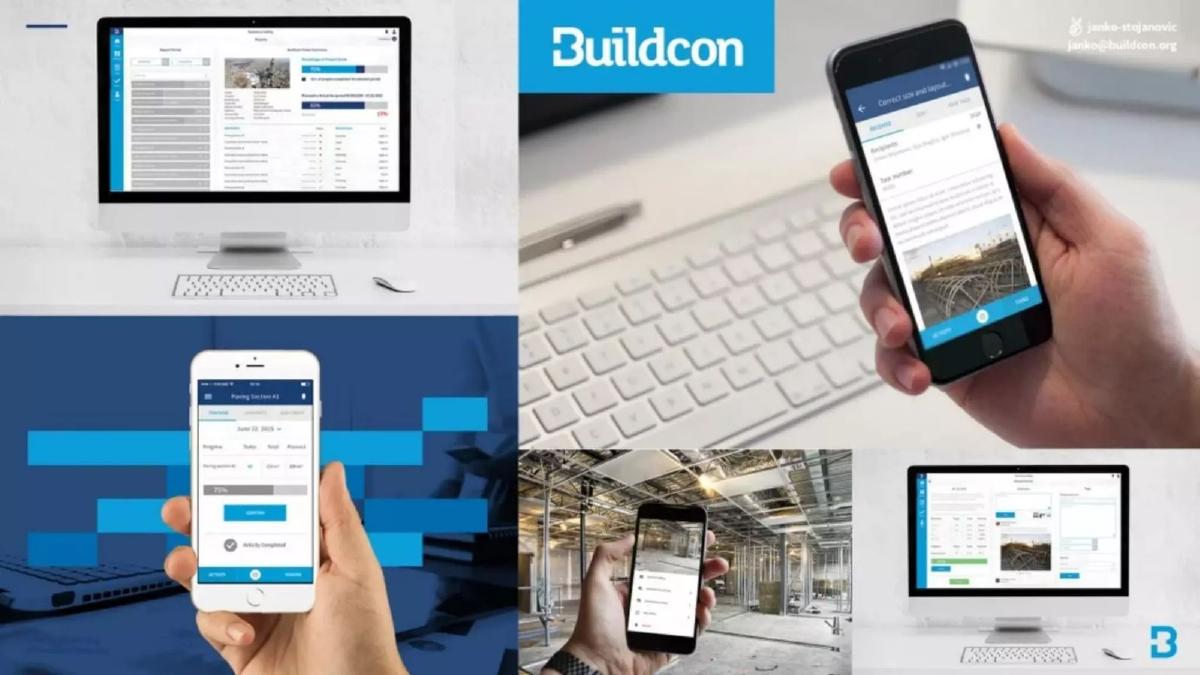
- The product is shown through high-fidelity mockups on both desktop and mobile devices, emphasizing cross-platform utility (Slide 6).
- The deck completely omits a business model slide, leaving the revenue generation strategy unexplained.
- There is no 'Ask' slide detailing how much capital is being raised or how it will be deployed.
Introduction: The 9-Slide Seed Pitch
Buildcon’s pitch deck is a minimalist artifact from the 2015 seed era. With only nine slides, it follows a narrative arc that prioritizes emotional resonance and market scale over granular operational detail. The company, which describes itself as a construction management web and mobile app, raised $125,000 using this presentation. The deck is characterized by high-contrast visuals, a lack of bullet points, and a heavy reliance on the founder's personal narrative to establish credibility in a notoriously difficult-to-disrupt industry.
Slides 1-2: The Hook and the Founder Story
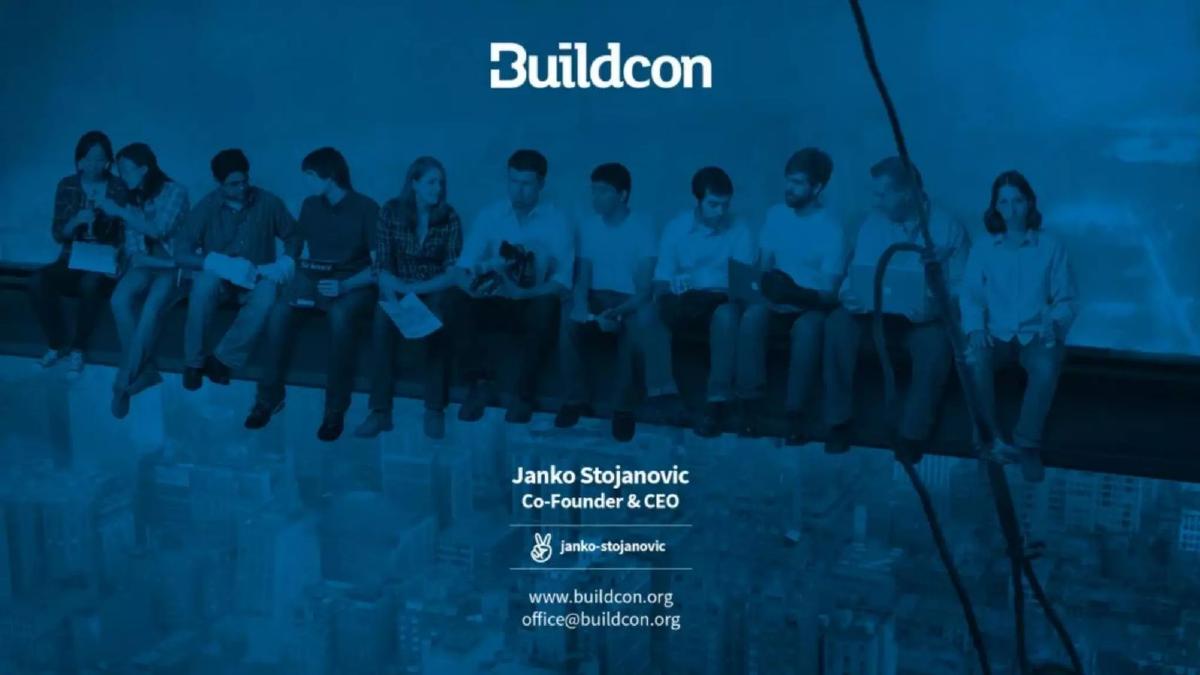
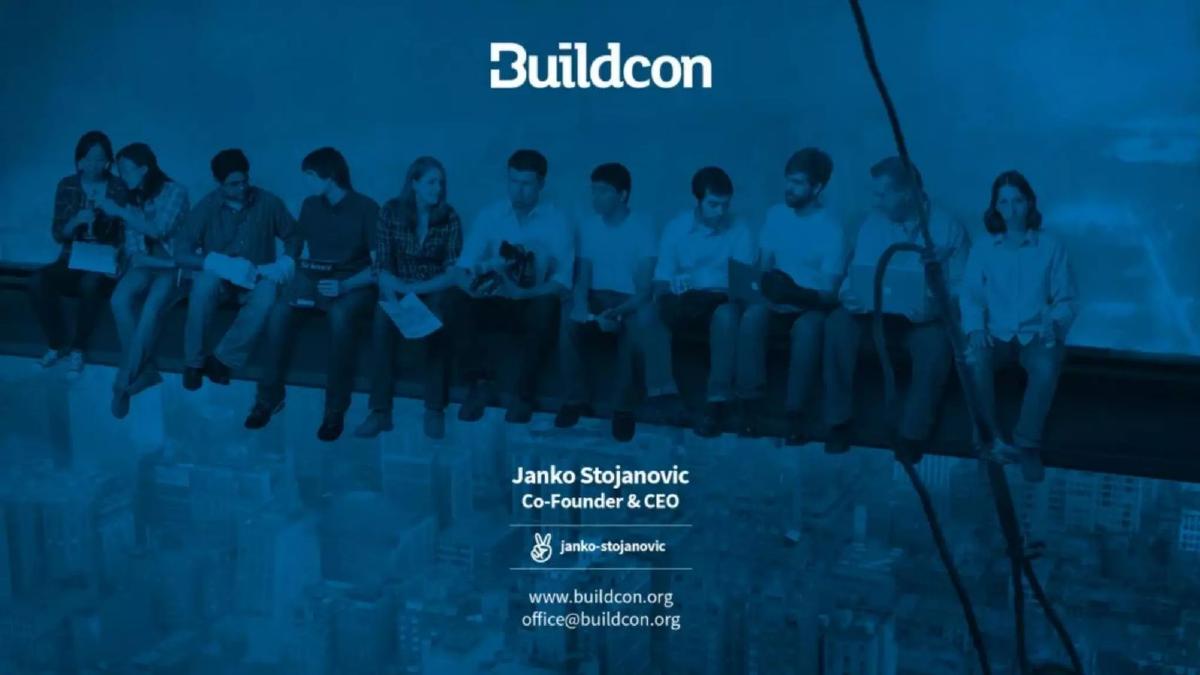
Slide 1 is the title slide, featuring the Buildcon logo over a blue-tinted image of workers sitting on a steel beam, reminiscent of the iconic 'Lunch atop a Skyscraper' photograph. It identifies Janko Stojanovic as the Co-Founder & CEO. This slide sets a professional, industry-specific tone immediately.
Slide 2 is an unconventional 'Origin Story' slide. Instead of listing professional accolades, it presents a collage of personal photographs showing a young child (presumably the founder) on various construction sites, operating heavy machinery, and standing with a father figure in construction gear. This is a strategic move to establish 'founder-market fit' without saying a word. It tells the investor that the founder didn't just stumble into this industry; he grew up in it, understands the dirt and the grit, and has a personal stake in solving its problems.
Slides 3-4: The Problem and the Chaos
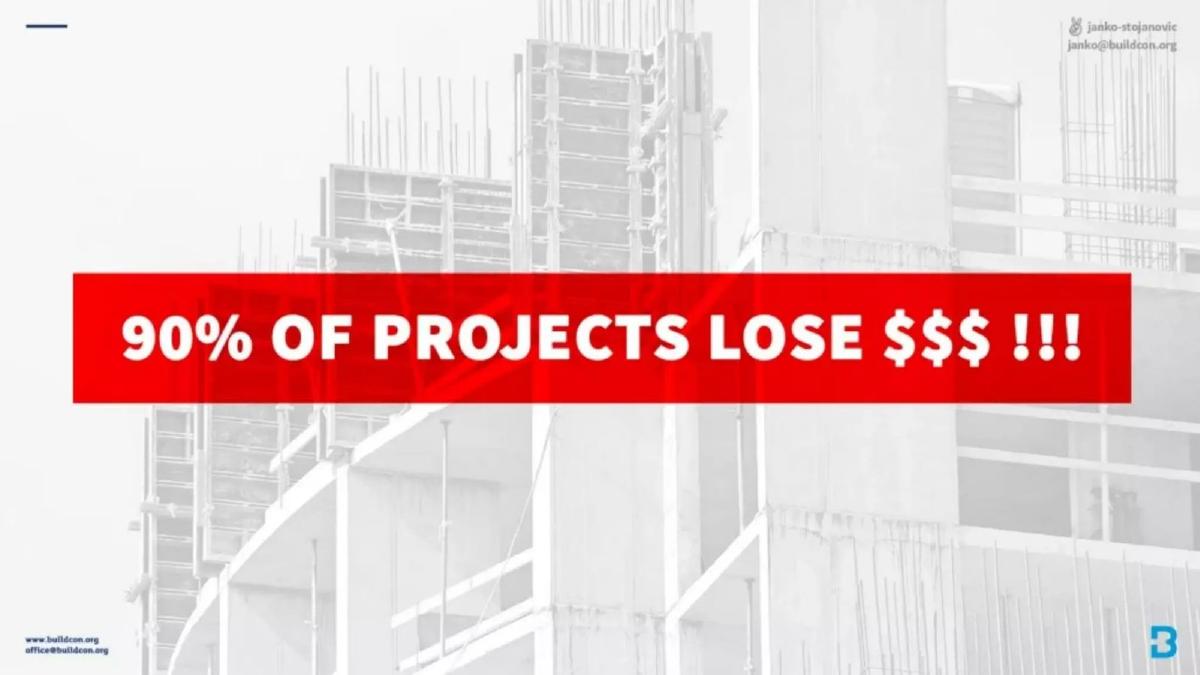
Slide 3 delivers a blunt, high-impact problem statement: '90% OF PROJECTS LOSE $$$ !!!' written in white text over a bright red banner. The background is a faded image of a concrete structure under construction. By leading with the financial failure of the industry, Buildcon frames its solution not as a 'nice-to-have' productivity tool, but as a financial necessity for survival.
Slide 4 visualizes the 'Why.' It is a chaotic collage of the current state of construction management: overlapping windows of complex Excel spreadsheets, handwritten notes on scrap paper, CAD drawings, and legacy Windows-based software. There is no text on this slide. The visual clutter is intended to make the investor feel the frustration of a project manager trying to coordinate a multi-million dollar project using fragmented, 20-year-old tools.
Slides 5-6: The Team and the Product
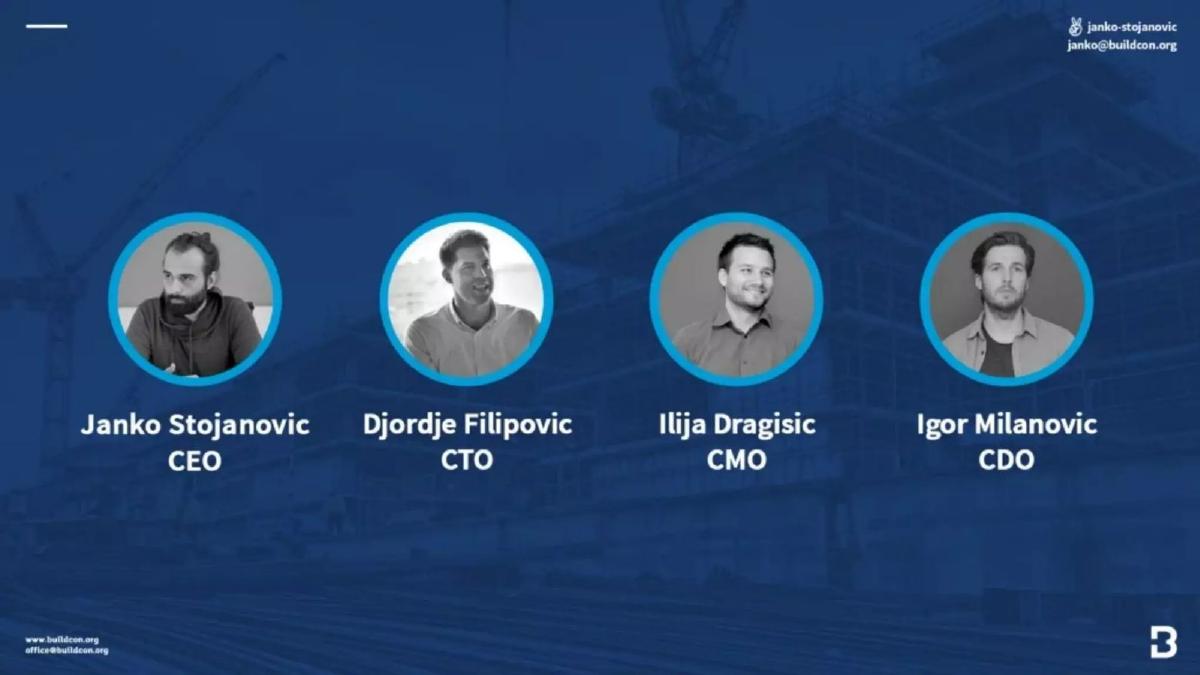
Slide 5 introduces the core team: Janko Stojanovic (CEO), Djordje Filipovic (CTO), Ilija Dragisic (CMO), and Igor Milanovic (CDO). The slide is clean, with black-and-white headshots in blue circles. However, it is missing any context regarding their backgrounds. There are no mentions of previous companies, successful exits, or specific technical expertise, which is a significant omission for a seed-stage deck where the team is often the primary investment criteria.
Slide 6 showcases the product. It uses a four-quadrant layout to show the Buildcon interface on a desktop monitor, an iPhone, and in a real-world site context (a hand holding a phone in an unfinished building). The UI appears clean and modern, contrasting sharply with the 'chaos' shown on Slide 4. The screenshots suggest features like task tracking, photo uploads, and progress reporting, though no specific feature list is provided.
Slides 7-8: Market Size and Traction
Slide 7 addresses the Total Addressable Market (TAM). It uses two large blue circles to highlight 'US + EU 1M construction companies' and an 'Industry Size > $10T.' By focusing on the US and EU, the deck suggests a global but manageable initial focus. The $10 trillion figure is a standard industry-wide stat used to signal that even a tiny fraction of the market represents a massive venture opportunity.
Slide 8 provides the 'Proof of Life.' It lists a 'FEB 2016 - LAUNCH' date, '52 COMPANIES' already on board, and '15% WOW' (Week-over-Week) growth. The bottom of the slide features photos of significant projects, including Lidl supermarkets and a large aquatic stadium. This slide is the strongest in the deck, as it proves that despite the lack of a detailed business model, the market is responding to the product.
Slide 9: The Summary and Contact
Slide 9 serves as the closing slide, repeating the core value proposition: 'MAKING CONSTRUCTION EASY.' It reiterates the three key pillars of the pitch: the '$10T INDUSTRY,' the '15% WOW' growth, and the fact that this is an 'UNDERSERVED SPACE.' It includes the CEO's contact information and social handles. The use of a 'crying face' emoji next to 'Underserved Space' is a rare moment of informal branding in an otherwise stark deck.
What Works in the Buildcon Deck
The most effective element of this deck is its visual storytelling . The transition from the 'Chaos' of Slide 4 to the 'Cleanliness' of Slide 6 is a classic 'Before and After' marketing tactic that works well in software pitches. By showing the mess of spreadsheets and paper, the founders make the case for a unified platform without needing to write long paragraphs of text.
Furthermore, the founder-market fit established on Slide 2 is powerful. In industries like construction, which are often resistant to outside 'tech disruptors,' showing that the leadership has deep roots in the field can alleviate investor fears about adoption and industry knowledge. The traction metrics on Slide 8—specifically the 15% week-over-week growth—provide the necessary momentum to justify a seed investment.
What is Missing from the Buildcon Deck
The deck is remarkably thin on business fundamentals . There is no mention of how Buildcon generates revenue. Is it a SaaS subscription? A per-project fee? A seat-based model? Without a business model slide, investors are left guessing about the path to profitability.
Additionally, the competitive landscape is entirely ignored. By 2015, companies like Procore (founded in 2002) and PlanGrid (founded in 2011) were already significant players in the space. Failing to acknowledge these competitors or explain Buildcon's unique differentiation is a major oversight that would likely be challenged in a live Q&A. Finally, the lack of an 'Ask' is notable. A fundraising deck should typically specify how much money is being raised and what milestones that capital will help the company reach.
What a Founder Should Copy
Founders should emulate Buildcon’s brevity . Each slide focuses on one single idea, making the deck very easy to digest in under three minutes. The use of high-quality, full-bleed imagery creates a professional aesthetic that makes the company feel larger and more established than a typical seed-stage startup might be.
The traction slide (Slide 8) is also a great template for early-stage companies. Instead of showing complex financial projections that are likely to be wrong, Buildcon focuses on 'Big Projects' and growth rates. Showing logos or photos of recognizable clients (like Lidl) provides instant social proof that is often more convincing to seed investors than a five-year revenue forecast.
Conclusion
Buildcon’s deck is a 'teaser' style presentation that relies on the massive scale of the construction industry and early signs of product-market fit to hook an investor. While it lacks the depth required for a Series A, its focus on the emotional pain of the customer (the chaos of the site) and the personal history of the founder makes it a compelling narrative for a $125,000 seed round. It proves that sometimes, a clear problem and a fast-growing user base are enough to get a foot in the door.
Frequently asked questions
- How much did Buildcon raise with this deck?
- According to the catalogue facts, Buildcon raised $125,000 in a Seed round in 2015. Interestingly, the deck itself does not include a slide specifying the amount they were seeking or the terms of the investment, which is a common omission in decks used for demo days or as teaser materials.
- What is the primary problem Buildcon aims to solve?
- The deck identifies financial loss as the primary problem, stating on Slide 3 that 90% of construction projects lose money. It attributes this to fragmented communication and data management, which Slide 4 illustrates through a messy collage of disparate tools like Excel, paper notes, and legacy software.
- Does the deck explain how Buildcon makes money?
- No. The 9-slide deck contains no information regarding the business model, pricing tiers, or sales strategy. It focuses entirely on the problem, the product interface, the market size, and early user traction metrics.
- What traction did the company have at the time of the pitch?
- Slide 8 lists several key traction metrics: a launch date of February 2016, 52 companies already using the platform, and a 15% week-over-week (WOW) growth rate. It also shows images of 'Big Projects,' including retail locations for Lidl and a large stadium/aquatic center.
- Who are the competitors mentioned in the deck?
- The deck does not mention any competitors. There is no competitive matrix or 'X vs. Y' slide. The founders rely on the 'underserved space' claim on Slide 9 to imply a lack of modern, effective competition rather than naming specific rivals like Procore or PlanGrid.