SplitBrick is a fractional real-estate investing platform whose 18-page August 2023 deck asks for roughly $200,000 at pre-seed. The company has real assets behind it: a working web and mobile MVP with bidding, governance ballots and Plaid/Dwolla banking, four founders spanning capital markets, software, property development and real-estate law, and $205,000 of founder savings already invested. The deck hides all of it — the product screenshots sit behind an 'Appendix' divider, the ask is a sub-bullet on a roadmap slide, traction is 96 landing-page email signups, and the securities question ev…
Key takeaways
- SplitBrick is a fractional real-estate investing platform; its investor deck runs 18 pages and was exported to PDF on 5 August 2023.
- The model is an Initial SplitBrick Offering (ISO): users propose a property, the crowd bids and collectively prices it, and each property sits in its own LLC with shares held pro rata to Bricks.
- The deck names three real competitors — RealT, Here and Landa — and compares six fee lines, with SplitBrick at a 5% onboarding fee, 0% AUM, 0% gross revenue fee, 10% profit share and 1% trading commission.
- Traction is one number: 96 email signups collected from a landing page in Q3 2022. There are no users, no onboarded properties and no seller LOIs.
- The founders disclose a ~$160,000 annual burn ($120k developer salary, ~$12k legal and accounting, ~$15k other, $0 marketing) and $205,000 already invested from their own savings.
- The ask — approximately $200,000 — appears as a sub-bullet on a roadmap slide, with no instrument, valuation, cap or milestone attached, and it barely covers one year of the stated burn.
- Securities regulation is never named: the deck says only that Brick trading is 'contingent on the completion of legal processes', despite a real-property LL.M. attorney sitting on the team slide.
- Slide 7 claims real-time market price discovery 'has never been done before in any crowdfunding market' — an absolute claim with no supporting reference.
What this deck actually is
This is an 18-page investor deck for SplitBrick, a fractional real-estate investing platform, exported to PDF from macOS on 5 August 2023 and circulated that autumn. It is a real founder deck, not a template and not a recreation: every slide contains content the team wrote, and the last six pages are screenshots of software that actually exists. The company is pre-revenue, pre-launch and asking for roughly $200,000 — a number that appears exactly once, in a sub-bullet, on the tenth slide.
The category is crowded and heavily regulated. Fractional real estate has been attempted by Fundrise, Arrived, Roofstock One, Lofty, RealT, Here and Landa, and every one of them has had to solve the same two problems: how to sell fractions of a property to retail investors without violating securities law, and how to make the fractions tradable. SplitBrick's deck is unusually clear-headed about the product it wants to build and unusually quiet about both of those problems.
What follows is a slide-by-slide read of all 18 pages, what the deck earns, where it would stall in a real meeting, and how the same material would be sequenced today.
Slide-by-slide walkthrough
Slide 1 — Cover: "Own a brick everywhere."
Five words, and they do more work than most cover slides manage in a paragraph. "Own a brick everywhere" carries the product mechanic (bricks are the share unit), the benefit (geographic diversification) and the emotional promise (ownership, not exposure) simultaneously. It is the best line in the deck. The cover does not carry a stage, a date, a raise amount or a contact address, which means the file circulates with no way to tell whether it is current or who to reply to.
Slide 2 — Our Mission
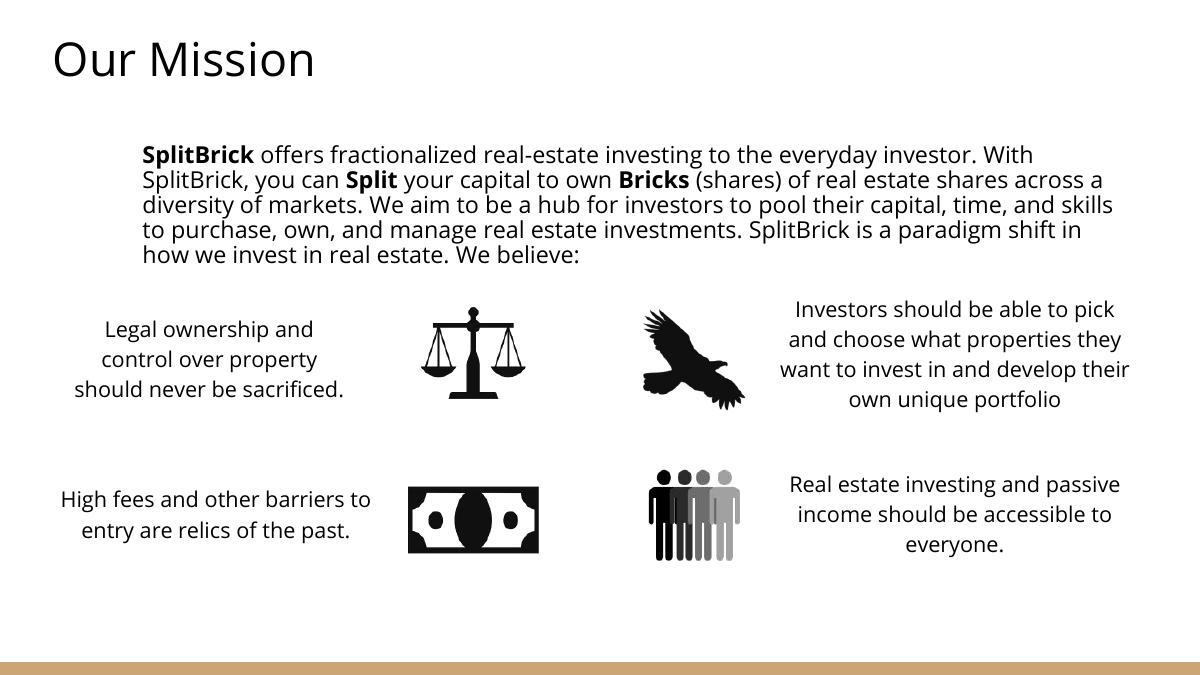
The mission slide defines the product in one sentence — "SplitBrick offers fractionalized real-estate investing to the everyday investor… Split your capital to own Bricks (shares) of real estate across a diversity of markets" — and then lists four beliefs: investors should pick their own properties and build their own portfolio; legal ownership and control should never be sacrificed; real estate investing and passive income should be accessible to everyone; high fees and other barriers to entry are relics of the past.
Those four beliefs are, in effect, the four differentiators the rest of the deck defends. That is a coherent structure. The problem is placement: this is slide 2, before the reader has been told what is broken. A manifesto delivered before a problem statement reads as opinion; delivered after, it reads as a conclusion.
Slide 3 — Real Estate Market: Investment Modality Comparison
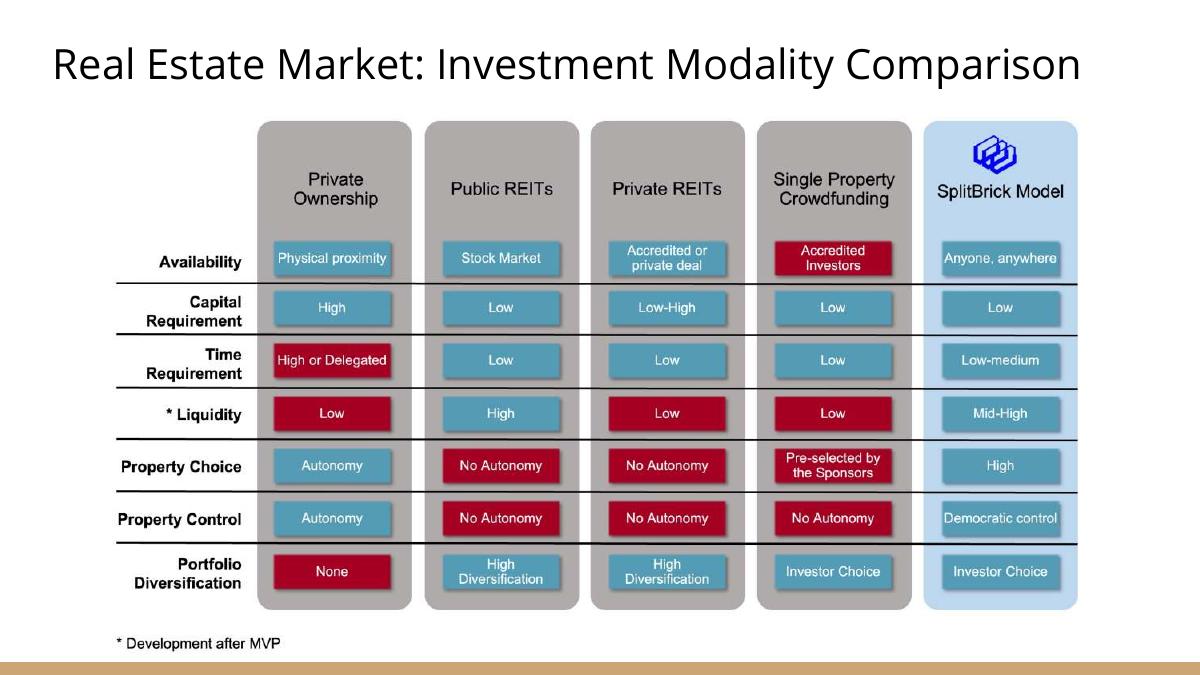
A matrix comparing direct property ownership, public-market real estate exposure and the SplitBrick model across physical proximity, capital requirement, liquidity, property choice autonomy, management autonomy and portfolio diversification. SplitBrick's column reads "anyone, anywhere", low capital requirement, liquidity, investor choice of property, and — the one term the whole deck rests on — "democratic control".
One asterisk on this slide matters more than the rest of it: liquidity is footnoted " Development after MVP". The single feature that makes fractional ownership feel like an investment rather than a commitment is, by the deck's own admission, not built. That footnote should not be a footnote.
Slide 4 — The SplitBrick Model
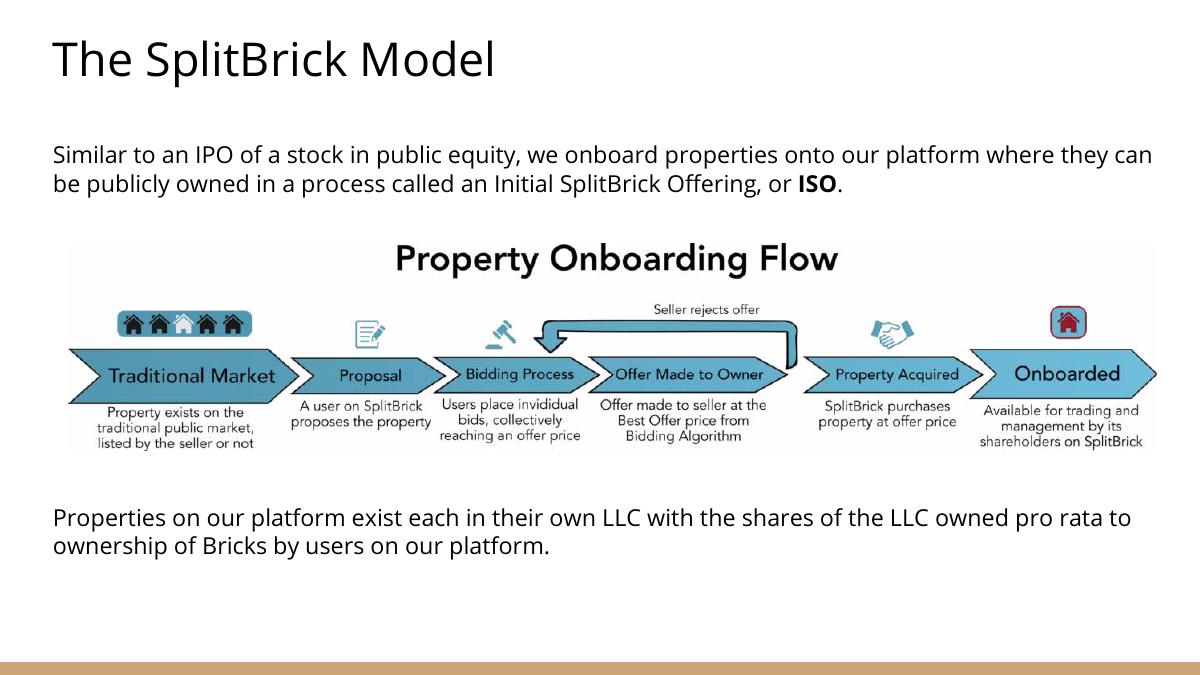
The mechanic, explained by analogy: "Similar to an IPO of a stock in public equity, we onboard properties onto our platform where they can be publicly owned in a process called an Initial SplitBrick Offering, or ISO." A five-step flow runs across the slide — a user proposes a property (listed or unlisted), users place individual bids that collectively reach an offer price, an offer is made to the seller at the best price from the bidding algorithm, SplitBrick purchases the property at the offer price, and the property becomes available for trading and management by its shareholders.
The structure is stated plainly: each property sits in its own LLC, and the LLC's shares are owned pro rata to Brick ownership. That is the right legal wrapper and the right slide to put it on. What is missing is the word "securities". An LLC membership interest sold to a pool of retail investors is a security in the United States, and the deck never says which exemption — Reg A+, Reg D, Reg CF, or a broker-dealer partnership — the ISO runs under.
Slide 5 — Market Analysis
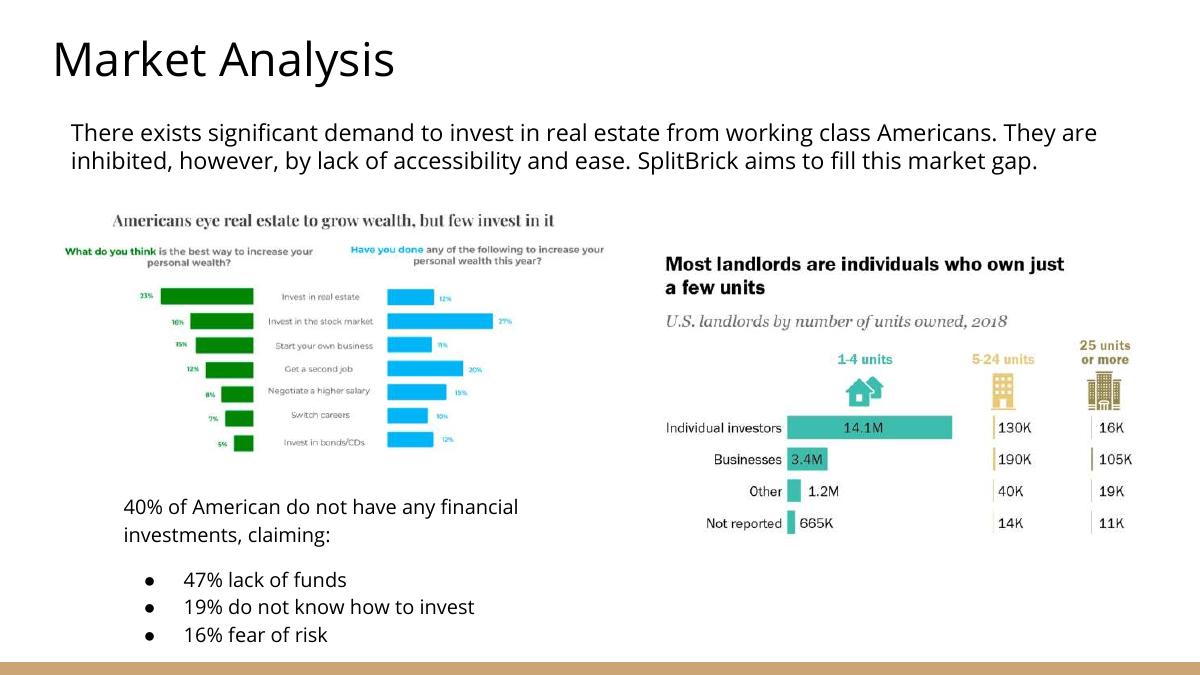
Two syndicated charts on Americans' attitude to real estate as a wealth vehicle, plus a breakdown of US landlords by number of units owned showing that most landlords are individuals with only a handful of units. Underneath, the headline statistic: 40% of Americans do not have any financial investments, citing 47% lack of funds, 19% do not know how to invest, and 16% fear of risk.
This is the weakest analytical slide in the deck, and it is weak in a way that is very common. "47% of people don't invest because they lack funds" is evidence that a large population cannot buy, not evidence that they will buy. There is no TAM, no serviceable market, no estimate of how many dollars a realistic cohort of users would deposit, and no citation dates on the charts. The landlord-concentration chart is genuinely interesting — a market of small individual owners is a supply-side opportunity for a platform that can aggregate them — but the deck never connects it to the ISO flow on the previous page.
Slide 6 — Market Competition: SplitBrick is better
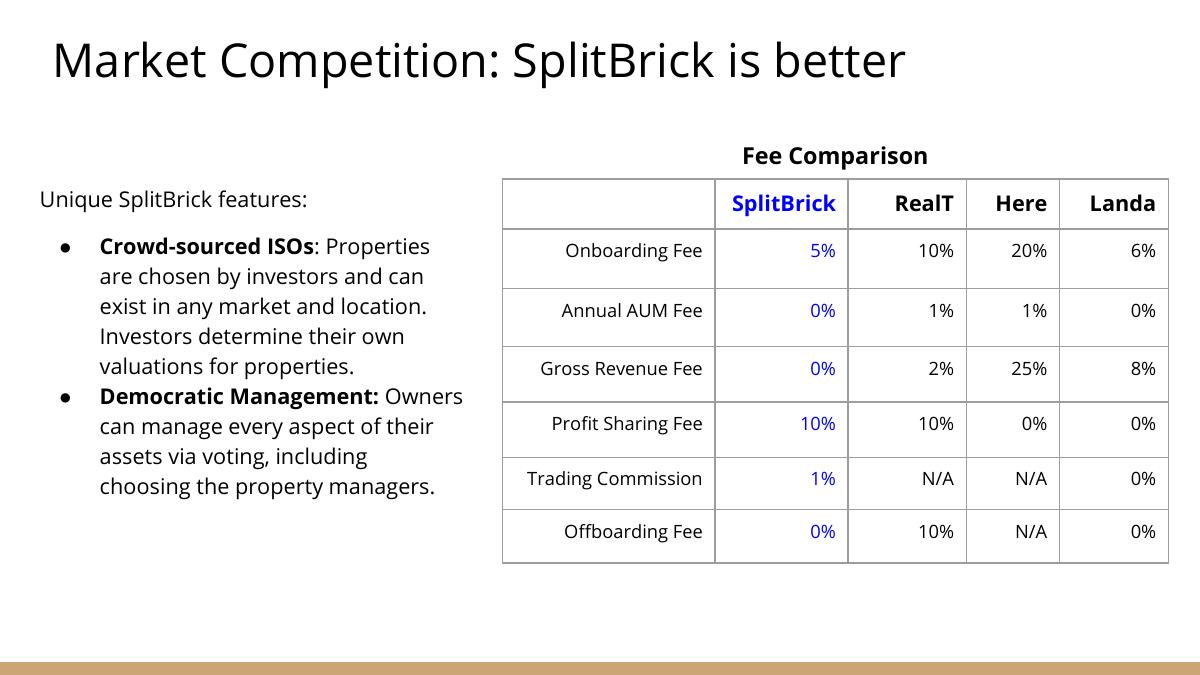
A direct fee comparison against RealT, Here and Landa. SplitBrick charges a 5% onboarding fee (RealT 10%, Here 20%, Landa 6%), 0% annual AUM (RealT and Here 1%), 0% gross revenue fee (RealT 2%, Here 25%, Landa 8%), 10% profit sharing (RealT 10%, Here and Landa 0%), 1% trading commission, and 0% offboarding (RealT 10%). Alongside it, two claimed unique features: crowd-sourced ISOs, where properties are chosen and valued by investors and can exist in any market; and democratic management, where owners vote on every aspect of the asset including who manages it.
Naming three real competitors with real numbers is more than most decks do, and the fee table is the most investor-legible page in the file. But a table whose thesis is "we charge less than everyone" invites the obvious question the deck never answers: at those rates, what does SplitBrick earn per property, and how many properties does it need to cover a $160,000 annual cost base? The competitive claim is priced; the business it implies is not.
Slide 7 — Crowd-sourced ISOs
The mechanic in detail. Any user can search for a property they want to invest in, post an investment proposal, and let other users bid on it. If sufficient funds are raised, the funds acquire the property and ownership is divided into Bricks pro rata to the bidders. The slide claims a "unique crowdfunding algorithm that allows markets to collectively value a property" and states that "real time market price discovery has never been done before in any crowdfunding market."
This is the genuinely novel idea in the deck — user-originated deal flow with collective valuation is different from the curated-inventory model every competitor runs — and it is also the most dangerous sentence. "Never been done before" is an absolute claim made without a single supporting reference, and a real-estate investor will immediately think of auction mechanics, Reg CF pricing rounds and tokenized property order books. Worse, the model creates a failure mode the deck never addresses: what happens when a crowd of amateur bidders collectively overvalues a house, or when a proposal raises 60% of its target and stalls.
Slide 8 — Democratic Management
The governance system. Owners co-manage their investments democratically, with participation optional — a passive investor can stay passive. Users vote on important decisions but elect a local property manager for day-to-day operations. The safeguard is a dual-consensus rule: a ballot requires sufficient consensus among exercising capital power, measured by percentage ownership, and among a majority of investors, which the deck says protects smaller holders.
The dual-consensus design is thoughtful and it is the sort of detail that signals the team has thought past the demo. It also raises an operational question worth pre-empting: an LLC with hundreds of member-voters and an elected property manager is a governance load, and the deck offers no view on quorum failure, deadlock, or what happens when a roof needs replacing and the vote does not pass.
Slide 9 — Roadmap and Financing (part one)
The history, dated: idea inception and planning in Q3 2021; development begins in Q1 2022 with one full-time full-stack developer and two part-time developers; Q3 2022 brings an email signup list of 96 investors who expressed interest via the landing page; from Q4 2022 the team hires lawyers and accountants to legally validate and formalise its processes; Q2 2023 delivers the MVP of the web and mobile platforms, including the ISO process and democratic management, with real-time Brick trading listed as an upcoming feature "contingent on the completion of legal processes."
Two years of consistent execution on savings, shipped to an MVP, is a real credential. But this is also the traction slide, and the only traction number on it is 96 email signups from a landing page — no users, no properties onboarded, no seller LOIs, no waitlist deposits. A deck that has a working product and no evidence of demand should be spending its energy converting the former into the latter.
Slide 10 — Roadmap and Financing (part two)
The financial page, and the most honest slide in the deck. Current expenses over the past twelve months run about $160,000 a year: $120,000 base salary for one full-stack developer, roughly $12,000 in legal and accounting, roughly $15,000 in other expenses, and $0 in marketing, with $5,000–$10,000 of marketing expected in the next twelve months. Total invested to date is $205,000, all from co-founders' savings. The plan forward is to begin marketing, gather feedback from real users, and fund the legal work that would let SplitBrick facilitate trading of Bricks. The ask: "To acquire ~$200k in funding: Provides us with at least 1 year of funding with additional funds to supercharge marketing and legal research & endeavours."
$205,000 of founder money already in is a strong signal, and a cost base disclosed line by line is rarer than it should be. The problems are structural. The ask is a sub-bullet on a roadmap slide rather than its own page. There is no instrument, no valuation, no cap, no equity offered. $200,000 buys one year of the current burn with essentially nothing left over — the same slide promises to "supercharge" both marketing and legal on a budget of $5,000–$10,000 for marketing. And the milestone the money is supposed to buy is never named: what specifically must be true twelve months from now for the next round to happen?
Slide 11 — The Team
Four people. Veb Anand, BS Computer Science and Business Economics, Caltech 2019 — data science and software development at a data analytics startup, and an analyst on an equities trading team at a hedge fund managing over $48 billion. Pedro Ojeda, BS Bioengineering, Caltech 2018 and MS Immunology, Harvard 2020 — founder of an information consulting business and a private real estate developer. James Fox, BS Computer Science with a mathematics minor, University of Nebraska 2020 — full-stack development at BuilderTrend, Ideal Industries, QSRSoft and SplitBrick. Maria Ojeda, Esq., BBA Business Law, University of Miami 2015, with a JD and an LL.M. in Real Property Development from Miami 2019 — real property acquisition, leasing and sales, and counsel to financial institutions on real estate financing.
For this specific company, that is close to an ideal founding table: capital markets, software, private real estate development, and a real-estate finance attorney with an LL.M. in the exact subject matter. The slide undersells all of it. There is no statement of who is full-time, no equity split, no indication that the attorney's presence is the answer to the securities question the deck otherwise ducks. A reader who skims will see four CVs; a reader who thinks will realise the regulatory risk is partly staffed — and the deck should have said so out loud.
Slide 12 — Appendix
A divider. Everything after it is product proof, which is a sequencing decision worth arguing with.
Slide 13 — MVP: front page and property search
Screenshots of the live web app: the front page and the property search interface. This is the first visual evidence that the company has built anything, and it arrives on page 13 of 18, behind a slide labelled "Appendix".
Slide 14 — Proposals
Two screens: viewing currently proposed properties, and drafting a new proposal. This is the crowd-sourced ISO mechanic from slide 7, working. The gap between "we have a unique crowdfunding algorithm" as a claim and "here is the proposal drafting screen" as an artifact is enormous, and the deck puts five slides between them.
Slide 15 — Portfolio
The investor's own view — owned properties and properties with active bids, in both list and tile layouts. Small detail, real product maturity: someone thought about how a user with twelve fractional positions actually reads them.
Slide 16 — Pre-ISO Property
The bidding section, where users place bids with a specified bid amount and their own valuation of the property. This screen is the market-price-discovery claim rendered as an interface. It is the single most persuasive image in the file.
Slide 17 — Onboarded Property
Post-ISO property pages showing financial history, ownership distribution, and the governance surface from which ballots can be created. Democratic management, built rather than described.
Slide 18 — Banking, transaction history, notifications and MFA
The compliance-adjacent plumbing: Plaid and Dwolla integrated for identity verification, bank verification and transfers, plus two-factor authentication by email and authenticator app. Identity verification and ACH rails are exactly the infrastructure a fintech investor probes for, and the deck answers the question on its last page, in an appendix, in small type.
What this deck does better than most startup pitch decks
A cover line that does three jobs. "Own a brick everywhere" states the unit, the benefit and the feeling in five words. Most cover slides state a category. · Named competitors with real numbers. RealT, Here and Landa, compared across six fee lines. Founders usually either avoid competitors or draw a two-by-two with themselves in the corner. · Disclosed cost structure. $120,000 developer salary, $12,000 legal, $15,000 other, $0 marketing, ~$160,000 a year total. That level of candour about burn is rare at pre-seed and it makes every other number more credible. · $205,000 of founder capital already in. Skin in the game, stated plainly, with the source named as co-founders' savings. · A shipped MVP with screenshots. Web and mobile, ISO flow, portfolio views, bidding, governance ballots, Plaid and Dwolla, and 2FA. Most pre-seed decks in this category are wireframes. · A governance design with a real safeguard. Requiring consensus among both capital weight and a majority of investors is a considered answer to the "whales control everything" objection nobody had asked yet. · The legal wrapper stated up front. One LLC per property, shares held pro rata to Bricks. Many fractional-ownership decks leave the reader guessing what they are actually buying. · A dated, honest roadmap. Quarter-by-quarter from Q3 2021, including the unglamorous quarters spent with lawyers and accountants.
Where this deck would fail in an investor meeting
The securities question is never named. Selling LLC interests in a property to a pool of retail investors, then letting them trade, implicates securities registration and potentially broker-dealer or ATS requirements. The deck says only that trading is "contingent on the completion of legal processes." An investor will ask which exemption, which counsel, which timeline, and what it costs. · The ask is buried. "~$200k" appears as a sub-bullet on the second roadmap slide, with no instrument, no valuation, no cap and no milestone attached. · $200,000 does not fund the plan. The same page reports a $160,000 annual burn and promises to accelerate both marketing and legal work. The arithmetic leaves roughly $40,000 to do both. · 96 email signups is the entire demand evidence. No users on the MVP, no properties onboarded, no seller conversations, no deposits. · "Never been done before in any crowdfunding market" is unsupported. One unverifiable absolute claim invites a reader to distrust the verifiable ones. · No revenue model. A 5% onboarding fee, 10% profit share and 1% trading commission are listed as competitive positioning, never modelled into revenue per property or a path to covering burn. · No customer acquisition plan. Marketing spend to date is $0, planned spend is $5,000–$10,000, and there is no channel, no CAC estimate and no view on which side of the marketplace gets acquired first. · The market slide argues the wrong point. "47% don't invest because they lack funds" describes a population with no capital, which is the opposite of the deposit base a marketplace needs. · The best material is in the appendix. Six pages of working product, sitting behind a divider slide, after the ask. · No contact details anywhere. Eighteen pages, four named founders, no email address.
What the deck says versus what a 2023 pre-seed investor needed to see
Question in the room What the SplitBrick deck provides What would have closed it
Is this legal? "Contingent on the completion of legal processes"; an attorney on the team slide A named exemption path (Reg A+ / Reg D / Reg CF), counsel engaged, cost and timeline to first compliant ISO
Does anyone want it? 96 landing-page email signups; national statistics on non-investors Waitlist conversion, MVP signups, one property proposal with real bids, or seller LOIs
How do you make money? A fee table positioned against three competitors Revenue per $500k property, properties needed per month to reach breakeven at $160k burn
What are you raising? "~$200k" as a sub-bullet A dedicated ask slide: amount, instrument, valuation or cap, 12–18 month use of funds, and the milestone it buys
Can this team build it? Four strong CVs, an MVP, $205k of own capital The same, plus who is full-time, equity split, and the explicit line that the securities risk is staffed in-house
Why now? Not addressed Reg CF limit increases, tokenization infrastructure maturity, rate-driven shifts in small-landlord supply
How you would rebuild this deck today
Open on the product, not the manifesto. Cover, then one slide of the bidding screen from page 16 with a single sentence: users propose a property, the crowd prices it, the crowd owns it. Proof in the first ninety seconds. · Make one slide the regulatory slide. Name the exemption, name the counsel, show the timeline to the first compliant ISO and the cost. In this category, the founder who addresses it first is the credible one — and with a real-property LL.M. on the team, SplitBrick had the strongest possible person to put on that page. · Rewrite the market slide around supply. Drop the "40% of Americans have no investments" framing and build on the landlord-concentration chart already in the deck: millions of small individual owners, illiquid positions, no exit mechanism short of a full sale. · Model the fee table. Keep the competitor comparison, then add one line: revenue per property at the average target price, properties per month to breakeven, and the assumption behind each. · Convert the MVP into traction before the next send. Ten real users, one live proposal, three seller conversations. Any of those beats 96 email addresses, and the product to generate them already exists. · Give the ask its own slide, and size it to the plan. If the plan is a year of runway plus meaningful legal and marketing spend, the number is not $200,000. State the instrument, the milestone, and what the round proves. · Promote the appendix. Move the six product screens into the main body, immediately after the model slide, and cut the mission slide's four beliefs down to one line each. · Delete the absolute claim. Replace "has never been done before in any crowdfunding market" with the mechanism and a comparison to how curated platforms price inventory. The mechanism is impressive enough without the superlative. · Put contact details on the last page. Names, roles, one email, one link to the MVP.
The transferable lesson
SplitBrick's deck fails in a way that should be encouraging to any founder reading it: nothing wrong with it is a problem with the company. The team is well-matched to the category, the product is built, the founders have put in $205,000 of their own money, and the core mechanic is genuinely differentiated. What the document does is bury all of that. The strongest evidence sits behind a slide labelled "Appendix". The ask hides in a sub-bullet. The one risk every investor in this category will lead with is answered in a half-sentence, even though the person who could answer it properly is on the team slide.
That is the most common failure mode in pre-seed decks, and it is entirely fixable: the deck is ordered by how the founders built the company rather than by what the reader needs to believe, in the order they need to believe it. Before you send yours, check whether your best proof is in the appendix and your biggest risk is in a footnote. If it is, you are not raising against your company — you are raising against your table of contents.
Frequently asked questions
- What is SplitBrick?
- SplitBrick is a fractional real-estate investing platform that lets everyday investors buy Bricks — shares in individual properties — across multiple markets. Each property is held in its own LLC, with LLC shares owned pro rata to Brick ownership. Users propose properties, bid to collectively price them, and then co-manage the asset through a voting system. The company's 2023 deck describes an MVP of the web and mobile platforms completed in Q2 2023.
- Is the SplitBrick deck a real investor pitch deck?
- Yes. It is an 18-page investor deck exported to PDF on 5 August 2023, containing mission, market, competition, model, roadmap, financing and team slides, plus a six-page appendix of screenshots from the working MVP. It is a genuine founder-written fundraising document, not a template or a reconstruction, and it discloses actual company costs and founder capital invested.
- How much was SplitBrick raising and at what stage?
- The deck asks for approximately $200,000, described as at least one year of funding with extra money for marketing and legal work. It is a pre-seed, pre-revenue raise: the product had reached MVP, the founders had put in $205,000 of their own savings, and annual expenses ran around $160,000. No instrument, valuation, cap or equity percentage is stated anywhere in the deck.
- What is an Initial SplitBrick Offering (ISO)?
- An ISO is SplitBrick's property-onboarding process, described in the deck as analogous to an IPO. A user proposes a property, other users place individual bids with their own valuations, a bidding algorithm produces a best offer price, an offer is made to the seller, and once purchased the property's ownership is divided into Bricks pro rata to the bidders. Each property is held inside a dedicated LLC.
- Which slides should founders copy from the SplitBrick deck?
- Three. The cover — 'Own a brick everywhere' — packs the unit, the benefit and the feeling into five words. The fee comparison names RealT, Here and Landa across six pricing lines instead of drawing a flattering two-by-two. And the financing slide discloses the full cost base line by line plus $205,000 of founder capital, which makes every other number in the deck more credible.
- What is the biggest weakness in the SplitBrick pitch deck?
- Sequencing and omission. The strongest evidence — six pages of working product including bidding, governance ballots and Plaid/Dwolla banking — sits behind a slide labelled 'Appendix', after the ask. The ask itself is a sub-bullet. And the first question any investor asks a fractional real-estate startup, which securities exemption the offering runs under, is answered only as 'contingent on the completion of legal processes'.