The GEOPON pitch deck, dating to approximately 2014, presents a solution for the friction inherent in traditional paper-based couponing. By leveraging geo-fencing, indoor mapping, and social media algorithms, GEOPON aimed to bridge the gap between local merchants and mobile-savvy consumers. The deck effectively identifies the pain points for both sides of the marketplace: consumers forgetting physical cards and merchants lacking ROI data. While the market opportunity slide cites impressive growth figures—projecting mobile payments to reach $618 billion by 2016—the deck is notably thin on busi…
Key takeaways
- The platform utilizes geo-location, geo-fencing, and indoor mapping to deliver relevant coupons and loyalty cards to consumers (Slide 2).
- Consumer pain points focus on the inconvenience of physical circulars and forgotten loyalty cards, while merchants struggle with high costs and unknown ROI (Slide 3).
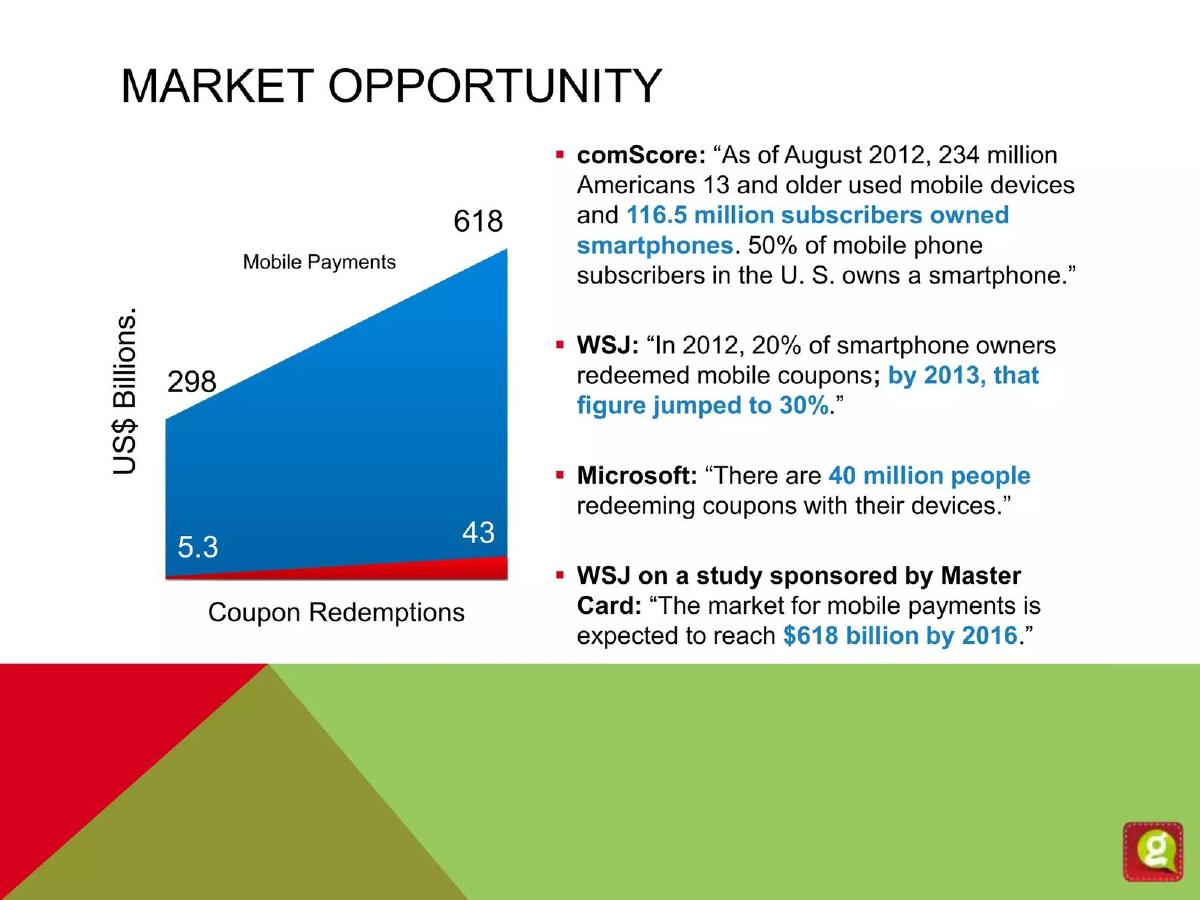
- Market data from 2012-2013 shows a jump in mobile coupon redemption from 20% to 30% among smartphone owners (Slide 4).
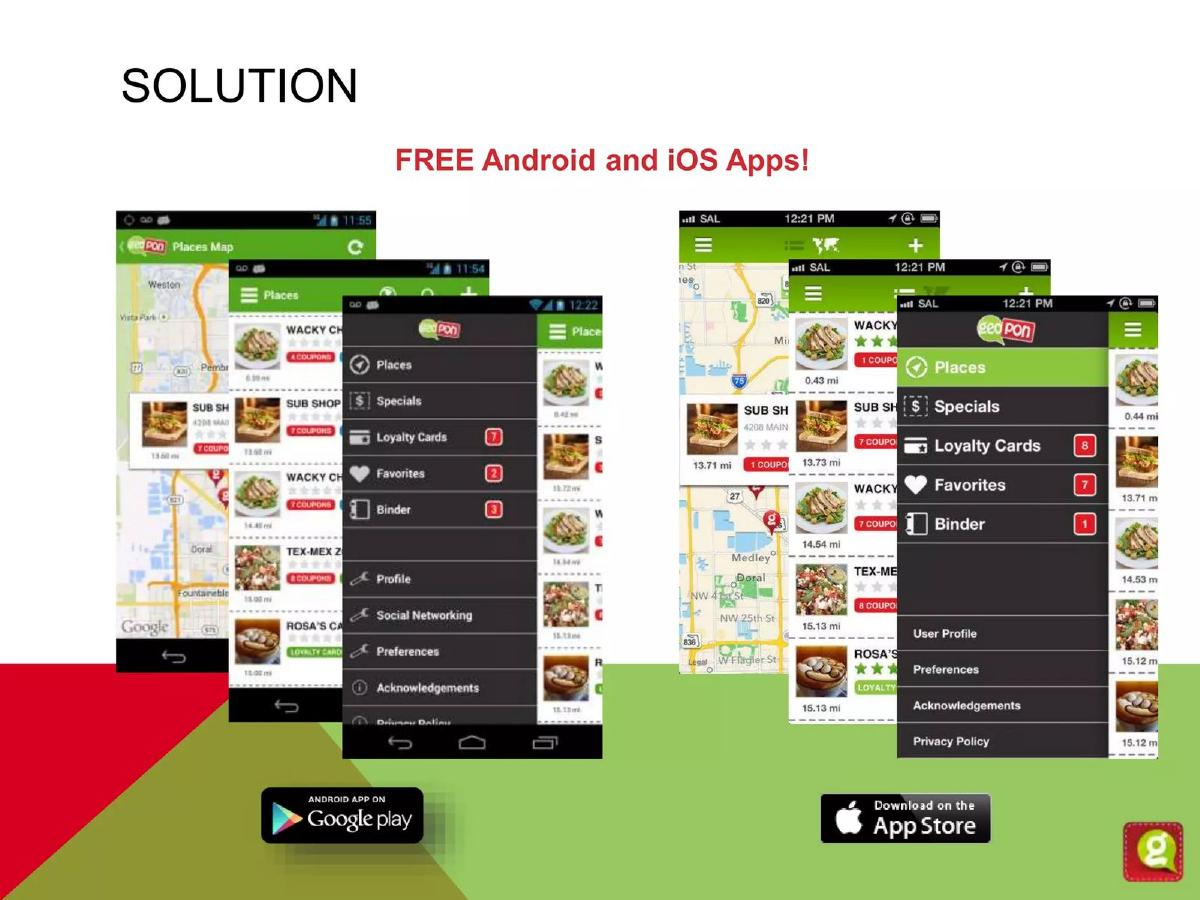
- The product includes free Android and iOS applications featuring a 'Binder' for saved offers and a 'Places' map view (Slide 6).
- Merchant tools include a 5-step registration wizard and a web-based CMS with real-time analytics and mobile previews (Slide 7).
- The competitive landscape analysis claims GEOPON is the only player offering a 'Knowledge Engine' and branded loyalty cards compared to Foursquare or Shopkick (Slide 8).
- The leadership team brings over 20 years of combined experience in electronic payments and internet marketing (Slide 9).
- The deck completely omits a financial ask, revenue projections, or a specific roadmap for scaling the business (General observation).
GEOPON Pitch Deck Analysis
The GEOPON pitch deck is a concise 11-slide presentation that focuses on the transition from physical to digital local advertising. Published around 2014, it targets the burgeoning mobile-first consumer market and the underserved small business sector. The deck follows a standard problem-solution-market structure but lacks the financial depth required for a late-stage investment round.
Slide 1: Title Slide
The cover slide is minimalist, featuring the company name GEOPON and the tagline "THE ULTIMATE ADVERTISEMENT PLATFORM." The design uses a diagonal split with red, olive, and light green colors, establishing a brand identity that is carried throughout the deck. It is a functional, if unremarkable, opening.
Slide 2: Introduction and Value Proposition
Slide 2 defines GEOPON as a mobile advertisement platform. It explicitly lists the delivery mechanisms: coupons, weekly ads, and loyalty cards. The slide also highlights the technical stack, mentioning geo-location, geo-fencing, indoor mapping, and proprietary social media aware algorithms . This slide does a good job of summarizing the "what" and the "how" in a single view.
Slide 3: Problem(s)
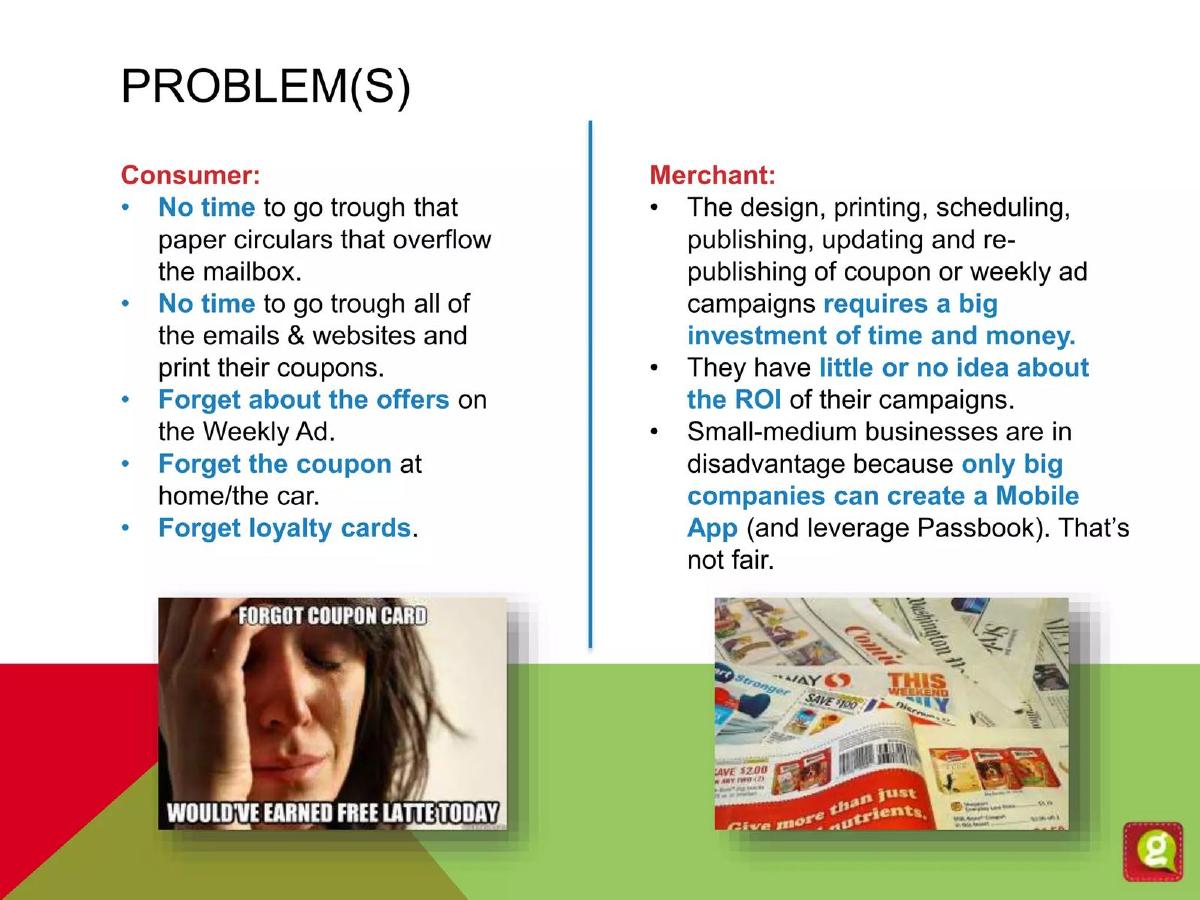
The deck splits the problem into two categories: Consumer and Merchant. For consumers, the focus is on time and memory—specifically the nuisance of paper circulars and the tendency to forget physical coupons or loyalty cards at home. For merchants, the deck identifies high costs, lack of ROI tracking, and the technical barrier to entry for mobile apps. The inclusion of a "Forgot Coupon Card" meme image reflects the informal pitch style common in the mid-2010s.
Slide 4: Market Opportunity
This slide uses third-party validation to build a case for the platform. It quotes comScore (234 million Americans using mobile devices as of August 2012), the WSJ (mobile coupon redemption jumping to 30% by 2013), and Microsoft (40 million people redeeming coupons). The most significant figure is a projection that the mobile payments market would reach $618 billion by 2016 . The chart visualizes the growth of mobile payments versus coupon redemptions, though the two metrics are not perfectly synonymous.
Slide 5: Solution (Consumer)
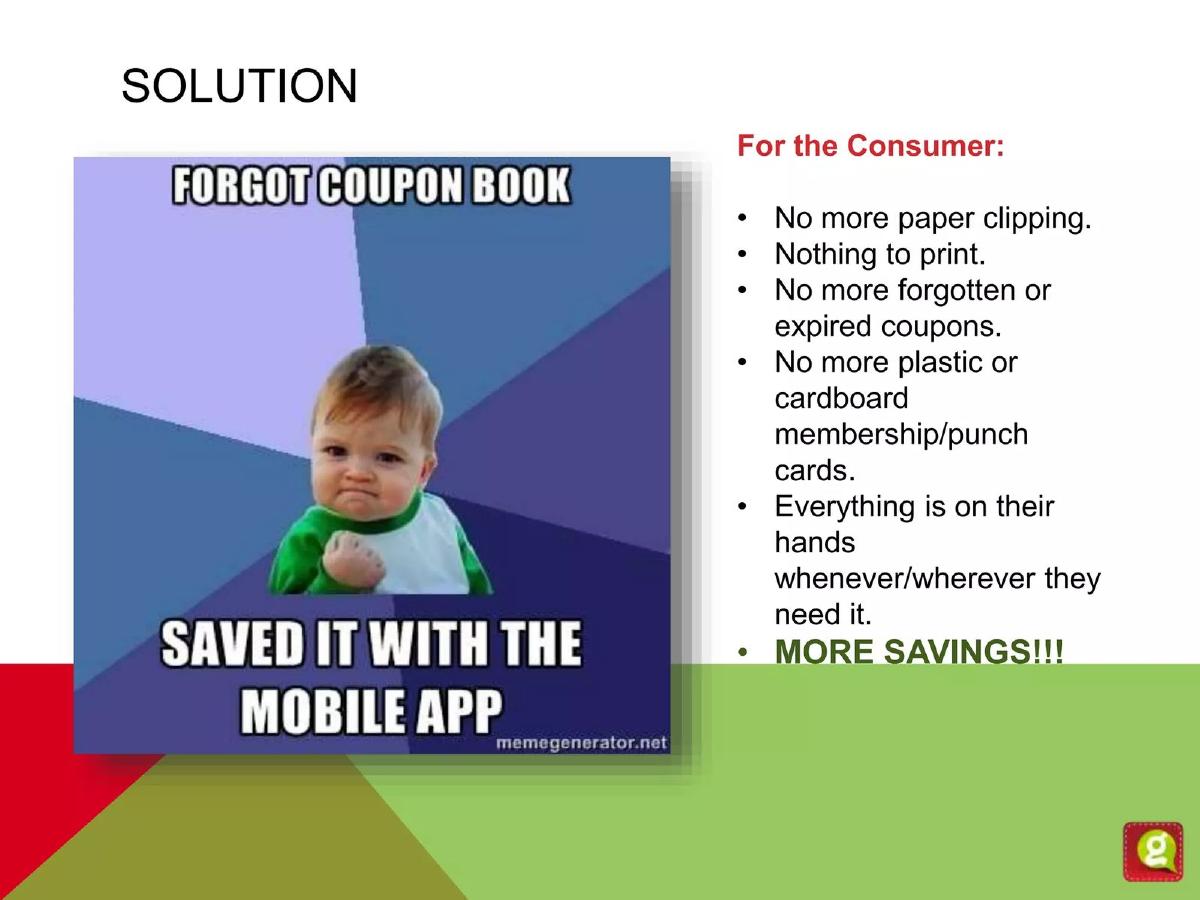
Continuing the use of internet memes, this slide features the "Success Kid" to represent the consumer solution. The bullet points are straightforward: no paper clipping, nothing to print, and no more plastic cards. The core value is that everything is available on the user's phone whenever they need it.
Slide 6: Solution (Product Screenshots)
Slide 6 displays the actual user interface for both Android and iOS. The screenshots show a "Places Map," a list of nearby deals (e.g., "Wacky Chicken," "Sub Shop"), and a digital "Binder" for saved coupons. This slide is critical as it proves the product is more than just a concept; it is a functional application with a clear UI/UX.
Slide 7: Solution (Merchant)
This slide addresses the B2B side of the marketplace. It describes a 5-step Web registration wizard and a web-based CMS. Key features for business owners include real-time analytics and a "Media Kit" that includes physical posters and stickers. The slide emphasizes a "cost effective model" similar to Google AdSense, hinting at a pay-per-performance or flat monthly fee revenue model, though specific pricing is not disclosed.
Slide 8: Competitive Landscape
The competitive matrix compares GEOPON against Redplum, SmartSource, Foursquare, RetailMeNot, and Shopkick . GEOPON claims to be the only platform that is "Easy to Use" and possesses a "Knowledge Engine." While these matrices are inherently biased, it shows that the founders were aware of the major players in the couponing and check-in space at the time.
Slide 9: About Our Team
The team slide features Ido Meros (CEO) and Mike Ginzburg (COO). It highlights their background at Check21.com LLC and Axis Interactive Media . The slide claims 20+ years of combined experience. It also lists two advisors: Dough Brisotti (former Director of Sales at Yahoo!) and Chaz Berman (former Co-Founder of MyPoints). The presence of experienced advisors adds significant credibility to the venture.
Slide 10: About Me (CTO)
Unusually, the deck includes a second team slide dedicated specifically to Oscar Salguero , the Co-Founder and CTO. It details his 20 years of experience developing software for various industries, including airlines and banking. This slide reinforces the technical capability of the founding team, which is essential for a platform relying on geo-fencing and mapping.
Slide 11: Contact Information
The final slide provides the website, social media handles, an email address, and a toll-free phone number (877-9-GEOPON). There is no concluding "Ask" slide, which is a major omission if this was intended for a formal investment pitch.
What GEOPON Does Well
The deck is very clear about the problem it is solving. By breaking down the friction points for both consumers and merchants, GEOPON makes a compelling case for why a digital transition is necessary. The use of actual product screenshots (Slide 6) and merchant dashboard previews (Slide 7) provides tangible proof of development. Furthermore, the team slide (Slide 9 and 10) highlights a strong mix of payment industry experience and technical expertise, which is a vital combination for a fintech/adtech hybrid.
What Is Missing from the GEOPON Deck
The most glaring omission is the Financials and the Ask . There is no mention of how the company makes money (beyond a vague reference to an AdSense-like model), what their current traction looks like (user numbers, merchant count), or how much money they are looking to raise. Additionally, the deck lacks a Roadmap . Investors want to see where the company is going over the next 18-24 months. Finally, the use of memes (Slides 3 and 5) may come across as unprofessional in a high-stakes venture capital environment, even if they were popular at the time of the deck's creation.
What a Founder Should Copy
Founders should emulate the way GEOPON segmented the problem and solution . By addressing the merchant and the consumer separately, they demonstrate an understanding of the two-sided marketplace dynamics. The competitive matrix (Slide 8) is also a good template for showing how a startup can carve out a niche by offering specific features (like a "Knowledge Engine") that larger incumbents might lack. Lastly, highlighting specific, relevant experience for the CTO (Slide 10) is a great way to build trust in the product's technical execution.
Frequently asked questions
- What is the core technology behind GEOPON?
- According to slide 2, GEOPON relies on a stack of location-based technologies including geo-location, geo-fencing, and indoor mapping. It also mentions proprietary social media aware algorithms to ensure that the content delivered—such as coupons, weekly ads, and loyalty cards—is relevant to the user's specific context and location.
- How does GEOPON differentiate itself from competitors like Foursquare or Groupon?
- Slide 8 provides a competitive matrix where GEOPON claims superiority by offering a 'Knowledge Engine' and 'Branded Loyalty Cards,' features it suggests are missing from competitors like Foursquare, Shopkick, and RetailMeNot. It also emphasizes being 'Easy to Use' and 'Geo-Targeted' across all categories, whereas it marks competitors as lacking in several of these areas.
- What specific problems does the deck address for small business owners?
- Slide 3 and slide 7 highlight that small-to-medium businesses (SMBs) are often at a disadvantage because they cannot afford to develop their own mobile apps. GEOPON offers them a cost-effective model, similar to Google AdSense, providing a web-based CMS and a media kit with physical stickers to help them leverage mobile technology without a large upfront investment.
- Who are the key members of the GEOPON team?
- The executive team consists of CEO Ido Meros and COO Mike Ginzburg, both formerly of Check21.com LLC. Slide 10 also highlights Oscar Salguero as Co-Founder and CTO, bringing 20 years of experience in software development. The advisory board includes former executives from Yahoo! and MyPoints (Slide 9).
- Is there a clear investment ask in this pitch deck?
- No. The 11-slide deck concludes with contact information on slide 11 but does not specify how much capital the company is seeking, the valuation, or how the funds would be allocated. This suggests the deck may have been used for general partnership outreach or as a preliminary teaser rather than a final funding presentation.