Genotik is a pre-seed stage startup aiming to launch what it describes as a 'revolutionary' blockchain-based cryptocurrency exchange. The deck, likely produced around late 2017 based on the market data provided, identifies a gap in the Indian market where existing competitors allegedly only supported single-currency trades and B2C models. The founders propose a platform that handles multiple altcoins, offers localized language support, and adheres to regional regulatory frameworks through localized portals. While the deck lists eight distinct revenue streams—ranging from trading fees to white…
Key takeaways
- The company identifies a 'monopoly situation' in the Indian market due to competitors only allowing single-currency B2C deals (Slide 4).
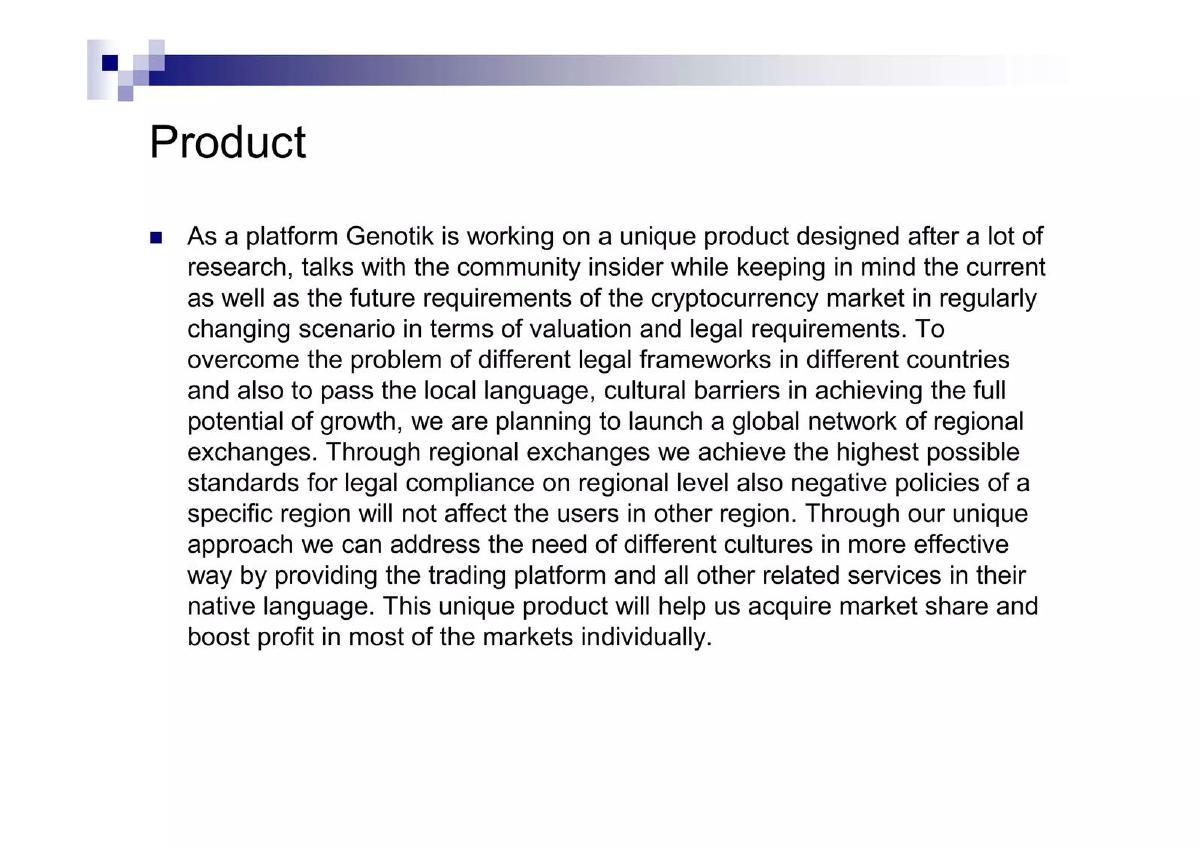
- The platform plans to differentiate through localized language support to address different cultures more effectively (Slide 4).
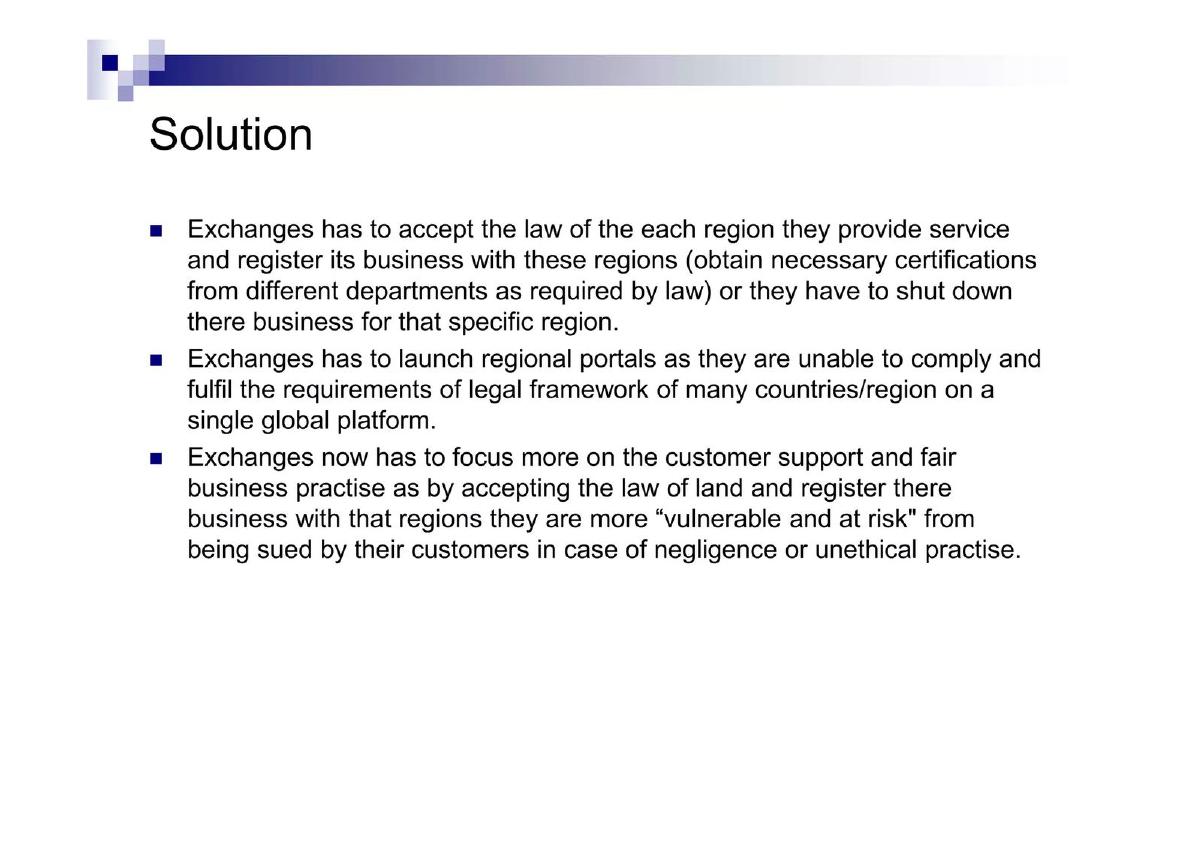
- Genotik intends to bypass global compliance hurdles by launching regional portals that comply with local laws (Slide 3).
- The business model relies on eight diverse revenue streams, including OTC desks, margin trading, and portfolio management (Slide 5).
- Market data cites a total cryptocurrency market cap of $180 billion as of October 2017 (Slide 6).
- The project roadmap is divided into five phases, spanning three years from initial development to global launch (Slide 7).
- The team consists of three key personnel, with Sandeep Goel serving as both CEO and CTO (Slide 8).
- The deck explicitly states they are currently 'looking for early seed investment' but does not specify a dollar amount (Slide 7).
Executive Summary and Vision
The Genotik pitch deck serves as an early-stage introduction to a proposed cryptocurrency exchange. The presentation focuses heavily on the market opportunity and the theoretical structure of the business rather than technical execution or existing traction. By positioning themselves as a 'revolutionary' blockchain-based solution, the founders attempt to capitalize on the rapid market growth seen in 2017.
Slide 1: Title Slide
The cover slide introduces the company name, Genotik , and its core mission: "The First Revolutionary Blockchain-based Crypto Currency Exchange." The design is minimalist, using a blue and white color scheme with a pixelated graphic. It establishes the sector immediately but uses the word "revolutionary," which is a high-bar claim that the subsequent slides must justify.
Slide 2: Educational Context
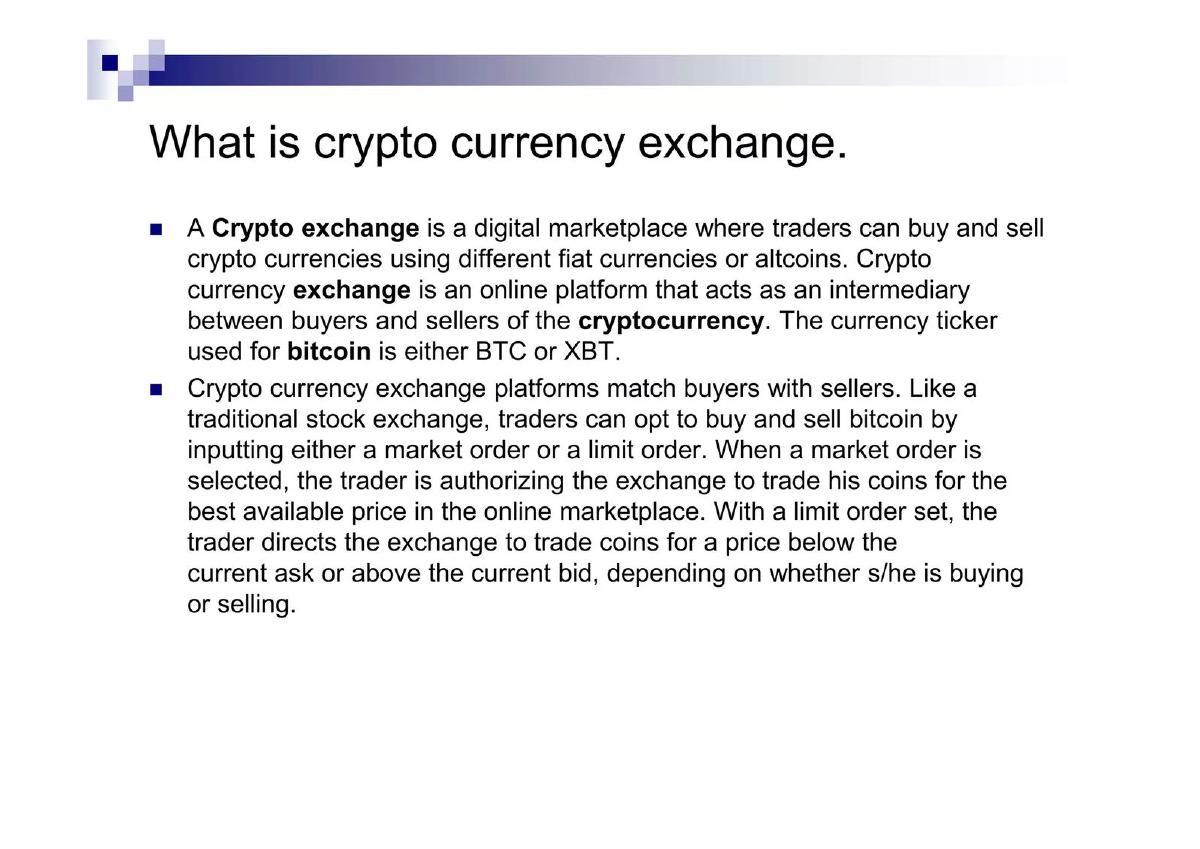
Slide 2, titled "What is crypto currency exchange," acts as an educational primer. It defines a crypto exchange as a digital marketplace for buying and selling cryptocurrencies using fiat or altcoins. It explains the role of the platform as an intermediary and describes basic trading functions like market and limit orders. While this might have been necessary in 2017 when crypto was less mainstream, for a modern investor, this slide would likely be considered filler. It does not explain what makes Genotik different; it only explains what an exchange is in general terms.
Slide 3: The Regulatory Solution
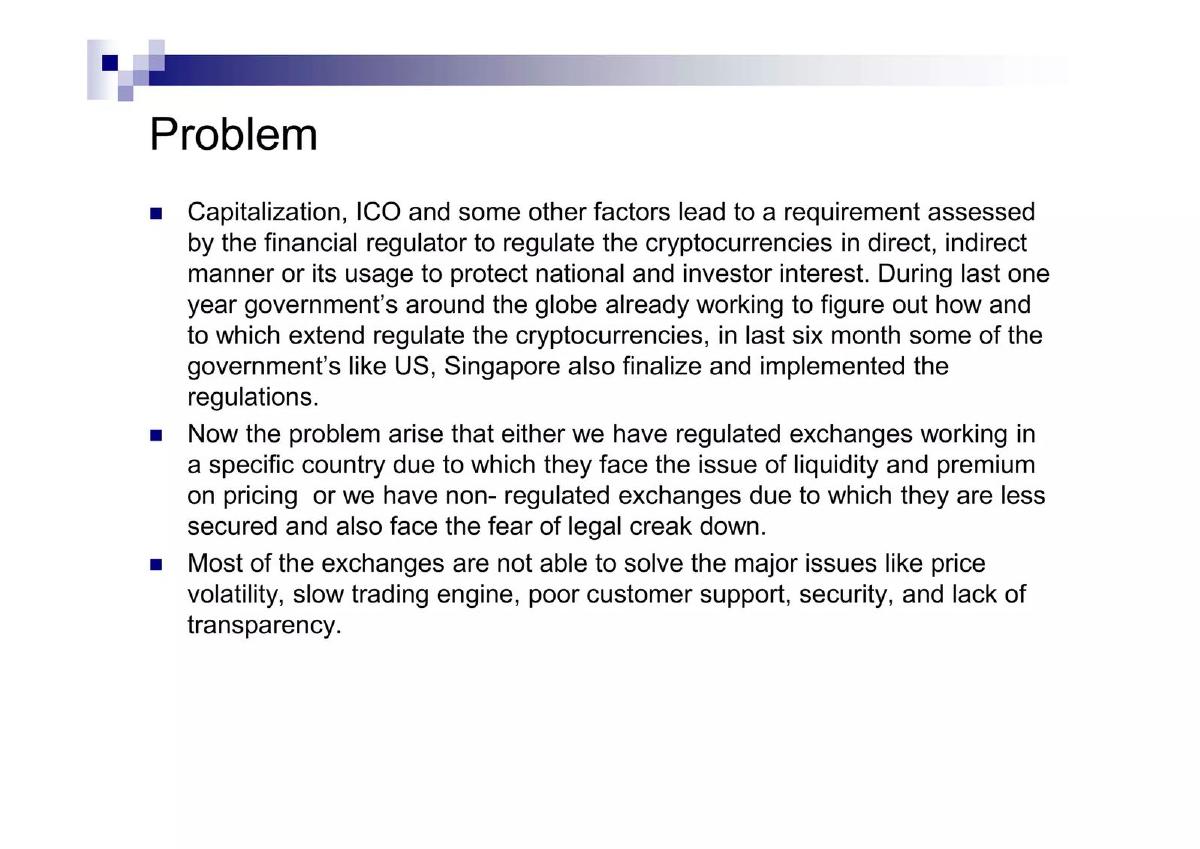
Under the heading "Solution," the deck addresses the problem of global compliance. The slide argues that exchanges must accept the laws of each region or face shutdown. The proposed solution is to "launch regional portals" rather than a single global platform. This is a strategic choice meant to mitigate the risk of being "vulnerable and at risk" from lawsuits or regulatory crackdowns. However, the slide is text-heavy and focuses more on the necessity of compliance than on Genotik's specific legal strategy or existing licenses.
Slide 4: Competitive Edge and Indian Market Strategy
This is arguably the most important slide in the deck. It identifies a specific gap in the Indian market. According to the text, current companies in India only allow trade in a single cryptocurrency and focus on B2C deals, which leads to "huge premium pricing." Genotik claims this creates a "monopoly situation" they can exploit. Their plan includes:
Investing in advertising at the start to cash in on the situation. · Creating a broker channel in India to reach small investors. · Providing the platform in native languages to address different cultures.
The slide cites the "first global cryptocurrency benchmarking study by the Cambridge Centre for Alternative Finance" to support its claims about the Indian market.
Slide 5: Revenue Streams
Genotik outlines a diversified business model with eight distinct revenue sources:
Trading fee: The standard commission on transactions. · Custodian Service: Fees for holding assets. · Merchant Services: Likely processing payments for businesses. · Paid tutorial & Software Subscription: An educational and SaaS component. · OTC Desk: Over-the-counter trading for large volume investors. · White label services: Selling their technology to other firms. · Margin Trading Loan Interest: Revenue from leveraged trading. · Portfolio Management: Professional management of user assets.
While comprehensive, the deck does not provide projected percentages for these streams or a timeline for when each would be activated.
Slide 6: Market Data
This slide provides a snapshot of the crypto market's growth. It notes that in April 2017, the total market cap was slightly higher than $25 billion, but by October 2017, it had reached $180 billion—a 700% increase. It also mentions that more than 3 million people were estimated to be actively using cryptocurrencies at the time. The slide highlights Bitcoin and Ethereum as leaders, noting that the top five currencies (including Ripple, Litecoin, Dash, and Monero) accounted for 20% of the market. This data effectively establishes the "why now" for the investment but is now significantly outdated.
Slide 7: Project Timetable
The roadmap is presented as a five-phase table. The company states they have "just finished the planning stage and looking for early seed investment."
Phase 1: Development (6 Months). · Phase 2: India Launch along with major part of Europe (6 Months). · Phase 3: Covering the complete European countries (6 Months). · Phase 4: US, Canada, Singapore launch (6 Months). · Phase 5: Rest of the world (1 Year).
The timeline is ambitious, suggesting a global rollout in just three years. However, it lacks specific milestones regarding user acquisition targets or regulatory approvals needed for each phase.
Slide 8: Key Personnel
Sandeep Goel: Co-Founder, CEO & Chief Technology Officer. · Bhushan Sakroria: Co-Founder & Chief Financial Officer. · Manish Dhiman: Chief Operating Officer.
The slide is minimalist to a fault. It lacks photos, LinkedIn links, or any biographical information that would verify the team's ability to build a secure, high-traffic financial platform. In a sector where security and trust are paramount, the lack of team credentials is a significant omission.
What Genotik Does Well
The deck identifies a very specific pain point in the Indian market: the lack of multi-currency support and the high premiums caused by B2C-only models. By focusing on a "broker channel" and "native language support," they show an understanding of the local nuances required to scale in a diverse country like India. Additionally, the revenue slide shows a broad vision for the company, moving beyond simple trading fees to include B2B services like white-labeling and merchant processing.
What is Missing from the Deck
The most glaring omission is the lack of a specific financial ask. While they mention they are looking for "early seed investment," they do not state how much capital they need or how it will be allocated. Furthermore, there is no mention of the technical stack or security measures. For a crypto exchange, investors would expect to see details on cold storage, multi-sig wallets, and the throughput of the matching engine. The deck also lacks a "Competition" slide that names specific rivals, which would have helped validate their claim of a "monopoly situation" in India. Finally, the team slide provides no evidence of prior experience in finance, blockchain, or scaling startups.
Founder Takeaways
Founders should take note of the clear categorization of revenue streams (Slide 5). Listing multiple ways to monetize a platform shows investors that the business isn't reliant on a single metric. However, founders should avoid the "educational" approach seen in Slide 2; unless you are pitching a completely new category of technology, assume your investors know the basics of the industry. Most importantly, if you are in a high-risk, high-security industry like fintech, your team slide must include credentials that prove you can handle other people's money safely. Simply listing names and titles is insufficient for a seed-stage pitch.
Frequently asked questions
- What is Genotik's primary value proposition?
- Genotik aims to be a multi-currency, blockchain-based exchange that solves the 'premium pricing' issue in India. By offering B2B/P2P capabilities rather than just B2C, and supporting multiple altcoins rather than just one, they intend to capture market share from limited local incumbents. They also emphasize regional compliance and native language support as core pillars of their expansion strategy.
- How does the company plan to handle global regulations?
- According to Slide 3, the company believes that a single global platform cannot fulfill the legal frameworks of all countries. Their solution is to launch regional portals. This allows them to register the business locally, obtain necessary certifications, and accept the specific laws of each region to avoid being shut down or sued for negligence.
- What are the projected timelines for the product launch?
- The project timetable on Slide 7 shows a 36-month roadmap. Phase 1 is a 6-month development period. Phase 2 involves launching in India and parts of Europe (6 months). Phase 3 covers the rest of Europe (6 months). Phase 4 targets the US, Canada, and Singapore (6 months), followed by a final one-year phase for the rest of the world.
- Who are the leaders of the company?
- The 'Key Personnel' slide lists three individuals: Sandeep Goel (Co-Founder, CEO, and CTO), Bhushan Sakroria (Co-Founder and CFO), and Manish Dhiman (COO). The deck provides their titles but does not include professional backgrounds, past successes, or specific technical expertise relevant to building a high-security financial exchange.
- What is missing from this pitch deck?
- The deck lacks several critical components for a fintech pitch: a specific funding ask (dollar amount), a breakdown of how funds will be used, technical details on security/matching engines, and any mention of current traction or a Minimum Viable Product (MVP). It also omits competitor names, despite referencing a 'monopoly' in the Indian market.