Web3 Competition Slide Examples: Crypto and Blockchain
How crypto, token and blockchain pitch decks name their competitors and show a real difference. Ten real web3 competition slides compared.
Web3 Competition Slide Examples: Crypto and Blockchain Competitors
Ten competition slides from real crypto, token and blockchain pitch decks, shown in full, compare who each deck names as a rival, what it compares them on, and whether the difference can be checked.
TL;DR
A web3 competition slide works best when it names the crypto rivals a buyer would actually consider and compares them on facts that can be checked, such as fees. CoinMall compares itself with three named crypto marketplaces on five features, including platform fees (0% vs "up to 8%" and "more than 10%"). AGV Protocol compares itself with three named tokenized-asset platforms. Genotik names Poloniex, Kraken and Bitfinex and gives four reasons it expects to win. Kruma compares itself only with banks and money transfer brands, Moneybridge lists strengths without naming any rival, and JSEcoin shares its competition slide with a "potential for 100x growth" token price claim. Fetch adds the strongest data: a table of five named crypto payment rivals with country, markets, 2019 business volume, user base and launch year, with footnotes on what was left out.
Web3 competition slides from real pitch decks
Each example shows the exact stored slide above its analysis and links to the full teardown. Stage and year are given only where the deck states them. Competitor claims are quoted as the slide states them; we have not checked them.
CoinMall competition slide — slide 7
Marketplace for digital goods paid in cryptocurrency. The web3 market, web3 business model and marketplace problem guides use different slides from this deck.
CoinMall deck, slide 7. Exact stored slide matched to this analysis.
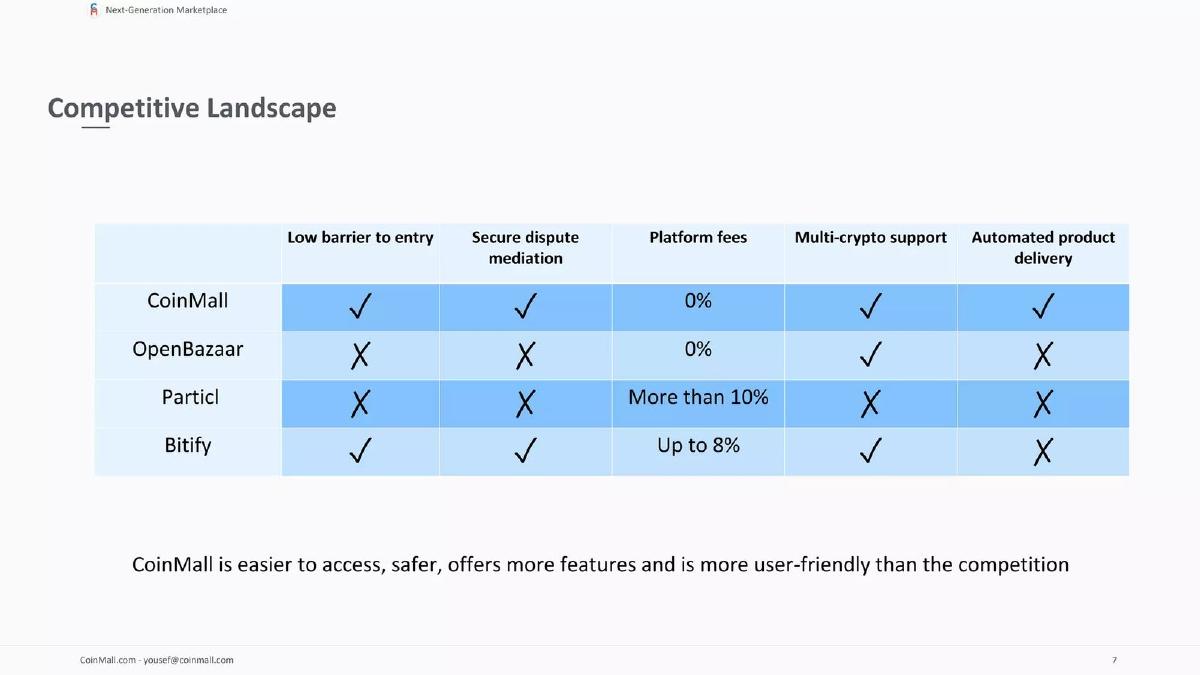
Our analysis: It names three rivals a crypto buyer would recognize, and the fee column gives a figure a reader can check rather than a tick.
Evidence and limitation: A tick in every column for yourself reads as marketing. OpenBazaar also charges 0%, so the table should say what CoinMall does better there, not just claim it is "safer".
What a founder can adapt: Put at least one column of checkable figures in your table, and name rivals your buyers actually use.
Supporting analysis
What the deck claims: "Competitive Landscape": a table comparing CoinMall, OpenBazaar, Particl and Bitify on low barrier to entry, secure dispute mediation, platform fees, multi-crypto support and automated product delivery. Fees: CoinMall 0%, OpenBazaar 0%, Particl "More than 10%", Bitify "Up to 8%". CoinMall has a tick in every column. Caption: "CoinMall is easier to access, safer, offers more features and is more user-friendly than the competition".
Presentation choice: It names three rivals a crypto buyer would recognize, and the fee column gives a figure a reader can check rather than a tick.
When it does not fit: A tick in every column for yourself reads as marketing. OpenBazaar also charges 0%, so the table should say what CoinMall does better there, not just claim it is "safer".
Tokenized real-world assets (orchards, solar and compute). Business development version of the deck. The web3 market guide uses a slide from AGV's institutional deck.
AGV Protocol deck, slide 8. Exact stored slide matched to this analysis.
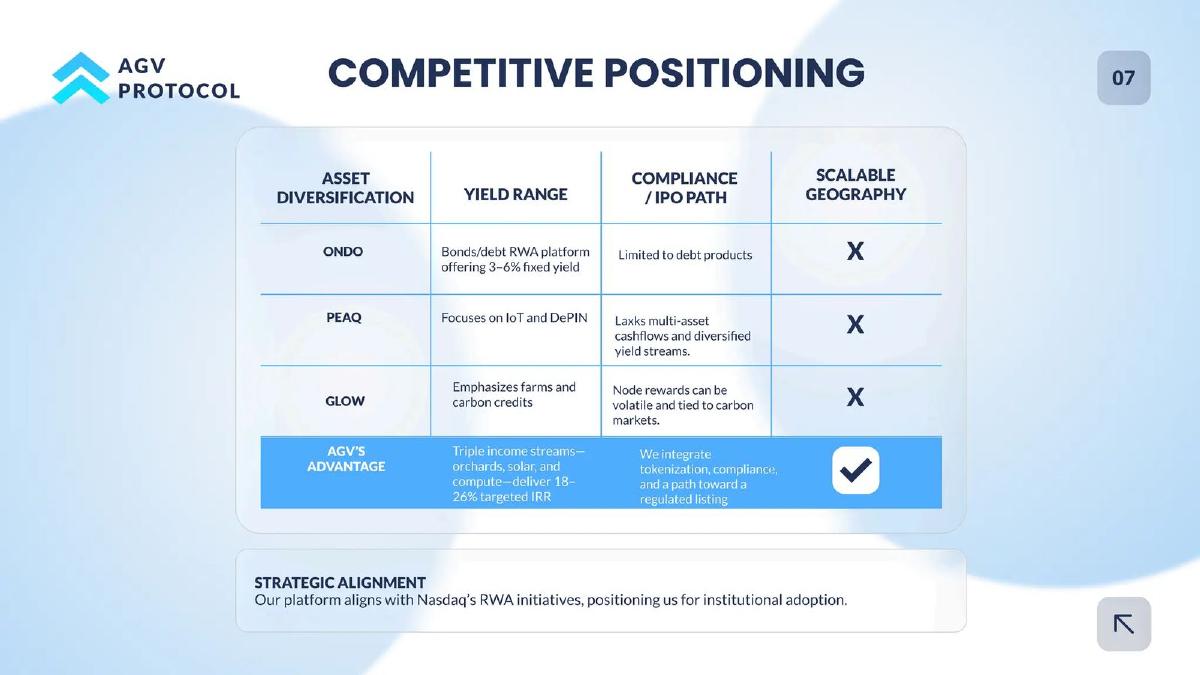
Our analysis: Each named rival gets a one-line description of what it does, so the reader can see AGV's claimed difference: several income streams instead of one.
Evidence and limitation: The column headings and the rows don't line up (asset types sit under "Yield Range"), the 18–26% figure is a target rather than a result, and "scalable geography" is marked X for every rival with no explanation.
What a founder can adapt: Describe each rival fairly in one line, then state the one thing you do that none of them do.
Supporting analysis
What the deck claims: "Competitive Positioning": ONDO ("Bonds/debt RWA platform offering 3–6% fixed yield", "Limited to debt products"), PEAQ ("Focuses on IoT and DePIN"), GLOW ("Emphasizes farms and carbon credits", "Node rewards can be volatile"), each marked X for scalable geography. "AGV's Advantage": "Triple income streams—orchards, solar, and compute—deliver 18–26% targeted IRR" and "a path toward a regulated listing". Footer: alignment with Nasdaq's RWA initiatives.
Presentation choice: Each named rival gets a one-line description of what it does, so the reader can see AGV's claimed difference: several income streams instead of one.
When it does not fit: The column headings and the rows don't line up (asset types sit under "Yield Range"), the 18–26% figure is a target rather than a result, and "scalable geography" is marked X for every rival with no explanation.
Cryptocurrency exchange aimed at the Indian market. Stage and year not stated.
Genotik deck, slide 12. Exact stored slide matched to this analysis.
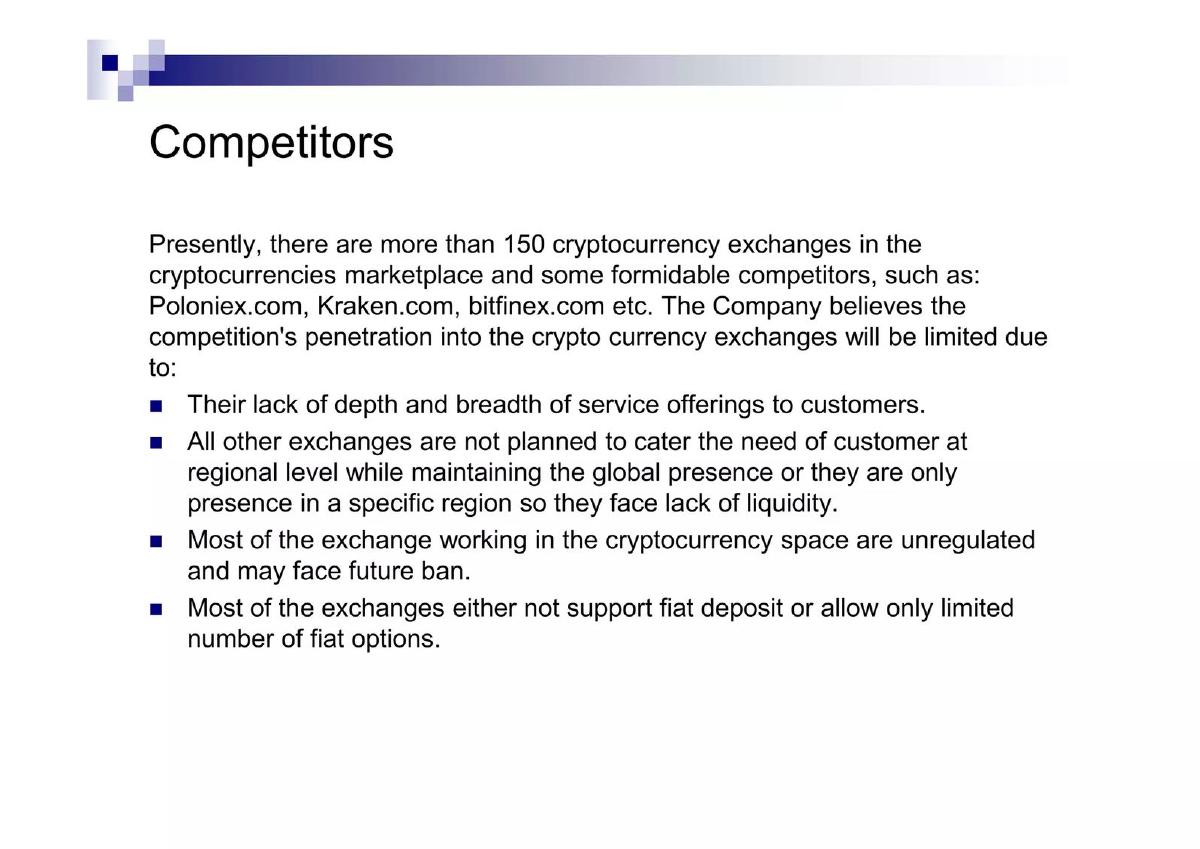
Our analysis: It admits the market is crowded, names real rivals and gives specific reasons, including regulation and fiat deposits, which matter to buyers in a single country.
Evidence and limitation: It is a paragraph of text with no comparison, and it doesn't say whether Genotik itself is regulated or which fiat options it supports, so the reasons can't be checked.
What a founder can adapt: Say how crowded your market is, name the leaders, and give reasons tied to what your buyers need.
Supporting analysis
What the deck claims: "Competitors": "more than 150 cryptocurrency exchanges", naming Poloniex.com, Kraken.com and bitfinex.com. Four reasons their growth will be limited: lack of depth and breadth of services; no regional focus with global presence, so they "face lack of liquidity"; "Most of the exchange working in the cryptocurrency space are unregulated and may face future ban"; most don't support fiat deposits or allow only a few fiat options.
Presentation choice: It admits the market is crowded, names real rivals and gives specific reasons, including regulation and fiat deposits, which matter to buyers in a single country.
When it does not fit: It is a paragraph of text with no comparison, and it doesn't say whether Genotik itself is regulated or which fiat options it supports, so the reasons can't be checked.
Fiat and cryptocurrency exchange focused on migrant communities. Stage and year not stated.
Kruma deck, slide 8. Exact stored slide matched to this analysis.
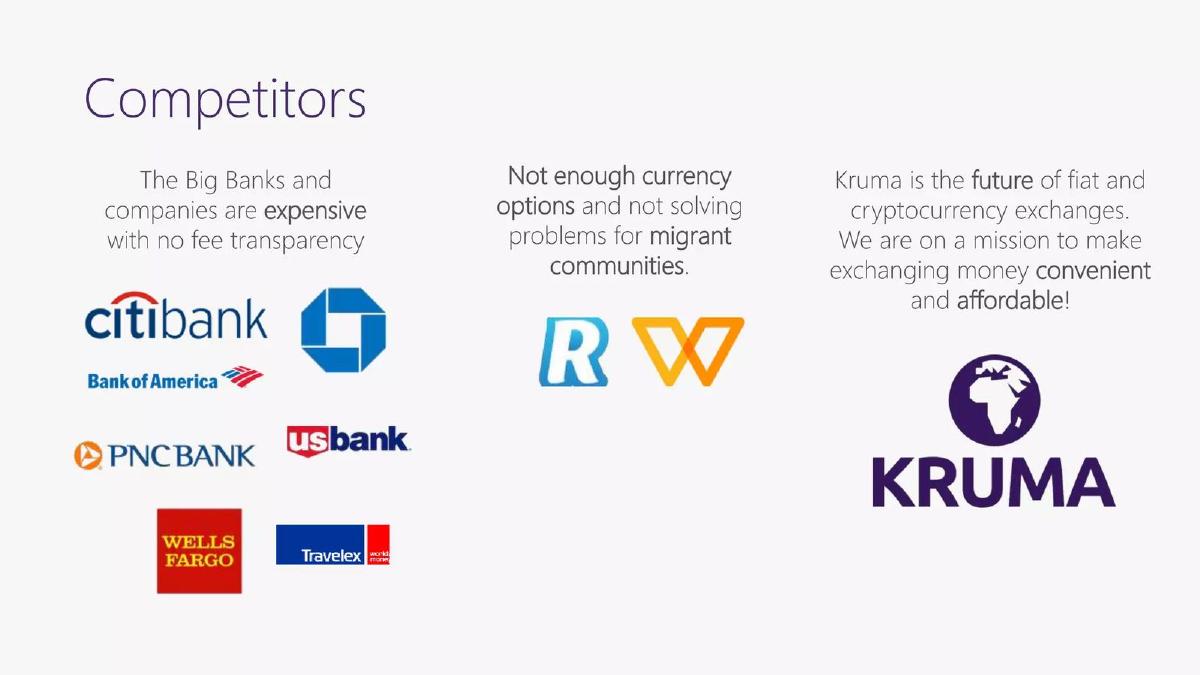
Our analysis: Grouping rivals by the problem each group leaves unsolved is clearer than a wall of logos.
Evidence and limitation: It names no crypto exchange, although Kruma calls itself one, and gives no fee figures to back "expensive". Investors will ask how it compares with other crypto on-ramps.
What a founder can adapt: Group rivals by the problem they leave open, and put a number (a fee, a currency count) against each group.
Supporting analysis
What the deck claims: "Competitors": "The Big Banks and companies are expensive with no fee transparency" (Citibank, Chase, Bank of America, PNC, US Bank, Wells Fargo, Travelex logos); "Not enough currency options and not solving problems for migrant communities" (two money transfer app logos); "Kruma is the future of fiat and cryptocurrency exchanges."
Presentation choice: Grouping rivals by the problem each group leaves unsolved is clearer than a wall of logos.
When it does not fit: It names no crypto exchange, although Kruma calls itself one, and gives no fee figures to back "expensive". Investors will ask how it compares with other crypto on-ramps.
Fiat-to-crypto on-ramp. The deck's file is dated 2024; stage not stated.
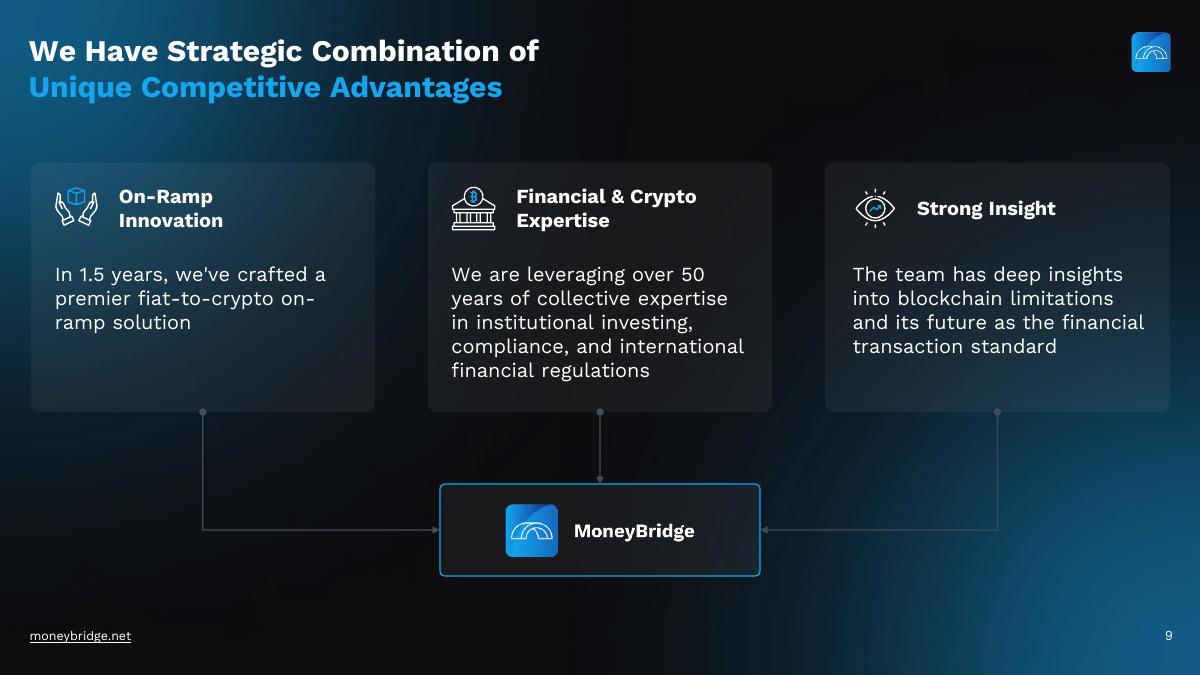
Moneybridge deck, slide 9. Exact stored slide matched to this analysis.
Our analysis: The team's combined compliance experience is a relevant strength for a regulated on-ramp.
Evidence and limitation: No competitor appears, so "unique" can't be judged, and "premier" and "strong insight" are claims without evidence.
What a founder can adapt: Keep your strengths, but show them against named on-ramps so the reader can see why they matter.
Supporting analysis
What the deck claims: "We Have Strategic Combination of Unique Competitive Advantages": "On-Ramp Innovation" ("In 1.5 years, we've crafted a premier fiat-to-crypto on-ramp solution"), "Financial & Crypto Expertise" ("over 50 years of collective expertise in institutional investing, compliance, and international financial regulations") and "Strong Insight" into blockchain limitations.
Presentation choice: The team's combined compliance experience is a relevant strength for a regulated on-ramp.
When it does not fit: No competitor appears, so "unique" can't be judged, and "premier" and "strong insight" are claims without evidence.
Browser-based cryptocurrency mining. Seed (recorded). The web3 product guide uses a different slide from this deck.
JSEcoin deck, slide 4. Exact stored slide matched to this analysis.
Our analysis: It recognizes that its rivals come from three different categories, which shows the reader where it sits.
Evidence and limitation: The token price projection has nothing to do with competition, assumes the company reaches a rival's valuation, and reads as a promise of returns. Keep projections like this out of the deck.
What a founder can adapt: Show the categories you compete with, and give each a fair, specific weakness.
Supporting analysis
What the deck claims: "Competition": three circles, Monero miners ("Resource Intensive", "Unethical Hidden Mining", "Blocked By Antivirus"), Bitcoin ("Large Carbon Footprint", "Scaling Issues") and ad networks ("Monopolised Marketplace", "Obtrusive User Experience"). Beside it, "Investor Opportunity": Monero market cap $3.7b (May 2018); if JSEcoin reached the same valuation, "price per token would be $0.638" against an ICO price of $0.006; "Potential for 100x growth".
Presentation choice: It recognizes that its rivals come from three different categories, which shows the reader where it sits.
When it does not fit: The token price projection has nothing to do with competition, assumes the company reaches a rival's valuation, and reads as a promise of returns. Keep projections like this out of the deck.
Crypto payments for merchants. The slide footer reads "Pitch Deck – Angel Round" and "2020 Fetch International Sdn. Bhd.". The web3 business model guide uses a different slide from this deck.
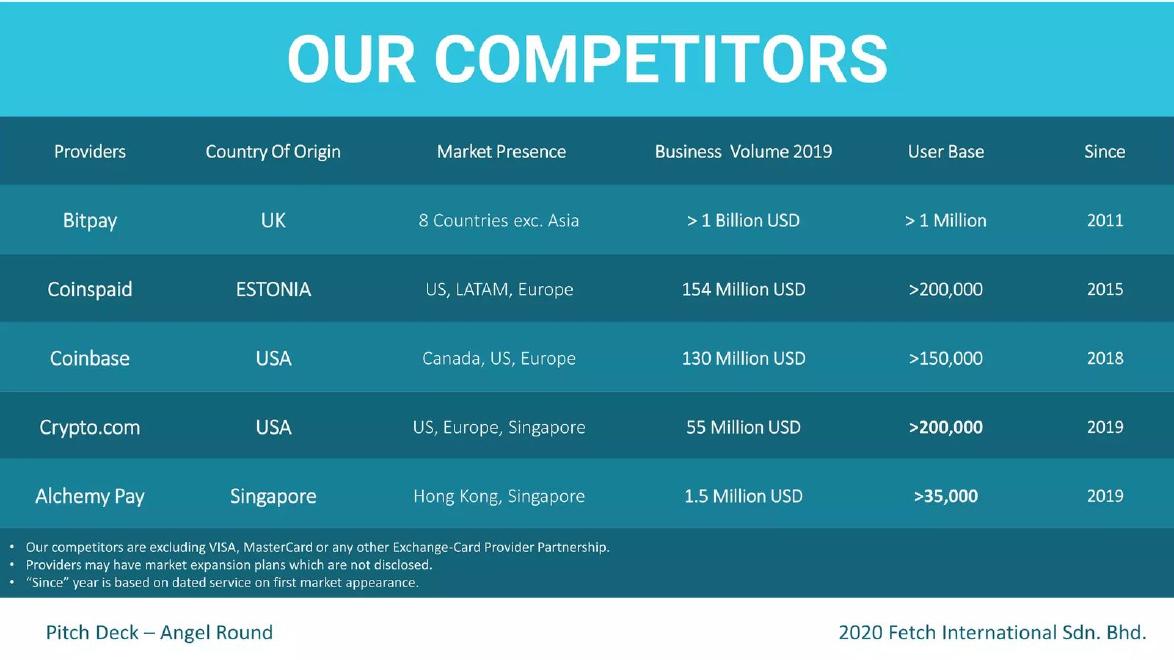
Fetch deck, slide 13. Exact stored slide matched to this analysis.
Our analysis: Every rival gets the same five facts, so the reader can see the market's size and spread. The footnotes say what is left out, which makes the table easier to trust.
Evidence and limitation: Fetch has no row of its own, so the reader can't see where it fits, and the slide doesn't name the gap it fills (Asia is only implied by Bitpay's "exc. Asia"). The figures are the deck's own and have no sources; we have not checked them.
What a founder can adapt: Give each rival the same few checkable facts and add a footnote for what your table excludes.
Supporting analysis
What the deck claims: "Our Competitors": a table of Bitpay (UK, "8 Countries exc. Asia", "> 1 Billion USD" business volume 2019, "> 1 Million" users, since 2011), Coinspaid (Estonia, 154 Million USD, ">200,000", 2015), Coinbase (USA, 130 Million USD, ">150,000", 2018), Crypto.com (USA, 55 Million USD, ">200,000", 2019) and Alchemy Pay (Singapore, Hong Kong and Singapore, 1.5 Million USD, ">35,000", 2019). Footnotes: competitors exclude Visa, Mastercard or other card partnerships; providers "may have market expansion plans which are not disclosed"; "Since" is the first market appearance.
Presentation choice: Every rival gets the same five facts, so the reader can see the market's size and spread. The footnotes say what is left out, which makes the table easier to trust.
When it does not fit: Fetch has no row of its own, so the reader can't see where it fits, and the slide doesn't name the gap it fills (Asia is only implied by Bitpay's "exc. Asia"). The figures are the deck's own and have no sources; we have not checked them.
Platform for listing, auditing and promoting token projects. Stage and year not stated. The web3 business model guide uses a different slide from this deck.
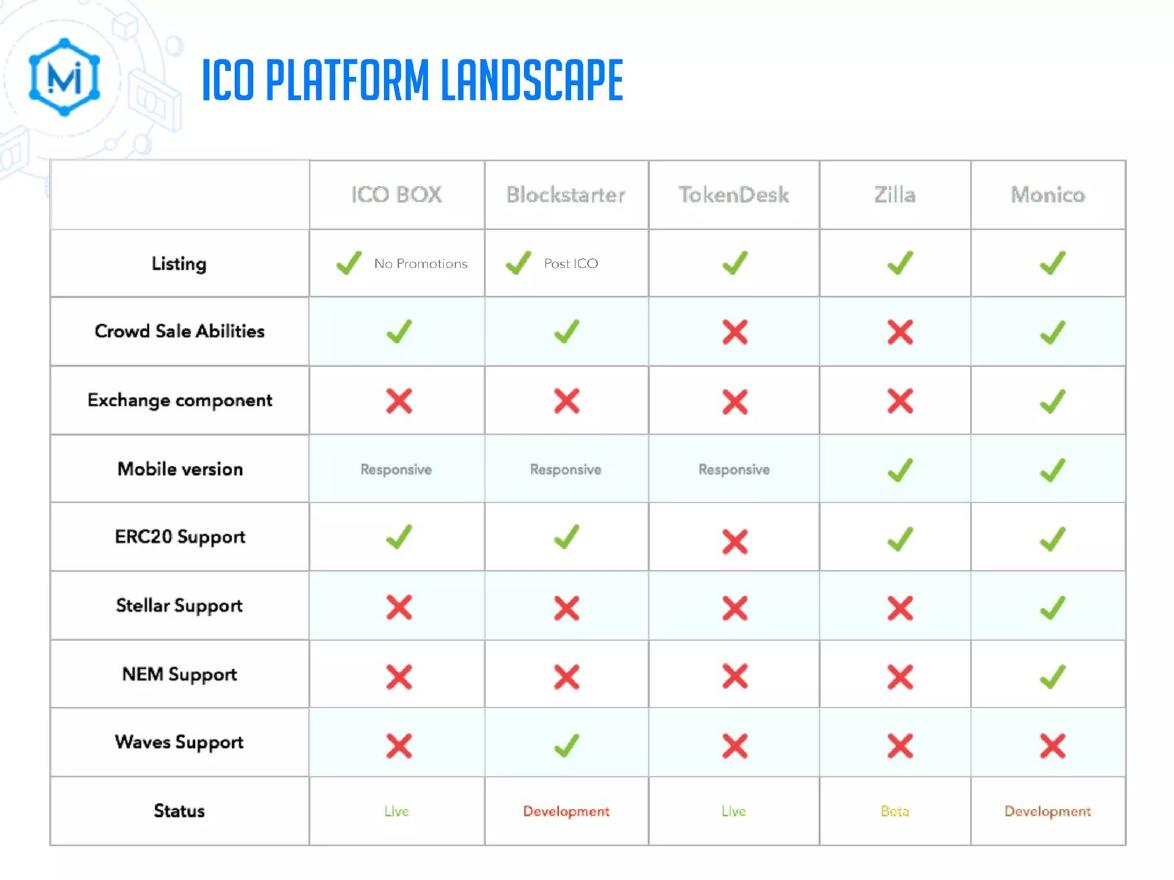
Monico deck, slide 12. Exact stored slide matched to this analysis.
Our analysis: It names four rivals in the same niche and includes a status row that admits Monico was still in development while two rivals were live.
Evidence and limitation: Nearly every row is a tick for Monico, chosen by Monico, with no figure (fees, projects listed, funds raised) to back it.
What a founder can adapt: Add a status or stage row, including your own, so the reader knows which comparisons are of live products.
Supporting analysis
What the deck claims: "ICO Platform Landscape": a grid comparing ICO BOX, Blockstarter, TokenDesk, Zilla and Monico on listing, crowd sale abilities, exchange component, mobile version and support for ERC20, Stellar, NEM and Waves. Monico has ticks on eight rows and an X for Waves (which Blockstarter supports). Status row: ICO BOX "Live", Blockstarter "Development", TokenDesk "Live", Zilla "Beta", Monico "Development".
Presentation choice: It names four rivals in the same niche and includes a status row that admits Monico was still in development while two rivals were live.
When it does not fit: Nearly every row is a tick for Monico, chosen by Monico, with no figure (fees, projects listed, funds raised) to back it.
Crypto trading ecosystem. Investor version of the deck; stage and year not stated.
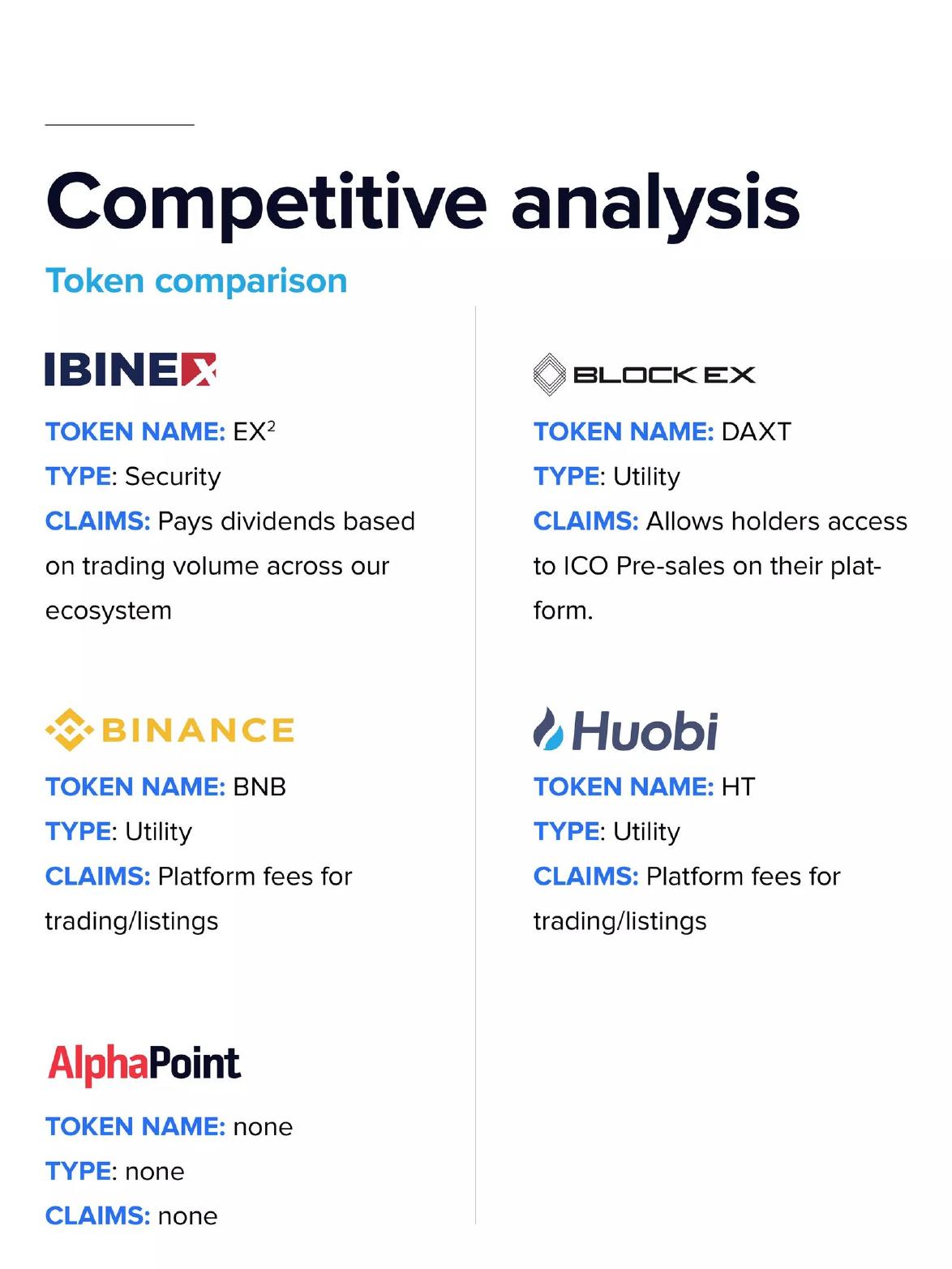
Ibinex deck, slide 18. Exact stored slide matched to this analysis.
Our analysis: It is the only slide here that compares what each rival's token gives holders, using the same three fields for every company.
Evidence and limitation: It compares tokens only, not the trading products buyers use, and its own token's dividend promise is a legal and return claim that needs care. We have not checked any token's legal status.
What a founder can adapt: If your token is part of the offer, compare token rights in the same fields for every rival.
Supporting analysis
What the deck claims: "Competitive analysis — Token comparison": Ibinex (token EX², type "Security", claims "Pays dividends based on trading volume across our ecosystem"), Block Ex (DAXT, Utility, "Allows holders access to ICO Pre-sales on their platform"), Binance (BNB, Utility, "Platform fees for trading/listings"), Huobi (HT, Utility, "Platform fees for trading/listings") and AlphaPoint (token, type and claims all "none").
Presentation choice: It is the only slide here that compares what each rival's token gives holders, using the same three fields for every company.
When it does not fit: It compares tokens only, not the trading products buyers use, and its own token's dividend promise is a legal and return claim that needs care. We have not checked any token's legal status.
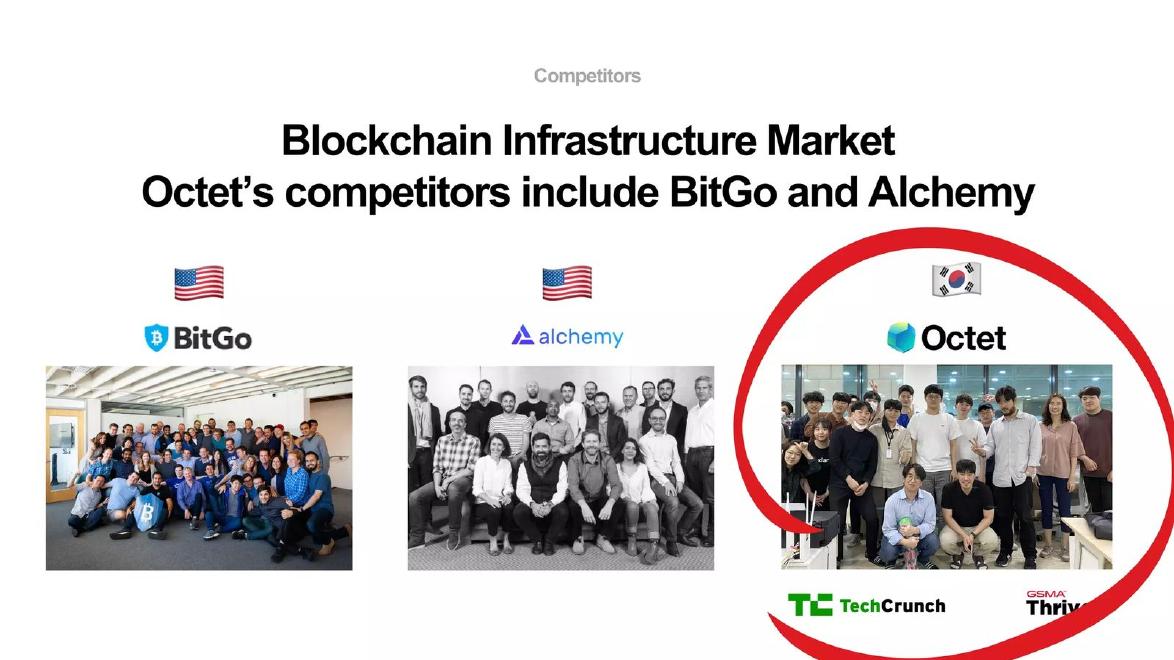
Blockchain infrastructure (Octet) from Korea. Stage and year not stated. The web3 market guide uses a different slide from this deck.
Hexlant (Octet) deck, slide 16. Exact stored slide matched to this analysis.
Our analysis: Naming two well-known rivals places Octet in a category at a glance, and the flags hint at a regional difference.
Evidence and limitation: Team photos are not a comparison. There are no figures, features or reasons, and the press logos say nothing about how Octet differs. We show it as a weaker example.
What a founder can adapt: If you name a big rival, add the one fact that makes buyers in your market choose you.
Supporting analysis
What the deck claims: "Competitors": "Blockchain Infrastructure Market — Octet's competitors include BitGo and Alchemy". Team photos of BitGo and Alchemy (US flags) and Octet (Korean flag), with Octet circled in red and TechCrunch and GSMA logos below it.
Presentation choice: Naming two well-known rivals places Octet in a category at a glance, and the flags hint at a regional difference.
When it does not fit: Team photos are not a comparison. There are no figures, features or reasons, and the press logos say nothing about how Octet differs. We show it as a weaker example.
Named crypto rivals and checkable figures make a comparison credible.
Example
Crypto rivals named
Checkable figures
Stated difference
Distractions
CoinMall
3
Fees (0%, up to 8%, more than 10%)
Features and fees
Tick in every column
AGV Protocol
3
Rival yield 3–6%; own IRR is a target
Several income streams
Mismatched columns
Genotik
3 (of 150+)
No
Regional focus, regulation, fiat
Text only
Kruma
0 (banks, transfer apps)
No
Fees, migrant focus
None
Moneybridge
0
No
Team expertise
None
JSEcoin
Categories only
No
Ethical, low-footprint mining
Token price projection
Fetch
5
Volume, users, markets, launch year
Not stated (no own row)
None
Monico
4
Status row only
Coin support, exchange
Tick in nearly every row
Ibinex
4 (+AlphaPoint)
Token rights
Dividend-paying token
Security/dividend claim
Hexlant (Octet)
2
No
Implied: Korean base
Team photos
Key Takeaways
Name the crypto products a buyer would actually compare you with, not only banks or "the old system".
Compare on facts a reader can check (fees, supported assets, regulation), not only ticks you award yourself.
Regulation is a real difference in crypto, but say what licence you hold or are seeking.
A list of your strengths is not a competition slide if no competitor appears.
Keep token price projections off the competition slide. They distract from the comparison and invite scrutiny.
If your token is part of what you sell, compare token rights side by side, and get legal advice before calling it a security.
Build your web3 competition slide
Answer these before designing the slide.
Rivals. Which crypto products would your buyer compare you with? Name three.
Incumbents. Which non-crypto option (banks, transfer apps, ad networks) do buyers use today?
Facts. Which differences can be checked: fees, supported coins or countries, settlement time, licences?
Regulation. What licence or registration do you hold or plan, and where?
Honesty. Where does a rival beat you, and why does it matter less to your buyer?
Copyable framework: [Rival]: [fee / coverage / licence]. Us: [same measure]. Why it matters to [buyer]: [one line].
Illustrative example 1 — written by us
Before: We Have Strategic Combination of Unique Competitive Advantages
After: vs [on-ramp A] and [on-ramp B]: fees [x% vs y%], countries [N vs M], licence [held / applied for]
What improved: Our illustrative rewrite, not Moneybridge's text. Bracketed parts are placeholders, not company facts. It turns a list of strengths into a comparison.
How this guide relates to the other competition and web3 guides
The main competition guide covers comparison tables, positioning maps and feature matrices for any company, and the fintech competition guide includes one crypto wallet. This guide covers what is specific to web3 decks: rivals that are often other protocols or exchanges rather than companies, fees and supported coins as the main points of comparison, regulation as a difference, and token price claims that sometimes appear beside the comparison.
Tables of facts beat tables of ticks
Most web3 competition slides in our library use a tick grid. Ticks are easy to make and hard to check: the founder decides the rows, and the founder's own column almost always wins. Monico's ICO platform table shows the usual pattern, with Monico ticked on eight of nine rows. It is more useful than most because it records rivals' status (Live, Beta, Development) and admits that Monico itself was still in development while two rivals were live.
Fetch takes the other approach. Instead of ticks it gives five rivals' country of origin, markets, business volume in 2019, user base and launch year. A reader can look those figures up and disagree with them, which is why they persuade. Its footnotes also say what the table leaves out: card partnerships with Visa or Mastercard, and rivals' undisclosed expansion plans. A table that says what it excludes is easier to trust than one that seems to cover everything.
If you only have ticks, add one column of figures (fees, coins supported, countries, volume, users) and a status row that includes your own stage. Investors notice when a pre-launch product is compared with live rivals as if they were equal.
Comparing tokens, not just products
In crypto, the token is often part of the offer, so some decks compare token rights rather than features. Ibinex lists the token name, type and "claims" for itself, Block Ex, Binance, Huobi and AlphaPoint. It is the only slide in this set that tells the reader what holding each rival's token gives you: platform fees for Binance and Huobi, access to pre-sales for Block Ex, and nothing for AlphaPoint, which has no token.
The same slide shows the risk. Ibinex describes its own token as a security that "Pays dividends based on trading volume". Whether a token is a security depends on the law where it is sold, and promising dividends is a claim investors and regulators will read closely. If you compare tokens, state the rights plainly, say which rules you are following, and keep return language out of it. We quote the slide; we have not checked any token's legal status.
Naming one or two large rivals
Some founders pick the best-known rival and stand next to it. Hexlant's Octet slide names BitGo and Alchemy, two well-known US blockchain infrastructure companies, and shows team photos of all three with Octet circled. The heading makes the claim ("Octet's competitors include BitGo and Alchemy") and the flags suggest the difference: two US companies and one Korean one.
That framing can work for an investor who already knows the big names, because it places the startup in a category in one glance. But the slide gives no reason a buyer would choose Octet, no figures and no comparison beyond photos. If you name a much larger rival, add the one fact that explains why buyers in your market pick you, such as local regulation, language, price or a feature the larger company lacks.
Questions investors ask about a web3 competition slide
Which of these rivals are live, and how many users or how much volume do they handle? Fetch answers this for every rival; most slides in this set do not answer it for any.
What licence do you and your rivals hold? Regulation separates crypto businesses more than features do, and Genotik is the only example here that raises it, without saying where it stands itself.
What does your token give holders that a rival's does not, and how is it treated legally? Ibinex compares token rights; no other slide here does.
Why would a buyer pick you over the largest name? Octet names BitGo and Alchemy but leaves the answer to the photos.
Where do rivals beat you today? Monico's status row, which shows rivals already live, is the closest any slide here comes to admitting it.
Common mistakes
No crypto rivals. Comparing only with banks skips the products investors will ask about.
Ticks you award yourself. Add figures a reader can check.
Unexplained regulation claims. Say which licence you hold or seek.
Strengths with no competitor. Show them against named rivals.
Token price upside. Keep return projections off the slide.
Diagnostic checklist
At least two named crypto rivals.
At least one checkable figure per rival.
The difference that matters most to your buyer is stated plainly.
Any regulation claim names the licence and place.
No token price or return projections.
Frequently asked questions
How we chose these examples
Update (2026-10-01): added Fetch p13, Monico p12, Ibinex p18 and Hexlant (Octet) p16 after searching the full slide corpus for competition, landscape and alternatives wording near blockchain, crypto, token, NFT, DeFi, wallet, exchange and web3 terms. Not used: Carbon Block p12 (used in the energy competition draft), Icaro AI p18 (text-only paragraph; the deck is used in the AI business model guide), Bitdharma p7 (unreadable grid), Merge p8 (a card-rewards product, not web3), and risk-factor pages from listed-company decks (Bit Gold, Goldmoney). Fetch, Monico and Hexlant appear in other web3 guides with different slides. The four new images were rendered from the published deck PDFs, inspected and stored on 2026-10-01 (editorial model review).
Corpus: published pitch deck teardowns on StartupFundraising.com. Founder-uploaded private decks are excluded.
Selection (2026-09-28): we searched extracted slide text for slides whose opening words include "competition", "competitors", "competitive", "landscape" or "alternatives" and whose text mentions crypto, blockchain, web3, NFTs, DeFi, tokens, wallets or bitcoin. Excluded: slides already used by another guide (Hoard's competition slide is in the fintech competition guide), market-landscape slides and non-web3 companies.
Images: five slide images were rendered from the published deck PDFs and stored on 2026-09-28; JSEcoin's was already stored.
Overlap check: no competition-slide facet for web3 existed. CoinMall, AGV Protocol and JSEcoin appear in other guides with different slides.
Review: all six stored slide images were inspected on 2026-09-28 and matched to company, deck and slide number (editorial model review). Competitor claims are quoted from the slides and were not checked. No person has yet completed an editorial review of this page.
We make no claim that any slide caused a fundraising outcome.