Web3 Business Model Slides: 7 Real Pitch Deck Examples
How crypto and blockchain startups show how they make money: trading fees, payment percentages, token charges and royalties.
Web3 Business Model Slide: Fees, Tokens or Royalties?
Crypto companies can earn money the usual way, through fees and subscriptions, or through their own token. Investors reading a web3 business model slide want to know who pays, how much, and in what currency. This guide compares seven real business model slides from decks tagged web3 in our library, from a payments company that prices every option to a slide that lists seven income ideas without a number.
TL;DR
Name who pays, what they pay for and the price, and say whether they pay in cash or your token. Fetch Payments charges merchants "2% of transaction volume" or "USD49 per month". Binance's early deck says it "will charge a 0.2% fixed fee per trade". Monico prices each action in its own token ("To list a project 10,000 MNC"). Good Gaming takes "5% in ETH or stablecoins" on trades. Fetch.ai says who pays whom but gives no prices, CoinMall charges "a minimal fee", and Bitdharma lists seven income ideas with no figures.
Web3 business model slides from real pitch decks
Each example shows the exact slide above its analysis and links to the full teardown. The clearest slides come first; weaker ones follow for contrast. Claims are as shown on the slides; comments are ours.
Fetch Payments business model slide — slide 12
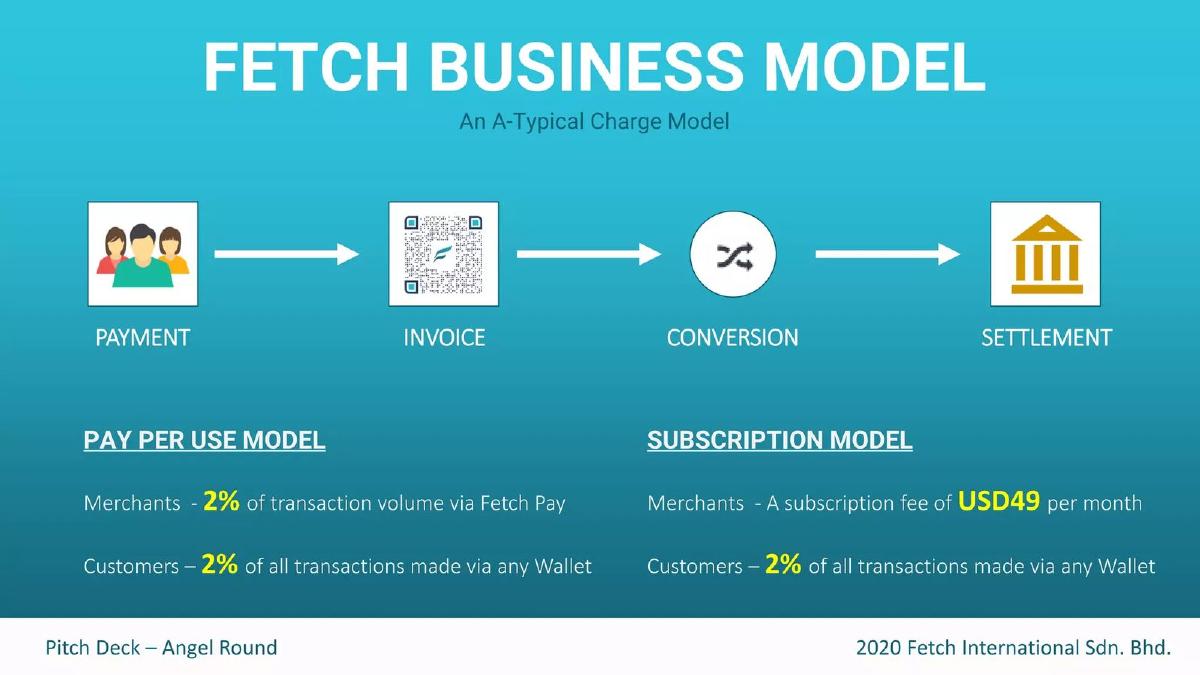
Crypto payments for merchants (angel round, 2020). Slide titled "Fetch Business Model: An A-Typical Charge Model".
Fetch Payments deck, slide 12. Exact stored slide matched to this analysis.
Our analysis: An investor can see who pays, how much and when. The slide doesn't say which option merchants are expected to choose, or how much a typical merchant would pay in a month.
Evidence and limitation: Two pricing options, each with a rate or price for merchants and for customers.
What a founder can adapt: Add the expected mix of the two plans and the revenue from a typical merchant.
Supporting analysis
What the deck claims: Flow: "Payment → Invoice → Conversion → Settlement". "Pay Per Use Model": "Merchants - 2% of transaction volume via Fetch Pay"; "Customers – 2% of all transactions made via any Wallet". "Subscription Model": "Merchants - A subscription fee of USD49 per month"; "Customers – 2% of all transactions made via any Wallet".
Presentation choice: Naming both sides of a payment and pricing each one is the clearest way to show payment revenue.
When it does not fit: Charging both sides without saying how often each pays.
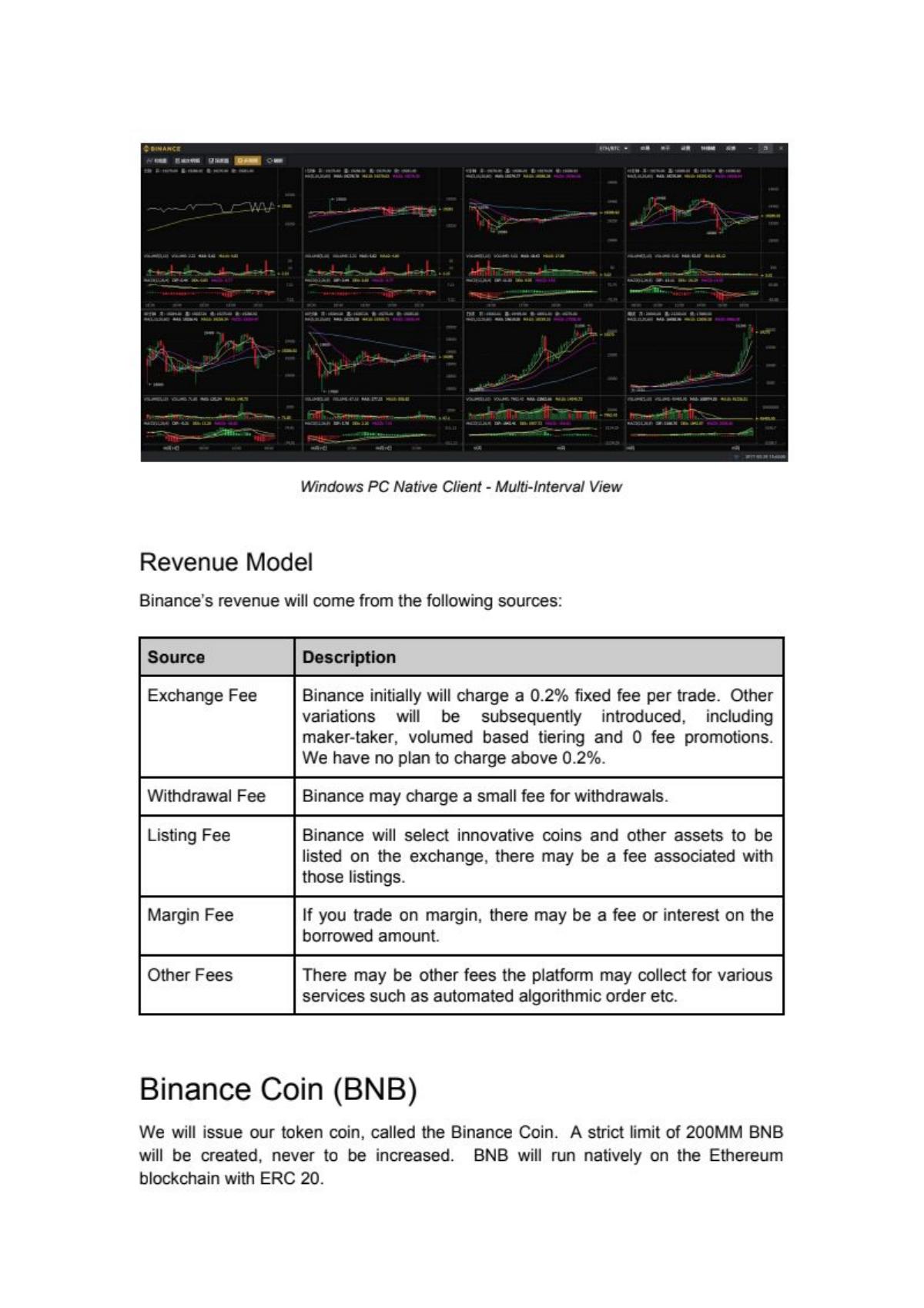
Binance deck, slide 7. Exact stored slide matched to this analysis.
Our analysis: The main fee is priced and the ceiling is stated, which answers an investor's first question. The other four fees are described as possible ("may charge"), and the page doesn't link the token to revenue. This is a text-heavy launch document, not a designed slide.
Evidence and limitation: A table of five fee types, one with a rate, and a fixed token supply.
What a founder can adapt: Put the priced fee first and move the possible fees to a note.
Supporting analysis
What the deck claims: "Binance's revenue will come from the following sources": "Exchange Fee: Binance initially will charge a 0.2% fixed fee per trade... We have no plan to charge above 0.2%." Also "Withdrawal Fee", "Listing Fee", "Margin Fee" and "Other Fees". Below: "Binance Coin (BNB)... A strict limit of 200MM BNB will be created, never to be increased."
Presentation choice: Pricing the main fee and stating a ceiling makes the core model easy to judge.
When it does not fit: Listing fees you may or may not charge alongside the one you will.
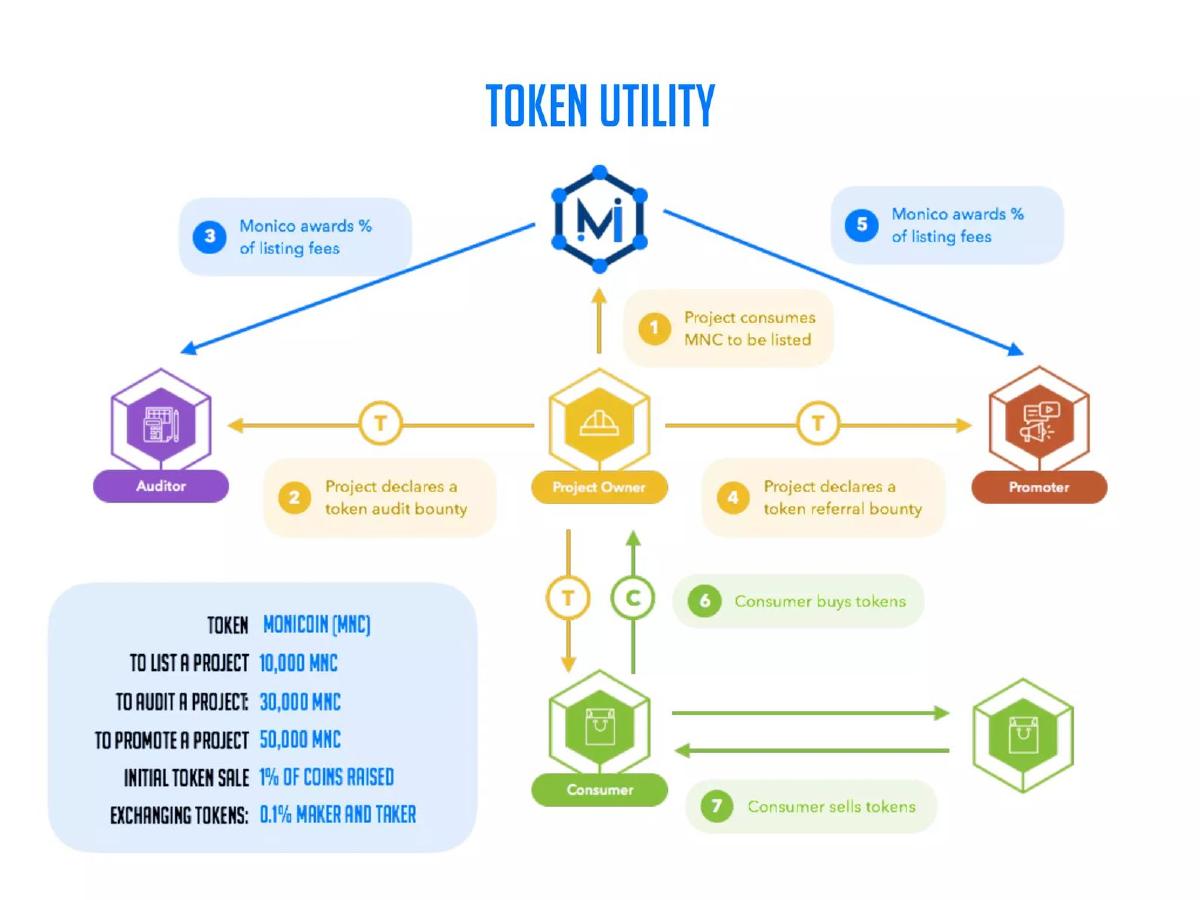
Token platform for listing, auditing and promoting crypto projects. Slide titled "Token Utility".
Monico deck, slide 9. Exact stored slide matched to this analysis.
Our analysis: Every action has a price, so the model is specific. But the prices are in Monico's own token, so the revenue in dollars depends on the token's price, which the slide doesn't give.
Evidence and limitation: A price in tokens for each action, plus two percentage fees.
What a founder can adapt: Add what each price is worth in dollars at an assumed token price.
Supporting analysis
What the deck claims: A diagram of "Project Owner", "Auditor", "Promoter" and "Consumer", with steps like "Project consumes MNC to be listed" and "Monico awards % of listing fees". Table: "Token: Monicoin (MNC)"; "To list a project 10,000 MNC"; "To audit a project 30,000 MNC"; "To promote a project 50,000 MNC"; "Initial token sale 1% of coins raised"; "Exchanging tokens: 0.1% maker and taker".
Presentation choice: Pricing each action shows exactly why people need the token.
When it does not fit: Token-only prices with no dollar reference.
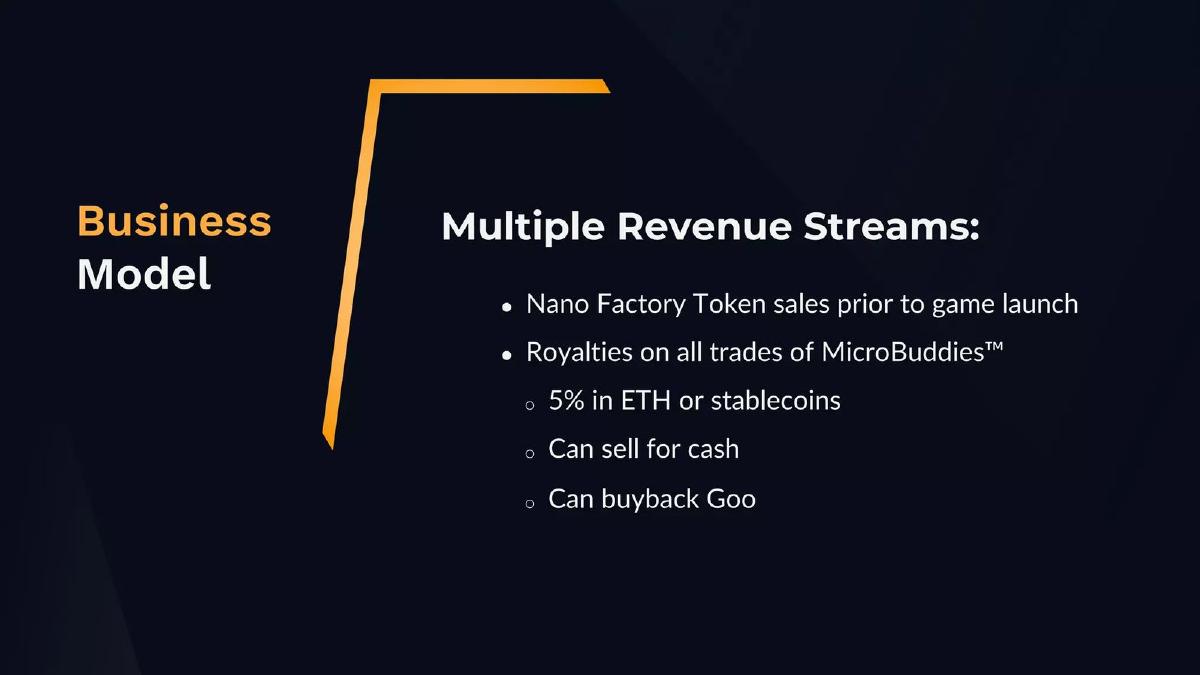
Blockchain game (MicroBuddies). Slide titled "Business Model: Multiple Revenue Streams".
Good Gaming deck, slide 11. Exact stored slide matched to this analysis.
Our analysis: The 5% royalty is clear, and saying it's paid in ETH or stablecoins answers the currency question. The token sale has no size or price, and the slide doesn't estimate trading volume.
Evidence and limitation: Two streams; one has a rate and a currency.
What a founder can adapt: Add expected trading volume and the size of the token sale.
Supporting analysis
What the deck claims: "Nano Factory Token sales prior to game launch"; "Royalties on all trades of MicroBuddies™": "5% in ETH or stablecoins", "Can sell for cash", "Can buyback Goo".
Presentation choice: A royalty rate and its currency are enough to start modelling revenue.
When it does not fit: A one-off token sale listed as a recurring revenue stream.
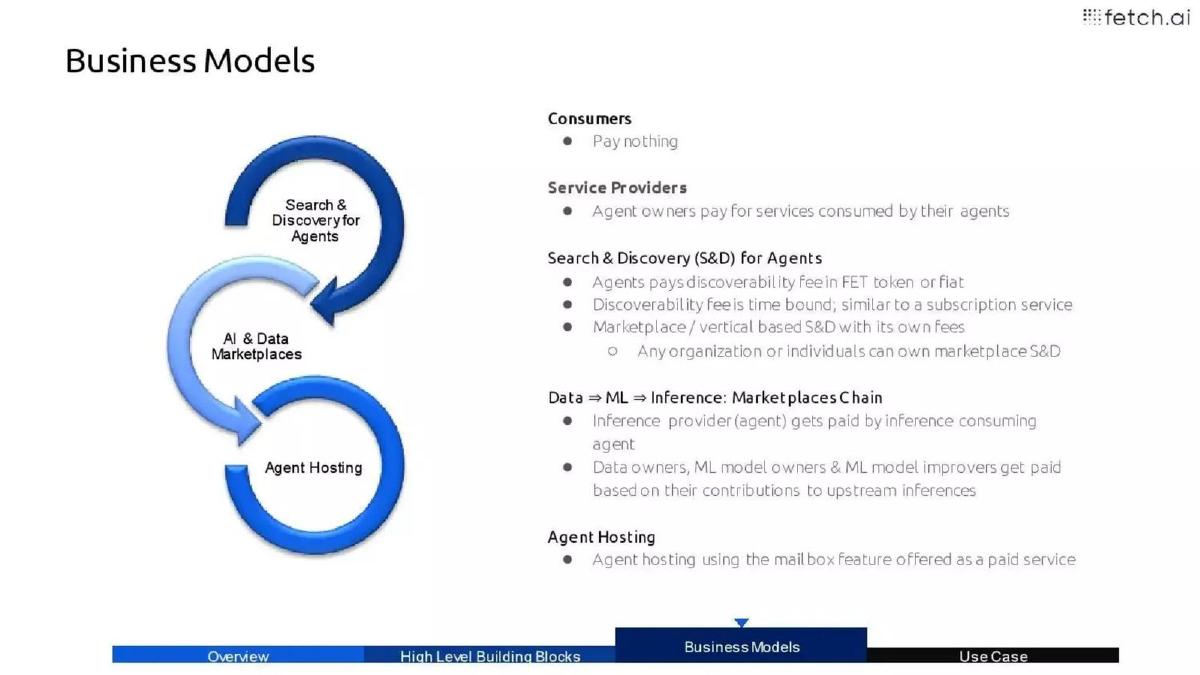
Network for AI agents. Slide titled "Business Models".
Fetch.ai deck, slide 12. Exact stored slide matched to this analysis.
Our analysis: The slide answers who pays and says fees can be in the token or in regular currency. With no prices or rates, an investor can't size any of the four streams.
Evidence and limitation: Who pays and who gets paid for four services; no prices.
What a founder can adapt: Add a price or rate for the discoverability fee and for hosting.
Supporting analysis
What the deck claims: "Consumers: Pay nothing"; "Service Providers: Agent owners pay for services consumed by their agents"; "Search & Discovery (S&D) for Agents: Agents pays discoverability fee in FET token or fiat"; "Data ⇒ ML ⇒ Inference": providers and data owners "get paid"; "Agent Hosting... offered as a paid service".
Presentation choice: Saying who pays is half the answer; the price is the other half.
When it does not fit: Four revenue streams with no numbers.
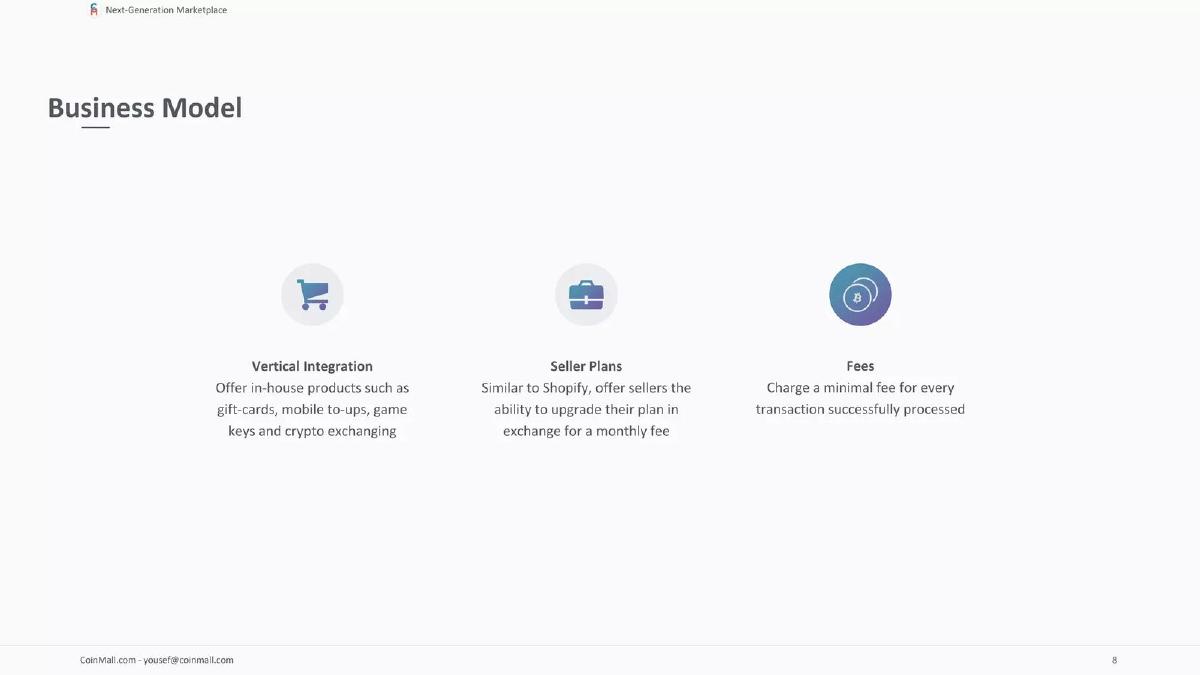
CoinMall deck, slide 8. Exact stored slide matched to this analysis.
Our analysis: The streams are clear, and the Shopify comparison helps. "Minimal fee" and "monthly fee" leave the investor to guess the amounts.
Evidence and limitation: Three streams; no prices or rates.
What a founder can adapt: State the transaction fee and the seller plan price.
Supporting analysis
What the deck claims: "Vertical Integration: Offer in-house products such as gift-cards, mobile to-ups, game keys and crypto exchanging"; "Seller Plans: Similar to Shopify, offer sellers the ability to upgrade their plan in exchange for a monthly fee"; "Fees: Charge a minimal fee for every transaction successfully processed".
Presentation choice: A comparison to a known company works better with the price beside it.
When it does not fit: Words like "minimal" in place of a rate.
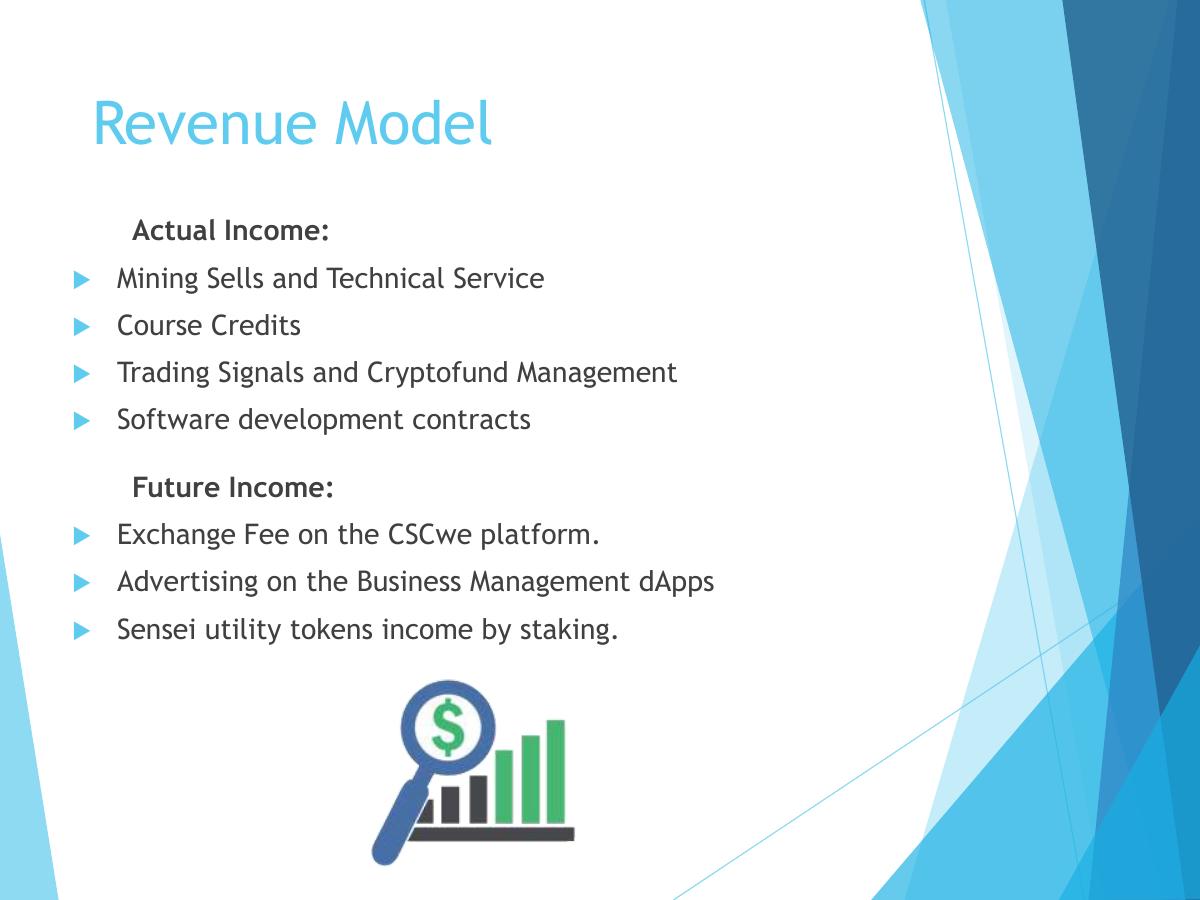
Crypto services for small businesses. Slide titled "Revenue Model".
Bitdharma deck, slide 9. Exact stored slide matched to this analysis.
Our analysis: Splitting current and future income is useful. But seven unrelated sources with no amounts make it hard to tell which one the business depends on.
Evidence and limitation: Seven income sources split into current and future; no figures.
What a founder can adapt: Show how much each current source earns and pick the main future one.
Supporting analysis
What the deck claims: "Actual Income: Mining Sells and Technical Service; Course Credits; Trading Signals and Cryptofund Management; Software development contracts." "Future Income: Exchange Fee on the CSCwe platform; Advertising on the Business Management dApps; Sensei utility tokens income by staking."
Presentation choice: Investors want to see the one or two streams that drive revenue.
When it does not fit: A long list of unrelated income sources.
Whether an investor can see who pays, how much, and in what currency.
Example
Business
Who pays
Price or rate
Currency
Fetch Payments
Crypto payments
Merchants and customers
2%; USD49/month
Stated (USD)
Binance
Exchange
Traders
0.2% per trade (main fee)
Not stated
Monico
Token platform
Project owners
10,000–50,000 MNC; 0.1%
Own token
Good Gaming
Blockchain game
Traders
5% royalty
ETH or stablecoins
Fetch.ai
AI agent network
Agent owners
None
FET token or fiat
CoinMall
Crypto marketplace
Buyers and sellers
"Minimal"
Not stated
Bitdharma
Crypto services
Not stated
None
Not stated
Key Takeaways
Say who pays for each revenue stream.
Give the rate or price.
Say whether customers pay in cash or in your token.
If your token is involved, say what people must buy it for.
A list of revenue ideas is not a business model.
Build your web3 business model slide
For each revenue stream, say who pays, how much and in what currency.
Payer. Who pays you, and for what?
Price. What is the rate or price?
Currency. Do they pay in cash, stablecoins or your token?
Token. If your token is involved, what must people buy it for?
Main stream. Which stream will bring in most of the revenue?
Copyable framework: Headline: [payer] pays [rate or price] per [unit], in [currency]. Main stream: [stream], [share] of revenue. Token role: [what the token is needed for].
Illustrative example 1 — written by us
Before: Fees: Charge a minimal fee for every transaction successfully processed
After: Buyers pay [rate]% per completed order, in [currency]; sellers pay [price] a month for upgraded plans.
What improved: Our illustrative rewrite; the bracketed details are placeholders, not CoinMall's facts. It replaces "minimal" with a rate and names the currency.
What this guide adds
The general business model guide covers any company. Crypto adds a question investors ask on every slide: does the company earn revenue in cash, or does it rely on demand for its own token? Both can work, but the slide needs to make clear which one it is.
Our library's web3 tag covers exchanges, crypto payments, token platforms, blockchain games and AI agent networks. We note each company's business in the examples.
How we read each slide
We quote the text on the slide images, which we rendered from the original deck files. We have not checked any fee, price or token figure.
Common mistakes
No price. Give a rate or amount for each stream.
Token-only pricing. Add a dollar reference.
Currency left out. Say whether revenue arrives in cash or tokens.
Token sale as revenue. Separate one-off sales from recurring income.
Too many streams. Lead with the one or two that matter.
Diagnostic checklist
Who pays for each stream.
A rate or price.
The currency.
What the token is needed for, if you have one.
The main revenue stream.
Frequently asked questions
What should a web3 business model slide show?
Who pays, how much and in what currency. Fetch Payments charges merchants 2% of transaction volume or USD49 a month.
Can I price everything in my own token?
You can, but add a dollar reference. Monico prices every action in its token, so its dollar revenue depends on a token price the slide doesn't give.
Is a token sale part of the business model?
Show it separately. Good Gaming lists a pre-launch token sale next to a recurring 5% royalty; they are different kinds of income.
How we chose these examples
Corpus: published pitch deck teardowns on StartupFundraising.com. Founder-uploaded private decks are excluded.
Selection (2026-09-27): we searched extracted slide text in decks tagged web3 for business model, revenue, pricing and token terms near the start of the slide, and reviewed each match.
Kept seven. Six of the seven images weren't stored yet, so we rendered them from the original public deck files and uploaded all seven in one batch under one single-use key. Left out: InnovateXchange p6 and Pragati p6 (revenue types named without prices, weaker than CoinMall), Teaser ReCheck p6 (already in the SaaS business model guide), AGV Protocol p9 (a token allocation slide, not a revenue model). Bitdharma's and CoinMall's decks appear in other guides with different slides.
Review: the rendered slide images were checked on 2026-09-27 and matched to company, deck and slide number (editorial model review). No person has yet completed an editorial review of this page.
Claims are as shown on the slides; we have not verified them. We make no claim that any slide caused a fundraising outcome.