Fetch Payments presented a vision for a hybrid crypto-fiat wallet and payment gateway specifically targeting the Southeast Asian market in 2020. The deck positions the company as a 'prime mover' in a region where global giants like BitPay and Coinbase had limited reach at the time. While the deck successfully outlines a multi-phase growth strategy—moving from system construction to mass marketing—it relies heavily on high-level value propositions rather than granular technical differentiation. The team slide showcases significant combined experience (30+ years), yet the deck lacks specific fi…
Key takeaways
- The company positions itself as a 'Prime Mover' in Southeast Asia, specifically citing a lack of Asian market presence from competitors like Bitpay (Slide 5).
- Fetch claims a consolidated team experience of over 30 years in payments and crypto industries (Slide 3).
- The product architecture is described as a 'Multi-Currency Hybrid Wallet' that enables instant cross-border payments and settlements (Slide 4).
- A strategic joint venture (JV) agreement with Brunei Crypto is listed as a completed milestone in Phase 1 (Slide 6).
- The competitive analysis compares Fetch against global players, noting Bitpay's >$1 Billion USD business volume in 2019 as the benchmark (Slide 5).
- The roadmap targets January 2021 for the commercialization of the final product and 'Market Expansion & Monopoly' (Slide 6).
- The deck omits a specific fundraising target, valuation, or detailed breakdown of how angel round funds will be allocated.
- The team consists of five key members, including three with Electronics Engineering backgrounds and a dedicated CEO for the Brunei operations (Slide 7).
Slide-by-Slide Analysis
Slide 1: Title Slide
The title slide introduces the brand as 'FETCH PAY' with the tagline 'ENABLING CRYPTO PAYMENTS EVERYWHERE.' The footer identifies the entity as Fetch International Sdn. Bhd., a Malaysian private limited company designation, and dates the deck to 2020. The 'Project Deck – BNM' notation suggests this version may have been prepared for or referenced in relation to Bank Negara Malaysia (the central bank) regulatory discussions.
Slide 2: The Need
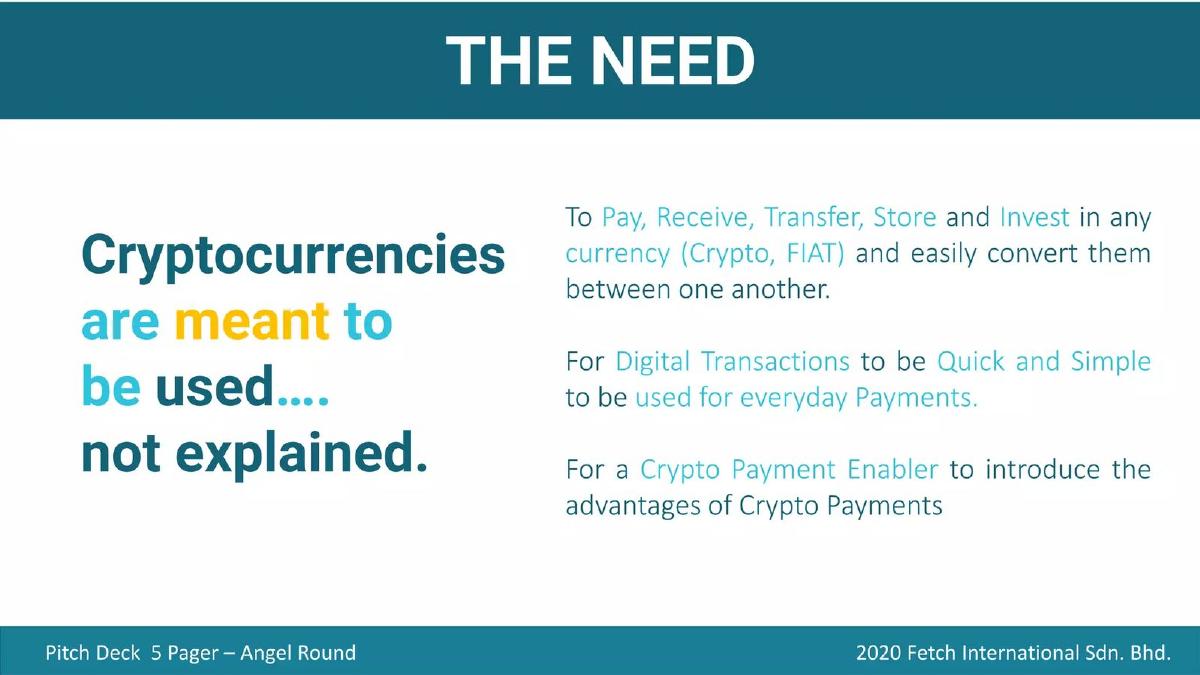
This slide addresses the problem statement. It argues that while cryptocurrency exists, it is too complex for everyday use. The 'Need' is categorized into three pillars: the ability to pay/receive/store/invest in any currency, the requirement for digital transactions to be 'Quick and Simple,' and the necessity for a 'Crypto Payment Enabler' to bridge the gap for the general public. The slide uses a clear, high-level approach to define the market friction.
Slide 3: Fetch Payment Enabler
Fetch details its solution here. The slide lists eight bullet points describing the platform's capabilities. Key technical claims include being an 'AML/KYC compliant Payment Gateway,' utilizing a 'Hybrid Wallet' for transparency, and featuring a 'built-in Cryptocurrency to Fiat Brokerage.' Notably, it mentions 'Open Banking' to connect with traditional financial institutions. The slide also highlights the team's '30+ years consolidated experience,' though it doesn't break down that experience by individual yet.
Slide 4: Unique Value Proposition
This slide focuses on the competitive edge. It lists five checkmarks: First to Market (specifically in South East Asia), Multi-Currency Hybrid Wallet, Local and International Payments, B2B & Commerce Payments, and Merchant Accounts for Online Merchants. A small diagram on the right illustrates a transaction flow where a user sends BTC and a merchant receives MYR (Malaysian Ringgit), emphasizing the fiat-settlement capability for businesses.
Slide 5: Our Competitors
The competitive landscape is presented in a table format. Fetch compares itself to Bitpay, Coinspaid, Coinbase, Crypto.com, and Alchemy Pay. The table includes 'Country of Origin,' 'Market Presence,' 'Business Volume 2019,' and 'User Base.' The strategic takeaway here is the 'Market Presence' column, where Fetch highlights that major players like Bitpay were excluding Asia at the time, and Alchemy Pay (based in Singapore) had a relatively small user base of >35,000 compared to Bitpay's >1 million.
Slide 6: Dev & Growth Phases
This roadmap slide breaks the company's journey into three phases. Phase 1 (Completed) includes incorporation, system construction, and a JV agreement with Brunei Crypto. Phase 2 (Ongoing) covers the beta wallet, brokerage operations, and licensing. Phase 3 (Targeted Jan 2021) focuses on commercialization, mass marketing, and 'Market Expansion & Monopoly.' The use of the word 'Monopoly' is an aggressive choice for a pitch deck, usually intended to signal dominant market share aspirations.
Slide 7: Our Team
The team slide features five individuals. Arravind (AP), CEO: 11 years in business development and 5 years in financial markets. Vimal S., CFO/COO: 12 years in project management and 3 years in crypto trading. Anandasurian, Lead Engineer: 15 years in technology and system integration. Sharol Azwan, CEO (Brunei): 2 years as a system analyst and 3 years managing crypto startups. Ian Chong, Sales Lead: 10+ years in financial product sales. Three of the five members hold B.Electronics Engineering degrees, suggesting a heavy technical foundation for the founding group.
Slide 8: Summary
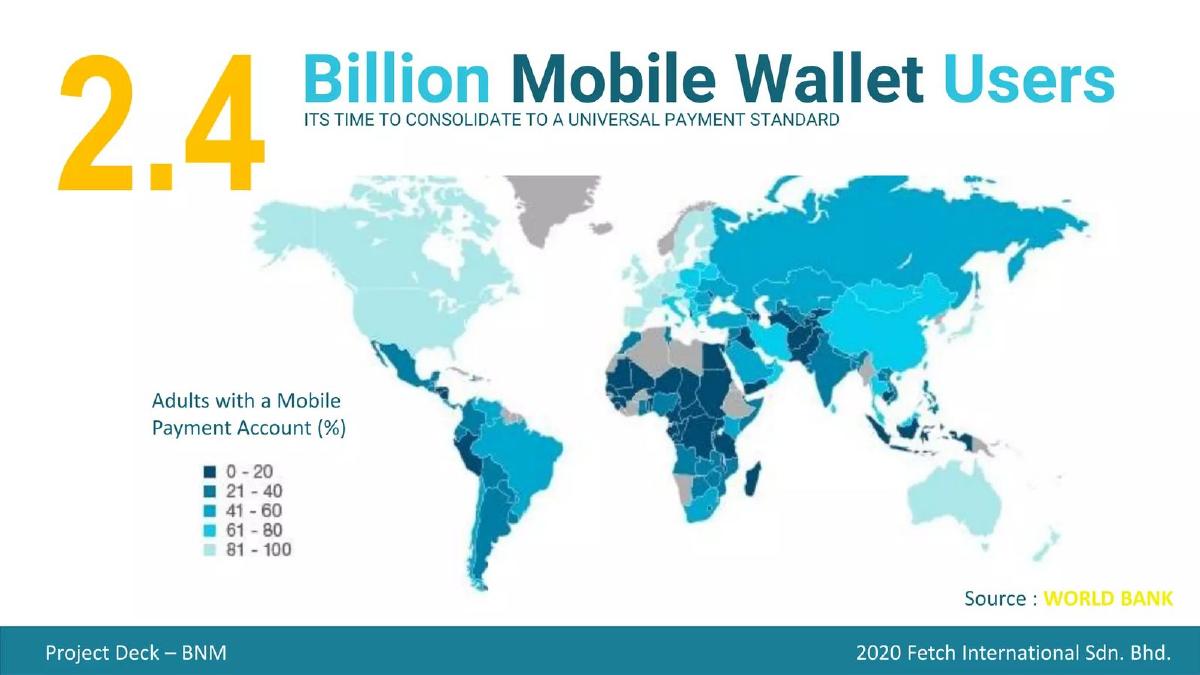
The final slide summarizes the macro thesis. It posits that Fintech is transforming the industry, cryptocurrencies are a 'safer digital cash option' due to their decentralized nature, and a 'Crypto Native Mobile Wallet' will consolidate all payment wallets into a single universal medium. It functions more as a closing statement on the industry's future than a summary of the company's specific financials or ask.
What Works in This Deck
Regional Focus: By explicitly pointing out the lack of Asian market presence among global competitors on Slide 5, Fetch creates a clear 'why now' and 'why us' for regional investors. · Clarity of Product: The diagram on Slide 4 effectively explains the complex process of crypto-to-fiat settlement in a single, simple graphic. · Milestone Tracking: Slide 6 provides a clear distinction between what has been built (Phase 1) and what is currently being worked on (Phase 2), which builds credibility regarding execution. · Team Technical Depth: Highlighting that the majority of the leadership team has engineering degrees provides reassurance regarding the 'Industrial grade security' claims made earlier in the deck.
What Is Missing
The Ask: There is no slide detailing how much money is being raised in this 'Angel Round,' what the valuation is, or what the specific use of funds will be. · Unit Economics: The deck mentions merchant accounts and B2B payments but does not explain the fee structure, take rates, or customer acquisition costs (CAC). · Financial Projections: While Slide 5 lists competitor volumes, there are no projections for Fetch's own expected transaction volume or revenue over the next 12-36 months. · Regulatory Detail: Given the 'BNM' (Bank Negara Malaysia) reference on the title slide, a more detailed slide on the specific licenses obtained or required in Malaysia and Brunei would be expected for a fintech play. · User Traction: While Phase 2 mentions 'Market Validation,' the deck does not provide specific numbers for beta users, waitlist signups, or early merchant partners.
Founder Takeaways: What to Copy
The Competitor Table: Use a table that includes 'Market Presence' and 'Since' dates. This helps investors see not just who the big players are, but where the geographic and timing gaps exist. · Phase-Based Roadmap: Grouping milestones into 'Completed,' 'Ongoing,' and 'Future' is much more effective than a simple linear timeline because it proves the team can actually ship code and sign agreements. · Simple Problem/Need Statements: Slide 2 is a great example of distilling a complex technological shift (crypto) into a simple human need (using it without needing to explain it). · Localized Value Prop: If you are building in a specific region, emphasize the 'Local' aspect of payments and settlements. Global investors often look for 'The [Global Company] of [Specific Region]' plays.
Frequently asked questions
- What is the core problem Fetch Payments is trying to solve?
- According to Slide 2, the 'Need' is that cryptocurrencies are 'meant to be used... not explained.' The company identifies a gap in the market for a tool that allows users to pay, receive, transfer, store, and invest in any currency (Crypto or Fiat) and easily convert between them for everyday digital transactions.
- How does Fetch Payments differentiate itself from Coinbase or BitPay?
- Fetch focuses on regional dominance. Slide 5 explicitly notes that BitPay excludes Asia from its 8-country market presence. Fetch positions itself as the 'First to Market' in Southeast Asia, offering localized merchant accounts and a hybrid wallet designed for the specific regulatory and commercial landscape of the region.
- What is the current development status of the product in this deck?
- At the time of the deck's creation in 2020, the company was in 'Phase 2' (Ongoing). This included a functional beta version of the Fetch Wallets, operations as a wallet and brokerage, market validation, and licensing efforts (Slide 6).
- Who are the key members of the Fetch Payments leadership team?
- The team includes Arravind (AP) as CEO/Co-Founder, Vimal S. as CFO/COO, Anandasurian as Lead Engineer, Sharol Azwan as CEO (Brunei), and Ian Chong as Sales Lead. The leadership team features a mix of engineering backgrounds and financial market experience (Slide 7).
- What are the specific features of the Fetch Payment Enabler?
- Slide 3 lists several features: an AML/KYC compliant gateway, a built-in Crypto-to-Fiat brokerage, industrial-grade security, and 'Open Banking' which enables access to a network of traditional financial institutions via the Fetch Wallet.