Fibery's Series A deck is a masterclass in positioning a 'horizontal' product within a crowded market. By explicitly naming competitors like Notion, Airtable, and Jira, and then mapping their weaknesses against Fibery’s 'connected processes' architecture, the company makes a compelling case for a new category of work management. The deck leans heavily on transparency, disclosing a modest $350K ARR and a 4% revenue churn rate while highlighting a high-pedigree R&D team from Targetprocess. The narrative focuses on the 'painful migration' startups face as they scale, offering Fibery as the singl…
Key takeaways
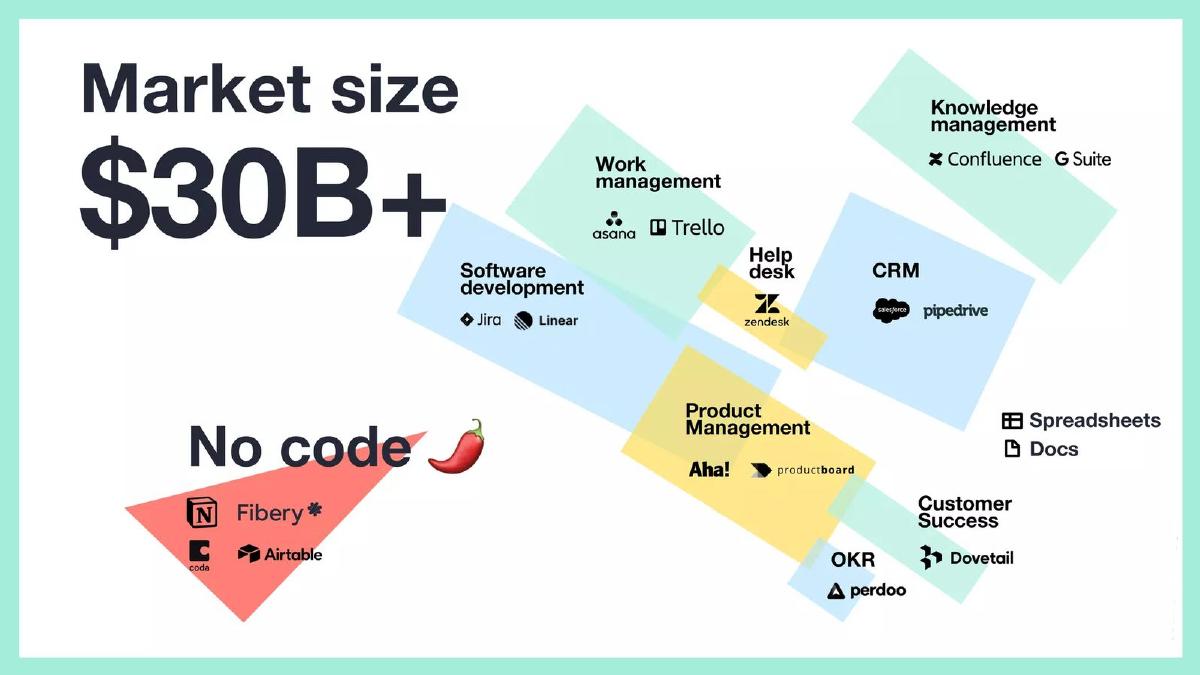
- The deck identifies a $30B+ market size by aggregating segments like CRM, OKR, and Software Development (Slide 4).
- Fibery reports $350K in ARR with 180 paid accounts and a largest customer (Lemonade) at 300 users (Slide 12).
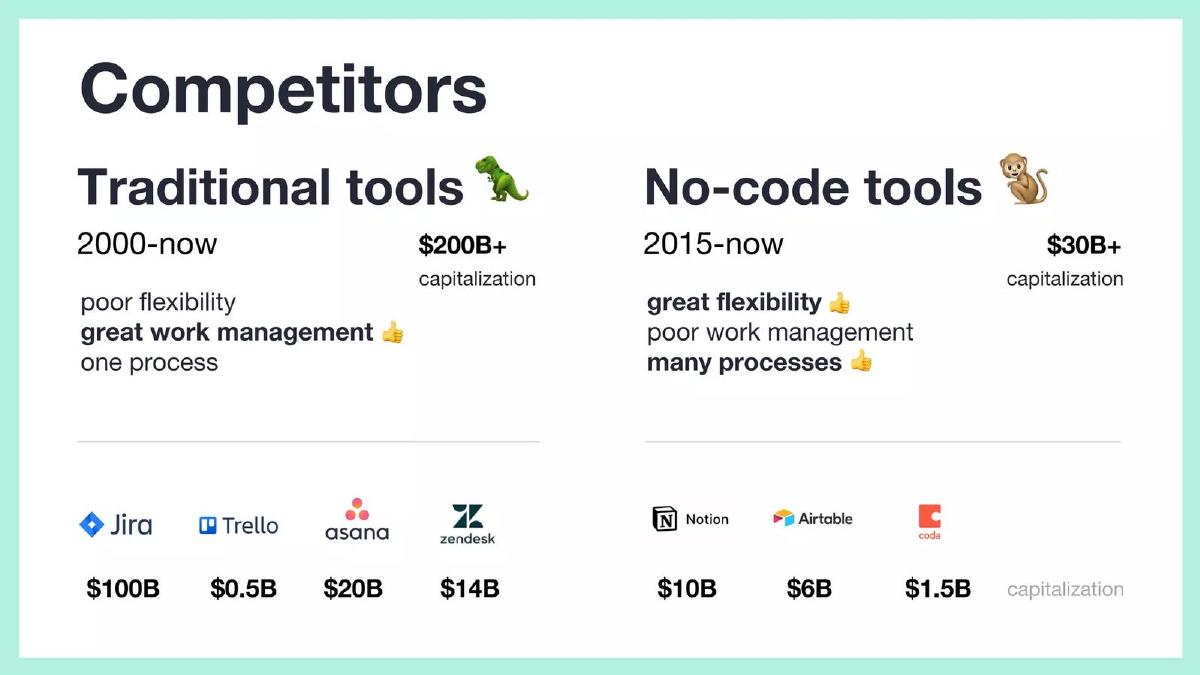
- The company positions itself against 'Traditional tools' ($200B capitalization) and 'No-code tools' ($30B capitalization) (Slide 5).
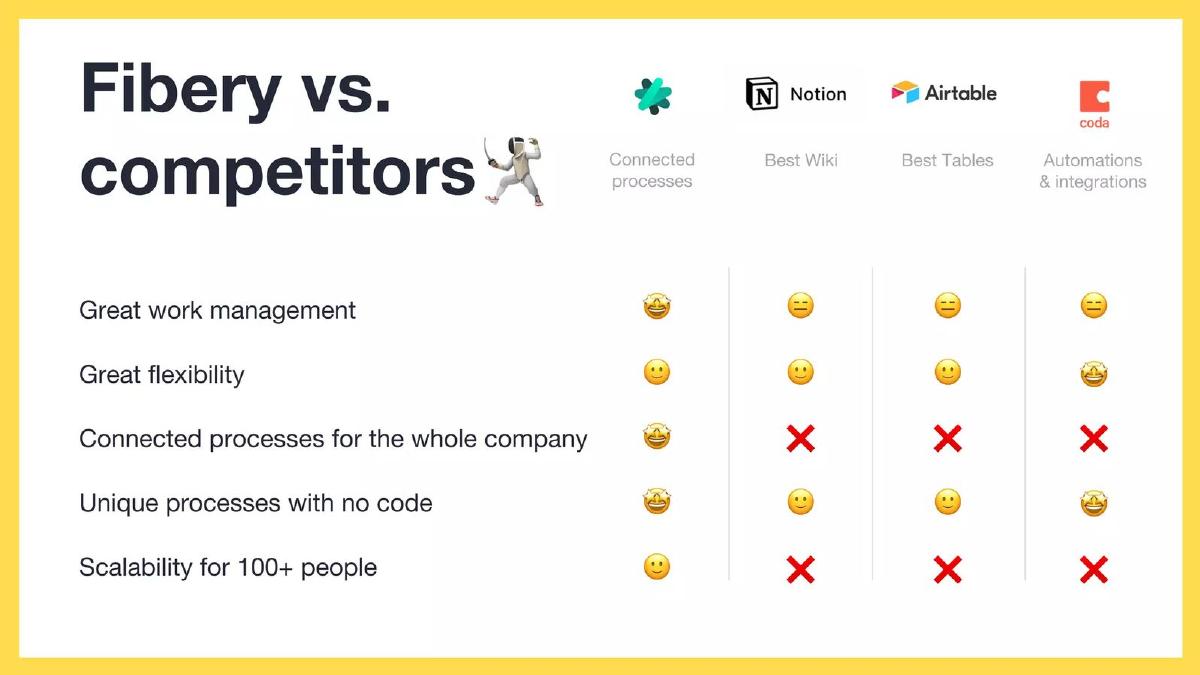
- A detailed comparison table claims Fibery is the only tool offering 'Connected processes for the whole company' and 'Scalability for 100+ people' (Slide 6).
- The team is comprised of 25 employees, including 15 R&D members with an average of 10+ years of experience (Slide 14).
- The fundraising ask is for a ~$4.5M round to build a marketing team and reach $1M ARR by December 2023 (Slide 15).
- Revenue churn is reported at a healthy 4%, with logo churn at 6% over a 6-month period (Slide 12).
- The product architecture is based on 'Connected spaces' and 'Customizable business domains' (Slide 7).
Fibery Series A Pitch Deck Analysis
Fibery’s pitch deck is a focused, data-driven presentation that attempts to solve the 'all-in-one' workspace paradox. While many startups claim to be the 'single source of truth,' Fibery uses its Series A deck to explain the technical 'how' behind that claim, specifically focusing on connected databases and scalability. The deck is notable for its competitive honesty and clear roadmap from a niche spin-off to a broad market contender.
Slide 1-3: The Hook and The Scale Problem
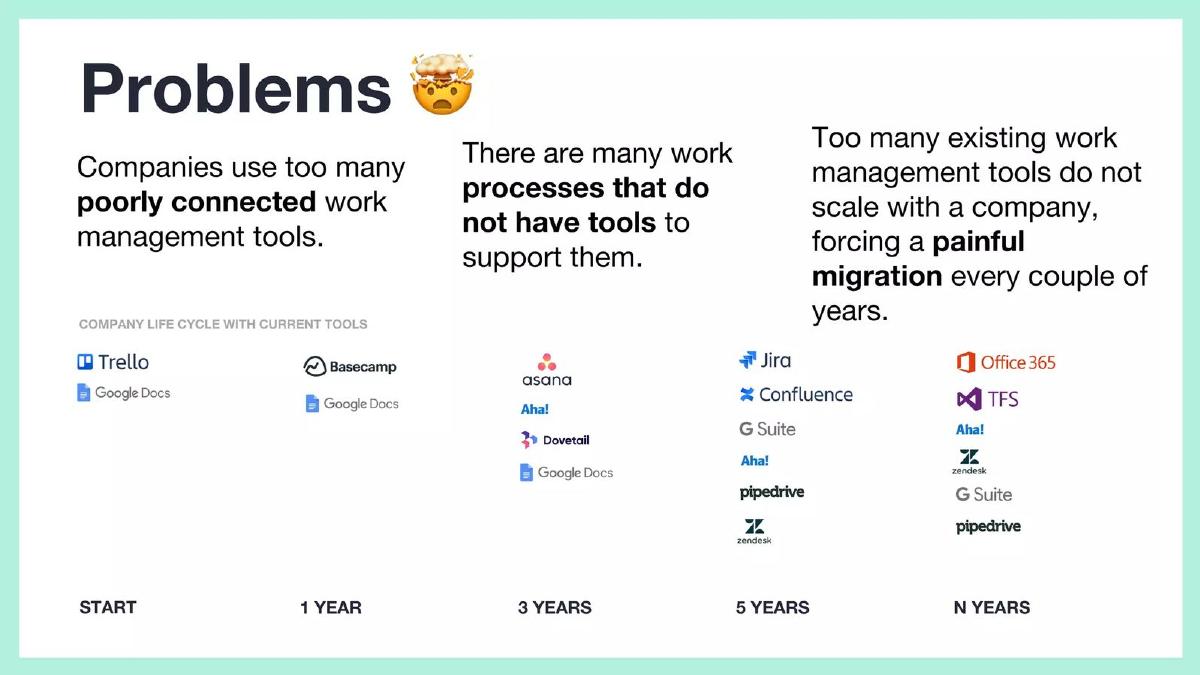
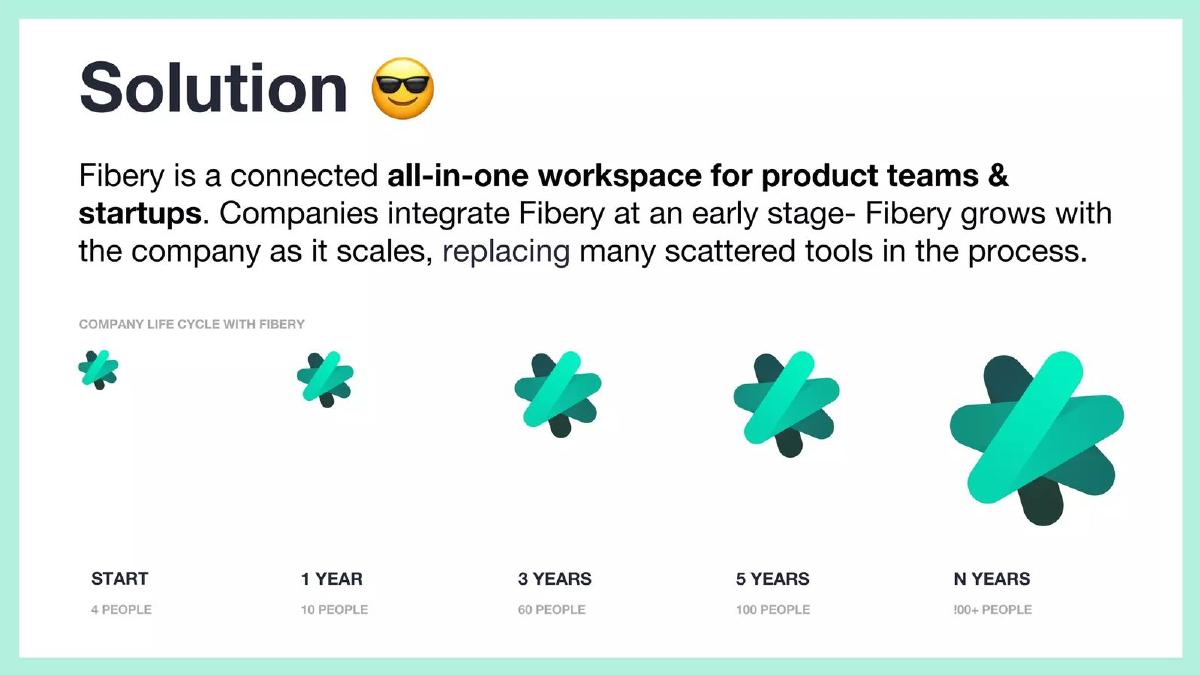
The deck opens with a simple value proposition: 'Fibery is a connected workspace for startups.' Slide 2, the Problem slide, uses a timeline to show how a company's tech stack becomes bloated over time. It lists tools like Trello, Google Docs, Asana, Jira, and Salesforce, noting that as a company reaches 'N Years,' the lack of connection between these tools forces a 'painful migration.' This sets the stage for Slide 3, the Solution, which depicts Fibery as a single, growing icon that scales from a 4-person team to over 100 people without requiring a tool swap.
Slide 4-6: Market and Competitive Positioning
Slide 4 estimates a $30B+ market size by overlapping various categories including CRM, OKR, Product Management, and Software Development. This is a strategic way to show that Fibery isn't just competing in one vertical but is eating the edges of several. Slide 5 categorizes competitors into 'Traditional tools' (Jira, Asana) and 'No-code tools' (Notion, Airtable). It acknowledges the strengths of others—giving Jira a 'thumbs up' for work management—while highlighting their lack of flexibility. Slide 6 is a direct 'Fibery vs. competitors' matrix. It uses emojis to rank features, claiming Fibery is the only tool that provides 'Connected processes for the whole company' and 'Scalability for 100+ people,' while labeling Notion as 'Best Wiki' and Airtable as 'Best Tables.'
Slide 7-9: Product Architecture
The product section avoids generic screenshots in favor of structural explanation. Slide 7 introduces 'Connected spaces' and 'Customizable business domains,' showing a workspace map that links Software Development, Product Management, CRM, and Hiring. Slide 8 visualizes 'Building Blocks,' showing how databases (like OKRs) connect to views (boards, timelines) and automations. This technical depth is intended to prove that Fibery is more than just a document editor; it is a relational database engine for business logic.
Slide 10-12: Traction and Social Proof
Slide 10 provides customer testimonials from COOs and CSOs, specifically mentioning that Fibery replaced 'Jira, Confluence, and Trello-style tools.' It also notes a 4.8 rating on G2 . Slide 11 outlines the Go-to-market strategy, focusing on replacing 'poorly connected tools' and integrating with 'specialized tools' like GitLab and Figma. Slide 12 is the 'Current metrics' slide, which is remarkably transparent. It lists $350K ARR , 180 paid accounts, and a 4% revenue churn . Mentioning Lemonade as their largest customer with 300 users provides enterprise-grade validation for a startup-focused tool.
Slide 13-15: History, Team, and The Ask
Slide 13 details the company's timeline, noting its origin as a Targetprocess spin-off in 2017 and its $3.1M Seed round in 2021. Slide 14 introduces the team, led by Michael Dubakov (ex-Targetprocess Founder & CEO). The emphasis here is on the R&D team’s 10+ years of experience in work management. Finally, Slide 15 presents the 'Plans': a ~$4.5M round to build a marketing team and reach $1M ARR by Dec 2023 and $2-3M ARR by Dec 2024 .
What Works in This Deck
Direct Competitive Comparison: Instead of ignoring Notion and Airtable, Fibery leans into the comparison, acknowledging what they do well while carving out a specific niche (connected processes) that the giants supposedly lack. · Metric Transparency: Disclosing churn rates and average account sizes ($2,000 ARR) builds trust with investors. It shows the founders understand the unit economics of their SaaS business. · Pedigree: Highlighting that the team came from Targetprocess (an established agile tool) mitigates the risk of 'yet another productivity tool' by showing they have deep domain expertise. · Visualizing the 'Why': The timeline of tool bloat (Slide 2) is a relatable pain point for any venture capitalist who has seen their portfolio companies struggle with internal operations.
What is Missing
Unit Economics (CAC/LTV): While the deck mentions an 'Expected LTV' of ~$7K, it does not provide the current Cost Per Acquisition (CAC). Given that the 'Plans' slide focuses heavily on building a marketing team, investors would want to know the efficiency of current acquisition channels. · Detailed Use Cases: The deck mentions 'Product Teams' frequently, but it doesn't show a deep dive into a specific workflow (e.g., a sprint planning cycle or a customer feedback loop) to demonstrate the UI/UX superiority. · Barriers to Entry: In a market with Notion and Airtable, 'connected processes' is a feature that could theoretically be built by competitors. The deck doesn't explicitly state what the 'moat' is beyond the current architectural head start.
Founder Takeaways
Own your niche: Fibery doesn't try to be the best wiki; they concede that to Notion. By picking one thing to be 'best' at (connected processes), they make the choice easier for a specific type of customer. · Use your history: If your startup is a spin-off or the founders have 10+ years in the industry, make that a central pillar of the 'Team' slide. It proves you aren't just guessing at the problem. · Set realistic milestones: The jump from $350K ARR to $1M ARR is a standard Series A trajectory. Fibery’s plan feels grounded because it ties the revenue growth directly to the hiring of a marketing team, which was previously a gap in their R&D-heavy structure.
Frequently asked questions
- What was the primary problem Fibery aimed to solve?
- According to Slide 2, Fibery targets the fragmentation of work management. They argue that companies use too many poorly connected tools, many processes lack dedicated software, and existing tools fail to scale, forcing companies into 'painful migrations' every few years as they grow.
- How does Fibery differentiate itself from Notion and Airtable?
- On Slide 6, Fibery uses a comparison matrix to claim that while Notion is the 'Best Wiki' and Airtable has the 'Best Tables,' both lack 'Connected processes for the whole company' and 'Scalability for 100+ people.' Fibery positions itself as the only solution that combines flexibility with robust work management.
- What are the key financial metrics disclosed in the deck?
- Slide 12 lists $350K ARR, 180 paid accounts, and 400 active company accounts. The average paid account size is 15 users, generating approximately $2,000 in ARR. They also disclose a 6-month revenue churn of 4% and a logo churn of 6%.
- What is the background of the founding team?
- Slide 14 highlights that Fibery is a spin-off from Targetprocess, an enterprise agile planning tool. Founder and CEO Michael Dubakov previously founded Targetprocess in 2004. The R&D team of 15 has an average of 10+ years of experience in the work management market.
- How does Fibery plan to use the Series A capital?
- As stated on Slide 15, the ~$4.5M round is intended to build a 'strong marketing team,' improve acquisition channels (partners, community, influencers), and launch 'Fibery 2.0' in late 2023. Their goal is to hit $1M ARR by Dec 2023 and $2-3M ARR by Dec 2024.