Sunnyside’s 10-slide Series A deck is a clinical example of how to frame a market gap. By identifying that 68 million Americans are 'heavy drinkers' but only 2% seek traditional treatment, Sunnyside positions itself not as a competitor to AA or rehab, but as a new category for the remaining 98%. The deck relies heavily on founder pedigree, showcasing experience from Lyft, MileIQ, and IPSY to prove they can build habit-forming products. While the deck is light on financial specifics—omitting a clear 'Ask' slide and detailed unit economics—it successfully uses a '1.4% penetration' argument to v…
Key takeaways
- The deck identifies a massive TAM of 68 million heavy drinkers in the U.S., defined by the CDC as more than 7-14 drinks per week (Slide 4).
- Sunnyside differentiates itself by targeting the 98% of heavy drinkers who do not seek traditional 'all-or-nothing' sobriety treatment (Slide 5).
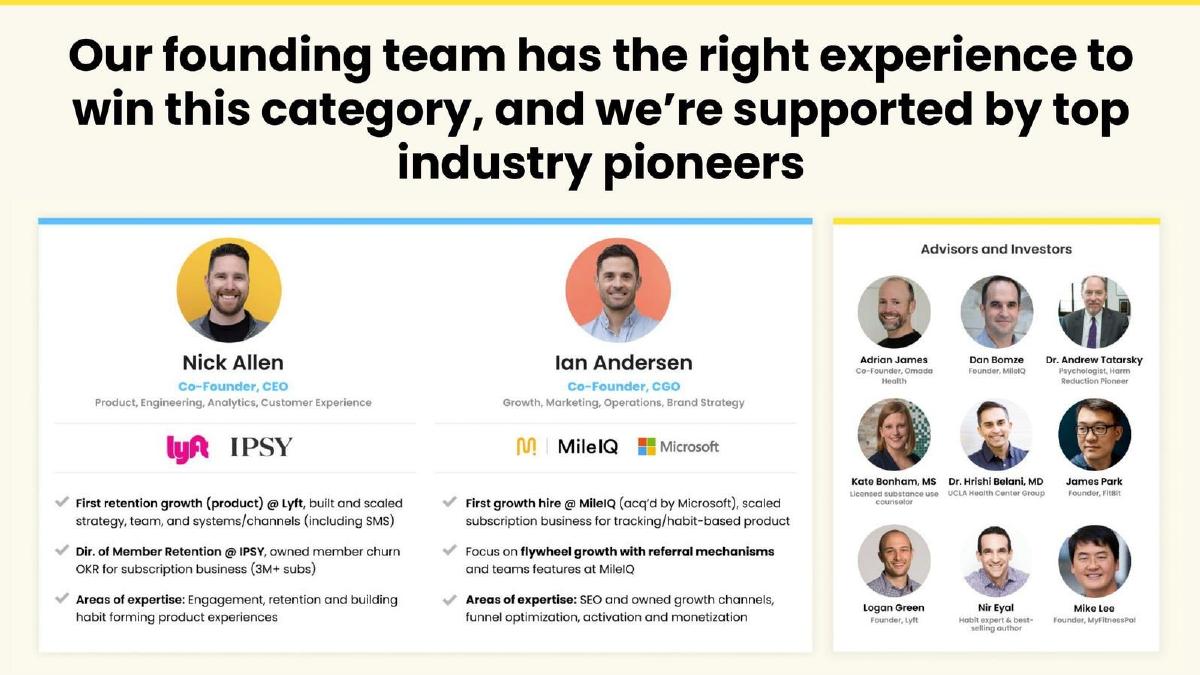
- The founders use their background at Lyft and MileIQ to establish credibility in building high-retention, habit-based subscription products (Slide 3).
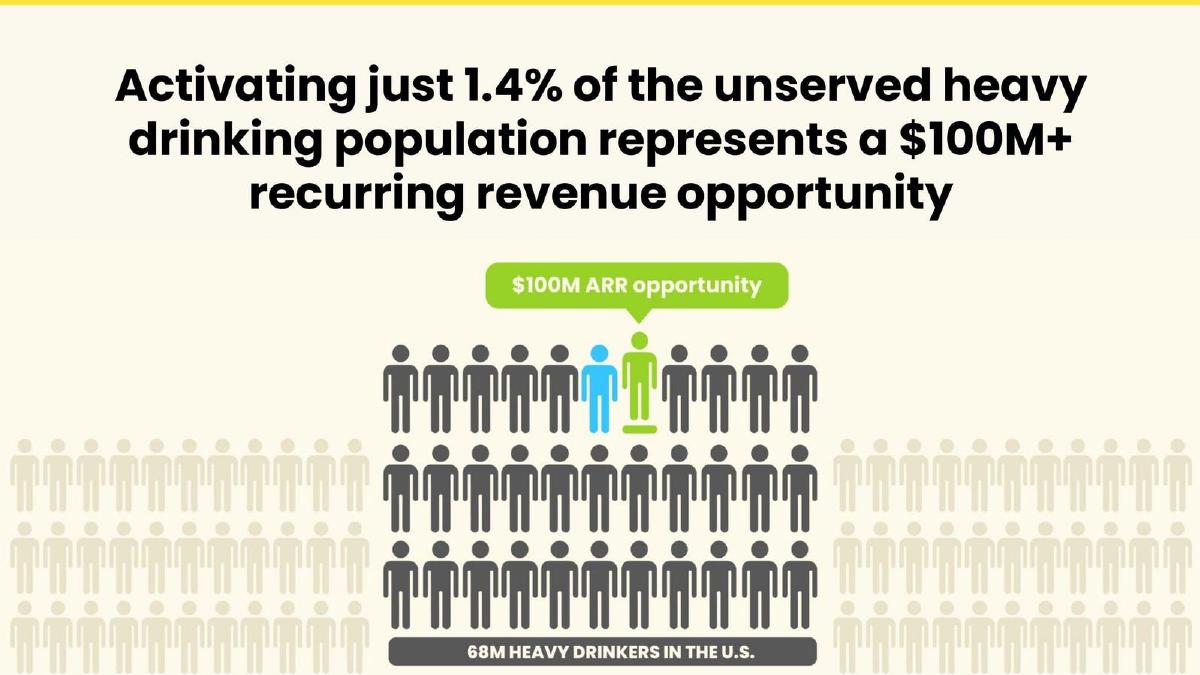
- A $100M+ ARR opportunity is projected by capturing just 1.4% of the unserved heavy drinking population (Slide 6).
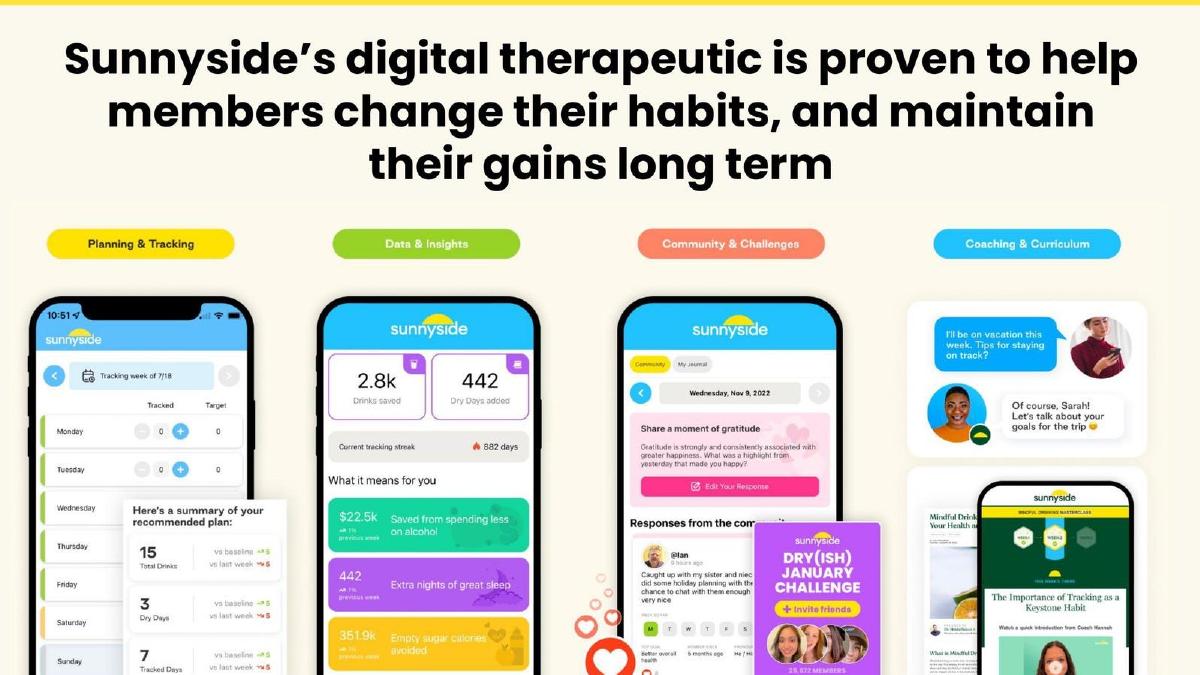
- The product is framed as a 'digital therapeutic' with four pillars: Planning, Data, Community, and Coaching (Slide 9).
- The deck includes a robust list of advisors and investors from companies like Fitbit, MyFitnessPal, and Omada Health to validate the healthtech angle (Slide 3).
- There is a notable absence of a specific 'Ask' slide detailing the $11.5M raise or the intended use of funds within the 10 slides provided.
- The team slide highlights a lean but experienced structure with hires from Airbnb, HireVue, and Podium (Slide 10).
The Strategy of Moderation: A 10-Slide Breakdown
Sunnyside’s Series A deck is a study in focused storytelling. In just 10 slides, the company moves from a massive societal problem to a specific, underserved niche, and finally to a team capable of capturing it. By the time the reader reaches the end, the logic of the $100M ARR goal feels grounded in demographic reality rather than just optimistic projection.
Slides 1-2: The Mission Statement
The deck opens with a clean, high-contrast title slide. Slide 2 immediately delivers the 'elevator pitch': "Sunnyside is the leading digital health platform for moderating alcohol use." This is a critical distinction. They are not a 'sobriety app'; they are a 'moderation platform.' This positioning allows them to claim a much larger market than traditional recovery tools.
Slide 3: The Pedigree Slide
Unusually early in the deck, Sunnyside introduces the team. This is a tactical choice. Because habit-change apps live or die by retention, the founders highlight their specific experience in this field. Nick Allen cites his role as the first retention growth hire at Lyft and his work at IPSY (managing 3M+ subscribers). Ian Andersen highlights his role at MileIQ (acquired by Microsoft). The message is clear: these founders know how to build products that people use every day. The inclusion of advisors from Fitbit and MyFitnessPal further cements their status in the health-tracking category.
Slides 4-5: Quantifying the 'Unserved'
Slide 4 uses CDC data to define the problem: 68 million heavy drinkers in the U.S. Slide 5 is the 'aha' moment for investors. It shows that while 68 million people have a problem, only 2% receive treatment. The remaining 98% are ignored because existing options (rehab, AA) are "rigid, all-or-nothing sobriety services" (as stated on Slide 7). This identifies a massive 'Blue Ocean' of users who want to improve their health without the stigma or extremity of traditional recovery.
Slide 6: The $100M Path
Slide 6 provides the financial justification for the round. It posits that "Activating just 1.4% of the unserved heavy drinking population represents a $100M+ recurring revenue opportunity." By breaking down a massive number into a small, achievable percentage (1.4%), the founders make the $100M target seem conservative rather than aggressive. This is a classic fundraising technique to de-risk the market size in the eyes of a VC.
Slides 7-8: The Gap and the Solution
Slide 7 reinforces the failure of the status quo (all-or-nothing services). Slide 8 introduces the Sunnyside solution through lifestyle imagery. Instead of showing medical charts, they show people sleeping better, losing weight, and avoiding hangovers. This frames the product as a lifestyle upgrade rather than a medical intervention, which is key to their 98% market capture strategy.
Slide 9: Product Architecture
Slide 9 breaks the 'digital therapeutic' into four functional areas: Planning & Tracking, Data & Insights, Community & Challenges, and Coaching & Curriculum. The screenshots show a polished, modern UI. Notable features include a 'Drinks Saved' counter and a 'Dry(ish) January Challenge,' which directly supports their moderation-first philosophy.
Slide 10: The Extended Team
The final slide showcases the broader team, including leads from Airbnb, Lyft, and HireVue. This slide emphasizes that the company has already moved past the 'two founders in a garage' stage and has built a professional organization capable of scaling the $11.5M investment reported by the publisher.
What Sunnyside Does Well
Market Reframing: The most successful element of this deck is how it reframes 'alcohol treatment' as 'alcohol moderation.' By doing so, they expand their TAM by 50x (from the 2% who seek treatment to the 100% who drink heavily). This is a textbook example of how to pitch a product in a crowded space by finding a massive, neglected segment.
Founder-Market Fit: The deck does not just say the founders are smart; it says they have the exact skills needed for this specific product. Retention and habit-forming growth are the two most important metrics for a health app, and the founders' histories at Lyft and MileIQ prove they have mastered these disciplines.
Visual Simplicity: The deck uses a consistent color palette (yellow and light blue) that feels 'sunny' and optimistic. This contrasts sharply with the dark, clinical, or somber tones often found in addiction recovery materials, reinforcing their brand as a positive health tool.
What is Missing from the Deck
The Ask: The 10 slides provided do not include a funding request. There is no mention of the $11.5M raised, the valuation, or how the capital will be allocated between engineering, marketing, and operations. This information was likely in a separate slide or discussed in person.
Unit Economics: While Slide 6 mentions a $100M ARR opportunity, the deck lacks current unit economics. Investors typically want to see Customer Acquisition Cost (CAC), Lifetime Value (LTV), and current churn rates, especially when the founders' primary claim to fame is 'retention expertise.'
Competitive Landscape: The deck mentions that 'existing options' don't resonate, but it doesn't name competitors like Noom (which has a similar habit-tracking approach) or other moderation apps like Less or Reframe. A competitive matrix would have helped clarify their unique technical or community advantages.
Founder's Playbook: What to Copy
The 'Small Percentage' Logic: If you are entering a massive market, don't just show the total size. Show what a tiny, realistic sliver of that market looks like in dollars. Sunnyside's '1.4% = $100M' is a compelling way to make a big vision feel attainable.
Early Team Validation: If your team has 'Big Tech' or 'Unicorn' experience, put it on Slide 3, not Slide 12. Use that credibility to buy the investor's attention for the rest of the deck.
Outcome-Based Imagery: Instead of focusing purely on features (e.g., 'we have a database of drinks'), focus on the user's desired outcome. Sunnyside's use of images for 'Sleep better' and 'Avoid hangovers' sells the dream, not the tool.
Frequently asked questions
- How much did Sunnyside raise with this deck?
- According to publisher-reported facts from Business Insider, Sunnyside raised $11.5 million in a Series A round in 2024. The deck itself does not state the amount.
- What is Sunnyside's core value proposition?
- Sunnyside positions itself as a digital health platform for alcohol moderation rather than total sobriety. It fills the gap for millions who want to drink less but are not interested in quitting entirely, using habit-tracking and coaching to improve health outcomes like sleep and weight loss.
- How does the deck define its target market?
- The deck uses CDC data to define 'heavy drinking' as more than 7 drinks per week for women and 14 for men. It claims 1 in 3 U.S. adults (68 million people) fall into this category, creating a massive top-of-funnel for their service.
- Who are the founders and what is their background?
- The founders are Nick Allen (CEO) and Ian Andersen (CGO). Allen was the first retention growth hire at Lyft and a Director at IPSY. Andersen was the first growth hire at MileIQ, which was acquired by Microsoft. Their expertise is centered on engagement and habit-forming products.
- Does the deck show any financial performance metrics?
- The provided slides do not show historical revenue, CAC, or LTV. It focuses on the potential scale, stating that 1.4% market penetration equals a $100M ARR opportunity, but omits current traction data.