Sun Flour Baking is a veteran in the plant-based sector, founded in 1997 by Rey Ortega. Their pitch deck outlines a transition from a small-scale operation with ~$300k in 2022 revenue to a high-growth manufacturer aiming for $6.3 million in revenue by Year 3. The company seeks a $5.2 million investment to build a 20,000 square foot facility and expand production lines. While the deck benefits from strong founder pedigree and clear revenue diversification across B2B and B2C channels, it relies heavily on projected growth following a significant capital injection. The inclusion of an M&A projec…
Key takeaways
- The founder, Rey Ortega, has over 30 years of experience and previously founded Alternative Baking Company, which hit ~$1M in sales in 1995/96 (Slide 3).
- Sun Flour Baking reported ~$300k in revenue for 2022, a 70% increase over 2021, with 95% of that revenue coming from their top 5 clients (Slide 7).
- The company achieved a net income of ~$70k in 2022, representing a 20-30% margin on sales (Slide 7).
- The business model is diversified across eight streams, including private label for the US Military (MREs) and co-packing for brands like Renewal Mills (Slide 9).
- Sun Flour Baking recently acquired Michy's Foods, which is sold through approximately 25 Ralphs stores (Slide 7).
- The ask is for a $5.2 million investment, with 29% allocated to building and equipment in Year 1 (Slide 14).
- Financial projections target $6.3 million in revenue and $1.7 million in net income by Year 3 (Slide 14).
- The expansion plan includes moving from a 4,000 square foot facility to a 20,000 square foot facility to support four production lines (Slides 7, 14, 15).
Executive Summary and Mission
Slides 1-2: The Hook and The Mission
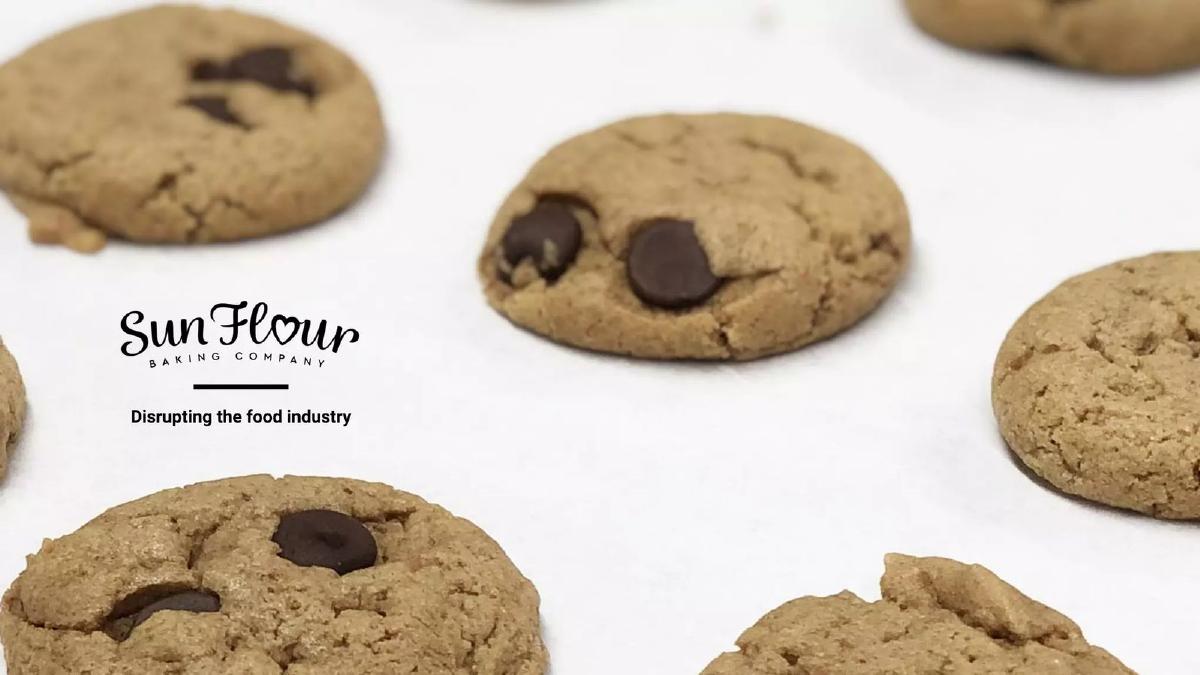
Sun Flour Baking opens with high-quality product photography of chocolate chip cookies, immediately establishing the brand's visual identity. The tagline on Slide 1 , "Disrupting the food industry," is a standard startup trope, but it is contextualized by the company's focus on vegan bakery products. Slide 2 defines the mission: improving the health and well-being of those seeking vegan options. It breaks down its approach into three pillars: stimulating curiosity, offering nutritious plant-based sweets, and maintaining a trusted vegan-only facility. The focus on a dedicated facility is a subtle but important nod to allergen safety, which is a significant pain point in the commercial baking industry.
Slide 3: Founder Pedigree
Slide 3 is perhaps the most important slide for establishing credibility. It highlights founder Rey Ortega's 30-year history in the sector. Specifically, it notes he founded Alternative Baking Company in 1994, which reached ~$1 million in sales by 1995/96. This establishes that the founder has successfully scaled a brand in this specific niche before. The slide also includes testimonials from industry figures like Colleen Holland (VegNews) and Gene Bauer (Farm Sanctuary), reinforcing Ortega's reputation as a pioneer in the plant-based movement.
Problem and Solution
Slide 4: The Problems We Address
The deck identifies six specific problems on Slide 4 : unsavory options, short shelf life, GMO usage, lack of nutrients, wasted energy in production, and allergens. The mention of "short shelf life" is particularly relevant for retail, as it directly impacts profit margins and waste. The slide also makes a health-based argument against dairy and eggs, citing D-galactose and inflammatory processes, which aligns with the brand's mission to provide "healthier" alternatives.
Slides 5-6: Value Proposition and Solution
Slide 5 positions the company as a "dairy and egg industry disruptor." It argues that consumers are more likely to try a vegan dessert than a meat alternative, suggesting a lower barrier to entry for their products. Slide 6 details the solution: a range of cookies, cakes, muffins, and brownies that are free of cholesterol, hormones, and pesticides. A key technical differentiator mentioned here is the use of a "patented sugar made from grape juice and brown rice syrup," which addresses the "healthy sugar" demand.
Traction and Market Context
Slide 7: Current Traction
Slide 7 provides the hard numbers. In 2022, the company generated ~$300k in revenue, which was a 70% increase over 2021. While $300k is relatively small for a company founded in 1997, the deck explains that they are currently operating out of a 4,000 square foot facility and that 95% of revenue comes from their top 5 clients. This suggests a concentrated but stable B2B base. The net income of ~$70k (20-30% of sales) demonstrates that the current small-scale model is profitable. The slide also mentions the acquisition of Michy's Foods, expanding their footprint into 25 Ralphs stores.
Slide 8: Market Validation
Slide 8 uses third-party data from Grand View Research and Statista to size the opportunity. It notes the vegan bakery and confectionery market was worth $343.2 million in 2021 with an 11.3% CAGR. Interestingly, it points out that 80% of sales in 2021 were offline, justifying the company's focus on traditional retail and food service rather than just D2C.
Business and Operations
Slides 9-10: Revenue Streams and Operations
Slide 9 lists eight revenue streams, showing a highly diversified approach. These include D2C (website, Amazon, delivery apps), B2B (Traditional Retail, Food Service), and B2B services (Private Label, Co-Packing). Notable clients mentioned include the US Military (MREs) and Renewal Mills. Slide 10 provides a "baking flowchart," illustrating a standard industrial baking process from mixing to climate-controlled storage. This slide is likely intended to show that the process is mapped and ready for the 20,000 sq. ft. expansion.
Slides 11-12: Customer and Competition
Slide 11 focuses on the rise of "Flexitarianism," noting that 46% of the US population considers it a lifestyle. This broadens the target market beyond strict vegans. Slide 12 uses a radar chart to compare Sun Flour Baking to competitors like Lenny & Larry's and Enjoy Life Foods. The company claims to lead in "Vegan & Allergens free" and "Revenues / employee," though the latter is a bold claim for a $300k revenue company competing against national brands.
The Team and The Ask
Slides 13-14: Team and Financials
Slide 13 introduces the team. Beyond the founder, Jill Hahn is highlighted for her production management and accounting background. The advisors provide additional coverage in marketing and sustainability. Slide 14 presents the $5.2 million investment ask. The chart shows a plan to scale from $1.0 million in Year 1 to $6.3 million in Year 3. The investment is heavily weighted toward infrastructure ($1.5 million for building/equipment) and working capital (COGS and office teams). The projection of reaching profitability in Year 2 ($0.1M net income) is the core of the financial pitch.
Slides 15-16: Timeline and Media
Slide 15 outlines the roadmap. 2023 is focused on funding and new product lines (toaster cookies, stuffed cookies). 2024 is the construction phase for the new facility, and 2025 targets international expansion and preparation for a 2026-2027 IPO phase. Slide 16 showcases historical media coverage, reinforcing the founder's long-standing presence in the industry.
What Works / What is Missing
What Works
Founder Credibility: The deck leans heavily on Rey Ortega's 30 years of experience. For a manufacturing-heavy business, having a founder who has built facilities before is a significant de-risking factor. · Diversified Revenue: By showing eight different revenue streams, the company demonstrates it isn't reliant on a single retail contract. The inclusion of private label and co-packing shows they can monetize their facility even if their own brand growth is slow. · Clear Use of Funds: The breakdown of the $5.2M investment is specific, linking the capital directly to the capacity constraints mentioned earlier in the deck.
What is Missing
Unit Economics: While the deck mentions a 20-30% net income margin on Slide 7, it does not provide a detailed breakdown of CAC (Customer Acquisition Cost) or LTV (Lifetime Value), especially for the D2C and Amazon channels. · Detailed M&A Strategy: The acquisition of Michy's Foods is mentioned as the "first M&A project," but there is no detail on the purchase price, how it was funded, or the specific integration plan. · Current Burn Rate: The deck shows a profitable 2022 but doesn't explicitly state the current monthly burn rate as they prepare for this massive $5.2M scale-up.
Founder Lessons
Copy This
The 'Spider-Web' Competitive Analysis: Using a radar chart (Slide 12) is often more effective than a standard checkmark grid because it allows you to show degrees of strength across multiple axes rather than a binary 'yes/no.' · Leveraging Legacy: If you have been in an industry for decades, use testimonials and old media clips (Slides 3 and 16) to prove you aren't just chasing a trend. It builds 'founder-market fit.'
Avoid This
Aggressive IPO Projections: Claiming an IPO phase in 2026-2027 (Slide 15) when currently at $300k in revenue can come across as unrealistic to seasoned investors. It is usually better to focus on the immediate scaling milestones. · Generic 'Disruption' Claims: The tagline on Slide 1 is very generic. In a crowded space like vegan snacks, it's better to lead with a specific technical or distribution advantage.
Frequently asked questions
- What is the primary use of the $5.2M investment?
- The capital is primarily intended for infrastructure and capacity building. According to Slide 14, $1.5 million (29% of the total) is earmarked for building and equipment in Year 1. Other major allocations include COGS for Year 2 (25%) and Year 1 (10%), and office team costs (11% in Year 1 and 11% in Year 2). The goal is to move from their current 4,000 sq. ft. space to a 20,000 sq. ft. facility.
- How does the company justify its competitive advantage?
- Sun Flour Baking uses a 'spider-web' model on Slide 12 to compare itself against Alternative Baking, Lenny & Larry's, and Enjoy Life Foods. They claim superiority in the 'Vegan & Allergens free' category and 'Revenues / employee per year.' They also highlight a patented sugar made from grape juice and brown rice syrup on Slide 6 as a key product differentiator.
- What is the company's current retail footprint?
- The deck mentions several key retail relationships. They are an approved vendor for Whole Foods via UNFI (Slide 15). Their recent acquisition, Michy's Foods, is in 25 Ralphs stores. Slide 9 lists Kroger and Safeway under 'Traditional Retail,' and Slide 15 sets a goal to introduce Michy's cookies into the entire Kroger chain.
- Who are the key members of the leadership team?
- The team is led by founder Rey Ortega, who has 30 years of experience and has owned 5 plant-based brands. Jill Hahn handles financial and production management, bringing experience from the film industry and plant-based events. The deck also lists two business advisors: BJ Hollifield (marketing) and Reed Parsell (sustainability/journalism) on Slide 13.
- What are the projected financial outcomes?
- Slide 14 projects a steep growth curve. After a Year 1 loss of -$0.8 million on $1.0 million in revenue, they expect to reach $2.8 million in revenue (Year 2) and $6.3 million in revenue (Year 3). By Year 3, they project a net income of $1.7 million, suggesting they expect to reach profitability in their second operational year post-investment.